
Roads
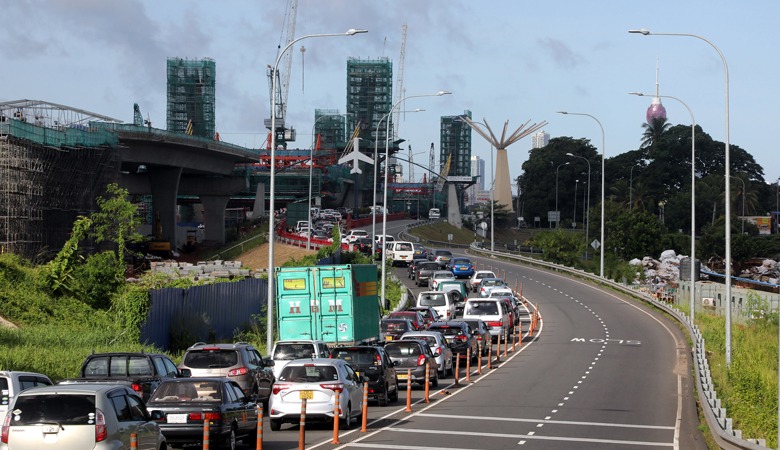
-
Road Network Length
119,000 km
-
Road Infrastructure Quality
3.9/7 1 (low)-7 (high)
km = kilometers
Sources: Government of Sri Lanka, Road Development Authority. 2021. National Road Masterplan (2021–2030) (accessed April 2024); Government of Sri Lanka, Road Development Authority. 2020. National Highways (accessed April 2024); Central Bank of Sri Lanka. 2021. Economic and Social Infrastructure; The World Economic Forum. 2019. The Global Competitiveness Report.
Roads
Contracting Agencies
The primary governing body for the road sector is the Ministry of Transport and Highways (MTH; formerly the Ministry of Highways and Road Development), which is responsible for the formulation of policies, programs, and projects relating to the development and operations of road and highway infrastructure in Sri Lanka.1 The RDA, which comes under the purview of the MTH,2 is the central governing body responsible for the development and maintenance of the national road network, planning, design, and construction of new highways, bridges, and expressways.3
- 1Government of Sri Lanka, Ministry of Transport and Highways. 2020. Overview (accessed July 2023).
- 2Government of Sri Lanka, Presidential Secretariat. 2022. Government Gazette Notification 22 July 2022.
- 3Government of Sri Lanka, Road Development Authority. 2021. Roles and Responsibilities (accessed August 2023)
Roads
Sector Laws and Regulations
The primary legislation overseeing the road sector is the National Thoroughfares Act, No. 40 of 2008, providing direction on strategic planning, design, construction, development, maintenance, and management of an integrated public road network of the country. Moreover, it establishes the legal framework required to facilitate private sector investment in road construction and offers guidance to provincial councils and local authorities on the development and maintenance of roads. The Act provides exclusive power to the RDA to implement and administer provisions of the Act in consultation with the MTH and other relevant government departments.1
A snapshot of the functions of various agencies associated with the road transport sector in Sri Lanka is provided in the table below.
- 1Government of Sri Lanka, Road Development Authority. 2008. National Thoroughfares Act (accessed August 2023).
Line Ministries or Agencies and Their Functions
Agency Function Ministry of Transport and Highways - Formulating national policies for the highway sector in relation to the subject of transport, in conformity with the prescribed laws, acts, and ordinances.
- Implementation of projects under the National Budget, State Investment, and National Development Programme.
- Development, maintenance, toll setting, collection, and regulation of expressways.
- Formulating rules and regulations required to ensure an environmentally friendly transport system is in operation.
- Introducing guidelines, rules, and regulations to be followed in minimizing passenger and traffic congestion and road accidents.
- Improving and maintaining a high-quality national highway system that enhances rural, pre-city, and urban connectivity.
- Providing high mobility among townships, efficient connectivity among economic centers, and improving accessibility for rural areas.
- Maintaining road networks to excellent standards to contribute to sustainable development.
- Providing an intelligent transport system for efficient traffic management.
- Investing in research and development for the road sector.
- Improving road safety measures for road users.
Road Development Authority - Maintaining and developing roads and bridges within the national road network.
- Planning, designing, and constructing new highways, bridges, and expressways to improve the existing network.
- Reducing road user cost.
- Improving road safety in the national road network.
- Protecting the environs.
- Ensuring efficient utilization of assets and investments.
- Promoting organizational development to enhance overall performance of the RDA.
- Assisting in the development of the local road construction industry.
National Council for Road Safety - Promoting a safe and secure road network for all citizens.
- Coordinating activities relating to road safety (creating a high-quality transport service via disciplined and law-abiding drivers and commuters).
- Preparing and implementing projects on road safety.
- Providing financial assistance to families affected by hit-and-run accidents.
- Providing financial assistance to implement economically and technologically viable social activities and environmentally friendly safety measures.
- Offering advice to the GOSL on policies and projects connected with road safety.
Sources: Ministry of Transport and Highways. 2020. About Us—Overview (accessed July 2023); Road Development Authority. 2021. Roles and Responsibilities (accessed July 2023); Government of Sri Lanka, Government of Sri Lanka, Presidential Secretariat. 2022. Government Gazette Notification 22 July 2022; National Council for Road Safety. 2022. Introduction.
The Road Maintenance Trust Fund (RMTF) was established as a dedicated fund in 2005 to carry out periodic maintenance of the national road network in a timely manner, to avoid deterioration of the road network. The main beneficiary of the fund is the RDA. The initial funding of $10.5 million (approximately SLRs1,365 million) was provided by the International Development Association for the period 2012–2014 through the Road Sector Assistance Project. Currently, the annual government budget allocates funding for the RMTF.2 However, it is believed that this budgetary allocation is inadequate for the maintenance of road and related infrastructure. The RMTF only oversees national roads, while expressways are maintained by the Expressway Operation, Maintenance and Management Division, which comes under the RDA.3
In 2017, it was proposed to establish a special infrastructure company that would own all existing expressway assets and undertake future expressway development.4
In March 2024, Cabinet approved the transferring of daily operations and management of expressways from RDA to a state-owned company “Sahasya Investments Limited,” effective 1 April 2024.5
- 2Report of the Auditor General. 2014. Road Maintenance Trust Fund (RMTF).
- 3Government of Sri Lanka, Road Development Authority. 2022. Expressway Operation Maintenance and Management Division (accessed July 2024).
- 4Government of Sri Lanka, Office of the Cabinet of Ministers. 2017. Press briefing of Cabinet Decision taken on 2017-02-21.
- 5Daily FT. March 2024. State-owned Sahasya takes over expressways from RDA.
Foreign Investment Restrictions
COMPAREDOWNLOADParameter 2021 2022 2023 Maximum allowed foreign ownership of equity in greenfield projects 100% 100% 100% LEARN MORERoads
Sector Laws and Regulations
No foreign investment restrictions in the road sector exist.
Source: Board of Investment of Sri Lanka. 2022. Exchange Control Laws Applicable for Foreign Investments.
Standard Contracts
COMPAREDOWNLOADType of Contract Availability PPP/concession agreement Performance-based operation and maintenance contract Engineering, procurement, and construction contract - Yes
- No
LEARN MORERoads
Sector Laws and Regulations
Specific standard contracts are not available for roads PPPs, while general engineering, procurement, and construction (EPC) contracts are used for PPP projects.
Several road projects have been proposed as PPPs, with ADB providing technical assistance for two key projects: Colombo–Katunayake Expressway in 2003,1 and the Elevated Highway from New Kelani Bridge to Athurugiriya during 2017–2019.2 Despite significant progress in the transaction preparation process, neither project progressed to the contract award stage.
- 1ADB. 2003. Technical Assistance to Sri Lanka for Preparing a Public–Private Partnership Expressway Project.
- 2Government of Sri Lanka, Road Development Authority. 2021. Project Details of Ongoing Projects.
Sources: ADB. 2019. Public–Private Partnership Monitor, Second Edition; Industry research.
Roads
Sector Master Plan
The RDA’s National Road Master Plan 2021–2030 outlines a comprehensive and long-term strategy for improving and maintaining the country’s road network and will help identify investment priorities through rigorous scientific analysis. This plan prioritizes the enhancement and expansion of road infrastructure to deliver convenient and eco-friendly transportation and promote economic growth for the public.1
In line with the master plan, the RDA and MTH (the two main institutions that formulate policies and projects related to the roads and highways) have identified several priority projects.
- 1Government of Sri Lanka, Road Development Authority. 2021. National Road Master Plan 2021–2030.
List of Roads Projects
No. Project Implementing Agency Estimated Project Cost Status $ million SLRs billion 1. Port Access Elevated Highway Project RDA 300 90 Under construction since 2019 2. New Kelani Bridge Construction Project RDA 179 54 Operational since November 2021 3. Elevated Highway from New Kelani Bridge to Athurugiriya RDA 822 248 Project awarded after RFP process, but concession agreement not signed 4. Central Expressway Project—Section I RDA 526 158 Under construction since 2016 5. Central Expressway Project—Section II RDA 495 149 Operational since December 2021 6. Central Expressway Project—Section III RDA 498 150 RFP issued in 2021, currently under evaluation 7. Central Expressway Project—Section IV RDA 551 179 Noncommitted 8. Ruwanpura Expressway Project RDA 182 55 RFP under preparation 9. Landslide Disaster Protection Project RDA 54 16 Ongoing project 10. Integrated Road Investment Program (iRoad)—Phase I RDA 906 273 Ongoing project 11. Integrated Road Investment Program (iRoad)—Phase II RDA 1,085 327 Ongoing project SLRs1 = $0.003319
Sources: ADB. 2021. ADB Supported Elevated Highway Improve Connectivity; Government of Sri Lanka, Ministry of Transport and Highways. 2020. Our Projects (accessed September 2023); Government of Sri Lanka, Road Development Authority. 2021. Project Details of Ongoing Projects (accessed July 2024); Integrated Road Investment Program. 2022. Integrated Road Investment Program (iRoad).
Projects under Preparation and Procurement
Roads Public–Private Partnerships under Preparation and Procurement
The Elevated Highway from New Kelani Bridge to Athurugiriya and Central Expressway Project—Section III are considered projects under procurement as of 2023, as the PPP concession agreements have not yet been signed.
The RFP process for the Elevated Highway from New Kelani Bridge to Athurugiriya project commenced in August 2017 and construction was expected to be completed by January 2025. The RFP review process was conducted with one party being shortlisted in 2019. However, the project has not progressed to the contract award stage due to a court case regarding the environmental clearance process.1
The Central Expressway Project—Section III was procured as a PPP using a similar RFP process as the Elevated Highway project, but it has since been halted due to objections from local bidders on the selection process.2 In March 2024, media sources mentioned that Japan has expressed interest in investing in this phase once the debt restructuring process is concluded.3
- 1The Island. 2021. Proposed elevated highway across wetlands provokes uproar.
- 2Business Times. 2022. Central expressway project phase 3 tainted with irregularities.
- 3Sunday Times. 2024. Japan to invest again in Central expressway Phase III.
COMPAREDOWNLOAD“–” indicates no projects, data not available, or not applicable according to the database.
Source: Government of Sri Lanka, Road Development Authority. Project Details of Ongoing Projects (accessed July 2024).
Roads
Features of Past PPP Projects
Procurement of PPP Projects
Roads Public-Private Partnerships procured through various modes
COMPAREDOWNLOAD“–” indicates no projects, data not available, or not applicable according to the database.
Source: World Bank. Private Participation in Infrastructure (PPI)—Sri Lanka (accessed July 2024).
PPP Projects Reaching Financial Close
Roads Public-Private Partnerships reaching Financial Close
Despite progress in PPP procurement processes, no road project has reached financial closure. Both projects in the preparation phase and planned for procurement through a competitive bidding process have faced interruptions.
COMPAREDOWNLOADPPP Projects with Foreign Sponsor Participation
Roads Public-Private Partnerships with Foreign Sponsor Participation
There has been no foreign sponsor involvement in PPP projects within the road sector. However, the recent bidding process that was conducted for the Elevated Highway project from New Kelani Bridge to Athurugiriya received interest from several foreign sponsors, with one submitting a full technical proposal that was evaluated by RDA and the procurement committees.1
- 1Government of Sri Lanka, Ministry of Transport and Highways. 2020. Our Projects (accessed September 2023).
COMPAREDOWNLOADGovernment Support to PPP Projects
Government Support for Roads Public-Private Partnerships
Since there have been no financial closures, no PPP road project has received government support including viability gap funding, government guarantees, or availability/performance payments. However, both the Elevated Highway project from New Kelani Bridge to Athurugiriya and the Central Expressway Project—Section III were proposed to be developed under availability or performance payment schemes from the RDA.1
- 1Government of Sri Lanka, Ministry of Transport and Highways. 2020. Our Projects (accessed September 2023).
COMPAREDOWNLOADPayment Mechanism for PPP Projects
Payment Mechanisms for Roads Public-Private Partnerships
Proposed payments in the form of user charges and government pay (offtake) in the road sector have not been evident. Both the Elevated Highway from New Kelani Bridge to Athurugiriya project and the Central Expressway Project—Section III were proposed to be under annuity payments from the RDA. The RDA is expected to directly collect tolls from users, operating in a similar manner to the existing expressways in Sri Lanka, and pay a predetermined annuity payment (quarterly or bi-annually) to the project company.1
- 1Government of Sri Lanka, Ministry of Transport and Highways. 2020. Our Projects (accessed September 2023).
COMPAREDOWNLOADTypical Risk Allocation for PPP Projects
Since there are no PPP road projects implemented thus far, information on typical risk allocation is unavailable.
The 1998 PSIP Guidelines state that the indexation risk and price negotiation risk may differ from project to project.
Roads
Tariffs
Traditionally, funding for roads and expressways has been through public financing. All construction and management of the road network was financed by central government budgets and foreign loans or grants (via development financial institutions and government-to-government arrangements).
Only 313 km are categorized as expressways.1 As per the National Thoroughfares Act, No. 40 of 2008, vehicles traveling on a user-fee national highway shall pay the imposed fee while users of the expressway must pay a fee according to the distance of travel and the vehicle category:2
- Category 01—motor cars, dual purpose vehicles, light motor lorries.
- Category 02—motor coach (all buses and lorries).
- Category 03—heavy motor coach, heavy motor lorry.
The RDA is responsible for toll collection on expressways. The Minister of MTH (overseeing expressways) is authorized to approve fares according to vehicle classifications, and these rates are regularly updated on the toll rate management company website.3 The Minister also has the authority to specify vehicle categories exempted from payment.4 Proposed rates require Cabinet approval and implementation is formalized through gazette notification.
- 1Government of Sri Lanka, Road Development Authority. 2018. National Road Master Plan (2018–2027); Road Development Authority. 2020. National Highways.
- 2Government of Sri Lanka. 2008. National Thoroughfares 40 of 2008.
- 3Government of Sri Lanka, Expressway Operation Maintenance and Management Division of Road Development Authority. 2024. Tariff Schedules.
- 4Government of Sri Lanka. 2008. National Thoroughfares 40 of 2008.
Roads
Challenges
Demand and Supply Factors
- Funding constraints for project preparation (e.g., appointment of technical consultants and land acquisitions) and project financing have delayed the execution of key projects.
- Insufficient funding for regular road maintenance has resulted in inadequate upkeep, particularly for provincial and local authority roads.
- Lack of digital interventions for traffic management and fare collection has contributed to inefficiency and congestion on the roads.
- There is limited awareness on key road projects, their priority of execution, clear-cut policies, and transparency in the procurement mechanism for road projects. This has generated unfavorable public opinion, suggesting that private involvement is more expensive than state sector implementation.
Regulatory Factors
- There have been significant delays in land acquisition due to the lack of land availability for road projects, lack of transparency in ownership and valuation of state land, unclear titles for private land, and resentment by landowners on resettlement. This has resulted in significant delays in project execution timelines and has substantially increased land acquisition costs, particularly in urban areas.
- Unavailability of standard PPP guidelines (project section, preparation, and bidding) for roads projects leads to delays in procurement processes as well as the lack of in-house technical and financial expertise for complex project structuring in the public sector.
- Constant changes to the procurement method for key expressways and underprepared PPP projects coming into the market have resulted in unsuccessful project closures in many instances. For example:
- The Colombo–Katunayake Expressway was initially proposed to be developed as a PPP project, but subsequently procured as an EPC contract—funded by a loan from Export-Import (Exim) Bank of China.
- The Elevated Highway project from New Kelani Bridge to Athurugiriya did not reach financial closure (despite a foreign private EPC company being shortlisted through a competitive bidding process) due to the lack of proper environmental clearances.
- Irregularities related to the bidder shortlisting process of Central Expressway—Section III have come under the scrutiny of some bidders and delayed financial closure of the project.
-
Railways
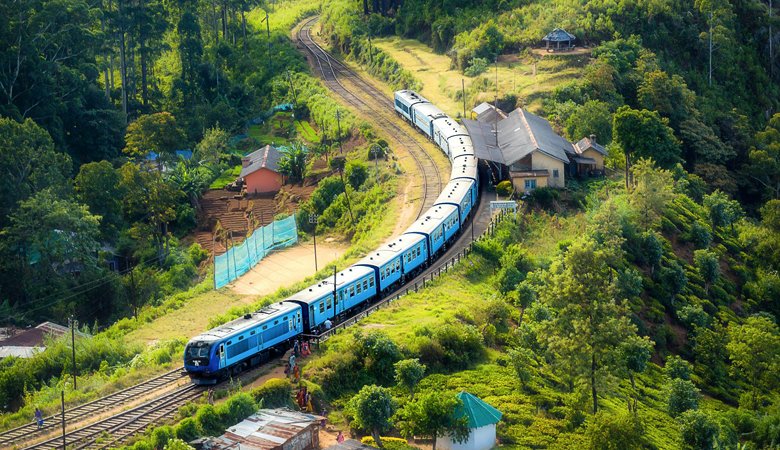
-
Railway Network Length
1,479 km
-
Number of Passengers
103 million annually
-
Freight Volume
2 million ton annually
-
Railway Infrastructure Quality
3.8/7 1 (low)-7 (high)
km = kilometers
Sources: Government of Sri Lanka, Sri Lanka Railway Department. 2022. Performance Report; World Economic Forum. 2019. The Global Competitiveness Report.
Railways
Contracting Agencies
The state-owned Sri Lanka Railways (SR) maintains a monopoly in rail transportation in Sri Lanka and is engaged in both passenger and cargo transportation. SR owns and operates the railway network, set up as a department under the MTH, and functions under the General Manager of Railways, who reports to the Secretary of the MTH.1 Formulation of policies, programs, and projects to be carried out in the railway sector and the monitoring and evaluation of initiatives and interventions related to rail transportation come under the purview of the MTH.
There have been several instances of private entity participation in passenger transportation for railway services. Private operators in the past have leased out a few carriages from SR, which were refurbished with luxury seating, interiors, and air conditioning, and tickets were sold to passengers (including tourists) at a higher price. Staff were allocated to provide catering and other services during the journey. The service was limited to a few popular routes and marketed as a premium experience. However, the services were discontinued in 2017. SR now offers premium services on key routes, with ticket prices based on seat classifications. This saw a notable increase in demand during the fuel price hike in 2022.
Railways
Sector Laws and Regulations
SR operates as a government department under the provisions of the Railway Ordinance 1902. The Act provides for the MTH (and the minister in charge) to regulate matters relating to the conveyance of passengers and goods by railway, including the revision of fares. However, the Railway Ordinance provides only limited decision-making authority to the General Manager of Railways, which has created several inefficiencies in decision-making.1
There is a significant need to update the 120-year-old railway sector legislations to current best practices, such as the separation of government ownership from service delivery, safety regulation, PPP, and the use of private operators, which should be brought into the legislative framework. While there have been several attempts in the past to amend existing legislations, they have been discontinued due to various shortcomings.
- 1Government of Sri Lanka, Ministry of Justice. 2021. Railway Ordinance.
Timeline of Past Legal Enactments
Act Enacted Timeline Railways Ordinance 1902 Provides the legal structure of SR Sri Lanka Railways Authority Act 1993 Made operational on 23 July 2003, and repealed on 10 February 2005 Railway Management Council Rules 2000 Superseded by the rules of 14 February 2003 Railway Management Council Rules 2003 Superseded by the operationalization of Sri Lanka Railways Authority Act of 23 July 2003 Cabinet Memo for Subcompanies 2007 Subcompanies not established Sources: ADB sector team discussions; Industry research.
The Sri Lanka Railways Authority Act, No. 60 of 1993, provided for the establishment of the Sri Lanka Railways Authority to move away from the departmental structure and to operate as a commercial enterprise. The Railways Authority was to be administered and managed by a Board of Directors, which has the authority to establish tariffs and engage in contracts, including private operations. The Railways Authority would have had absolute title of railway lands. Existing SR staff were to be continued as government employees and become Railways Authority employees.2 The Act was kept inactive for 10 years and suddenly brought into operation in July 2003 for a brief period of 18 months before it was repealed.
During 2000, the GOSL established the Railways Management Council which included the position of the General Manager Railways of SR. The structure attempted to formulate an internal reorganization within SR (keeping SR as a GOSL department) but this proved unsuccessful. The Railways Management Council established in 2000 was superseded by the Railways Management Council Rules of 2003, which did not include the General Manager Railways. The Supreme Court ruled against the 2003 regulations, and the Board resigned after five months when the Sri Lanka Railways Authority Act was operationalized.
In 2007, a Cabinet Memorandum was submitted for establishing commercial institutions to implement railway development projects. However, this decision was also not operationalized.
Currently, any changes to the conveyance of passengers, parcels, and fares are subject to amendments being made to the Supplement to Gazette No. 7514 dated 26 February 1926, with the Minister of Transport by virtue of the powers vested by Section 03 and 04A of the Railways Ordinance (Chapter 200) having the authority to do so.
A snapshot of the functions of various agencies associated with the railway sector are provided in the table below:
- 2Government of Sri Lanka, Ministry of Justice. 2021. Sri Lanka Railways Authority Act (accessed July 2024).
Line Ministries or Agencies and Their Functions
Agency Function Ministry of Transport and Highways - Formulating policies, rules, and regulations required to ensure an environment-friendly transport system.
- Constructing new railway lines, maintenance and widening of existing railway lines, and acquisition of lands for railway infrastructure development.
- Introducing necessary measures to establish a high standard and public confidence in railway transport systems.
- Taking necessary measures to ensure efficient operation of integrated passenger and freight rail transport services by adopting new technology and developing railway infrastructure.
- Introducing procurement methodologies required to build up the local industry to manufacture train compartments.
- Overseeing and monitoring project implementation as well as the adequacy of overall project funding.
Sri Lanka Railways - Acquiring and maintaining assets related to rail track, rolling stock, bridges, communication systems, and other structures.
- Maintaining assets related to a fleet of rolling stock consisting of locomotives, diesel multiple units, passenger carriages, freight wagons, and communication systems.
- Providing train services for the movement of people and goods on the railway network.
Railways Authoritya - Fixing tariffs, rates, and procedures for carriage of goods and persons by rail (ensuring competitiveness of the railway services with other modes of transport).
- Entering into public service obligation contracts with the GOSL to provide services at concessionary tariff rates to public entities.
- Developing a railway costing system designed to meet its commercial objectives.
- Employing staff required to provide railway services (determine staff cadre, remuneration, and the terms and conditions of services applicable).
- Formulating standards, including safety standards, for rail services.
- Acquiring, holding, taking, or giving on lease, hire, pledge, sell, or otherwise dispose of any movable or immovable property.
- aCurrently inactive due to repeal of the Sri Lanka Railways Authority Act in 2005.
Sources: Government of Sri Lanka, Ministry of Transport and Highways. 2020. About Us—Overview; Government of Sri Lanka, Presidential Secretariat. 2022. Government Gazette Notification 22 July 2022; Government Information Center. 2021. Sri Lanka Railways; Sri Lanka Railways. 2022. About Us.
Foreign Investment Restrictions
COMPAREDOWNLOADParameter 2021 2022 2023 Maximum allowed foreign ownership of equity in greenfield projects 100% 100% 100% LEARN MORERailways
Sector Laws and Regulations
There are no foreign investment restrictions in railways.
Source: Board of Investment of Sri Lanka. 2022. Exchange Control Laws Applicable for Foreign Investments.
Standard Contracts
COMPAREDOWNLOADType of Contract Availability PPP/concession agreement Performance-based operation and maintenance contract Engineering, procurement, and construction contract - Yes
- No
LEARN MORERailways
Sector Laws and Regulations
Sector-specific standard contracts are not available for PPPs. General EPC contracts are used for rail PPP projects as well.
Sources: ADB. 2019. Public–Private Partnership Monitor, Second Edition; Industry research.
Railways
Sector Master Plan
A comprehensive master plan for railways is currently unavailable to the public. ADB has provided technical support to the MTH on the preparation of a railways master plan, which was accepted by the GOSL on 1 September 2023.1
- 1ADB. 2023. Sri Lanka: Railway Master Plan.
List of Public–Private Partnership Projects
No. Project Implementing Agency Estimated Project Cost Status $ million SLRs billion 1. Kelani Valley line development SR 1,020 307 Feasibility studies and detailed designs have been completed under the CSRP project 2. Main line development SR UA UA 3. Coastal line development SR UA UA 4. Puttalam line development SR UA UA 5. Railway efficiency improvement SR 192 58 Ongoing implementation CSRP = Colombo Suburban Railway Project, SR = Sri Lanka Railways, SLRs = Sri Lankan Rupees, UA = Unavailable in Public Sources.
Note: SLRs1= $0.003319.
Sources: Colombo Suburban Railway Project. 2021. Main Components; ADB. 2019. Sri Lanka: Railway Efficiency Improvement Project.
The Colombo Suburban Railway Project (CSRP) is an initiative to improve railway services in the Colombo suburban area; the project is being implemented by MTH and SR with a loan facility from ADB. The CSRP comprises four main components targeting the country’s key railway lines: Kelani Valley, main, coastal, and Puttalam lines.2
The Railway Efficiency Improvement Project was ADB’s first project loan in railways in Sri Lanka. The project focuses on financing high-impact subprojects to modernize the country’s railway network by improving operational efficiency, maintenance capacity, safety management, skills development, and implementation capacity of SR under a $160 million concessionary loan. The main components to be financed by the project include modern telecommunications and ticketing systems, operations headquarters and train control center, modern railway workshops, and maintenance equipment.3
- 2Colombo Suburban Railway Project. 2021. About CSRP (accessed July 2024).
- 3ADB. 2021. Sri Lanka: Railway Efficiency Improvement Project.
Projects under Preparation and Procurement
Railways Public-Private Partnerships under Preparation and Procurement
As of 31 December 2023, there were no PPP-based rail projects under preparation or procurement. In April 2024, the MTH invited investors to participate in the development of six railway stations in Western Province through a PPP model.1
- 1Government of Sri Lanka, Sri Lanka Railways. 2024. Transforming Urban Mobility (accessed April 2024).
COMPAREDOWNLOADRailways
Features of Past PPP Projects
Procurement of PPP Projects
Railways Public-Private Partnerships procured through various modes
COMPAREDOWNLOADPPP Projects Reaching Financial Close
Railways Public-Private Partnerships reaching Financial Close
COMPAREDOWNLOAD“–” indicates no projects, data not available, or not applicable according to the database.
Source: World Bank Group. 2024. Private Participation in Infrastructure (PPI)—Sri Lanka.
PPP Projects with Foreign Sponsor Participation
Railways Public-Private Partnerships with Foreign Sponsor Participation
There has been no foreign sponsor involvement in railways PPP projects.
COMPAREDOWNLOAD“–” indicates no projects, data not available, or not applicable according to the database.
Source: World Bank Group. Private Participation in Infrastructure (PPI)—Sri Lanka (accessed July 2024).
Government Support to PPP Projects
Government Support for Railways Public-Private Partnerships
There have been no railways PPP projects and therefore government support for such projects is not considered.
COMPAREDOWNLOADPayment Mechanism for PPP Projects
Payment Mechanisms for Railways Public-Private Partnerships
COMPAREDOWNLOADTypical Risk Allocation for PPP Projects
No railway sector PPP projects have been implemented and so information on typical risk allocation for projects is unavailable.
Railways
Tariffs
Traditionally, funding for railways has been provided through public financing. Maintenance of railway infrastructure is financed by the central government budget and foreign loans or grants (through development finance institutions and government-to-government arrangements).
As per the Sri Lanka Railways Authority Act, No. 60 of 1993, the Railways Authority shall fix tariffs, rates, and procedures for carriage of goods and persons by rail (ensuring competitiveness of the railway services with other modes of transport). The Railways Authority can also enter public service obligation contracts with the GOSL to provide services at concessionary tariff rates to public entities.1 The proposed rates must receive approval from Cabinet and a gazette must be published to enact the new rates.
Passenger fares are quoted under several categories and are based on distance. Online booking is available via a web platform operated in collaboration with a state-owned telecommunications player.2 In March 2024, an enhanced system to issue electronic train tickets was also launched.3 The fare categories follow:
- First class.
- Second class.
- Third class.
- Sleeper compartments.
- Observation compartments.
Tariff rates for parcels are based on distance and weight, while cargo transport is charged on the type of cargo at a rate per metric ton (t), and a reservation charge for the compartment.4
- 1Government of Sri Lanka. 1993. Sri Lanka Railways Authority Act (No. 60 of 1993).
- 2Government of Sri Lanka, Sri Lanka Railways. 2022. Online Advance Train Seats Reservation (accessed April 2024).
- 3Ministry of Transport and Highways. 2024. Train Tickets Goes Digital (accessed April 2024).
- 4Government of Sri Lanka, Sri Lanka Railways. 2020. List of Ticket Fare and Charges.
Tariff Schedules for Passengers
Passenger - Normal Train Distance
(km)First Class
(SLRs)Second Class
(SLRs)Third Class
(SLRs)Colombo to Kandy 121 950 500 240 Colombo to Gampaha 28 300 150 80 Colombo to Anuradhapura 205 1,450 750 360 Colombo to Kurunegala 95 800 400 200 Colombo to Trincomalee 297 NA 950 460 Colombo to Jaffna 396 2,250 1,150 580 Colombo to Kilinochchi 330 2,000 1,000 500 Colombo to Vavuniya 254 1,650 850 420 Colombo to Badulla 292 1,800 900 460 Colombo to Matara 157 1,150 600 300 NA = Not available, SLRs = Sri Lankan Rupees, km = kilometers.
Source: Government of Sri Lanka, Sri Lanka Railways. 2022. List of Ticket Fare and Charges (accessed April 2024).
Tariff Schedules for Passengers—Reservations
Passenger—Train Seat Reserved Distance
(km)First Class
(SLRs)Second Class
(SLRs)Third Class
(SLRs)Colombo to Kandy 121 2,000 1,200 900 Colombo to Nanu-oya 207 2,500 1,700 1,200 Colombo to Ella 272 2,800 1,800 1,300 Colombo to Badulla 292 3,000 2,000 1,500 Colombo to Kurunegala 95 2,100 1,300 1,000 Colombo to Anuradhapura 205 2,400 1,700 1,200 Colombo to Kilinochchi 332 3,000 2,200 1,600 Colombo to Kankasanthurai 413 3,200 2,500 1,800 Colombo to Maho 139 2,300 1,500 1,100 Colombo to Polonnaruwa 260 2,500 1,600 1,200 Colombo to Batticaloa 350 3,000 2,000 1,400 Colombo to Aluthgama 60 900 700 500 Colombo to Galle 114 1,100 900 600 Colombo to Matara 157 1,400 1,100 700 Colombo to Beliatta 176 1,600 1,300 1,000 SLRs = Sri Lankan Rupees, km = kilometers.
Source: Government of Sri Lanka, Sri Lanka Railways. 2022. List of Ticket Fare and Charges (accessed April 2024).
Tariff Schedules for Cargo—Minimum Charges for Reserving Wagons
Wagon Type Rate (SLRs) Four wheeled wagons 2,500 Eight wheeled wagons with a loading capacity up to 28 tons 3,000 Eight wheeled wagons with a loading capacity up to 39.6 tons 4,000 Eight wheeled wagons with a loading capacity above 39.6 tons 4,500 Source: Government of Sri Lanka, Sri Lanka Railways. 2022. List of Ticket Fare and Charges (accessed April 2024).
Railways
Challenges
Demand and Supply Factors
- Limited effort taken by the transportation authorities to promote intermodal transportation. Road transport services are at present not adequately connected to the railway network, both in terms of infrastructure availability and synchronization of timetables. Expected future developments such as the Light Rail Transit project must be integrated for transport planning.1 Secured park-and-ride facilities at key transit points are available only in a few railway stations and bus terminals. There is a significant demand for and use of public transport in Sri Lanka and it is likely to continue to increase as the capital city Colombo becomes more congested. The need for a good quality and reliable public transport service was particularly evident in the recent current economic and fuel crisis amidst steep escalation of fuel prices.
- High staff costs and a heavy union presence coupled with non-cost-reflective tariffs prevents SR from operating in a commercially viable manner (on average, SR only recovers 40%–50% of its operating expenditure through total revenue).2
- SR’s depleted asset base, obsolete signal and communication systems, and aged rolling stock has resulted in poor service quality. Constant delays due to maintenance and repair work have made railway transportation inefficient in its ability to provide an acceptable quality of service.3
- Cargo transportation, which was an additional revenue generator, has been reduced over time due to the lack of proper infrastructure. The financial constraints of SR have led to poor maintenance of cargo transport infrastructure.
- Insufficient digitalization for railway services and fare collection has resulted in inefficiencies and subpar service quality. Implementing digitalization will improve service quality and minimize financial management inefficiencies.
- Railway tariffs are not set at cost recovery levels as railways largely operate as a social service. The General Manager of the SR does not have the flexibility to introduce new service offerings and charge premium fares. Any new tariff introduction or revision requires ministerial and Cabinet approvals which restricts commercial interventions and delays the implementation of critical policies.
Regulatory Factors
- Inadequate legal provisions to enable the utilization of resources available for capital investments through land value capture and asset monetization. Outdated sector legislations, dating 120 years, must be revised to incorporate modern best practices such as the separation of government ownership (from service delivery), safety regulation, PPPs, and the use of private operators.
- 1Sunday Times. 2022. Govt. plans to restart suspended Japanese-funded LRT project.
- 2Government of Sri Lanka, Sri Lanka Railways. 2019. Administration Report—2019.
- 3ADB. 2019. Proposed Loan and Technical Assistance Grant: Railway Efficiency Improvement Project.
-
Ports
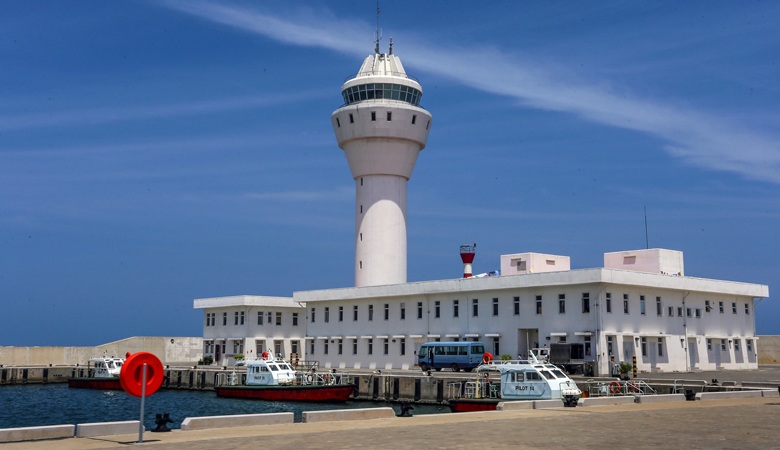
-
Number of Ports
4
-
Container Traffic
6,950,000 TEU
-
Port Infrastructure Quality
4.5/7 1 (low)-7 (high)
-
Number of PPPs Reaching FC
5
-
Value of PPPs Reaching FC
2,680 M
-
Number of PPPs with Foreign Sponsors
4
TEU = Twenty-Foot Equivalent Unit, M = million.
Sources: Government of Sri Lanka, Sri Lanka Ports Authority. 2022. Annual Report; World Economic Forum. 2019. Global Competitiveness Report, 2019; Drewry. 2023. Ports & Terminals Insight; UNCTAD. 2024. Regional analysis of Liner Shipping Connectivity: What does the revised LSCI reveal?
Ports
Contracting Agencies
The Ministry of Ports, Shipping and Aviation is responsible for formulating and implementing a national policy on ports and shipping. The Ministry undertakes the regulation, governance, implementation, creation, and development of ports.1
The Sri Lanka Ports Authority (SLPA) is the competent authority empowered by law (Sri Lanka Ports Authority Act, No. 51 of 1979) to enter into agreements with a private entity for the development or operation of a port. The SLPA will seek Cabinet approval on the negotiated terms for private investors to enter into a concession agreement. Such a project is generally undertaken through a special purpose vehicle incorporated for this purpose, where the SLPA will also have a minority stake.2
All ports and port lands fall under the ownership and purview of the SLPA in terms of the Sri Lanka Ports Authority Act. The SLPA owns and manages all commercial and regional ports in Sri Lanka, including Colombo, Hambantota, Galle, Oluvil, Kankasanthurai, Point Pedro, Trincomalee, and Puttalam.3
- 1Government of Sri Lanka, Ministry of Ports and Shipping. 2022.
- 2Government of Sri Lanka, Sri Lanka Ports Authority. 2020. Act of SLPA.
- 3Government of Sri Lanka, Sri Lanka Ports Authority. 2020. Act of SLPA.
Ports
Sector Laws and Regulations
The SLPA is entitled to acquire land by following the process set out under the Land Acquisition Act where land is required for the purposes of port development. The SLPA operates on its own revenue and resources, without receiving financial allocations from the GOSL. The Sri Lanka Ports Authority Act empowers the SLPA with the exclusive authority to provide all port-related services within all ports owned by the GOSL. However, in exceptional circumstances, on a direction by the Minister of Ports, Shipping and Aviation, other service providers may also be authorized by the SLPA to provide port services.
The SLPA or any service provider must ensure sufficient and efficient waste discharge facilities are available within or outside any port to enable ships using such ports or crossing Sri Lankan waters to dispose of their waste without unnecessary delays. These requirements are outlined in the Marine Pollution Prevention Act, No. 35 of 2008.1
Certain port activities are entitled to specific exemptions under the Commercial Hub Regulation, No. 1 of 2013, enacted under the Finance Act, No. 12 of 2012. These activities include any new enterprise established or incorporated in Sri Lanka and engaged in entrepot trade or the provision of logistics services such as bonded warehouses where at least 65% of the investment has been from foreign sources and of which the total turnover is from the export of goods or services. Entities engaged in these activities have exemptions from provisions of certain legislations (provided they adhere to the minimum investment limits and other criteria specified therein).2 The exemptions include the application of Provisions of the Customs Ordinance, the Exchange Control Act, and the Imports and Exports (Control) Act, No. 1 of 1969.
There is currently no independent regulatory body for ports in Sri Lanka. Institutions coming under the purview of the Ministry of Ports, Shipping and Aviation include the following:3
- SLPA.
- Merchant Shipping Secretariat.
- Ceylon Shipping Corporation (CSC).
The formulation, implementation, and monitoring of policies on ports sector development and shipping services in Sri Lanka are some of SLPA’s key functions. The SLPA is granted wide and far-reaching powers by the Sri Lanka Ports Authority Act to manage all matters concerning the development, regulation, maintenance, operation, and supply of other services related to all ports in Sri Lanka that fall within the purview of the SLPA.
The Merchant Shipping Secretariat has the overall responsibility for overseeing all maritime concerns, developing the GOSL’s maritime safety policy, regulating coastal maritime transportation of passengers, and for creating a competitive and efficient port, shipping, and maritime market. The Merchant Shipping Secretariat is governed by the following three Acts:4 the Merchant Shipping Act, No. 52 of 1971; the Licensing of Shipping Agents Act, No. 10 of 1972; the Admiralty Jurisdiction Act, No. 40 of 1983; and subsequent regulations made thereafter.
The CSC was established under the provisions of the Ceylon Shipping Corporation Act (No. 11 of 1971) as the national carrier of Sri Lanka. In 1992, the CSC was converted to a fully government-owned commercial enterprise through the Companies Act.5
The Ministry of Environmental and Natural Resources and the Marine Environment Protection Authority regulate environmental matters at the port.
- 1ADB. 2019. Public–Private Partnership Monitor, Second Edition.
- 2Gazette. 2013. Finance Act—Commercial Hub Regulation No. 1 of 2013.
- 3Government of Sri Lanka, Ministry of Ports and Shipping. Related organizations.
- 4Government of Sri Lanka, Ministry of Ports and Shipping. Merchant Shipping Secretariat.
- 5Government of Sri Lanka, Ministry of Ports and Shipping. Ceylon Shipping Corporation.
Line Ministries or Agencies and Their Functions
Agency Function Ministry of Ports, Shipping and Aviation - Coordinate, monitor, and supervise programs and projects carried out by the institutions coming under the Ministry.
- Introduce new guidelines to provide better services to the users of ports and shipping.
- Formulate an effective mechanism for implementation of national policies on ports and shipping.
- Make available a highly effective and business friendly regulatory and monitoring system for service suppliers such as shipping agents and container depot operations.
- Introduce the legal framework required for smooth functions of the institutions coming under the Ministry.
- Develop and manage commercial harbors and container yards, and expand their investment opportunities.
Sri Lanka Ports Authority (SLPA) - Provide efficient and regular tally and protective services in any specified port in Sri Lanka.
- Regulate and control navigation within the limits of, and approaches to, the specified ports.
- Maintain port installations and promote the use, improvement, and development of the specified ports.
- Coordinate and regulate all activities within any of the specified ports excluding the functions of customs.
- Establish and maintain lights and other means for the guidance and protection of vessels as necessary for navigation in and out of the specified ports on and off the coast of Sri Lanka.
- Collect charges for services rendered by the SLPA, ensuring revenue of the SLPA is not less than sufficient for meeting the charges that are to be paid out of its revenue.
- Manage each of the specified ports as self-supporting enterprises in accordance with the provision of its Act.
Merchant Shipping Secretariat - Develop and implement the GOSL’s maritime safety policy.
- Ensure the operation of safe and efficient ships in cleaner oceans.
- Ensure safety of life at sea.
- Ensure quality maritime education, training and examination, and certification.
- Promote Sri Lankan seafarers in the international maritime industry.
- Promote the registration of ships under the Sri Lankan flag.
- Licensing of shipping agents, container depot operators, container terminal operators, container freight stations, freight forwarders, or non-vessel operating common carriers.
- Enforce compliance with provisions of applicable national and international conventions and standards.
- Ensure that shipping agencies conduct their business in a legal, just, and mutually beneficial manner to both the principals and local partners.
Ceylon Shipping Corporation - Own, manage, charter, and broker ships on Sri Lankan waters.
- Ensure efficient sea transportation of cargo.
- Provide logistics services and customs clearance (inward and outward).
- Provide ship agency and port agency services.
Marine Environment Protection Authority - Prevent, control, and manage the pollution of Sri Lanka’s marine environment
Sources: Government of Sri Lanka, Marine Environment Protection Authority. 2022. Environment Protection Authority; Government of Sri Lanka, Ministry of Ports, Shipping and Aviation. 2021. Functions; Government of Sri Lanka, Merchant Shipping Secretariat. 2021. About Us; Government of Sri Lanka, Sri Lanka Ports Authority. 2020. Act of SLPA.
Foreign Investment Restrictions
COMPAREDOWNLOADParameter 2021 2022 2023 Port operations 100% 100% 100% Deep-sea fishing 40% 40% 40% Freight forwarding 40% 40% 40% Shipping agencies 40% 40% 40% LEARN MOREPorts
Sector Laws and Regulations
The maximum equity investment allowed for foreign investors in freight forwarding, travel, and shipping agencies is 40%. This restriction does not apply to the operation of container terminals as is evident by existing PPPs: China Merchant Port Holdings Company Limited holds an 85% stake each in both the Colombo International Container Terminal (CICT) and the Hambantota International Port; and Adani Ports and Special Economic Zone Limited (India) holds a 51% stake in the Colombo West International Container Terminal (CWICT). Exemptions on restrictions may be pre-approved on a case-by-case basis by the BOI.1
- 1Board of Investments of Sri Lanka. 2022. Investment Guide—2022.
Source: Board of Investment of Sri Lanka. 2022. Exchange Control Laws Applicable for Foreign Investments.
Standard Contracts
COMPAREDOWNLOADType of Contract Availability PPP/concession agreement Performance-based operation and maintenance contract Engineering, procurement, and construction contract - Yes
- No
LEARN MOREPorts
Sector Laws and Regulations
There is currently no standardized PPP model or a standard concession agreement template available for ports projects. However, the BOT PPP concession agreements for South Asia Gateway Terminal (SAGT), CICT, and CWICT at the Colombo Port may be considered successful model templates for future projects. General EPC contracts are used for construction activity in PPP projects as well.
Sources: ADB. 2019. Public–Private Partnership Monitor, Second Edition; Industry research.
Ports
Sector Master Plan
With assistance from ADB and in collaboration with the Maritime & Transport Business Solutions B.V. Netherlands, SLPA developed a national ports master plan. The master plan was approved by the GOSL in 2019 and included the possibility of restructuring the SLPA.
Developing Sri Lanka into one of the most competitive and preferred ports and shipping destinations in the region is the primary objective of the master plan. The project has two outputs: national port master plan, and the technical review of the final design of the Port Access Elevated Highway.1
- 1ADB. 2021. Sri Lanka- National Port Master Plan—TCR Validation Report—July 2021.
List of Projects
No. Project Name Implementing Agency Estimated Project Cost Status $ million SLRs billion 1. Development of Colombo West International Container Terminal SLPA 650 196 Awarded in 2021 2. Development of East Container Terminal— Phase II SLPA UA UA EPC awarded in 2022 3. Galle Port Development—Phase II SLPA UA UA Under preparation 4. Enhancing Deep Berth Capacity of Jaya Container Terminal (JCT)-V SLPA 14 4.2 Under preparation 5. Colombo North Port Development SLPA UA UA Under preparation 6. Expansion Project at the port of Trincomalee SLPA UA UA Under preparation 7. Port of Kankesanthurai SLPA 61.5 19.6 Under preparation SLRs1 = $0.003319.
UA = Unavailable in Public Sources.
Sources: Government of Sri Lanka, Sri Lanka Ports Authority. 2022. Projects (accessed April 2024); ADB. 2019. Colombo Port Development Plan.
The CWICT is a 35-year BOT agreement between India’s Adani Ports and Special Economic Zone Limited (51% stake), Sri Lankan conglomerate John Keells Holdings (34% stake), and SLPA (15% stake). The estimated project cost, which was awarded in 2021, is $650 million (SLRs235 billion) with the US International Development Finance Corporation (DFC) committing $553 million in financing.2 In November 2023, the SLPA announced that it had initiated steps to facilitate the construction of the West Container Terminal 2, with the initial feasibility study of the project underway.3
The East Container Terminal (ECT) that is fully owned by SLPA is expected to be completed by 2024. Construction activities of the project commenced in 2022 by a consortium of local and foreign developers.4 The ECT was initially intended for development as a PPP project. In 2016, SLPA sought transaction advisory assistance from ADB to oversee the RFP process.5 The project proposal outlined a 35-year concession following the BOT model.
A suitable concessionaire was to be shortlisted by Q1 of 2017.6 Despite five consortiums submitting bids, the PPP procurement process was cancelled by SLPA due to a change in government policy.7
Phase II of the Galle Port Development project is currently at the conceptual stage. The basic design is completed and awaiting clearance from United Nations Educational, Scientific and Cultural Organization (UNESCO) to commence detailed feasibility studies.8
Developing the Deep Berth Capacity of Jaya Container Terminal (JCT)-V at the Colombo Port will expand three additional berths for oil/fuel ships to anchor and pump fuel.9
The Colombo North Port expansion project is currently being carried out by SLPA and expected to be completed by 2035. The SLPA intends to use the proposed Colombo North Port for liquid bulk, dry bulk, roll-on roll-off, and containers. The North Port will be implemented in stages depending on the demand. Currently, the feasibility study and consultation work are being carried out by AECOM Infrastructure & Environment UK Limited.10
The Trincomalee Port Expansion project is currently ongoing as per guidance of the ports master plan, along with the renewed interest on the Trincomalee tank farm development. In November 2022, a joint venture company, Trinco Petroleum Terminal Ltd., was incorporated to refurbish 61 oil tanks located in the Trincomalee port (remaining from the World War II era). The joint venture company will own 654 acres of land along with the oil tanks for additional development activities. Ceylon Petroleum Corporation (CPC, the state-owned largest petroleum retailer in Sri Lanka) holds 51% of Trinco Petroleum Terminal Ltd., while Lanka IOC PLC (subsidiary of Indian Oil Corporation Ltd) holds the remaining 49%. The project (with an expected total investment value of $70 million) is to be executed in two phases. Phase 1 would comprise the development of nine out of 10 tanks at an estimated cost of $15–20 million and the ground clearing work around three tanks has already commenced, and few tanks will be expected to be in operation by the end of 2023.11 Phase 2 would comprise the development of the remaining 51 tanks and developments in the additional land area, at an estimated cost of up to $50 million.12
In March 2024, the Government of India pledged a grant of $61.5 million to develop the Port of Kankesanthurai in the northern region of the country. As part of the project, the construction of a new breakwater will be initiated, the port will be dredged to a depth of 30 meters to accommodate deep-draft vessels and a new terminal will be constructed to cater to the rising number of Indian tourists visiting the island through sea transport.13
- 2DailyFT. 2021. SL seals biggest-ever investment in port sector (accessed July 2022).
- 3Maritime Gateway. 2023. Sri Lanka Announces West Container Terminal 2, Followed By Colombo North Port
- 4Container News. 2022. Second phase of Colombo East Container Terminal construction begins (accessed July 2022).
- 5Government of Sri Lanka, Sri Lanka Ports Authority. 2016. ADB to help expand Colombo Port operations using PPP.
- 6Government of Sri Lanka, Sri Lanka Ports Authority. 2016. Request for Proposal - Colombo Port—East Container Terminal.
- 7The Journal of Commerce Online. 2016. New Colombo terminal bidding in danger of cancellation.
- 8Government of Sri Lanka, Sri Lanka Ports Authority. Galle Port (accessed April 2024).
- 9Government of Sri Lanka, Sri Lanka Ports Authority. 2022. Projects (accessed April 2024).
- 10Government of Sri Lanka, Sri Lanka Ports Authority (accessed April 2024).
- 11Economynext. 2023. Sri Lanka IOC-CPC joint venture to develop 9 tanks (accessed July 2024).
- 12Tank Terminals. 2022. Sri Lanka’s Trinco Petroleum Terminal to Invest Up to US$70mn in Tank Farm.
- 13News.lk. 2024. India grants USD 61.5 million for the development of KKS Port (accessed April 2024).
Projects under Preparation and Procurement
Ports Public-Private Partnerships under Preparation and Procurement
COMPAREDOWNLOADLEARN MOREPorts
Sector Master Plan
The CIWCT and ECT projects have been under procurement from 2019 and CIWCT was awarded during 2021 (stated as under procurement for 2021). However, it is to be noted that the ECT was initially to be developed as a government-to-government project, but it is currently under construction by SLPA, hence it is no longer under procurement. The JCT expansion project, North Port development, Trincomalee Port development, and the Galle Port—Phase II are four PPP projects considered as being under preparation.
Although, the Inland Water Transport project (a ferry transport system) was considered a 10-year PPP project under procurement in 2019, it was eventually implemented on a smaller scale as a fully government-funded initiative. Under the original plan, the operator was responsible for operating the ferry services and financing the ferry assets, while eligible to collect all fare box and ancillary revenues. The Sri Lanka Land Reclamation and Development Corporation was to provide for the basic water infrastructure such as jetties, embankment enforcements, and maintain canal depth (dredging). The feasibility study and detailed designs were completed for this project in July 2019 and the passenger boat service between two locations was launched in March 2020.1 The project is solely handled by the GOSL, with no private sector participation.
“–” indicates no projects, data not available, or not applicable according to the database.
Sources: ADB. 2019. Public–Private Partnership Monitor, Second Edition; Government of Sri Lanka, Sri Lanka Ports Authority. Galle Port.
Ports
Features of Past PPP Projects
Procurement of PPP Projects
Ports Public-Private Partnerships procured through various modes
COMPAREDOWNLOADLEARN MOREPorts
Features of Past PPP Projects
Details of five ports projects that reached financial closure and the respective mode of procurement is as follows:
- SAGT (1999)—competitive bidding.
- CICT (2011)—competitive bidding.
- LAUGFS Liquefied Petroleum Gas Terminal (2017)—unsolicited bid.
- Hambantota Port Lease (2017)—direct government appointment.
- CWICT (2021)—direct government appointment.
Sources: World Bank Group. Private Participation in Infrastructure (PPI)—Sri Lanka (accessed April 2024); Industry research.
PPP Projects Reaching Financial Close
Ports Public-Private Partnerships reaching Financial Close
COMPAREDOWNLOADLEARN MOREPorts
Features of Past PPP Projects
In Sri Lanka, ports PPP contracts hold significant importance as having substantial financial closure in terms of investment value.1
The initial ports PPP (that reached financial closure in 1999) was the first of its kind in the country. The SAGT project was aimed both at expanding the Colombo Port’s Queen Elizabeth Quay terminal from its original capacity of 250,000 TEUs per year to a capacity of 1.1 million TEUs and improving port sector efficiency. It consisted of a 30-year BOT contract signed between SLPA and the South Asia Gateway Terminals Private Limited (SAGT partnership); shareholders at inception were P&O Netherlands B.V., John Keells Holdings PLC,2 Evergreen Marine Corporation, and SLPA.3 The current consortium of private sector participants at SAGT includes John Keells Holdings PLC (42% majority stake), A.P. Moller Maersk, Evergreen Marine Corporation, and the SLPA (15% stake).4 Construction was completed in 2003 and led to a 30% increase in the Colombo Port capacity. The total cost of the project was estimated at $240 million.5
The second ports PPP that reached financial closure was CICT in 2011. The project included the Colombo South Port expansion through a 30-year BOT. The concession was signed between SLPA (15% stake) and a joint venture company created by China Merchants Port Holdings (who currently holds 85% stake). The total investment was $500 million.6 Aitken Spence PLC,7 a shareholder of the initial consortium of CICT, sold its stake (30%) to China Merchants Port Holdings in 2012.8
The third ports PPP reached financial closure in 2017. The project was to construct a liquefied petroleum gas import and export terminal in Hambantota by LAUGFS Gas PLC.9 It is the largest liquefied petroleum gas terminal in South Asia, with a capacity of 30,000t. The construction was completed in 2018 and the terminal commenced operations in 2019. The total investment was $120 million.10
The fourth ports PPP reached financial closure in 2017. It consisted of a 99-year lease-operate-transfer contract of the Hambantota Port to China Merchants Port Holdings Company. The total investment of the lease–operate–transfer contract was $1,120 million, which is the single largest PPP investment in Sri Lanka.11 China Merchants Port Holdings owns 70% stake of the port, while the remaining 30% is retained with the SLPA.12 The commercial operation of the port is handled by China Merchants Port Holdings, with SLPA overlooking the support activities.
The fifth ports PPP that reached financial closure in 2021 was the CWICT, which was awarded to Adani Ports India under a 35-year BOT agreement. The total investment is $700 million.13 Construction of Phase I commenced in January 2022. In 2023, DFC granted a $550 million loan for the project.14
- 1ADB. 2019. Public–Private Partnership Monitor. Second Edition.
- 2John Keells Holdings PLC is a leading diversified conglomerate in Sri Lanka with interests in retail, property development, leisure, food and beverage, financial services, logistics and plantations.
- 3IFC. IFC Project Information and Data Portal. South Asia Gateway Terminals (SAGT).
- 4SAGT. About Us (accessed July 2024).
- 5IFC. IFC Project Information and Data Portal. South Asia Gateway Terminals (SAGT).
- 6CICT. About Us (accessed July 2024).
- 7Aitken Spence PLC is a leading diversified conglomerate in Sri Lanka with interests in leisure, food and beverage, plantation, logistics, and energy
- 8Ship Technology. 2012. Aitken Spence sells Sri Lankan port stake to CMHI.
- 9LAUGFS Gas PLC is a diversified conglomerate in Sri Lanka with interests in energy, leisure, and logistics.
- 10LAUGFS PLC. 2020. Annual Report.
- 11Hambantota International Port Sri Lanka. About Us (accessed July 2024).
- 12The Diplomat. 2020. The Hambantota Port Deal: Myths and Realities.
- 13World Bank Group. Private Participation in Infrastructure Database. https://ppi.worldbank.org/en/customquery. https://www.ft.lk/top-story/SLseals-biggest-ever-investment-in-port-sector/26-723702.
- 14US Embassy in Sri Lanka. 2023. DFC Commits Half a Billion Dollars to Port Infrastructure in Colombo, Sri Lanka.
Sources: World Bank. Private Participation in Infrastructure (PPI)—Sri Lanka (accessed April 2024); The Diplomat. 2020. The Hambantota Port Deal: Myths and Realities.
PPP Projects with Foreign Sponsor Participation
Ports Public-Private Partnerships with Foreign Sponsor Participation
COMPAREDOWNLOADSources: World Bank. Private Participation in Infrastructure (PPI)—Sri Lanka. (accessed July 2024); ADB. 2019. Public–Private Partnership Monitor, Second Edition; Government of Sri Lanka, Sri Lanka Ports Authority.
Government Support to PPP Projects
Government Support for Ports Public-Private Partnerships
COMPAREDOWNLOADLEARN MOREPorts
Features of Past PPP Projects
Although the GOSL has so far not provided any viability gap funding, government guarantees, and availability payments for ports sector PPPs, it has committed to provide related infrastructure developments. An example of this is the dredging and construction project of the breakwater ($480 million ADB-funded initiative) of the Colombo Port Expansion Project, followed by the subsequent development of CICT.1 In addition, the GOSL has also granted tax concessions for PPP projects.
Moreover, the GOSL typically supports strategic port projects with land acquisition, though private entities may also be responsible in some cases. Viability gap funding, government guarantees, and concession fee waivers may be granted by the GOSL on a case-by-case basis depending on the project’s strategic importance, its net present value, and other factors. Availability payments are not typically available for ports projects.
- 1ADB. 2015. Sri Lanka: Colombo Port Expansion Project (formerly Colombo Port South Harbor Development).
Payment Mechanism for PPP Projects
Payment Mechanisms for Ports Public-Private Partnerships
All ports PPPs in Sri Lanka operate with terminal handling charges (THC) that can be considered as user charges paid to use port infrastructure.
COMPAREDOWNLOAD“–” indicates no projects, data not available, or not applicable according to the database.
Sources: ADB. 2019. Public–Private Partnership Monitor, Second Edition; Government of Sri Lanka, Sri Lanka Ports Authority
Typical Risk Allocation for PPP Projects
COMPAREDOWNLOADRisk Category Private Public Shared Comment Demand risk Shipping and logistics providers will only enter into shortterm (1-4 year) terminal usage contracts. This leaves the project company exposed to significant demand risk. Competition risk (exclusivity) In principle, the public sector is required to regulate the ports development. Tariff risk Environmental and social risk SLPA bears the greatest responsibility in developing basic infrastructure in compliance with environmental and social regulations. Permits Geotechnical risk SLPA bears the greatest responsibility in land acquisition or reclamation. Land acquisition risk SLPA bears the greatest responsibility in land acquisition or reclamation. Foreign exchange risk Most international trade will be conducted in United States Dollars, mitigating this risk. Typically, cranes and equipment are imported, with purchase denominated in United States Dollars. Political risk - Yes
Source: ADB. 2019. Public–Private Partnership Monitor, Second Edition.
Financing Details
Parameter 1990–2021 1990–2022 1990–2023 PPP projects with foreign lending participation 3 3 3 PPP projects that received export credit agency/international financing institution support 1 1 1 Typical debt:equity ratioa UA UA UA Time for financial closea UA Typical concession period 30–35 years Typical financial internal rate of returna UA - aSince the SPVs are private entities, project-specific information is not available in the public domain.
LEARN MOREPorts
Features of Past PPP Projects
The SAGT (1999) and CICT (2011) were PPPs with foreign lending participation during the period 1990–2020 while CWICT is the latest foreign lending PPP project in 2021.
UA = Unavailable in Public Sources
Source: ADB. 2019. Public–Private Partnership Monitor, Second Edition.
South Asia Gateway Terminal
South Asia Gateway Terminals (Pvt) Ltd (SAGT), a port development project initiated in 1999, was one of the first successful PPP projects in Sri Lanka. The new terminal in the port of Colombo was established to address a slowdown in port volumes. The two port terminals in operations at the time, the Jaya Container Terminal and Queen Elizabeth Quay, were struggling to cater to the increasing demand due to inefficiencies and delays caused by outdated systems and equipment.
The project was developed on a 30-year BOT concession agreement. The total investment of the project was estimated at $240 million. The equity investment amounted to $96 million, and comprised a consortium of investors led by John Keells Holdings PLC. Other equity investors included P&O Netherlands & Nedlloyd, SLPA, Evergreen Group, IFC, ADB, and the Commonwealth Development Corporation. Meanwhile, debt was provided by IFC, ADB, Commonwealth Development Corporation, and Private Sector Infrastructure Development Corporation.
With the construction of SAGT in August 2003, the throughput for Queen Elizabeth Quay increased by 350% from 2000 to 2004, leading to an overall 30% increase for Colombo Port volumes. Moreover, economic efficiencies of Colombo Port improved due to better management techniques. SAGT has also consistently achieved well over the expected annual capacity of 1.1 million TEUs, which was one of the main objectives of the PPP project.
Furthermore, following the success of this agreement, PPP templates of SAGT were subsequently used as a guideline for Colombo International Container Terminal (South Port) investment in 2011, and the Colombo West Container Terminal investment in 2021.
John Keells Holdings PLC currently owns 42% of the Special Purpose Vehicle.
Sources: ADB, John Keells Holdings PLC, and the United Nations Office for South–South Cooperation.
Ports
Tariffs
There are no specific laws or regulations relating to the imposition of tariffs. The SLPA sets its own tariffs for port dues and tariffs in concession agreements. The latest port tariffs (published in 2022) are applicable only to SLPA-operated terminals. Private terminal operators, like SAGT (at Colombo Port), are not bound by the SLPA tariffs. They may impose and collect their own tariffs directly from service users. Terminal operators set the THC with respect to container movement services at a terminal. For container terminals, THCs cover the movement of a container between the ship’s hold and the exit–entry gate via the container terminal yard.
The table below gives a general indication of the destination THCs for a full container load as charged by the relevant terminal operator, port authority, or shipping line.1 The updated tariff list for 2021 is unavailable.
- 1ADB. 2019. Public–Private Partnership Monitor, Second Edition.
Tariff Rates
Designation Company Year Terminal Handling Charge ($) Twenty-foot equivalent unit Forty-foot equivalent unit Shipping line Safmarine 2014 151 234 Shipping line ANL 2018 151 234 Source: ADB. 2019. Public–Private Partnership Monitor, Second Edition.
Ports
Challenges
Demand and Supply Factors
There is a significant and growing demand for port-related activities such as container handing and transshipments at Colombo Port. However, with continued delays in proposed expansions, the port has been operating at approximately 80% capacity. Currently, Sri Lanka handles approximately 23% of India’s transshipment cargo and 33% of Bangladesh’s transshipment cargo at Colombo Port, with volumes expected to grow at approximately an 8% CAGR during 2015–2041.1
- Ports cannot function in isolation, and port-related infrastructure such as logistics and intermodal transport are key components in the wider trade and business logistics network. Thus, the lack of adequate port infrastructure in Sri Lanka affects trade and business activities associated with ports.
- The absence of technological advancements and digitalization in interagency activities involving SLPA, private terminal operators, and transport has resulted in extended lead times. Additionally, the delay in establishing a unified single window service to handle import, export, and transit-related regulatory requirements has further exacerbated transaction expenses, contributing to heightened inefficiencies throughout.
Regulatory Factors
- Policy inconsistencies and practical barriers when conducting operations within Colombo Port have been a cause for concern for private partners. This includes the high level of red tape involved in customs procedures, which leads to inefficiencies affecting the level of competitiveness of port operations.
- Bottlenecks in customs procedures, foreign ownership restrictions, and outdated regulations have been a limiting factor for port-related investment.
- Restrictions on foreign ownership of shipping agencies and freight forwarders has been a challenge for the country to receive inward investments from larger global logistics players.
- Lack of a consistent and comprehensive national master plan for ports results in poor planning and a lack of integration between key stakeholders as well as delays in project execution.
- 1Ceylon Association of Shipping Agents (CASA). 2021. Bridge—12th Edition.
-
Airports
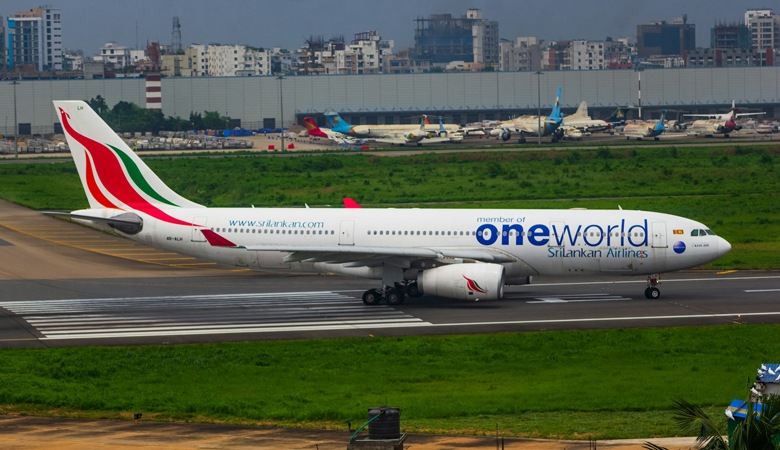
-
Number of Airports
14
-
Passenger Capacity
6.5 M
-
Airport Infrastructure Quality
4.6/7 1 (low)-7 (high)
M = million.
Sources: World Bank. The Global Economy. Compare Countries; The World Economic Forum. 2019. Global Competitiveness Report; Airport and Aviation Services (Sri Lanka) Ltd. 2023. Annual Report 2022 (accessed April 2024).
Airports
Contracting Agencies
Sri Lanka has five international airports located in Katunayake, Mattala, Ratmalana, Jaffna, and Batticaloa, and nine domestic airports. Bandaranaike International Airport (BIA) in Katunayake, is the main airport handling the largest volume of international passengers and cargo. It is managed by Airport and Aviation Services (Sri Lanka) Ltd. (AASL).
The domestic airports are also handled by the AASL. However, the Sri Lanka Air Force remains the de facto operator of domestic airport activity while some civilian aviation services are run privately.1 Scheduled civilian aviation services connect Katunayake to Sigiriya, Trincomalee, Kandy, Pasikudah, Batticaloa, Jaffna, Hambantota, Dickwella, Koggala, and Bentota. These services are presently managed and operated by Cinnamon Air, a private air taxi service in Sri Lanka.2
The Civil Aviation Authority of Sri Lanka (CAASL) is the regulatory body of the aviation sector under the purview of the Ministry of Ports, Shipping and Aviation. The primary function of the CAASL is to regulate the local civil aviation industry under the legislative provisions in the Civil Aviation Authority of Sri Lanka Act, No. 34. of 2002, and Civil Aviation Act, No. 14 of 2010, and conform to international standards, recommended practices, and national legislative requirements. The CAASL handles all policy formulations and legislative reforms in relation to aviation, authorization of airline schedules, airfares, and overseeing and maintaining international standards and recommended practices in the aviation field. It is also responsible for master planning of aviation infrastructure.3
The AASL is a fully state-owned institution in charge of the infrastructure at airports. The core obligation of the AASL is to manage and operate the civil airports within Sri Lanka.4
SriLankan Airlines (SLA) is the country’s national carrier responsible for passenger and freight air transportation as well as airport and ground handling services and is owned and controlled by the GOSL.5 SLA is the sole provider of ground handling, engineering, and catering services at the BIA.
Additional to SLA, FitsAir is the first privately operated international passenger carrier in Sri Lanka. Passenger services commenced in October 2022.6
- 1World Bank Group. 2016. Options Study for Private Sector Participation in the Development of the Domestic Airport Sector in Sri Lanka.
- 2 Cinnamon Air. Destinations and route map (accessed July 2023).
- 3Civil Aviation Authority of Sri Lanka. 2020. Annual Report 2020.
- 4Airport Aviation Services (Sri Lanka) Ltd. Company Overview (accessed July 2023).
- 5SriLankan Airlines. 2021. Annual Report 2021.
- 6DailyFT. 2022. FitsAir takes to smarter flying as Sri Lanka’s first private scheduled intl. carrier.
Airports
Sector Laws and Regulations
The Civil Aviation Act of Sri Lanka provides a regulatory framework for matters relating to civil aviation. The provisions of this Act apply to all activities relating to civil aviation within the territory of Sri Lanka, and in particular, the regulation, administration, and safety oversight of activities relating to civil aviation carried out within the territory of Sri Lanka.1
In addition to the above Act, the industry is governed by the following legislations:
- Air Navigation Act, No. 15 of 1950.
- Air Navigation (Special Provisions) Act (No. 55 of 1992).
- Offences Against Aircraft Act, No. 24 of 1982.2
Details of airports regulatory and operational agencies are shown in the table below.
- 1Law of Sri Lanka. 2010. Civil Aviation Act.
- 2SriLankan Airlines. 2020. Institutional Information.
Line Ministries or Agencies and Their Functions
Agency Function Ministry of Ports, Shipping and Aviation - Formulation of policies, programs, and projects and monitoring and evaluation for matters related to aviation.
- Development and regulation of airports.
- Regulatory functions including those related to progress, charges levied and quality service delivery by airports, use of airports in Sri Lanka by foreign countries, private air services, aircraft registration, etc.
- Entering into agreements for expansion of international aviation services with other countries.
- Supervising the CAASL.
Civil Aviation Authority of Sri Lanka (CAASL) - Provide policy advice to government and other organizations related to aviation.
- Development of aviation policy, rules, legislative reforms, and procedure manuals.
- Safety assessment and certification.
- Giving authorization for airline schedules, airfares, registration of aircraft, high structure constructions, etc.
Airport Aviation Services (Sri Lanka) Ltd (AASL) - Oversee the development, maintenance, administration, and services delivery of airports.
- Maintenance of search, rescue and firefighting services, and aviation security services for the airports.
- Provide services for air traffic, aeronautical information, and aeronautical communication.
- Provide aid for aeronautical communication, navigation, surveillance, and ensure the safety and security of all aircraft and passengers within the Colombo flight information region.
SriLankan Airlines (SLA) - Carriage of passengers and goods by air.
- Provide ground handling and catering services to aircrafts at BIA, Mattala Rajapaksa International Airport, and Colombo International Airport Ratmalana.
Sources: Civil Aviation Authority of Sri Lanka. 2021. Annual Report 2021; Airport Aviation Services (Sri Lanka) Ltd. 2021. Annual Report 2021.
Foreign Investment Restrictions
COMPAREDOWNLOADParameter 2021 2022 2023 Maximum allowed foreign ownership of equity in greenfield projects 100% 100% 100% LEARN MOREAirports
Sector Laws and Regulations
No foreign investment restrictions are in place regarding airports.
Source: Board of Investment of Sri Lanka. 2022. Exchange Control Laws Applicable for Foreign Investments.
Standard Contracts
COMPAREDOWNLOADType of Contract Availability PPP/concession agreement Performance-based operation and maintenance contract Engineering, procurement, and construction contract - Yes
- No
LEARN MOREAirports
Sector Laws and Regulations
Specific standard contracts are unavailable for airports PPPs. General EPC contracts are used for PPP projects as well.
Sources: ADB. 2019. Public–Private Partnership Monitor, Second Edition; Industry research.
Airports
Sector Master Plan
There is no specific master plan for airports. The National Civil Aviation Policy was approved by Cabinet in March 2019 and was gazetted in 2021. The policy states that it was developed in consultation with many stakeholders of the industry, including private entities. The policy was developed with the objective of pursuing liberalization of air transport to benefit all stakeholders and position Sri Lanka as an aviation hub.1
Key aspects highlighted in the National Civil Aviation Policy are:
- Establish and operate an aircraft maintenance, repair, and overhaul (MRO) facility for modern commercial aircraft types, aviation training facilities, aerospace engineering services and manufacturing industries, and enterprises engaged in aviation commerce (e.g., insurance and aircraft brokers).
- Changes to regulation to encourage passenger charter operations (to be encouraged with relaxed financial regulations but with no compromise to safety).
- Improve accessibility, exchange of traffic rights with bilateral or multilateral partner states, negotiate expanded network opportunities and increase market access for designated carriers of Sri Lanka, route capacity, and aspects relating to local airlines.
The policy states that every airport shall develop a master plan outlining development strategies and options for its optimum use including the use of lands adjoining the airport. To balance capacity and demand, airport master plans are aligned with traffic forecasts, to enable development in phases. A business case with capital costs, timeframes, and other considerations such as airspace capacity and environmental impact will be studied from the start. A work stream on users’ requirements and affordability will also be included. Recognizing the importance of airports as key elements of the national economic infrastructure, and future airport infrastructure needs will be addressed through properly coordinated and integrated airport master plans.
The construction of the Mattala Rajapaksa International Airport (MRIA) commenced in 20092 and was constructed with loan funding. In 2018, it was understood that an Indian investor was to operate the airport. In 2019, however, the CAASL was to develop and operate the airport instead of a foreign investor. Despite multiple rounds of negotiations, the project did not proceed.3 The GOSL also initiated a PPP development model to lease out MRIA in 2017, and despite interest from India and the People’s Republic of China, neither progressed.4
Meanwhile, construction work for Terminal 2 of BIA commenced in December 2020. This project is funded by a loan from the Japan International Cooperation Agency (JICA) and the total estimated cost of the project is JPY41,554 million (SLRs35,136 million).5 The Project Management Unit comprises AASL, JV Japan Airport Consultants, and Nippon Koei Co. Ltd., as project consultants, with TAISEI Corporation Japan, serving as the constructor.6 The associated apron and taxiway was constructed in 2021 as a part of the BIA expansion project. This was constructed by Hazama Ando Corporation Japan, under the financing facility obtained from JICA.7 However, due to the circular issued by the Treasury in April 2022 on the interim policy regarding the servicing of Sri Lanka’s external public debt (sovereign default), JICA subsequently halted loan disbursements until external debt restructuring is completed. Due to suspension of payments, TAISEI Corporation suspended their work in July 2022 and issued a notice of termination due to the inability of GOSL to service loan payments. At present, JICA’s ongoing work in the terminal is on hold, until external debt restructuring is completed.8 Due to the importance of the project in June 2023, GOSL resumed construction work of the terminal, allocating funds from the AASL9 and contracting Access Engineering PLC, as the main local contractor.10
The Colombo International Airport Ratmalana (CIAR), is the preferred choice for international corporate aircraft. It also promotes domestic air flights and facilitates flight training.11 In March 2022, the airport commenced international passenger flights to Maldives after a lapse of 54 years. This operation is likely to connect all domestic airports in Maldives via Maldivian, the national carrier of Maldives. Currently, all ground handling facilities at CIAR are carried out by AASL.12 To facilitate international regional flight operations at CIAR requires certain infrastructure developments and upgrades, and an investment of SLRs500 million was identified as costs related to a terminal enhancement project. However, because of the current economic climate, the project was put on hold.
Further, the Palaly Airport in the Northern Province was also upgraded as Jaffna International Airport in 2019. This was funded by the Governments of Sri Lanka and India at a cost of SLRs2.25 billion, with SLRs300 million financed by the Government of India.13 International passenger flights to India commenced in July 2022 to boost the Sri Lankan tourism sector.14
The Batticaloa International Airport is also expected to be redeveloped as a complete domestic airport with the aim of facilitating tourist arrivals, especially from India. A tripartite agreement is to be signed between CAASL, AASL, and the Sri Lanka Air Force to develop a suitable plan. This airport is being developed to improve basic facilities at the airport including new control towers, the northern section of the runway, and installing firefighting and rescue systems.15 Currently the GOSL is also calling for competitive bids to set up an aviation training academy at Batticaloa International Airport.16 Although this airport was gazetted as an international airport for many years, it has not been developed to the level required for a domestic airport and was opened only for civil operations in 2018.17
One of the primary reasons driving interest in the development of Sri Lanka’s domestic aviation sector is the creation of a more established domestic aviation industry which would, in turn, act as an enabler for the tourism market. This includes domestic flights to the southern coast, ancient cities (Sigiriya), northern region (Jaffna), east coast (Batticaloa), and hill country (Kandy).18 Domestic aviation was a strong segment in the aviation industry in the 1970s prior to the ethnic war. Access to tourist destinations in the north and east will be facilitated with the availability of air access as road travel to these regions is time consuming.
The AASL has tied up with multiple domestic carriers to promote Sri Lanka’s domestic airports as well as famous tourist hotspots by carrying out joint marketing campaigns while providing the necessary infrastructure, hangar facilities, and services.19
In Q1 2024, the Ministry of Ports, Shipping and Aviation requested for proposals to assist with the preparation of a master plan for BIA.
- 1Airport and Aviation Services (Sri Lanka) Ltd. 2016. A National Aviation Policy for Sri Lanka.
- 2Airport Technology. 2017. Mattala Rajapaksa (formerly Hambantota) International Airport.
- 3The Hindu. 2019. International.
- 4Airport Aviation Services (Sri Lanka) Ltd. 2021. Annual Report 2021.
- 5Airport Aviation Services (Sri Lanka) Ltd. 2021. Annual Report 2021.
- 6Airport Aviation Services (Sri Lanka) Ltd. Latest News.
- 7JICA. 2021. Press release. JICA Supports the Bandaranaike International Airport (BIA) Expansions-New Apron and Taxiways Ceremonially Opened.
- 8The Island. 2023. Govt. planning to resume BIA expansion project.
- 9Daily FT. 2023. Govt. resumes work on 2nd terminal at BIA with Rs. 500 m from AASL.
- 10Daily Ft. 2024. Sri Lanka’s Access Engineering wins work under airport expansion project.
- 11Airport Aviation Services (Sri Lanka) Ltd. 2021. Annual Report 2021
- 12DailyFT. 2022. Intl. regional flights to restart on 27 March from Ratmalana after 54-year hiatus.
- 13Sunday Times. 2021. Palaly Airport revival gets underway with Indian expert’s review.
- 14The Economic Times. 2022. Lanka to resume flights to India from Jaffna to woo Indian tourists.
- 15Sunday Times. 2022. Batticaloa Airport upgrades to a fully- fledged domestic airport soon.
- 16Daily Mirror. 2022. Investors sought to set up aviation training academy at Batticaloa airport.
- 17The Morning. 2021. Batticaloa Airport to become domestic airport.
- 18World Bank Group. 2016. Options Study for Private Sector Participation in the Development of the Domestic Airport Sector in Sri Lanka
- 19AASL. 2021. Annual Report 2021.
Projects under Preparation and Procurement
Airports Public-Private Partnerships under Preparation and Procurement
COMPAREDOWNLOADLEARN MOREAirports
Sector Master Plan
There has been limited private participation in aviation (in airlines, airport management, or ground handling services). In 1998, the national carrier SLA (formerly known as Air Lanka) entered into a 10-year management agreement with Dubai-based Emirates Airlines, giving them a 40% stake acquisition. This arrangement granted Emirates the authority to make most of the managerial decisions. During this period, SLA was profitable with minimal losses in 2001 and 2002 and it also modernized its fleet operations. However, since the end of the partnership with Emirates in 2008, SLA has not performed as well under state ownership and has accumulated losses amounting to $1,491 million during 2009–2019.1
In October 2023, the GOSL called for bids to divest its stake in SLA and announced Treasury would absorb $512 million of outstanding debt in order to make the airline more attractive to potential investors.2 At present, a potential restructuring of SLA and its subsidiary companies is being discussed. The restructuring process involves a possible divestment of ~49% stakes in SriLankan Catering, SLA Ground Handling, and SLA as well as a restructuring of its foreign and domestic debt of ~$1.0 billion.3
- 1SriLankan Airlines. 2021. Annual Report 2021.
- 2DailyFT. 2024. Govt. absorbs $512 m debt to dress up SriLankan Airlines for sale (accessed April 2024).
- 3DailyFT. 2022. Cabinet checks-in to SriLankan Airlines restructuring.
“–” indicates no projects, data not available, or not applicable according to the database.
Source: World Bank. Private Participation in Infrastructure (PPI)—Sri Lanka. (accessed April 2024).
Airports
Features of Past PPP Projects
Procurement of PPP Projects
Airports Public-Private Partnerships procured through various modes
COMPAREDOWNLOADLEARN MOREAirports
Features of Past PPP Projects
In December 2023, the Ministry of Ports, Shipping and Aviation on behalf of AASL invited proposals from prospective investors for direct and indirect aviation-related business ventures at MRIA, Hambantota.1 Direct ventures are considered MRO support services, flying/engineering schools, aircraft spares manufacturing, fixed base operations, and long-term aircraft parking services. Meanwhile, renewable energy, resorts and other hospitality services, industrial parks, and logistics services are considered indirect ventures.
In 2024, in a Cabinet decision, it was announced that the GOSL received five proposals and the management of the airport would be granted for a period of 30 years.2 In April 2024, Cabinet granted approval to transfer management rights to Shaurya Aeronautics Pvt. Ltd of India and Airports of Regions Management Company of Russia.3
- 1Government of Sri Lanka, Ministry of Ports, Shipping and Aviation. Calling Expressions of Interest to Invest Direct / Indirect Aviation Related Business Ventures at Mattala Rajapaksa International Airport, Sri Lanka.
- 2Government of Sri Lanka, Department of Government Information. 2024. Cabinet Decisions.
- 3Ada Derana. 2024. Two companies from Russia, India to take over management of Mattala airport.
PPP Projects Reaching Financial Close
Airports Public-Private Partnerships reaching Financial Close
No airports PPP projects have reached financial closure; therefore, no government support or payment mechanisms are applicable.
COMPAREDOWNLOAD“–” indicates no projects, data not available, or not applicable according to the database.
Source: World Bank. Private Participation in Infrastructure (PPI)—Sri Lanka (accessed April 2024).
PPP Projects with Foreign Sponsor Participation
Airports Public-Private Partnerships with Foreign Sponsor Participation
No airports PPP projects received foreign sponsor participation.
COMPAREDOWNLOAD“–” indicates no projects, data not available, or not applicable according to the database.
Source: Source: World Bank. Private Participation in Infrastructure (PPI)—Sri Lanka (accessed April 2024).
Government Support to PPP Projects
Government Support for Airports Public-Private Partnerships
COMPAREDOWNLOADPayment Mechanism for PPP Projects
Payment Mechanisms for Airports Public-Private Partnerships
COMPAREDOWNLOADTypical Risk Allocation for PPP Projects
Since there are no airports PPP projects implemented thus far, the information on typical risk allocation for airports PPP projects is unavailable.
The 1998 PSIP Guidelines state that the indexation risk and price negotiation risk may differ from project to project.
Airports
Tariffs
The tariff charges levied by AASL, as of April 2024, are as follows:
- Landing charges for domestic flights: $4.0 (SLRs1,204)/1,000 kg maximum take-off weight subject to a minimum charge of $250 (SLRs75,250).1
- 1Airport Aviation Services (Sri Lanka) Ltd. Business Information.
Airports
Challenges
Demand and Supply Factors
- Delays in realizing economies of scale. Airports grapple with elevated operational expenses per passenger, while initial years may witness constrained revenue generation due to affordability challenges. This limits private participation and prospects to achieve sufficient economies of scale to generate profitable business.
- There is a lack of private participation in aviation, particularly in relation to ground handling services, cargo services, and engaging in additional aviation-related services such as engineering (MRO) and training. Further, the current monopoly within ground handling services (handled by the national carrier SLA) has a negative impact on customers as they are required to pay higher fees compared to other regional peers.1
- Limited ability to utilize the airport premises at BIA and MRIA to allow third-party foreign players to set up and provide airport-related services for international flights such as ground handling, training, and MRO services has prevented the local airline industry capitalizing on such revenue generating opportunities and positioning Sri Lanka as an aviation hub.
- Limited connectivity within the domestic airport network presents a challenge for tourism, especially for tourists arriving at BIA and traveling onwards to the northern and eastern coasts. Despite having several domestic airports across the island, the lack of an efficient and regular internal fight network has hindered efforts to promote tourism and domestic travel. This issue is compounded by the underdeveloped commercial facilities at domestic airports and delays in renovating the required infrastructure to convert former military-based airports into fully functional domestic airports for passenger traffic.
Regulatory Factors
- Lack of a long-term master plan (and a policy framework to effectively enable changes) that is implemented consistently for the development of airports and related services such as cargo, ground handling, MRO, catering, and flight training has prevented greater private participation; there is limited direction and coordination between all key stakeholders.
- 1Advocata. 2021. SriLankan Airlines and the follies of State enterprise (accessed July 2024).
-
Energy
-
Power Consumption
642 kWh per capita
-
Share of Clean Energy
51.2 % of total energy use
-
Electricity Access
100 % of population
-
Energy Imports
5,131 $ million
-
Number of PPPs Reaching FC
162
-
Value of PPPs Reaching FC
1,963 M
-
Number of PPPs with Foreign Sponsors
25
-
Number of PPPs with Govt. Support
25
FC = financial closure, Govt. = government, mbps = megabits per second.
Sources: Ceylon Electricity Board. 2024. Statistical Digest 2023; Ceylon Electricity Board. 2023. Long Term Generation Expansion Plan 2023–2042; Central Bank of Sri Lanka. 2022. Economic and Social Infrastructure; The World Economic Forum. 2019. The Global Competitiveness Report.
Energy
Contracting Agencies
There are multiple contracting agencies related to power including the Ministry of Power and Energy (MoPE), the Ceylon Electricity Board (CEB), and the Sri Lanka Sustainable Energy Authority (SLSEA).
- The MoPE is the main government body that oversees power developments in Sri Lanka and is responsible for the formulation, implementation, monitoring, and evaluation of policies, programs, and projects in relation to power and energy. All departments, public corporations, and statutory institutions related to power and energy come under the purview of the MoPE.1
- The CEB is the main government authority for electricity. The CEB is engaged in power generation, transmission, distribution, and collection of revenue. The CEB holds the only transmission and bulk supply license, including four out of five distribution licenses, while the state-owned Lanka Electricity Company (Pvt) Limited (LECO) holds the fifth license.2 The CEB also commands a monopoly position as a purchaser of electricity; through its license for electricity generation, it accounts for approximately 70% of the total installed capacity on the national grid.3 Meanwhile, private entities can generate and sell electricity to the CEB via independent power purchase agreements (IPPAs). Approximately, 25% of the installed capacity in the country is held by private companies established as PPPs under standard IPPAs. In April 2024, the Minister of Power and Energy presented a new Electricity Bill to the Parliament to repeal the Ceylon Electricity Board Act, No. 17 of 1969.
- The SLSEA, established under the Sri Lanka Sustainable Energy Authority Act, No. 35 of 2007, is responsible for identifying, conserving, and managing all renewable energy resources and appropriate conversion technologies. The SLSEA also assists in the formulation of the National Energy Policy, promotes the development of renewable energy projects through private investment, and conducts research on the development of indigenous resources.4
- The Public Utilities Commission of Sri Lanka (PUCSL), established under the Public Utilities Commission Act, No. 35 of 2002, acts as the technical, economic, commercial, and safety regulator of the electricity industry. Despite its initial formation in 2003, the PUCSL was empowered to operate as the power regulator only after the enactment of the Electricity Act, No. 20 of 2009.5 The new Electricity Bill presented to Parliament provides for the PUCSL to be the regulator for the industry.
- LECO is a limited liability company incorporated in 1983 under the Companies Act, for electricity distribution. LECO purchases bulk power from the CEB and distributes approximately 10% of the total electricity in the country. The main shareholder of LECO is the CEB (with a 55% shareholding), while other shareholders are MOF and other state entities.6
- 1Government of Sri Lanka, Presidential Secretariat. 2022. Government Gazette Notification 22 July 2022.
- 2ADB. 2019. Sri Lanka Energy Sector Assessment, Strategy, and Road Map.
- 3Ceylon Electricity Board. 2021. Long Term Generation Expansion Plan 2022–2041.
- 4ADB. 2019. Sri Lanka Energy Sector Assessment, Strategy, and Road Map.
- 5ADB. 2019. Sri Lanka Energy Sector Assessment, Strategy, and Road Map.
- 6ADB. 2022. Story of Lanka Electricity Company.
Energy
Sector Laws and Regulations
The Sri Lanka Electricity Act of 2009 (amended in 2013 and 2022) constitutes the legal framework for power. The formation of the CEB took place through Act, No. 17 of 1969, replacing the Government Electricity Department. Since its inception, power has operated as a vertically integrated monopoly. The CEB has maintained a greater level of financial autonomy compared to a government department, enabling it to independently make administrative and financial determinations.
Key reforms in Sri Lankan power commenced in 1983, with the creation of a state-owned company to distribute power to certain designated areas. In 1996, private entities started getting involved in power generation projects and since 2000, the CEB was internally unbundled into generation, transmission, and four distribution divisions through an administrative CEB decision. Nonetheless, no legal or financial separation occurred thereafter.1 The Sri Lanka Electricity Act introduced limited unbundling, where all businesses remained under one corporate ownership, while generation, transmission, and distribution functions were separately licensed. This Act introduced a single-buyer model, with the CEB as the transmission entity acting as the designated single buyer for the industry. The CEB holds one generation license (to cover all power plants owned by the CEB), one transmission and bulk supply license, and four distribution licenses. However, these six licensed entities are embedded within the CEB, and do not have an independent ownership structure and management.2
- 1ADB. 2014. Assessment of Power Sector Reforms in Sri Lanka: Country Report.
- 2ADB. 2019. Sri Lanka Energy Sector Assessment, Strategy, and Road Map.
Current Functional Structure of Power in Sri Lanka
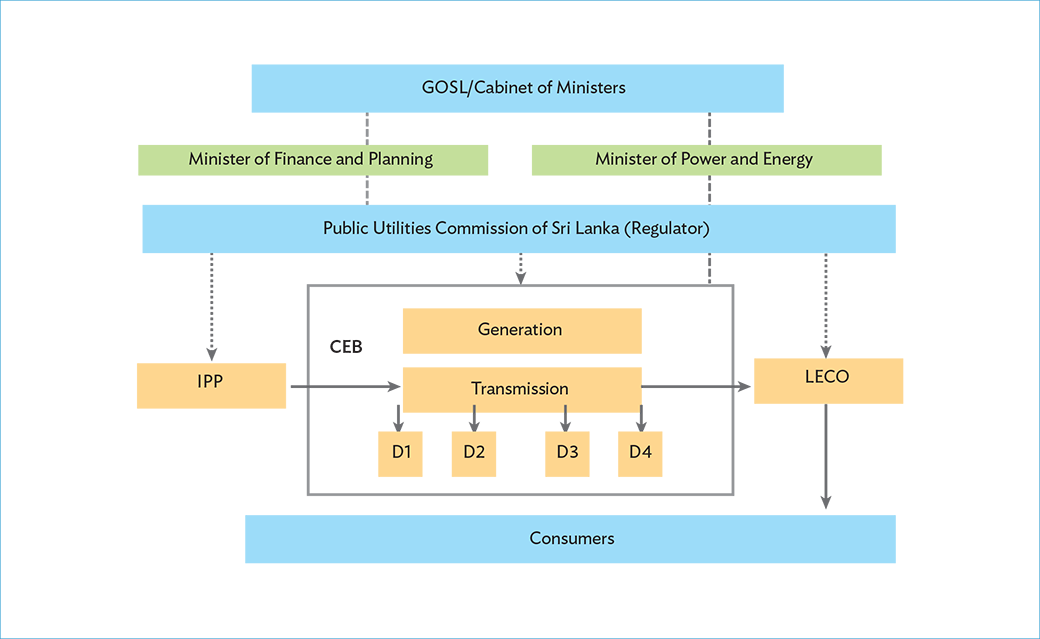
Source: ADB. 2019. Sri Lanka Energy Sector Assessment, Strategy and Road Map.
Considering the severe power crisis faced by the country in 2021 and 2022, the GOSL is currently pursuing significant power sector reforms. Greater and more comprehensive unbundling of the CEB is considered a key aspect of this new reform program. Cabinet approval was given to execute the unbundling process in August 2022,3 which was followed by the appointment of a special technical committee to provide guidance on the process.4 The committee provided their expert recommendations in November 2022, and a special Cabinet Memorandum was submitted outlining the process to be followed for CEB unbundling, and specific objects to be achieved by the process.5
- 3ADB. 2019. Sri Lanka Energy Sector Assessment, Strategy, and Road Map.
- 4The Island. 2022. CEB restructuring proposals to be finalized in two weeks.
- 5Government of Sri Lanka, Ministry of Power and Energy. 2022. Cabinet Memorandum - Institutional Reforms for Power Sector.
Expert Committee Opinion on the Sri Lankan Electricity Industry
Committee Recommendations for Institutional Reforms in the Sri Lankan Electricity Industry 1. Have an integrated electricity policy that includes private sector participation toward funding, innovation, and leadership of the electricity industry. 2. Establishment of independent entities to manage the generation, transmission, distribution, sale of electricity, and promotion of market competition. 3. Develop a standard code of conduct and ethics for new entities on financial self-sufficiency and a cost-reflective and transparent system of tariffs and financial commitments. 4. Establish an independent and transparent investment planning process based on the concept of integrated resource planning. 5. Improve the regulatory oversight of the electricity industry through the establishment of an independent regulator exclusively for power. 6. Increase the share of renewable energy in Sri Lanka’s electricity generation mix. 7. Integrate the Electricity Reform Act, No. 28 of 2002, with the Sri Lanka Electricity Act, No. 20 of 2009. 8. Establish a high-level committee under the subject ministry to direct and monitor the restructuring process. 9. Establish an electricity tribunal for enforcement and resolution of disputes arising out of operations. Source: Government of Sri Lanka, Ministry of Power and Energy. 2022. Cabinet Memorandum—Institutional Reforms for Power Sector.
The expert committee proposed several recommendations projected to be enforced in the upcoming years.
Summary of Expert Committee Recommendations on the Electricity Supply Industry
Recommendations of the Expert Committee (implementation process yet to be enacted) 1. Reorganize the CEB.
- Formation of independent companies (successor entities) under the Companies Act to take over the generation and distribution businesses of the CEB.
2. Discontinue the single-buyer model and establish an independent system operator.
- Bulk power purchase and sale be carried out by the independent system operator (ISO) with mandatory Bulk Supply Transaction Account and the transaction licensee to maintain and operate its network assets on a nondiscriminatory basis.
- Implement Power Sales Agreements allowing direct contracting between generators, distribution companies, and individual bulk customers.
3. Enact new legislations.
- Electricity Sector Reforms Act (ESRA)—provides guidance on the reorganization of the energy sector. Proposes the establishment of an ISO as a separate and independent body and Bulk Supply Transaction Account to be operated by the ISO.
- New Consolidated Electricity Act—amendment of the SLEA 2009 to ensure coordination with the proposals contained in the ESRA. Proposals under this Act include the following: any entity governed under the Companies Act to be eligible to apply for generation, transmission, or distribution license; licensing decision to be exclusively under the purview of the regulator (not with the concurrence of the Minister); amendments to allow power wheeling; and removal of a distance requirement making the licensee responsible for supplying the electric line to the boundary of the land of the owner/occupier.
4. Establish an electricity tribunal:
- To include members who will bring legal, managerial, technical and judicial perspectives to the dispute settlement process.
- To be chaired by a person with judicial experience appointed by the Chief Justice or the Judicial Service Commission.
5. Develop renewable energy and assets by tapping into global financial markets:
- Recommendations in relation to decarbonizing and developing renewable based electricity to provide for power wheeling (to minimize off-taker risk factors of renewable energy projects).
6. Create a National Energy Policy, a national integrated electricity policy, and long-term planning functions:
- National Energy Policy recommends setting up of a national energy commission with representatives from the MOF and the CBSL to carry out the overall national-level planning function for the country’s total energy aspects.
- National energy commission does not need to be a permanent entity but structured to be automatically and mandatorily established at regular intervals.
- National integrated electricity policy that would reflect the changing socioeconomic conditions and societal aspirations.
- Long-term planning function will guide the development of Sri Lankan power and enable integrated resource planning.
7. Proposed sequence for the reform process:
- Introduce the ESRA to restructure the electricity industry by establishing successor entities and repealing the CEB.
- Once the proposed reforms outlined in the ESRA are realized, a new Electricity Act should be put into effect as a comprehensive legislation to address all aspects of the electricity sector by reassigning the PUCSL mandate.
- Establish a dedicated independent regulator for electricity.
Source: Government of Sri Lanka, Ministry of Power and Energy. 2022. Cabinet Memorandum—Institutional Reforms for Power Sector
In April 2024, the Minister of Power and Energy presented to Parliament a new Electricity Bill, that addresses many of the above. Key objectives of the Bill are:6
- To provide for the implementation of reforms to the electricity industry.
- To provide for the establishment of the National Electricity Advisory Council.
- To provide for the PUCSL to be the regulator for the electricity industry.
- To provide legislative measures applicable to the incorporation of corporate entities under the Companies Act, No. 07 of 2007, in which all activities connected to the generation, transmission, distribution, trade, supply, and procurement of electricity shall vest.
- To specify the processes to be applicable to all related activities.
- To repeal the Ceylon Electricity Board Act, No. 17 of 1969, and the Sri Lanka Electricity Act, No. 20 of 2009.
Another recent development to the Electricity Act was the amendment passed in Parliament in June 2022, allowing any person to apply for a license to generate electricity. This amendment removed the restriction that existed previously on a person’s eligibility to apply for a generation license for projects above 25 MW capacity (only the CEB, a state entity, or a company with more than 50% state holding were previously eligible).7
Process of Developing a Renewable Power Project
According to the Sri Lanka Electricity Act 2009, a license must be obtained for the generation, transmission, and distribution of electricity, subject to specific conditions. The generation license specifies that the licensee must adhere to all environmental laws in force at the time of applying for the license.8 Both generation and distribution licenses are unlikely to be provided to a single entity; however, such licenses could be assigned with the consent of the PUCSL and the Minister of Power and Energy. Further, the PUCSL has the power to exempt the requirement of a license and to revoke any licenses issued.9
According to the Sri Lanka Sustainable Energy Authority Act, a permit must be issued by the SLSEA to engage in or carry out an on-grid renewable power generation and supply project within a development area. Following an initial screening and in consultation with the CEB, the Director General of the SLSEA will submit the registered application along with their insights to the Project Approving Committee for provisional approval. The provisional approval granted will be valid for 1 year from the date of approval. If the documents and other requested information are not submitted prior to the expiry of the 12-month period, the application will be cancelled automatically. On receipt of the necessary documents and information, final approval (permit) is then granted for 20 years. However, a permit may be cancelled if the project is not commenced within 2 years of issuing the permit. At the end of the 20-year period, the permit may be extended for a further 20 years.10
In June 2022, Parliament passed the Sri Lanka Electricity Amendment Bill, No. 20 of 2009, which removed the restrictions on the issuance of a power generation license for any entity, over and above the generation capacity of 25 MW, allowing the GOSL to accept unsolicited proposals on a case-by-case basis. The objective of this amendment was to speed up the procurement process of large-scale nonconventional renewable energy (NCRE) projects in the country and minimize its dependance on more expensive emergency power alternatives.11
Currently, most renewable power projects in Sri Lanka operate as grid-tied systems, while there have been few successful pilot projects operating as micro-grids. Grid-tied systems would generate electricity from renewable sources and excess power will be exported to the utility grid, while power will be imported from the grid when more electricity is required for usage.
The transmission system is owned and operated by the CEB, and only the CEB is eligible to apply for the issue of a transmission license. Distribution is limited to companies that obtain a license. These companies are incorporated under the Companies Act, No. 7 of 2007, in which the GOSL or a public corporation holds more than 50% of the shares.12 In theory, private companies (local or foreign) are allowed to operate in the distribution market. In practice, only one local company, LECO (which is also 55% owned by the CEB), is active in this market apart from the CEB.
- 6Government of Sri Lanka. 2024. Sri Lanka Electricity Bill.
- 7Government of Sri Lanka. 2022. Sri Lanka Electricity Act, 16 of 2022.
- 8ADB. 2019. Public–Private Partnership Monitor, Second Edition.
- 9Public Utilities Commission of Sri Lanka. 2020. Licensing under the Sri Lanka Electricity Act, No. 20 of 2009
- 10ADB. 2019. Public–Private Partnership Monitor, Second Edition.
- 11Ada Derana. 2022. Sri Lanka Electricity Amendment Bill passed in Parliament.
- 12ADB. 2019. Sri Lanka Energy Sector Assessment, Strategy, and Road Map.
Line Ministries or Agencies and Their Functions
Agency Function Ministry of Power and Energy (MoPE) - To formulate, implement, monitor and evaluate policies, programs, and projects in relation to power and energy.
- Reform all systems and procedures using modern management techniques and technology, to ensure that Ministry functions are fulfilled while eliminating corruption and waste.
- Explore, plan, develop, and supervise activities relating to generation of renewable power, electricity, and other energies from sources such as solar, water, thermal, coal, waste, and wind.
- To implement a power generation plan based on long-term requirements.
- To explore petroleum and natural gases and related activities.
- Formulate an appropriate energy policy for the control, regulation, and utilization of energy resources.
Ceylon Electricity Board (CEB) - Purchase electrical energy in bulk.
- Conduct investigations and collect and record data concerning the generation, distribution, and utilization of power, and the development of power resources.
- Acquire, hold, lease, hire, mortgage, and sell any immovable or movable property and enter into contracts that are necessary to perform the duties of the Board (either directly or through duly authorized agents).
- Enter into joint schemes with any government department or any institution approved by the Minister for the generation of electrical energy, the irrigation of lands, or control of floods.
- Conduct research with regards to the generation, distribution, transmission, supply, and use of electricity.
Public Utilities Commission of Sri Lanka (PUCSL) - Issue and regulate licenses related to the power sector.
- Act as the economic, technical, and safety regulator for the electricity industry.
- Advise the GOSL on all matters concerning electricity.
- Exercise licensing, regulatory, and inspection functions, and regulate tariffs and other charges levied by licensees.
- Set and enforce technical and other standards on safety, quality, continuity, and reliability of electricity supply and metering services.
- Maintain necessary records, promote efficient use of electricity, and undertake incidental and ancillary measures for effective discharge of its functions.
Sri Lanka Sustainable Energy Authority (SLSEA) - Assist in developing the National Energy Policy.
- Implement policy for renewable energy, and for energy efficiency and conservation.
- Promote development of renewable energy projects through private investment.
- Conduct research on the development of indigenous energy resources.
- Issue licenses for sustainable energy development.
- Develop renewable energy resources and declare energy development areas.
- Implement energy efficiency measures and conservation programs.
- Promote energy security, reliability, and cost-effectiveness in energy delivery and information management.
Sources: Government of Sri Lanka, Presidential Secretariat. 2022. Government Gazette Notification 22 July 2022; ADB. 2019. Sri Lanka Energy Sector Assessment, Strategy, and Road Map; ADB. 2019. Public–Private Partnership Monitor, Second Edition.
Foreign Investment Restrictions
COMPAREDOWNLOADBusiness Activity 2021 2022 2023 Power generation 100% 100% 100% Power transmission 0% 0% 0% Power distribution 50% 50% 50% Oil and gas 100% 100% 100% Mining and primary processing of nonrenewable national resources 40% 40% 40% LEARN MOREEnergy
Sector Laws and Regulations
Foreign ownership is allowed in most subsectors within power; however, the country’s land ownership laws prohibit foreigners from owning land with some exceptions. If the foreign investment in certain subsectors exceeds 40% ownership of the company, the respective project and foreign company of ownership is subjected to specific approvals from the BOI (see table below). In areas where foreign investment is permitted, investors are treated as equal to domestic investors and will benefit from any incentives provided by BOI or from Treasury.1
- 1ADB. 2019. Public–Private Partnership Monitor, Second Edition.
Sources: ADB. 2019. Public–Private Partnership Monitor, Second Edition; Board of Investment of Sri Lanka. 2022. Exchange Control Laws Applicable for Foreign Investments.
Standard Contracts
COMPAREDOWNLOAD- aStandard IPPAs.
- bCapacity take-or-pay contracts are not available as separate contracts, but such conditions are embedded in certain IPPAs.
- cThermal power plants operate with a fuel supply agreement.
- Yes
- No
LEARN MOREEnergy
Sector Laws and Regulations
Standard IPPAs signed between the private project developer and the CEB to purchase electricity generated by the power plant can be considered as a standard PPP concession agreement. Additionally, fuel supply agreements have been used for thermal power plants in the past, while general EPC contracts are used for construction activities of these power plants.
The CEB has standardized pricing formulas based on the power purchase agreement being signed. The IPPA will depend on the form of energy being committed to, with rates normally being higher for NCRE sources and lower for nonrenewable sources.
Sources: ADB. 2019. Public–Private Partnership Monitor, Second Edition; Industry research.
Energy
Sector Master Plan
The Long-Term Generation Expansion Plan published by the CEB is the main document that outlines the National Electricity Sector Master Plan. The latest edition of the Long-Term Generation Expansion Plan 2023–2042 outlines several key projects. The master plan recommends the adoption of the most justifiable generation mix for the future while evaluating contingency options to prepare for possible events in the near term. Providing a stable power supply to the nation and utilizing the most economical and sustainable options are key considerations of the master plan.1 Additionally, the GOSL is also looking at options to unbundle the energy sector and encourage market-based pricing and private sector participation.2
The CEB’s Long-Term Generation Expansion Plan 2023–2042 and the Progress Report issued by the MoPE in 2023, outline several key projects across the power generation (e.g., renewable energy and new thermal energy) and transmission and distribution (e.g., India–Sri Lanka interconnection grid) spectrum.
- 1Ceylon Electricity Board. 2023. Long Term Generation Expansion Plan 2023–2042.
- 2Government of Sri Lanka, Ministry of Power and Energy. 2022. Cabinet Memorandum—Institutional Reforms for Power Sector.
Status of Selected Power Projects
No. Project Implementing Agency Estimated Project Cost Status $ million SLRs billion 1. Moragolla Hydro Plant (30 MW) CEB 114 34 Under construction 2. Uma Oya Hydro Plant (122 MW) a CEB 530 160 Added to grid April 2024 3. Broadlands Hydro Plant CEB 82 25 Under commission 4. Natural Gas-Fired Combined Cycle Power Plant I at Kerawalapitiya (350 MW)b CEB 300 90 Awarded in 2021, under construction 5. Gas turbine power plants at Kelanitissa (135 MW) CEB UA UA Awarded in 2022 6. Natural Gas Fired Combined Cycle Power Plant II at Kerawalapitiya (350 MW) CEB UA UA Under preparation 7. Lakvijaya Coal Power Plant Extension (300 MW) CEB UA UA Discontinued 8. Mannar Phase II and Pooneryn Renewable Energy Park projects (500 MW)c CEB 500 151 Provisional Approval granted. Technical Review pending from CEA for Mannar land acquisition in progress 9. Siyambalanduwa Solar Park (100 MW) CEB UA UA Awarded 10. Floating Storage and Regasification Unit (FSRU) and the mooring system development CEB 240 72 Under procurement 11. Regasified Liquefied Natural Gas (R-LNG) pipeline development CPC 40 12 Under procurement 12. India–Sri Lanka Power Interconnection Project CEB NA NA Discussions ongoing at government level 13. Poonakary Tank Solar Project (700 MW) CEB 1,727 520 Awarded 14. Sampur Ground Mounted Solar Project (135 MW) CEB 170 51 Awarded 15. Mannar Wind Power Project (50 MW) CEB 70 21 Under preparation 16. Oddamawadi Solar Project (100 MW) CEB UA UA Under procurement 17. Veravil Wind Project (210 MW) CEB UA UA Under preparation 18. Hambantota Solar Project (150 MW) CEB UA UA Under procurement - aTotal cost of the project, including cost of irrigation and other infrastructure in addition to the hydro plant.
- bDelays due to force majeure and change of law events. Currently exploring the possibility of negotiating a tariff adjustment to cover cost increments due to interest during construction. The Morning. 2024. 350 MW Sobadhanavi LNG power plant: New VAT sparks delays in plant completion.
- cAs of March 2024, it seems a technical review on the Mannar Wind Power Project (Phase II) will be conducted by the CEA once the SLSEA completes its technical analysis of the responses received from environmentalists and the general public during the EIA. The Morning. 2024. Mannar Wind Power Project (Phase II): CEA to conduct a technical review.
- NA = Not Applicable,
- UA = Unavailable
SLRs1 = $0.003319 as of 19 April 2024
Sources: Ceylon Electricity Board. 2023. Long Term Generation Expansion Plan 2023–2042; Ceylon Petroleum Corporation. 2019. Annual Report 2019; Government of Sri Lanka, Ministry of Power and Energy. 2023. Performance Report; Ceylon Electricity Board. 2021. Request for Proposal—The Development of FSRU at Offshore Kerawalapitiya on BOO Basis and Mooring on BOOT Basis; Ceylon Petroleum Corporation. 2021. Request for Proposal—Construction of Regasified Liquefied Natural Gas (R-LNG) Pipeline on BOOT Basis; Government of Sri Lanka, Ministry of Mass Media. 2024. Uma-Oya Project to be commissioned on Wednesday; LTL Holdings. 2024. Lakdhanavi commences the second phase of heavy equipment transportation of Sobadhanavi CCPP; Industry research.
As initial steps to diversify the country’s thermal power sources and develop its liquified natural gas (LNG) power generation capacity, two natural gas fired combined-cycle power plants along with an offshore floating storage and regasification unit (FSRU) and a regasified liquefied natural gas pipeline have been identified as key development projects.
- Two gas fired combined-cycle power plants are expected to be developed at Kerawalapitiya and would provide 700 MW. The first project was awarded in 2021 to a consortium led by LTL holdings3 after a competitive bidding process, as a 20-year concession on a BOOT basis.4 The first phase is currently under construction and expected to be commissioned shortly.
- A gas turbine power plant at Kelanitissa of 135 MW is expected to be commissioned by 2023.5
- The CEB issued an RFP (February 2021) for the development of a FSRU at offshore Kerawalapitiya on a BOO basis, and the mooring system on a BOOT basis.
- The CPC issued an RFP in February 2021 for the construction of the regasified liquefied natural gas pipeline on a BOOT basis. Based on information available, several bidders have responded to these RFPs and are currently under evaluation, with no further notice being given on the project since February 2021.
Although RFPs have been floated for the above LNG-related projects, in September 2021, New York based New Fortress Energy Inc. and the GOSL executed an agreement to develop the FSRU and become the exclusive supplier of LNG to the Kerawalapitiya power complex.6 However, there have been several fundamental rights petitions filed demanding to halt this project (questioning the procurement method), resulting in heavy delays in project execution.7 In February 2024, media sources suggest that Petronet will supply LNG to operate power plants of 300 MW capacity starting 2025, while the company is expected to establish the FSRU subsequently.8
To help enhance the country’s renewable energy contribution (especially nonconventional energy such as wind and solar), the GOSL has been increasingly promoting renewable energy projects. Among the key renewable energy projects are a 100 MW solar park in Siyambalanduwa, which has been under preparation with technical assistance from ADB for project structuring, feasibility study assistance, and development of the IPPA framework. During 2021, an EOI was called via a gazette notification by the State Ministry of Solar, Wind and Hydro Power Generation Projects Development (along with 35 other projects). The project is to be developed on a BOO basis, under a 20-year IPPA.9 Following the EOI, a pre-feasibility study report that was prepared by the SLSEA was released giving a comprehensive background into the project (including the objective, location specifics, renewable power potential, and estimated costs). The CEB and the SLSEA shortlisted potential investors and RFPs were called from shortlisted investors. In August 2023, the letter of award was handed over by the CEB to a tri-party bid proposal led by Windforce PLC, Lakdhanavi, and The Blue Circle, a pure renewable Independent Power Producer based in Singapore.10
In March 2022, a Memorandum of Understanding was signed between the representatives of India’s Adani Group, CEB, and SLSEA to develop up to 500 MW of renewable energy plants in Mannar and Pooneryn. As of March 2024, negotiations were ongoing on the power purchase agreement.11
The Progress Report published by the MoPE mentions that the proposal submitted by the United Solar Energy SL (Pvt) Company has been evaluated and permission granted to develop 700 MW of solar with a battery energy storage system in Kilinochchi. Of the lake, 1080 acres of shallow area has been granted to the company on a 35-year lease to establish the power plant. Additionally, 135 MW of ground-mounted solar is expected to be developed by the Trincomalee Power Company Limited, a joint venture between the National Thermal Power Corporation of India and CEB, under Asian Infrastructure Investment Bank financing.
- 3One of the leading power companies in the country with EPC and operations and maintenance experience in Sri Lanka and South Asia region. CEB holds a 63% stake in LTL Holdings.
- 4LTL Holdings. 2021. Construction of a 350 MW LNG power plant at Kerawalapitiya commences.
- 5Ceylon Electricity Board. 2021. Long Term Generation Expansion Plan 2023–2042
- 6New Fortress Energy. 2021. New Fortress Energy Finalizes Contract with Government of Sri Lanka for LNG Terminal.
- 7New Fortress Energy. 2022. New Fortress Energy Reiterates Commitment to LNG and Power Projects in Sri Lanka Following Favorable Court Ruling.
- 8The Hindu. 2024. Petronet LNG to supply gas to Sri Lanka.
- 9State Ministry of Solar Wind and Hydro Power Generation Projects Development. 2021. Invitation of Proposals to Generate and Supply of Electricity from Renewable Energy Sources.
- 10DailyFT. 2023. Siyambalanduwa sprouts SL’s first integrated renewable energy project.
- 11EconomyNext. 2024. Sri Lanka negotiating power purchase price with India’s Adani: Minister.
Projects under Preparation and Procurement
Energy Public-Private Partnerships under Preparation and Procurement
COMPAREDOWNLOADLEARN MOREEnergy
Sector Master Plan
Apart from the power generation projects discussed above, the India–Sri Lanka Cross Border Electricity Network Interconnection project, which had been under discussion since 2002, has been revisited by both governments. The feasibility study that was conducted by the CEB and the Power Grid Corporation of India in 2011 will be updated with technical assistance from ADB. The project is proposed to have a significant change from the original layout with the undersea cable structure replaced by an oversea cable structure (to reduce the initial project capital expenditure requirement).1
As of the end of 2023, four projects were under procurement and two under preparation. By Q1 2024, the RFP process for the Mannar Solar Project (50 MW) had commenced.
- 1Ceylon Electricity Board. 2023. India–Sri Lanka Cross Border Electricity Network Interconnection.
Sources: Ceylon Electricity Board. 2022. Long Term Generation Expansion Plan 2023–2042; Government of Sri Lanka, Ministry of Power and Energy. 2023. Progress Report; LTL Holdings. 2021. Construction of a 350 MW LNG power plant at Kerawalapitiya commences; Ceylon Electricity Board. 2020. Request for Proposal—Financial Consultants for Lakvijaya Power Plant—300 MW Extension Project; Lanka IOC. 2022. Corporate Disclosure.
Energy
Features of Past PPP Projects
Procurement of PPP Projects
Energy Public-Private Partnerships procured through various modes
COMPAREDOWNLOADLEARN MOREEnergy
Features of Past PPP Projects
Although the institutional capacity for structuring and procuring large-scale and complex PPPs is limited, power is one of the most successful in terms of successfully executed number of PPPs, with many projects reaching financial closure through IPPAs. We have not considered IPP ownership structures due to limitations in data availability. We note that the total number of PPPs in this sector includes projects with IPPs who are partly owned by government institutions.
New project additions during 2019–2021 are mainly from the NCRE sector (mini-hydro, wind, solar, biomass, and other NCRE) with less than 5 MW capacity (detailed breakdown in table below). A total of 51 new NCRE plants (including the feed-in tariff based renewable energy developments) were added to the national grid during 2020–2021, resulting in a cumulative 77 MW of new capacity additions. Assuming an estimated average investment of $1.6 million per MW (average investment derived using the capacity and investment addition requirements outlined for 2016–2030 in the Assessment of Sri Lanka’s Power Sector),1 total PPP investment in power was $125 million during 2020–2021.
All NCRE projects added during 2019–2021 under IPPAs are considered as projects procured under license schemes as all projects have obtained individual licensing from the GOSL to develop energy and sell to the national grid (refer to the ADB definition of “License Schemes” in Definition of Terms).
- 1Asian Development Bank and United Nations Development Programme. 2017. Assessment of Sri Lanka’s Power Sector - 100% Electricity Generation Through Renewable Energy by 2050.
Capacity Additions in Other Renewable Power Segment
Number of NCRE Projects Projects as of 2021 Additions in 2021 Projects as of 2022 Additions in 2022 Projects as of 2023 Additions in 2023 Mini-hydro power 211 3 211 - 212 1 Wind power 17 - 17 - 19 2 Solar power 57 25 78 21 86 8 Biomass and other NCRE 14 - 14 - 14 - Total 28 21 11 Capacity (MW)
Mini-hydro power 414 5 414 - 419 5 Wind power 148 - 148 - 163 15 Solar power 100 25 130 - 139 9 Biomass and other NCRE 50 - 50 - 54 4 Total 29 742 30 775 Rooftop solar projectsa
Number of rooftop solar projects 27,068 6,727 33,378 6,310 39,827 6,449 Capacity (MW) 415 140 535 120 652 117 - aRooftop solar not included in the calculation of new power PPP projects, as individual investment values are not significant (average capacity of 0.01 MW per project).
Sources: Ceylon Electricity Board. 2023. Statistical Digest 2023; Ceylon Electricity Board. 2023. Long Term Generation Expansion Plan 2023–2042; Ceylon Electricity Board. 2021. Long Term Generation Expansion Plan 2020–2039.
AES Kelanitissa Power Plant
The AES Kelanitissa (AKL) power plant, a 163 MW auto diesel-fired combined cycle gas turbine powerplant developed in 2003, was one of the initial power PPP projects executed in Sri Lanka. The main objective of the project was to ease the critical power supply shortage the country was facing during the early 2000s. The AKL provided a cost effective and reliable alternative to the country’s over-dependance on hydropower plants (at the time, approximately 90% of country’s energy generation was catered by hydro plants, which require a longer development timeline).
The AKL project was a joint-venture initiative between AES corporation, an American-based independent power producer, and Hayley’s Limited, a domestic diversified conglomerate. The total project cost was estimated at $104 million, and the concession was on a 20-year BOOT basis. The project was partly funded by the ANZ Bank of New Zealand and ADB, respectively.
The CEB signed a 20-year power-purchasing agreement with AKL, with Treasury providing a government guarantee for payment obligations of CEB, and fuel supply obligations through the CPC.
At the time of completion, the project provided an important addition in easing the power supply shortage of the country, while also making power more accessible to a wider base of users around the nation. The project acted as a stepping-stone toward greater private participation in the country’s energy, with several smaller IPP projects being initiated after this project.
In 2016, the Japanese independent power producer, Sojitz Corporation, acquired the majority share AES Corporation held in the AKL project. The energy asset has readily made itself available for emergency power supply requirements of the country, especially during the dry seasons where many hydro resources cannot be exploited.
In March 2023, with the 20-year PPA between the AKL project and CEB expiring, the asset was successfully transferred as a state entity. The plant continues to be utilized as an emergency power source, while new proposals are being developed toward converting the plant to operate on LNG, which would make energy generation more affordable.
Sources: ADB, Sojitz Corporation, and CEB.
- We have not considered ownership structures when formulating the number of power PPP projects due to complexity involved in identifying ownership of IPPs.
- Projects with IPPs who are partly owned by government institutions have also been considered as PPP projects as no clear distinction and breakdown is given in the public domain.
Sources: World Bank. Private Participation in Infrastructure (PPI)—Sri Lanka (accessed April 2024); ADB. 2019. Public–Private Partnership Monitor, Second Edition; Ceylon Electricity Board. 2022. Long Term Generation Expansion Plan 2023–2042.Ceylon Electricity Board. 2021. Long Term Generation Expansion Plan 2022–2041; Ceylon Electricity Board. 2021. Long Term Generation Expansion Plan 2020–2039.
PPP Projects Reaching Financial Close
Energy Public-Private Partnerships reaching Financial Close
COMPAREDOWNLOADLEARN MOREEnergy
Features of Past PPP Projects
Although the number of power PPP projects is high, the investment value per project is relatively small, with most projects within 1–3 MW; only a few projects out of the 162 total projects that reached financial closure during 1990–2023 have an investment value of more than $15 million. Small projects in size and value are largely due to the nature of the power projects, of which IPPs have a total installed capacity of only 1,163 MW as of 2023, out of the total installed capacity 4,381 MW.1
The rooftop solar segment has shown notable growth in Sri Lanka’s NCRE sector, though individual project sizes are insignificant. As of 2023, total rooftop solar capacity exceeded installed capacity of the mini-hydro segment, which used to be the leading NCRE contributor of the country. The GOSL’s emphasis on increasing solar contribution in the country, and ADB’s concessionary funding lines are the main contributors to the successful project implementation.2
In terms of larger, utility-scale power projects, within the thermal power segment the Combined Cycle Power Plant I at Kerawalapitiya (350 MW) was awarded in 2021 via a competitive bidding process, while Lakvijaya Coal Power Plant Extension (300 MW) was a direct appointment by the CEB in 2020. The Long-Term Generation Plan, however, suggests that the Lakvijaya Coal Power Plant Extension has now been discontinued. Since these projects are yet to reach financial closure, they have not been factored into the analysis below. Within the NCRE segment, the 10 MW Mannar Island Wind Power project (Mannar Phase I) that was commissioned in 2020 with a $130 million investment, is also not considered as a PPP, since it was executed as an EPC by CEB with ADB funding assistance.3
A summary of power projects that reached financial closure from various energy types are as follows and have been updated to 2022, as per the latest available information in the Statistical Digest for 2023.
- 1Ceylon Electricity Board. 2024. Statistical Digest 2023.
- 2ADB. 2022. Sri Lanka: Rooftop Solar Power Generation Project.
- 3ADB. 2020. Sri Lanka: Wind Power Generation Project.
Power Projects Reaching Financial Closure Based on Fuel Type
Power Projects 2021 2022 2023 Renewable energy Mini-hydro 52 52 53 Wind 12 12 14 Solar 43 43 43 Biomass and other 11 32 40 Thermal energy Coal 1 1 1 Diesel 9 9 11 Total 128 149 162 Sources: Ceylon Electricity Board. 2023. Statistical Digest 2023. Sri Lanka; Ceylon Electricity Board. 2022. Statistical Digest 2022; Ceylon Electricity Board. 2022. Long Term Generation Expansion Plan 2023–2042; Ceylon Electricity Board. 2021. Long Term Generation Expansion Plan 2022–2041; Ceylon Electricity Board. 2021. Long Term Generation Expansion Plan 2020–2039.
* Does not include two thermal powerplant additions in 2023, as project value is not available in the public domain.
PPP Projects with Foreign Sponsor Participation
Energy Public-Private Partnerships with Foreign Sponsor Participation
All power projects commissioned during 2019–2021 were locally sponsored projects, with no new additions to the 25 projects previously commissioned with foreign sponsor participation.
COMPAREDOWNLOADSources: World Bank. Private Participation in Infrastructure (PPI)—Sri Lanka (accessed April 2024); ADB. 2019. Public–Private Partnership Monitor, Second Edition.
Government Support to PPP Projects
Government Support for Energy Public-Private Partnerships
The GOSL provided no viability gap funding, guarantees, or performance payments for new power projects during 2019–2023. The GOSL has only facilitated the IPPA process via the CEB, and concessionary land lease agreements for certain projects during this period.
COMPAREDOWNLOAD“–” indicates no projects, data not available, or not applicable according to the database.
Sources: World Bank. Private Participation in Infrastructure (PPI)—Sri Lanka (accessed April 2024); ADB. 2019. Public–Private Partnership Monitor, Second Edition.
Payment Mechanism for PPP Projects
Payment Mechanisms for Energy Public-Private Partnerships
All new power PPP projects during 2019–2023 are under the government pay mechanism via IPPAs.
COMPAREDOWNLOAD“–” indicates no projects, data not available, or not applicable according to the database.
Sources: World Bank. Private Participation in Infrastructure (PPI)—Sri Lanka (accessed April 2024); ADB. 2019. Public–Private Partnership Monitor, Second Edition.
Typical Risk Allocation for PPP Projects
COMPAREDOWNLOADRisk Category Private Public Shared Comments Demand risk The GOSL is actively promoting the development of large-scale renewable energy parks, creating an enabling environment such as the development of evacuation facilities and systems to ensure that the transmission and distribution systems are ready for renewable energy evacuation. Revenue collection risk CEB and its subsidiaries are the only institutions involved in tariff collection from consumers. Tariff risk NCRE projects below 10 MW will be entitled for feed-in tariffs and the tariff risk is borne by the public partner. For projects above 10 MW, the private partner carries the tariff risk until the signing of the IPPA. Government payment risk CEB's weak and deteriorating financial standing poses significant offtake risk for generators. Environmental and social risk Land acquisition risk Most investors cite land acquisition as the biggest challenge for any new business in Sri Lanka. The GOSL owns approximately 80% of the land. State land for industrial use is usually allotted on a 50-year lease. Permits The private investor is responsible for obtaining the Generation License and Energy License which require approvals from entities such as the CEA, the Forest Department, and the Wildlife Department. Handover risk Political risk Regulatory risk Interconnection risk Lack of proper transmission and evacuation infrastructure is a serious barrier and risk for foreign institutional investors and compromises the steady returns that they require. Brownfield risk: asset condition CEB only provides the IPPA. Grid performance risk Distribution and transmission of electricity is only handled by the CEB and its subsidiaries. Hydrology risk Exploration and drilling risk Not applicable as these activities do not happen in the Sri Lankan market context. - Yes
- Not Applicable
Source: ADB. 2019. Public–Private Partnership Monitor, Second Edition.
Financing Details
Parameter 1990–2021 1990–2022 1990–2023 PPP projects with foreign lending participation 3 3 3 PPP projects that received export credit agency/international financing institution support 6 6 6 Typical debt:equity ratioa 70:30 70:30 70:30 Time for financial closeb UA Typical concession perioda 20 years Typical FIRRb UA Source: ADB. 2019. Public–Private Partnership Monitor, Second Edition; Industry research.
UA = Unavailable
Energy
Tariffs
Electricity Generator Tariffs
The CEB, as the sole off-taker of electricity, sets up electricity purchase tariffs, under the purview of the PUCSL. The IPPAs define prices for capacity and energy sold by generators and purchased by the single buyer, establishing commercial conditions for such sales and purchases. Until 2012, Sri Lanka followed a policy of developing renewable energy by the private sector as embedded powerplants, based on a feed-in tariff and a standardized power purchase agreement. However, based on the Amendment No. 31 of 2013 to the CEB, which demanded all projects to be procured through a competitive bidding process, this created an adverse bottleneck in the implementation of new energy projects.1
The feed-in tariffs were initially launched based on the avoided cost principle—avoided cost represents the cost a utility would have incurred to provide the same amount of electricity from conventional fossil fuel plants operated in the country. However, this tariff structure did not consider fossil fuel subsidies provided for plants operating in the country and used the 3-year historical average to calculate the feed-in tariffs. Meanwhile, generation prices were continuously increasing, resulting in the estimated avoided costs being lower than actual avoided costs. This avoided cost principle was used to set up mini-hydro plants across the country, despite the discrepancies in tariffs set.2
With the launch of SLSEA in 2007, the avoided cost principle was replaced with a technology specific cost-based tariff calculation, which was implemented either as a fixed tariff or a three-tier tariff structure. The rates were announced by the PUCSL in 2011 following detailed stakeholder consultations.3
In September 2022, Cabinet approved a revised list of feed-in tariffs for NCRE projects with a capacity of up to 10 MW. The new tariff structure that is applicable for projects with capacity of up to 1 MW has a fixed as well as a variable component. Fixed tariffs have three tiers: years 1–8, 9–15, and 16–20, with the variable component revised annually.4
This tariff revision came into place after 2012, with an opinion given by the Attorney General’s Department that all power projects must be procured through a competitive bidding process. Under the new standard tariff schedule, the CEB can sign IPPAs for renewable energy projects less than 10 MW capacity, with no requirement for competitive bidding. Additionally, SLSEA is of the view that larger capacities may also be contracted without competitive bidding (through a negotiation process with the CEB) because of this amendment.
- 1Gazette of the Democratic Socialist Republic of Sri Lanka. 2013. Sri Lanka Electricity (Amendment) Act, No. 31 of 2013.
- 2ADB. 2019. Public–Private Partnership Monitor, Second Edition.
- 3ADB. 2019. Public–Private Partnership Monitor, Second Edition.
- 4Government of Sri Lanka, Ministry of Power and Energy. 2022. Cabinet Memorandum—Cabinet Paper No. 48/ 2022/ PE.
Nonconventional Renewable Energy Purchase Tariff (for Projects up to 10 MW)
Technology Variable Base Operations and Maintenance Rate (SLRs/kWh) (Years 1–20) Variable Base Fuel Rate (SLRs/kWh) (Years 1–20) Fixed Rate (SLRs/kWh) Years 1–8 Years 9–15 Years 16–20 Small hydro power 3.15 None 32.28 17.52 11.95 Wind power 3.91 None 29.79 14.99 9.89 Solar power 2.96 None 33.74 16.98 11.21 Biomass (Dendro) (Years 1–15) 2.35 23.00 17.92 9.02 5.95 (16 years onwards) 3.14 Agricultural and industrial waste (Years 1–15) 2.35 14.95 17.92 9.02 5.95 (16 years onwards) 3.14 Excess power from agri-industrial waste (Years 1–15) 1.77 4.98 13.44 6.76 4.46 (16 years onwards) 2.35 Escalation rate for the year 2022 11.04% 9.10% None None None Source: Government of Sri Lanka, Ministry of Power and Energy. 2022. Cabinet Memorandum—Cabinet Paper No. 48/ 2022/ PE.
In addition to the above revision, Cabinet also approved a revised tariff for rooftop solar projects in October 2022. The two-tier feed-in tariff of SLRs22.0 (years 1–7) and SLRs15.50 (years 8–20) was revised to a flat 20-year tariff of SLRs37.0 for below 500 kWh (and SLRs34.5 for over 500 kWh).5
- 58 DailyFT. 2022. Cabinet nod to revise rooftop solar tariff.
Variable Nonconventional Renewable Energy Purchase Tariff (for Projects up to 10 MW)
Technology Scalable Base Fuel Rate
(SLRs/kWh)Variable Tariff, Including Fuel
(SLRs/kWh)Small hydro power - 44.12 Wind power - 41.97 Solar PV (ground mounted) - 41.95 Solar PV (floating) - 53.26 Biomass (Dendro) 23.00 47.77 Agricultural and industrial waste 14.95 33.55 Municipal Solid Waste - 53.26 Source: Ceylon Electricity Board. Non-Conventional Renewable Energy Tariff Announcements
In October 2023, the CEB introduced a variable tariff rate policy in addition to the previous revisions made in September 2022. The NCRE power plant developers are permitted to select either the existing fixed three-tier tariff published on 8 September 2022, or the proposed variable tariff as shown in Table 65 at the time of entering into the tariff agreement. The NCRE powerplants commissioned under this scheme are not allowed to migrate from the tariff scheme once selected, for the complete period of the Standardised Power Purchase Agreement (20 years).6
Electricity Consumer Tariffs
To pass on more cost-reflective tariffs to consumers, tariffs were revised with effect from August 2022 after a delay of 8 years. The recent tariff revision has resulted in a >100% increase in prices across many consumer segments. Nevertheless, implementation of a cost-recovery energy pricing model is one of the key recommendations by the International Monetary Fund under the ongoing program, which is yet to be implemented, despite the one-off tariff increases.7
In addition to the August 2022 revision,8 three additional tariff revisions were announced in January 2023, June 2023, and March 2024, which has seen the overall increase of tariff rates. It is important to note that the most recent tariff change in March 2024 saw an overall average reduction of 22% in the tariff rates from that of revisions made in June 2023.9
- 6Ceylon Electricity Board. 2023. Non-Conventional Renewable Energy Tariff Announcement.
- 7International Monetary Fund. 2022. IMF Executive Board Concludes Consultation with Sri Lanka.
- 8Public Utilities Commission of Sri Lanka. 2023. Revision of Electricity Tariffs.
- 9Daily FT. 2024. Switch on Sri Lanka!(accessed April 2024).
Sri Lanka Customer Electricity Tariffs (August 2022 Revision)
Consumption Block / Time of Use Period Revised (5 March 2023) Previous (9 August 2022) Change (%) Energy Monthly Fixed Energy Monthly Fixed Energy Monthly Fixed Charge Charge Charge Charge Charge Charge (SLRs/kWh) (SLRs/kWh) (SLRs/kWh) (SLRs/kWh) (SLRs/kWh) (SLRs/kWh) Domestic If consumption 0–60 kWh per month (incremental block) Block 1: 0–30 kWh 8 150 8 120 - 20% Block 2: 31–60 kWh 20 300 10 240 100% 20% If consumption above 60 kWh per month (incremental block) Block 1: 0–60 kWh 25 N/A 16 N/A 56% - Block 2: 61–90 kWh 30 400 16 360 90% 10% Block 3: 91–120 kWh 50 1,000 50 960 0% 5% Block 4: 121–180 kWh 50 1,500 75 1,500 –50% - Block 5: Above 180 kWh 75 2,000 N/A N/A - - Domestic—optional time of use tariff Peak (18:30–22:30 hours) 90 2,000 25 1,500 260% - Day (05:30–18:30 hours) 70 54 30% 33% Off-peak (22:30–05:30 hours) 30 13 131% - Religious Consumption per month (incremental block) Block 1: 0–30 kWh 8 150 8 90 0% 40% Block 2: 31–90 kWh 9 250 15 120 -40% 52% Block 3: 91–120 kWh 18 600 20 120 -10% 80% Block 4: 121–180 kWh 32 1,500 30 450 7% 70% Block 5: Above 180 kWh 43 2,000 66 1,500 -35% 25% Industry Consumption per month (volume differentiated) 0–300 kWh 18 300 20 960 -10% -69% Above 300 kWh 25 1,000 N/A 1,500 N/A -33% Industrial—Optional time of use tariff for agriculture Peak (18:30–22:30 hours) 37 1,000
20
1535 N/A 5% - Day (05:30–18:30 hours) 33 3 41% -33% Off-peak (22:30–05:30 hours) 29 N/A 48% - Sources: Ceylon Electricity Board. 2023. Tariff plans. https://www.ceb.lk/commercial-tariff/en.
Energy
Challenges
Demand and Supply Factors
- The CEB as the electricity apex body has the responsibility to provide uninterrupted power supply to citizens, in coordination with the respective government authorities (i.e., SLSEA, MOF, CPC, and PUCSL). However, the rollout of renewable energy projects and use of more efficient energy sources (i.e., LNG and Sri Lanka–India Grid Interconnection) were not implemented in a timely manner, leading to a significant demand–supply gap in the energy sector and an increased reliance on expensive thermalbased power supply. This in turn led to countrywide power interruptions during 2022 that caused significant economic loss.
- Limited budgets delay the development and implementation of new generation projects. Despite having an ambitious Long-Term Generation Plan, the GOSL does not have the budgetary capacity to fund large-scale projects. This lack of funds is driven by subsidized pricing and operational inefficiencies.
- The CEB has not raised tariffs to match production costs over the last 8 years. Although recent tariff revisions allowed the CEB to generate profits from some segments (bulk customers and nonhousehold customers), increasing tariffs on household and economically important sectors (e.g., the service sector) has been perceived as socioeconomically challenging. Therefore, the CEB has been continuously operating with financial losses, largely relying on credit provided by state banks.
- The ongoing economic crisis has limited further access to credit facilities and foreign capital. The economic crisis has tightened access to state bank credit, creating working capital constraints for the CEB. Furthermore, foreign exchange shortages in the country have limited the ability to import fuel for power generation through thermal plants.
- Private players have been reluctant to invest in PPPs in the sector. This has been further exacerbated by financial and nonfinancial factors such as:
- Payment settlement terms from the CEB for IPPA-based power generation has usually been 3–4 months. However, currently there are long payment delays from the CEB extending up to 9–12 months, due to the ongoing economic crisis in the country and the poor financial standing of the CEB. This was further worsened in the past by subsidized energy pricing. This problem is expected to be partially rectified with the recent tariff revisions.
- There are significant financing costs for the private sector for new project preparation, which is acting as a bottleneck (e.g., cost for appointment of technical consultants and land acquisitions).
- Additionally, the lack of appropriate system stability standards for high NCRE contribution is a limitation for greater PPP project development. For instance, advanced wind and solar capacity forecasting techniques and smart grid solutions are required as more wind and solar capacity is added to the grid. However, these implementations currently remain at a primary level.
Coordination, Legal, and Regulatory Factors
- Unclear government policy and lack of interministerial coordination causes significant delays in renewable energy project implementation. Reimplementation of the bidding process for all power projects in 2012 created uncertainty among investors. Nevertheless, due to the ongoing crisis, Cabinet approved a new feed-in tariff table for renewable energy during August 2022,which is expected to create a more enabling environment for renewable energy projects.1
- Despite recent consumer tariff revisions, the GOSL is yet to implement a standard pricing formula for electricity. Until the completion of the CEB unbundling process and facilitation of market-based pricing, it is practical to have a pricing formula that is revised based on global energy prices (since ~60% of electricity in Sri Lanka is currently generated from fossil fuels). Consumers must be made aware of the variables of the formula that must be revised at pre-announced intervals (e.g., monthly or quarterly). This would reduce the uncertainty on planning aspects, and industries with high energy consumption can forecast their budgets more effectively.
- Weak energy policy analysis and planning has been a continuing challenge. The CEB prepares a LongTerm Generation Expansion Plan and accompanying transmission and distribution development plans. However, actual implementation of the plan falls short of the recommended process, with significant impacts on the reliability of supply and overall economic losses due to power outages and higher generation cost.
- Lengthy delays experienced in the approval process (largely caused by complex operating procedures and a lack of interministerial coordination) have also led to significant delays in project implementation. The SLSEA guidelines require the development of new renewable energy projects to follow a very complex process. Developers must obtain approval from 10 relevant line agencies to obtain the generation license. At the time of issuing the license, the project developer may even need to renew the approvals obtained from the CEA, the Forest Department, and the Wildlife Department if expired. As a result, a developer must spend 2–5 years to obtain a generation license.2
-
Solid Waste Management
-
Municipal solid waste generation (national level)
10,768.00 t/day
-
Collection of municipal solid waste generated
3,458.00 t/day
-
Average household size-in persons (national level)
3.7
-
Number of registered households (national level)
5.2 M
-
Households where garbage is collected by a truck
22 % of households
-
Households burying/ burning garbage
44.2 % of households
-
Households processing garbage for fertilizer
28.6 % of households
M = million
Sources: Government of Sri Lanka, Ministry of Economic Policies and Plan Implementation, Department of Census and Statistics. 2022. Household Income and Expenditure Survey 2019; Government of Sri Lanka, Ministry of Environment. 2021. National Action Plan on Plastic Waste Management 2021–2030.
Solid Waste Management
Contracting Agencies
The following institutions are responsible for implementing projects in solid waste management:
- Ministry of Public Administration, home affairs provincial councils, and local government.
- State Ministry of Urban Development, Coast Conservation, Waste Disposal and Community Cleanliness.
- Ministry of Environment.
Solid Waste Management
Sector Laws and Regulations
- The responsibility for waste disposal lies with the local authorities, which is either the Pradeshiya Sabha (local authority), Municipal Council, or Urban Council.
- The Pradeshiya Sabha Act, No. 15 of 1987, governs the functions of the Pradeshiya Sabha, the local authority within an area responsible for the regulation, control, and administration of all matters relating to public health, public utility services, and public thoroughfares and generally for the protection and promotion of the comfort, convenience, and welfare of the people and all amenities within the area.1
- Urban Council Ordinance No. 61 of 1939 governs the Urban Council constituted for each town and is responsible for the regulation, control, and administration of all matters relating to public health, public utility services, and public thoroughfares, and generally for the protection and promotion of the comfort, convenience, and welfare of the people and the amenities of the town, subject to the powers reserved to or vested in any other authority.2
- Municipal Council Ordinance No. 29 of 1947 governs each municipality and is responsible for the regulation, control, and administration of all matters relating to public health, public utility services, and public thoroughfares, and generally for the protection and promotion of the comfort, convenience, and welfare of the people and the amenities of the town, subject to the powers reserved to or vested in any other authority.3
- National Environmental Act, No. 47 of 1980, established the CEA, which is responsible for recommending a national environmental policy including the extent to which discharge of wastes may be permitted without detriment to the quality of the environment.4 Prohibitions of the manufacture of certain types of polyethylene products have also been introduced through amendments to this Act.
The institutions in solid waste management and their functions are captured in the table below:
- 1Laws of Sri Lanka—Consolidated and Annotated. Pradeshiya Sabhas Act, No. 15 of 1987.
- 2Laws of Sri Lanka—Consolidated and Annotated. Urban Council Ordinance No. 61 of 1939.
- 3Laws of Sri Lanka—Consolidated and Annotated. Municipal Council Ordinance No. 29 of 1947.
- 4Central Environmental Authority. 1980. National Environmental Act, No. 47 of 1980.
Line Ministries and Agencies and Their Functions
Agency Function Ministry of Public Administration, home affairs provincial councils, and local government - Formulation, implementation, monitoring, and evaluation of policies, programs, and projects, in relation to public administration, home affairs, provincial councils, and local government.
- Formulation of productive public policies on recruitment, remuneration, and other service conditions in the human resource management of public service.
- Provincial councils and local government (under the Ministry) are responsible for removal of solid waste and for providing suitable disposal sites in the area.
- The National Solid Waste Management Support Centre is a division within the State Ministry of Provincial Councils and Local Government Affairs. Its primary role is to compile legislation to promote systematic and effective solid waste management practices for local authorities. The center also offers technical assistance, executes awareness programs, and provides vehicles and equipment for solid waste management.
State Ministry of Urban Development and Housing - Assists in the formulation of policies under the direction and guidance of the Minister of Urban Development and Housing.
- Departments, statutory institutions, and public corporations under the State Ministry:
- Urban Development Authority.
- Sri Lanka Land Reclamation Development Corporation and related institutions.
- Urban Settlement Development Authority.
- Condominium Management Authority.
- Marine Environment Protection Authority.
- Department of Coast Conservation and Coastal Resource Management.
Ministry of Environment - Formulation, implementation, monitoring, and evaluation of policies, programs, and projects, in relation to the environment.
- Departments, statutory institutions, and public corporations under the Ministry relevant to solid waste management:
- CEA, which also has a division for waste management. The CEA recently published technical guidelines on solid waste management.
Sources: The Gazette of the Democratic Socialist Republic of Sri Lanka. No. 2289/43; Government of Sri Lanka, State Ministry of Provincial Councils and Local Government Affairs. National Solid Waste Management Support Center; Central Environmental Authority. Technical Guidelines on Solid Waste Management in Sri Lanka.
Foreign Investment Restrictions
Parameter 2021 2022 2023 Maximum allowed foreign ownership of equity in solid waste management sector projects 100% 100% 100% LEARN MORESolid Waste Management
Sector Laws and Regulations
There are no foreign ownership restrictions applicable.
Source: Board of Investment of Sri Lanka. 2022. Exchange Control Laws Applicable for Foreign Investments. https://investsrilanka.com/wp-content/uploads/2023/01/InvestmentGuide2022.pdf.
Standard Contracts
Type of Contract Availability What standardized contracts are available and used in the market? PPP/concession agreement. Performance-based operation and maintenance contract. Engineering, procurement, and construction contract. - Yes
- No
LEARN MORESolid Waste Management
Sector Laws and Regulations
Specific standard contracts are not available for solid waste management PPPs.
Sources: ADB. 2019. Public–Private Partnership Monitor, Second Edition; Industry research.
Solid Waste Management
Sector Master Plan
There is no specific master plan for solid waste management. However, the Environment Pollution Control and Chemical Management Division of the Ministry of Environment published an updated National Policy on Waste Management, which was approved by Cabinet in October 2019. Although the Ministry had developed a National Strategy on Solid Waste Management in 2000 and a National Policy on Solid Waste Management in 2007, varying agencies had been practicing different waste management methods. The revised policy document in 2019 aimed to create a cohesive and consensus-based waste management system, offering precise guidance for both policymakers and implementers. The policy also identifies the need to address waste streams other than municipal solid waste (MSW).
The primary goal of the 2019 policy is to provide a coherent and comprehensive direction for waste management in Sri Lanka to meet the acute short-term challenges in line with medium- and long-term sustainable solutions up to 2030.1 The policy refers to private–public collaboration and states that appropriate market mechanisms and tools will be developed to improve the cost-effectiveness of waste management with suitable PPPs.
Furthermore, in 2021, the Ministry of Environment published a National Action Plan on Plastic Waste Management 2021–2030. The action plan covered aspects that Sri Lanka needs to follow based on the principle of the 3Rs (Reduce, Reuse, and Recycle).2 Several other policies have also been formulated by various government agencies covering such areas as climate change, drinking water, and marine pollution.
The country has also made a commitment to the United Nations under its Nationally Determined Contribution in the waste management sector for 2021–2030. This includes improving “Circular Economy” practices in all MSW generation sources, managing biodegradable waste component through biological treatments, introducing energy recovery using nonrecyclables and waste which cannot be managed by other means, increasing the use of sanitary landfills for the disposal of residual waste (from the current 5% levels to 100% on weight basis), and other generic enabling activities such as regulations, finance, and operating activities.3
- 1Government of Sri Lanka, Ministry of Environment. 2020. National Policy on Waste Management.
- 2Government of Sri Lanka, Ministry of Environment. 2021. National Action Plan on Plastic Waste Management 2021–2030.
- 3Government of Sri Lanka, Ministry of Environment. 2021. Updated Nationally Determined Contributions—September 2021.
Projects under Preparation and Procurement
Solid Waste Management Public-Private Partnerships under Preparation and Procurement
Only one PPP project is under preparation and procurement for solid waste management in Sri Lanka.
In December 2023, the Ministry of Urban Development and Housing floated a notice requesting proposals for the construction of the Metro Colombo Solid Waste Management project on a BOOT basis. The closing date for proposals was set for January 2024; however, no further update is available.1
- 1Government of Sri Lanka, Ministry of Urban Development and Housing. 2023. Expression of Interest.
COMPAREDOWNLOAD“–” indicates no projects, data not available, or not applicable according to the database.
Sources: ADB. 2019. Public–Private Partnership Monitor, Second Edition; Industry research.
Solid Waste Management
Features of Past PPP Projects
Procurement of PPP Projects
Solid Waste Management Public-Private Partnerships procured through various modes
COMPAREDOWNLOAD“–” indicates no projects, data not available, or not applicable according to the database.
Source: World Bank. Private Participation in Infrastructure (PPI)—Sri Lanka (accessed April 2024).
PPP Projects Reaching Financial Close
Solid Waste Management Public-Private Partnerships reaching Financial Close
During 1990–2023, two solid waste management projects reached financial closure.
Charts shows the number of solid waste management PPP projects that have reached financial closure and the total value of those projects in Sri Lanka. Given that we have limited financial information on the BUC plastic recycling plant, the value of PPPs reaching financial closure in the chart does not account for the project.
COMPAREDOWNLOAD“–” indicates no projects, data not available, or not applicable according to the database.
Sources: Industry research, IFC, Sunday Times.
PPP Projects with Foreign Sponsor Participation
Solid Waste Management Public-Private Partnerships with Foreign Sponsor Participation
No solid waste management projects have received foreign sponsor participation. The distressed Fairway Waste Management project was granted foreign funding via a $7 million loan by the IFC. Although this loan was approved in 2018, the funds have not been disbursed.1
- 1IFC. 2018. Fairway WtE.
COMPAREDOWNLOADNote: “–” indicates no projects, data not available, or not applicable according to the database.
Source: World Bank. Private Participation in Infrastructure (PPI)—Sri Lanka (accessed April 2024).
Government Support to PPP Projects
Government Support for Solid Waste Management Public-Private Partnerships
COMPAREDOWNLOADLEARN MORESolid Waste Management
Features of Past PPP Projects
Chart presents the number of PPP projects that have received government support including viability gap funding mechanism, government guarantees, and availability or performance payment in solid waste management in Sri Lanka.
- The waste-to-energy project signed a 20-year IPPA with the CEB, and long-term waste collection agreements with the relevant municipal authorities. These IPPAs and waste supply agreements can be considered as part of government support.
- The BUC recycling plant received its initial funding from a combination of central and provincial government sources as well as private organizations. This stands as an example of utilizing viability gap funding. Following inefficiencies in operating the plant, the BUC called for tenders and awarded the operations of the plant to a private party, where the private party buys the plastic collected by BUC at market price and all profits are shared between the BUC and the private party.1
- 1The first bid was awarded to Green Earth Waste Management Private Limited in 2014, which was held until the end of 2018. After this, BPPL Holdings PLC outbid and took over operations in 2019. Institute for Global Environmental Strategies. 2020. Effective Plastic Waste Management in Sri Lanka.
Note: “–” indicates no projects, data not available, or not applicable according to the database.
Source: World Bank. Private Participation in Infrastructure (PPI)—Sri Lanka (accessed April 2024).
Payment Mechanism for PPP Projects
Payment Mechanisms for Solid Waste Management Public-Private Partnerships
In terms of payment mechanisms, the BUC recycling plant is a project with user charges, while the waste-to-energy plant is considered under government pay (offtake) since the electricity generation and tipping fees are to be paid by the GOSL.
COMPAREDOWNLOADNote: “–” indicates no projects, data not available, or not applicable according to the database.
Source: World Bank. Private Participation in Infrastructure (PPI)—Sri Lanka (accessed April 2024).
There have been a few solid waste management PPP projects in the past.
Status of Solid Waste Management Projects
No. Project Name Implementing Agency Investment Status $ million SLRs million 1 Plastic recycling company involved in crushing, compacting, and bailing for plastic recyclables Balangoda Urban Council UA UA Operating as a PPP since 2014 2 Western Power Company Waste-to-Energy CEB, Colombo Municipal Council 81.9 24.6 Operational since 2021 UA = Unavailable in Public Sources.
SLRs1 = $0.003319
Sources: World Bank. 2021. Private Participation in Infrastructure (PPI)—Sri Lanka; Aitken Spence. Power Generation; Food and Agriculture Organization of the United Nations. 2016. Composting urban organic waste into agricultural inputs: Balangoda.
The Balangoda Urban Council (BUC) engaged a private firm to operate a plastic recycling facility, established and equipped using public funding. The project started in 1999 as a city service to provide a solution to the solid waste problem and eventually converted into a business model. Currently, the facility processes approximately 25 tons of waste per day. Prior to this facility, all waste collected from the BUC was disposed in a marsh land near a stream that runs through the town, raising concern among the residents. To address this issue, the BUC (supported by the central and provincial government and private organizations) established an integrated solid waste management center including a waste sorting space, windrow composting facility, cleaning and storage space for recyclables, night soil treatment facility, and a residual waste disposal site.1
In 2012, the facility also opened the plastic recycling center with the financial support of the National Post Consumer Plastic Recycling Project and technical assistance from the CEA. However, in 2014, BUC recognized that the operating costs of the plastic recycling center were not manageable due to capacity utilization concerns. This led to BUC outsourcing management of the facility to a private company, which expanded its scope of collection outside of BUC boundaries for better capacity utilization. This not only resulted in a more effective and efficient operation but also led to better marketing, use of professional machine operators, ability to develop value-added products, and higher flexibility in daily operations.
The BUC then stipulated rules that the private operator should be selected through an annual open tender and be permitted to purchase all recyclable plastic collected by the BUC at market price, and for profits to be equally shared between both parties.2 A similar operation is also conducted by the Kandy Municipal Council, although not on a PPP basis.
The first waste-to-energy power plant in Sri Lanka was commissioned in early 2021, by Western Power Company, a subsidiary of Aitken Spence PLC. The project has a 10 MW capacity to generate sustainable power and was awarded through a competitive bidding process. The company entered into a Waste Supply Agreement with the Colombo Municipal Council to receive 700 t of MSW daily, and signed an IPPA with the CEB for a 20-year period.3 In the first full year of operations ending March 2022, the waste-to-energy power plant processed over 200,000 t of MSW, and was fully operational during the energy crisis of the country.4
Other Initiatives
In 2018, JICA extended support for the construction of a MSW Material Recovery Facility through a Japanese private company, Recycle Co. Ltd. Under this initiative, a total of 25 t of waste dumped at the Karadiyana garbage dumping facility is converted into organic fertilizer, daily.5 This is one of many initiatives and studies undertaken by JICA regarding solid waste management.
Further, the CEA introduced the first sanitary landfill in Dompe, Sri Lanka, with technical and financial assistance from the Korean International Cooperation Agency, which provided a grant of $4.5 million for this purpose. Although the project was ready for operation by 2009, official functioning of the project only commenced in 2015 due to public protests.6
Moreover, local private players have been increasingly involved in supporting waste management in the country. INSEE Ecocycle established a Resource Recovery Center in collaboration with Unilever Sri Lanka to facilitate the collection of fast-moving consumer goods and postconsumer waste through a systematic clearing process. The segregation and purification process (to reuse and recycle/upcycle) takes place in the facility.7
The company BPPL Holdings PLC is involved in recycling PET bottles into filaments used in brushes and cleaning devices, as well as yarn. The company has several partnerships with local businesses and municipal councils for waste collection and operates a recycling plant in Balangoda. The company recently secured long-term funding of $15 million from USA’s DFC to expand its operations.8
The Municipal Waste Recycling Program was a 5-year waste management program funded by the United States Agency for International Development (USAID) to reduce land-based sources of ocean pollution in four countries including Sri Lanka. The Ceylon Chamber of Commerce was a grantee under this program and worked toward bringing together the GOSL, civil society, and large private plastic producers, collectors/recyclers, and consumers to agree on an Extended Producer Responsibility Mechanism (i.e., a mechanism where the technical and financial responsibility is placed on producers and brand owners for environmentally conscious treatment and disposal of postconsumer plastic packaging).9
Both solid waste management projects that were financially closed were procured through competitive bidding.
In terms of cancelled projects, Fairway Waste Management Pvt Ltd. (a subsidiary of Fairways Holding Private Limited) was awarded a tender to develop and operate another waste-to-energy project in Karadiyana. Following a competitive bidding process, the Ministry of Megapolis and Western Development awarded the concession for 22.5 years (including construction period) in 2017.10 The International Finance Corporation (IFC) and other sustainability funds were committed to provide a $7 million loan assistance toward the project but did not disburse funds. The project is currently considered to be in a distressed state, with the promoters unable to continue its development.
- 1Food and Agriculture Organization of the United Nations. 2016. Composting urban organic waste into agricultural inputs: Balangoda, Sri Lanka.
- 2CCET/Institute for Global Environmental Strategies and University of Peradeniya Sri Lanka. 2020. Effective Plastic Waste Management in Sri Lanka.
- 3Aitken Spence News. 2021.
- 4Aitken Spence PLC. 2022. Annual Report.
- 5JICA. 2018. JICA Helps Waste Management by Introducing Municipal Solid Waste Material Recovery Facility at Karadiyana through Verification Survey with the Private sector for Disseminating Japanese Technologies.
- 6Daily Mirror. 2018. Sri Lanka’s first sanitary landfill in Dompe.
- 7INSEE Ecocycle. INSEE Ecocycle, the pioneer in professional waste management established a fully-fledged Resource Recovery Center (RRC) in collaboration with Unilever Sri Lanka.
- 8BPPL Holdings PLC. 2022. BPPL Secures US$ 15mn Long-Term Funding from DFC.
- 9USAID. 2021. Municipal Waste Recycling Program. Extended Producer Responsibility: Lessons Learned from Sri Lanka.
- 10IFC Project Information and Data Portal.
Although not a PPP, a biogas power plant was expected to be built at a cost below SLRs64 million in the Matara district to add 400 kW to the national grid using 50 t of garbage. Operations were expected to begin in October 2021 and was to be jointly implemented by the Matara Municipal Council and the CEA.11
The Ministry of Megapolis and Western Province Development proposed a MSW landfill development at Aruwakkalu in the Puttalam district as a solution for the MSW disposal problem faced by the Colombo Metropolitan Area. Garbage collected at the Kelaniya Transfer Station, where the waste is to be processed into residual waste blocks and deodorized, is expected to be transported through special garbage trains running from Kelaniya to Aruwakkalu.12 For this purpose, four locomotives were also shipped from the People’s Republic of China.13 Based on public sources, a Chinese consortium (China Harbour Engineering Company Limited and the Southwest Municipal Engineering and Research Institute of China) was awarded the contract to design, supply, and install and construct the MSW sanitary landfill disposal facility.14 The EIA was completed in 2017.15 The project reached 90% completion by the end of 2022.16 Upon completion, ~1,200 t of waste per day would be transported to Aruwakkalu landfill using existing railway lines.17
- 11The Island. 2021. First biogas project to be built in Matara under Rs. 64 million investment—Minister.
- 12The Morning. 2020. Waste transfer to commence in 2022 at Aruwakkalu waste disposal site.
- 13Sri Lanka Railways. Power Cars for Aruwakkalu Waste Processing Facility (Metro Colombo Solid Waste Management Project).
- 14Newswire.lk. 2020. Aruwakkalu waste management project to continue.
- 15EML Consultants. 2017. Environmental Impact Assessment Report of the Proposed Project on Metro Colombo Solid Waste Management.
- 16CBSL. 2022. Annual Report.
- 17CBSL. 2022. Annual Report.
Typical Risk Allocation for PPP Projects
No information on the risk allocation for solid waste management is available because concession agreements are not public.
Financing Details
Parameter 1990–2021 1990–2022 1990–2023 PPP projects with foreign lending participation 0 0 0 PPP projects that received export credit agency/international financing institution support 1 1 1 Typical debt:equity ratioa UA UA UA Time for financial closea UA Typical concession period 20 years Typical FIRRa UA UA = Unavailable in Public Sources.
Source: Industry research.
- aProject-specific information not available in the public domain.
Solid Waste Management
Tariffs
The tipping fee for incoming waste to the disposal sites varies depending on the type of waste and the authority collecting the fee. A data collection survey on solid waste management conducted by JICA in 2016, identified the following rates:1
- The tipping fee of industrial waste transported by a certified business entity itself or a private waste collection company entrusted by business entities is SLRs2,389 per t while that of industrial sludge is SLRs5,972 per t in the Kesbewa Urban Council.
- Tipping fee for night soil is SLRs2,200 per load for households and SLRs5,700 per load for businesses.
Most local authorities do not charge fees for waste collection from households, while some local authorities charge from businesses and commercial operators. Additionally, most waste management facilities in the country are backed by government and development funding assistance.
Based on our research on waste-to-energy facilities, the off-taker is the CEB with a feed-in tariff of SLRs36–SLRs37 per kWh,2 which is considered relatively high compared with the typical electricity tariff, possibly due to the waste disposal element involved.
Solid Waste Management
Challenges
Demand and Supply Factors
- Significant supply gap in good quality waste management processes or facilities. Good waste management processes and facilities continue to be in high demand as only a portion of MSW comes under a collection mechanism by the authorities (only 22% of households have formal waste collection facilities).1 The Meethotamulla garbage dump collapse in 2017 which led to the loss of several lives is an example of the critical nature of this issue.2
- Demand for waste as a raw material input stems from multiple economic sectors. The demand for electricity is expected to continue to rise, with a greater focus on sustainable sources of power (including biowaste). Meanwhile, Sri Lanka’s apparel industry imports yarn and plastic raw material for local value addition, a considerable drain on the country’s balance of payments. Waste material, particularly recycled plastic, can be used as an input for several industries, if recycling processes were expanded, collection systems were in place, and segregation at source was ensured through public awareness.
- Lack of waste management infrastructure and workers have resulted in delayed waste collection and have longer term detrimental impacts on health and environment. The lack of vehicle fleets and inadequate workforce and the consequent absence of a regular waste collection schedule has been a key reason for garbage piling up in urban public places.
- Local authorities collect only 3,458 t of the 10,768 t of solid waste generated in Sri Lanka per day, of which over 50% contains plastics that go to open dumps and the surrounding environment.3
- The haphazard dumping of waste on the roadside, wetlands, next to water bodies, and in wildlife protected areas has not only been a health hazard but has also raised environmental concerns. Health hazards have been rising recently, given the adverse weather conditions, resulting in an outbreak of dengue and other illnesses.
- Chemicals, polyethylene, and plastic in garbage disposal sites flow into drains during the rainy season, polluting water bodies with heavy metals and other hazardous waste.4 It was recently highlighted that there are 21 active garbage dumps near human settlements in the Western Province.5 Ocean pollution due to the flow of plastics via water bodies to the sea is another serious area of concern.
- Inefficiencies in waste management including in collection, transportation, and disposal are due to poor planning and coordination and lack of budgetary allocations at the local authority level. Solid waste management is the responsibility of the local authority and hence policy execution is not integrated across the country. Since there are also multiple authorities involved, the lack of coordination between institutions is also a concern.
- Inefficient and ineffective recycling and processing are due to poor or no segregation of waste at the source of generation. Nonsegregation at source also leads to higher costs for the local authorities as they are then required to hire additional workers to handle segregation. Additionally, private establishments engaged in plastic recycling and waste-to-energy projects generally lack adequate segregated waste material which are inputs to their process. Similarly, there has been low public awareness on the possibilities of setting up innovative waste management schemes including waste-to-energy projects, mostly due to the lack of knowledge of outcomes and experience in such projects. This, in turn, has delayed the implementation of solid waste management projects across the island as there is community resistance to setting up of such projects near neighborhoods.
- Limitations in space for waste disposal and management pose a significant challenge, mainly in urban areas. This is more notable in the Western Province, where more than 50% of the country’s waste is currently generated. Furthermore, transportation to landfills in distant areas increases the cost of waste management for the local authority.
Regulatory Factors
- Lack of knowledge on waste management rules and regulations results in low accountability of polluters and miscreants. The lack of knowledge of the regulatory measures available is also a concern as it enables public as well as the authorities to commit offenses by dumping garbage without due regard to laws and regulations. Although damages can be claimed under the “polluter pays” principle, lack of awareness regarding the available legal solutions has led to no action being taken against the parties committing such offenses.6
- Responsibilities and powers relating to solid waste management are distributed across different institutions, causing efficiencies in implementing policies. For example, the Ministry of Environment is responsible for implementation of waste management policies, but taking legal action against miscreants is entrusted with the CEA. Land use, meanwhile, is assigned to the Ministry of Local Government and the Ministry of Urban Development and Housing.7
- 1Government of Sri Lanka, Ministry of Environment. 2021. National Action Plan on Plastic Waste Management 2021–2030.
- 2National Building Research Organization. 2017. Disastrous Failure at the Solid Waste Disposal Site at Meethotamulla.
- 3Government of Sri Lanka, Ministry of Environment. 2021. National Action Plan on Plastic Waste Management 2021–2030.
- 4Sunday Times. 2022. Colombo municipality dumps waste creating public health risk.
- 5Sunday Times. 2022. Western Province sitting atop a mounting disaster.
- 6National Building Research Organization. 2017. Disastrous Failure at the Solid Waste Disposal Site at Meethotamulla.
- 7Government of Sri Lanka, Ministry of Environment. 2021. National Action Plan on Plastic Waste Management 2021–2030.
-
Water and Wastewater
-
Average annual per capita water supply
2,529 cubic meters
-
Access to potable water (national level)
96 % of population with access
-
Access to pipe-borne water (national level)
60 % of population with access
-
Piped water consumption (national level)
611.8 million cubic meters
-
Number of water connections
2.9 M
-
Water withdrawn for irrigation activities
13 billion cubic meters
-
Capacity of reservoirs
3,940 million cubic meters
-
Improved access to sanitation facilities
93 % of population with access
-
Piped sewerage
2.1 % of population with access
-
Total sewerage connections
27,820
M = million
Sources: National Water Supply and Drainage Board. 2022. Annual Report—2022; Central Bank of Sri Lanka. 2023. Sri Lanka Socio Economic Data.
Water and Wastewater
Contracting Agencies
The National Water Supply and Drainage Board (NWSDB) is the main government contracting agency for water and wastewater and is also the largest water supplier in Sri Lanka. The NWSDB is responsible for providing safe drinking water to the public and has an estimated 2.7 million registered metered connections. In addition to the NWSDB, a range of community-based organizations are also engaged in the supply of water. The NWSDB comes under the direct purview of the Ministry of Water Supply along with the Water Resources Board (WRB) and the Department of National Community Water Supply. The Department of National Community Water Supply is responsible for rural water supply of the country, supported by many community-based organizations that operate and maintain water supply facilities in villages.
Water supply for the agricultural needs of the country is largely handled by the Irrigation Department and the Mahaweli Authority of Sri Lanka (MASL). The total cultivated area in Sri Lanka is estimated at 1.86 million ha, out of which 728,000 ha is sustained by irrigated water while the rest is rain fed. The overall irrigation system of the country consists of 73 major, 160 medium, and more than 12,000 minor irrigation reservoirs (village tanks) and several canals. Two-thirds of the irrigated area is in the dry zone, while one-third of the area under controlled irrigation is in the wet zone.1
- 1Food and Agriculture Organization of the United Nations. 2022. Efficient agricultural water use and management in paddy fields in Sri Lanka.
Water and Wastewater
Sector Laws and Regulations
Sri Lanka has about 41 institutions and 52 laws to cover all aspects of water requirements. These agencies mutually decide on the allocation and distribution of water according to demand and uses. Among these, the NWSDB and the WRB are the two key governing and managing institutions, both of which fall under the purview of the Ministry of Water Supply. The MASL and the Irrigation Department oversee the water supplies for the agricultural needs of the country.
The National Water Supply and Drainage Board Law, No. 2 of 1974, provides for the establishment of the NWSDB and for matters concerning water supply and sewerage.1 This Act provides the NWSDB with the authority to:
- Develop, provide, operate, and control an efficient, coordinated water supply and to distribute water for public, domestic, and industrial purposes.
- Establish, develop, operate, and control an efficient, coordinated sewerage system.
The Act also vests power to the NWSDB to:
- Purchase water in bulk.
- Carry out investigations and collect and record data concerning the provision, development, and maintenance of water supply and sewerage services.
- Enter into joint schemes with any government department or any institution approved by the Minister of Water Supply for the provision, development, and maintenance of water supply and sewerage services.
The extraction and use of groundwater in Sri Lanka is regulated by the WRB, established under the Water Resources Board Act, No. 29 of 1964. The WRB works in collaboration with at least 18 authorities and organizations with regards to groundwater or surface water. The Water Resources Board Act, No. 29 of 1964 (as amended), specifically provides that the entire project should be carried out under the supervision and directions of the WRB, where any government institution, nongovernment organization, or individual uses natural water springs or groundwater for the purposes specified in the Act.
The Mahaweli Authority of Sri Lanka Act, No. 23 of 1979, proposed the establishment of the MASL with the main objective of planning and implementing the Mahaweli Ganga Development Scheme including the construction and operation of reservoirs, irrigation distribution systems and installations for the generation and supply of electricity. Additionally, the MASL is responsible for fostering and securing the full and integrated development of any Special Area (i.e., water resources of the Mahaweli Ganga or of any major river, as defined by the Minister with the approval of the President of Sri Lanka). Its other responsibilities include optimizing agricultural productivity and employment potential, generating and securing economic and agricultural development within any Special Area, and promoting and securing the participation of private capital (both internal and external) in the economic and agricultural development of any Special Area.2 The MASL comes under the purview of the Ministry of Irrigation.3
The Department of Irrigation oversees land and water resources coming under its purview for irrigated agriculture, hydro power, flood control, domestic usage, industrial usage, and aquaculture development. This department is responsible for several activities that include the preparation of a master plan for river basin development, project formulation, and detailed designs of irrigation, hydro power, flood control and reclamation projects, operation, maintenance, improvements, rehabilitation, and water management of medium and major irrigation schemes.4 The Department of Irrigation comes under the purview of the Ministry of Irrigation.5
The regulation of the water service industry (excluding irrigated water and bottled water) was officially assigned to the PUCSL in 2002. However, due to the lack of an Industrial Act enacted for water, the PUCSL currently has no authority to regulate. In anticipation of the envisaged regulatory role in the water services industry, the PUCSL provided inputs for the finalization of draft amendments to the NWSDB Act during 2008. Further, the PUCSL has already commenced drafting minimum standards for water quality and tariff methodology, and once the proposed Industrial Act is passed by Parliament, the PUCSL will introduce proposed regulatory tools for the sector.6
The main institutions involved in wastewater management are the CEA (under the Environmental Ministry), the NWSDB, the Ministry of Agriculture, and the Environmental Health and Occupational Health unit under the Ministry of Health. The key legislation is the National Environment Act, No. 47 of 1980. The National Environment Act gives general provisions for the protection, management, and enhancement of the environment; for the regulation, maintenance, and control of the quality of the environment; and for the prevention, abatement, and control of pollution.
Currently, Sri Lanka uses a traditional command and control approach for environmental protection and management. Present wastewater discharge standards are concentration-based (not based on quantity of pollutants and wastewater volume). Therefore, the pollution load released into the environment and the excessive use of water resources cannot be controlled to maintain the ambient environmental quality. The CEA is currently in the process of implementing a new approach known as the Wastewater Discharge Fee System; this economic incentive-based mechanism encourages firms to internalize the cost of pollution and provides them with an incentive to minimize the generation of wastewater and appropriately treat what is generated. This system has been developed and restructured by the CEA for selected high polluting industries. The proposed draft of the above regulation is expected to be released soon.7
The Sri Lanka Land Development Corporation was initially formed by Act, No. 52 of 1982, of the Colombo District (Low Lying Areas). The corporation is mainly responsible for reclaiming and developing marshy and low-lying areas, while retaining the custody, management, and control of such vested lands. The corporation is also responsible for ensuring a flood-free habitat by rehabilitating, creating, and maintaining pollution-free inland water bodies, and undertaking consultancy work for drainage design and land filling activities. As per the latest amendment to the Governing Act (in 2006), the corporation is empowered to take legal action against unauthorized activities and the pollution of water bodies.8
Furthermore, the National Thoroughfares Act, No. 40 of 2008, (although mainly governing the public road network in Sri Lanka) also relates to water and sanitation, including protecting, conserving, and managing existing waterways and drainage systems. The Act provides stringent regulations to avoid damage to water and sanitation resources and infrastructure.9
As an island nation, there are also many laws and regulatory authorities that govern the use of coastal resources and the conservation of coastal resources and marine life.
The table below contains the details of the roles and responsibilities of the water agencies in Sri Lanka:
- 1Public Utilities Commission of Sri Lanka. 2022. National Water Supply and Drainage Board Law, No. 2 of 1974.
- 2Sri Lanka Consolidated Acts. 2022. Mahaweli Authority of Sri Lanka Act (No. 23 of 1979).
- 3Government of Sri Lanka, Presidential Secretariat. 2022. Government Gazette Notification 22 July 2022.
- 4Irrigation Department in Sri Lanka. 2022. Overview.
- 5Government of Sri Lanka, Presidential Secretariat. 2022. Government Gazette Notification 22 July 2022.
- 6Public Utilities Commission of Sri Lanka. 2022. Water Services.
- 7Central Environmental Authority. 2022. Special projects / programs.
- 8Sri Lanka Land Development Corporation. 2022. About SLLDC.
- 9Government of Sri Lanka, Department Printing. 2008. The National Thoroughfares Act, No. 40 of 2008.
Line Ministries and Agencies and Their Functions in Water and Wastewater
Agency Functions Ministry of Water Supply - Formulation, implementation, monitoring, and evaluation of policies, programs, and projects, in relation to water supply, and those subjects that come under the purview of departments, statutory institutions, and public corporations based on the national policies implemented by the GOSL.
- Taking necessary measures to provide clean drinking water to all citizens.
- Inspect and maintain water supply services, drainage systems, and sanitary facilities and formulate and implement new plans.
- Improve water security and urban water supply schemes by coordinating rural tanks and reservoirs and irrigation systems.
- Prevent wastage in drinking water distribution.
National Water Supply and Drainage Board (NWSDB) - Operation and maintenance of water supply and sewerage schemes to provide a satisfactory service to customers.
- Investigation, planning, design, and construction supervision of water supply and sewerage projects with local funds and donor assistance. Carry out feasibility studies, cost estimation and EIA for such projects.
- Billing and collection through affordable tariff setting.
Water Resources Board (WRB) - Advise the GOSL and the people on assessing, harnessing, developing, and prudently utilizing the finite groundwater resources through regulation.
- Set up standard legislative protocols on water and well construction.
- Establishing and updating the Centralized Groundwater Information and Data Centre for management, research, and development of ground water resources.
Public Utilities Commission of Sri Lanka (PUCSL) - PUCSL is the official regulator of the water and sewerage sector. However, due to unavailability of an Industrial Act passed in the Parliament, PUCSL is currently unable to make any regulatory reforms to the sector.
Irrigation Department - Facilitate the sustainable management and improvement of land and water resources for food, livelihoods, and environment, including provision of irrigation and drainage facilities for cultivable lands in irrigation and drainage projects.
Mahaweli Authority of Sri Lanka (MASL) - Preparation of a master plan for the development of the different river basins for the optimum utilization of land and water resources, giving priority to environmental factors.
- Collection, development, and management of a historical database for water resources and flood management.
- Construction of drainage, flood protection, and salt-water extrusion projects for the protection of cultivable land to enable the rainfed cultivation of such lands for food crop production with minimized risk.
- In parallel with the Irrigation Department, the MASL is responsible for the provision of irrigation facilities in designated areas of the country including the Mahaweli River Basin.
Central Environment Authority (CEA) - The CEA is the main environmental regulator in the country. Its objective is to integrate environmental considerations into the development processes of the country.
- The CEA is also responsible for the quality of water. This function is performed by the Water Quality Monitoring Unit of the CEA, which aims to:
- Control water pollution by monitoring water and industrial wastewater.
- Conserve water quality of inland water bodies.
- Conduct environmental educational and awareness programs.
Sri Lanka Land Reclamation and Development Corporation - Construction of works for the provision of public services in the areas of surface water drainage, sewerage and disposal of sewage, lighting, and water supply.
- Ensure flood-free habitat and improve the environment by rehabilitating, creating, and maintaining pollution-free inland water bodies.
Sources: Government of Sri Lanka, Presidential Secretariat. 2022. Government Gazette Notification 22 July 2022; Public Utilities Commission of Sri Lanka. 2022. National Water Supply and Drainage Board Law, No. 2 of 1974; Irrigation Department in Sri Lanka. 2022. Overview; Central Environmental Authority. 2022. Special projects/programs.
Foreign Investment Restrictions
COMPAREDOWNLOAD- aAs per public sources, no restriction on foreign investor participation.
LEARN MOREWater and Wastewater
Sector Laws and Regulations
Upon special approval from the BOI, foreign equity ownership of up to 100% is permitted for bulk water supply and treatment, wastewater treatment, and wastewater collection.1
Private participation in water and wastewater has been largely limited to EPC contracts due to the absence of a clear private investment mechanism and the high investment cost. Nonexistence of a feed-in tariff for private participation is also a key bottleneck for private and foreign investor participation.
- 1Board of Investments. 2022.
Source: National Water Supply and Drainage Board. 2022. National Policy on Private Sector Participation in Water Supply and Sanitation.
Standard Contracts
COMPAREDOWNLOADType of contract Availability PPP/concession agreement Performance-based operation and maintenance contract Engineering, procurement, and construction contract - Yes
- No
LEARN MOREWater and Wastewater
Sector Laws and Regulations
Specific standard contracts are not available for water and wastewater PPPs. General EPC contracts are used for PPP projects as well.
Source: ADB. 2019. Public–Private Partnership Monitor, Second Edition.
Water and Wastewater
Sector Master Plan
In the national budget for 2023 (presented in November 2022), the GOSL declared water supply and sanitation as a high priority. Under the “Water for All” national plan, the GOSL planned to invest SLRs12 trillion during 2021–2025 across 1,000 community water projects.1 There were 171 major projects identified, including initiatives to enhance production capacity, new water supply schemes, and expediting ongoing projects to ensure the entire population has greater accessibility to drinking water. The GOSL also aimed to provide pipe-borne water connections to approximately 200,000 new households in 2022, while expanding community water projects and developing reservoirs. However, given the country’s recent fiscal challenges, the progress of these initiatives is unclear. While the budget for 2022 had a large allocation for development of water supply schemes, funding to these initiatives has been reduced significantly in the Interim Budget for 2022, published in August 2022. As per the national budget estimates for 2023 (presented in November 2022), the total allocation to water and wastewater was SLRs74 billion.2
A Sanitation Master Plan for Sri Lanka was under consideration during 2017 but was not undertaken since a national master plan for water supply and sanitation was to be prepared with Japanese funding assistance. However, the NWSDB published a pipeline of projects that includes PPP projects.
The Weliwita Bulk Water Supply Project was structured as a PPP with the assistance of the IFC in 2017. An RFP was floated, with eight private sector investors shortlisted.3 However, due to several shortcomings, the contract was not awarded, and the project did not commence.4 As the project was not awarded as of 2022 (after calling for RFPs), the project is noted as being in the project pipeline.
Listed below are the foreign-funded water and wastewater projects (as per the NWSDB).
- 1Government of Sri Lanka, Ministry of Finance. 2023. Budget Estimates.
- 2Government of Sri Lanka, Ministry of Finance. 2022. Budget Estimates—Volume III—2023.
- 3National Water Supply and Drainage Board. 2017. Awarded Contracts.
- 4National Water Supply and Drainage Board. 2017. Closing date of submission of Request for Qualification (RFQ) for Weliwita Bulk WS PPP is extended up to 20th March 2017.
Priority Water Supply Projects in the Pipeline
No. Project Name Implementing Agency Investment Status $ million SLRs billion PPP Projects 1 Weliwita Bulk Water Supply Project NWSDB 160.0 48.2 Eight bidders were shortlisted from the prequalification (EOI) round. RFP yet to be floated. Foreign-Funded Projectsa 2 Katupotha, Bamunakotuwa, Panduwasnuwara water supply project NWSDB 73.0 22.0 UA 3 Pothuvil, Siyambalanduwa water supply project (from Heda Oya reservoir) NWSDB 66.4 20.0 UA 4 Mannar water supply project NWSDB 61.7 18.6 UA 5 Valaichchenai water supply project NWSDB 53.1 16.0 UA 6 Puttalam (South) water supply project NWSDB 46.5 14.0 UA 7 Kalpitiya water supply project NWSDB 42.5 12.8 UA 8 Vavuniya water supply project NWSDB 41.8 12.6 UA ADB/JICA-Funded Projects 9 Bandarawela, Haputale, Diyathalawa Integrated Water Supply Project (ADB) NWSDB 53.8 16.2 UA 10 Weliwita distribution (ADB) NWSDB 36.5 11.0 UA 11 Ruhunupura Stage II (ADB) NWSDB 25.9 7.8 UA 12 Eheliyagoda (ADB) NWSDB 14.9 4.5 UA 13 Kalpitiya water supply project (ADB) NWSDB 1.3 0.4 UA 14 Construction of a salinity barrier across Kalu Ganga (JICA) NWSDB 16.6 5.0 UA - a As per NWSDB, these projects are funded by a range of bilateral funding arrangements.
SLRs1 = $0.003319, UA = Unavailable in Public Sources.
Source: National Water Supply and Drainage Board. 2022. Projects in Pipeline.
In addition, the following new sewerage projects were proposed for implementation by the NWSDB during 2021–2025. These projects are expected to have a total treatment capacity of ~130,000 m3 /day and are likely to result in ~150,000 new connections into NWSDB.
- Jaffna City sanitation project.
- Hambantota wastewater disposal project.
- Kattankudy wastewater disposal project.
- Dehiwala-Mount Lavinia sewerage project.
- Sri Jayewardenepura Kotte wastewater disposal project.
- Jaela-Ekala wastewater management project stage II.
- Coastal city sanitation project—Galle.
- Coastal city sanitation project—Unawatuna.
- Coastal city sanitation project—Kelaniya/Peliyagoda.
Projects under Preparation and Procurement
Water and Wastewater Public-Private Partnerships under Preparation and Procurement
The Weliwita Bulk Water Supply project is considered as under preparation during 2019–2021, although the project was not awarded (after calling for RFPs). The project has potential to be reviewed in future, since project structuring is done for a PPP procurement. The Jaffna Seawater Desalination Plant was under procurement during 2019 and 2020 and reached financial closure in 2021.1
- 1World Bank Group. 2022. Private Participation in Infrastructure (PPI)—Sri Lanka (accessed July 2024).
COMPAREDOWNLOADSource: World Bank. Private Participation in Infrastructure (PPI)—Sri Lanka (accessed July 2024).
Water and Wastewater
Features of Past PPP Projects
Procurement of PPP Projects
Water and Wastewater Public-Private Partnerships procured through various modes
According to publicly accessible information, there has been just one financially concluded water and wastewater PPP project, specifically the Jaffna Seawater Desalination Plant. The project was awarded to a French multinational company SUEZ International on a design, build, and operate basis. This project is partly financed by ADB, and construction of the plant is expected to be completed by mid-2024. As per the contract, on completion of the construction, SUEZ International will operate the plant for 7 years. This plant in Jaffna will supply water to the NWSDB under an agreed upon tariff.
COMPAREDOWNLOAD“–” indicates no projects, data not available, or not applicable according to the database.
Source: World Bank. Private Participation in Infrastructure (PPI)—Sri Lanka (accessed July 2024).
PPP Projects Reaching Financial Close
Water and Wastewater Public-Private Partnerships reaching Financial Close
COMPAREDOWNLOADNote: “–” indicates no projects, data not available, or not applicable according to the database.
Source: World Bank. Private Participation in Infrastructure (PPI)—Sri Lanka (accessed July 2024).
PPP Projects with Foreign Sponsor Participation
Water and Wastewater Public-Private Partnerships with Foreign Sponsor Participation
As the Jaffna Seawater Desalination Plant was awarded on a design, build, and operate basis to the French multinational company SUEZ International, it is considered a foreign investment.
COMPAREDOWNLOADNote: “–” indicates no projects, data not available, or not applicable according to the database.
Source: World Bank. Private Participation in Infrastructure (PPI)—Sri Lanka (accessed July 2024).
Government Support to PPP Projects
Government Support for Water and Wastewater Public-Private Partnerships
As per public sources, the GOSL has not provided support in terms of viability gap funding, government guarantees, or availability payments to the Jaffna Seawater Desalination Plant.
COMPAREDOWNLOADPayment Mechanism for PPP Projects
Payment Mechanisms for Water and Wastewater Public-Private Partnerships
Given that the Jaffna Seawater Desalination Plant is projected to function for 7 years under SUEZ International and the concessionaire is expected to receive payments from the NWSDB, the payment arrangement for the project falls under the category of government pay.
COMPAREDOWNLOADNote: “–” indicates no projects, data not available, or not applicable according to the database.
Source: World Bank. Private Participation in Infrastructure (PPI)—Sri Lanka (accessed July 2024).
Typical Risk Allocation for PPP Projects
No information on the risk allocation for water and wastewater PPPs is publicly available.
Financing Details
Only the Jaffna Seawater Desalination Plant by SUEZ International reached financial closure as of 2021 and no specific financing details on the project are available in the public domain.
Water and Wastewater
Tariffs
The consumer tariff structure for water supply and sewerage was revised after a decade, in September 2022, and subsequently revised again in July 2023.1 As the previous tariff structure prior to 2022 led to the NWSDB running significant losses (due to the gap in the actual cost vs. revenue), the new tariff is expected to reflect the NWSDB’s recurring operational costs and working capital loan obligations. As per the new gazette, a cost-reflective pricing formula is in place and sewerage charges (classified under domestic, commercial, and industrial tariffs) will depend on the total consumption of water for the relevant month.
- 1Government of Sri Lanka. 2023. Gazette Extraordinary No. 2343/28.
Water Tariff for Consumers
The monthly water bill for any consumer or premises includes the water charges, monthly service charges, other charges, and applicable taxes. The water bill generally displays only the total monthly charge and if necessary, the consumer can request the water bill with separate Value-Added Tax (VAT)/Simplified VAT invoices with prior registration with the NWSDB.
No. of Units
(cubic meters)Revised (2 August 2023) Previous (18 September 2012) Change Usage Charge (SLRs/Unit) Monthly Service Charge (SLRs) Usage Charge (SLRs/Unit) Monthly Service Charge (SLRs) Usage Charge (%) Monthly Service Charge (%) Domestic 00–05 60 300 12 50 400 500 06-10 80 300 16 65 400 362 11-15 100 300 20 70 400 329 16-20 110 400 40 80 175 275 21-25 130 500 58 100 124 200 26-30 160 600 88 200 82 350 31-40 180 1,500 105 400 71 125 41-50 210 3,000 120 650 75 269 51-75 240 3,500 130 1,000 85 140 Over 75 270 4,000 140 1,600 93 119 Over 100 300 4,500 NA NA NA NA Government institutions and industrial 00-25 110 500 58 275 90 82 26-50 110 750 58 550 90 36 51-75 110 1,500 58 1,100 90 36 76-100 110 1,750 58 1,100 90 59 101-200 110 2,000 58 1,760 90 14 201-500 110 3,000 58 2,750 90 9 501-1,000 110 5,000 58 4,400 90 14 1,001-2,000 110 10,000 58 8,250 90 21 2,001-4,000 110 15,000 58 13,750 90 9 4,001-10,000 110 30,000 58 27,500 90 9 10,001-20,000 110 60,000 58 55,000 90 9 Over 20,000 110 130,000 58 110,000 90 18 Small and medium enterprise industries 00–25 110 500 56 265 96 89 26–50 110 750 56 525 96 43 51–75 110 1,500 56 1,050 96 43 76–100 110 1,750 56 1,050 96 67 101–200 110 2,000 56 1,680 96 19 201–500 110 3,000 56 2,625 96 19 501–1,000 110 5,000 56 4,200 96 19 1,001–2,000 110 10,000 56 7,875 96 27 2,001–4,000 110 15,000 56 13,125 96 14 4,001–10,000 110 30,000 56 26,250 96 14 10,001–20,000 110 60,000 56 52,500 96 14 Over 20,000 110 130,000 56 105,000 96 24 Commercial premises, tourist hotels/guest houses, private institutions, mixed developments, and bowser supply 00–25 150 500 75 290 100 72 26–50 150 750 75 575 100 30 51–75 150 1,500 75 1,150 100 30 76–100 150 1,750 75 1,150 100 52 101–200 150 2,000 75 1,840 100 9 201–500 150 3,000 75 2,875 100 4 501–1,000 150 5,000 75 4,600 100 9 1,001–2,000 150 10,000 75 8,625 100 16 2,001–4,000 150 15,000 75 14,375 100 4 4,001–10,000 150 30,000 75 28,750 100 4 10,001–20,000 150 60,000 75 57,500 100 4 Over 20,000 150 130,000 75 115,000 100 13 BOI approved institutions 00–25 150 500 61 290 146 72 26–50 150 750 61 575 146 30 51–75 150 1,500 61 1,150 146 30 76–100 150 1,750 61 1,150 146 52 101–200 150 2,000 61 1,840 146 9 201–500 150 3,000 61 2,875 146 4 501–1,000 150 5,000 61 4,600 146 9 1,001–2,000 150 10,000 61 8,625 146 16 2,001–4,000 150 15,000 61 14,375 146 4 4,001–10,000 150 30,000 61 28,750 146 4 10,001–20,000 150 60,000 61 57,500 146 4 Over 20,000 150 130,000 61 115,000 146 13 Sources: National Water Supply and Drainage Board. 2023. The Extraordinary Gazette of the Democratic Socialist Republic of Sri Lanka, No. 2343/28; Department of Printing. 2022. The Extraordinary Gazette of the Democratic Socialist Republic of Sri Lanka, No. 1776/13— Tuesday September 18, 2012.
In terms of irrigation-related water supplies, there are no water charges for farmers with less than 10 ha land area. Water for commercial farmers who have more than 10 ha landholding is provided by the Irrigation Department, at SLRs25 per cubic meter.2
- 2Food and Agriculture Organization of the United Nations. 2022. Efficient agricultural water use and management in paddy fields in Sri Lanka.
Sewerage Tariff for Consumers
The monthly sewerage charge for any consumer or premises includes usage charges, monthly service charges, other charges, and applicable taxes. The sewerage charge for the relevant month is based on the consumption of water, taking into consideration the utilization of all sources of water supply. Consumers can request the bill with separate VAT/Simplified VAT invoices with prior registration with the NWSDB.
Sewerage tariffs are segregated into three main categories and faced a revision in 2022:
- Domestic tariff—applies to sewerage services provided to premises for domestic purposes.
- Commercial tariff—applies to education institutions (government and private), religious institutions, hospitals (government and private), nonstate institutions, shops, grocery stores, tourist hotels, guest houses, condominiums, and any other entity not classified as domestic or industrial.
- Industrial tariff—applies to sewerage services provided to premises for mass production purposes.
Water Consumption Units (cubic meters) Revised (2 August 2023) Previous (28 December 2011) Change Usage Charge (SLRs/unit) Monthly Service Charge (SLRs) Usage Charge (SLRs/unit) Monthly Service Charge(SLRs) Usage Charge (%) Monthly Service Charge (%) Domestic tariff 1–05 10 250 1 200 900 25 1–10 10 400 2 200 400 100 1–15 15 400 2 200 650 100 1–20 22 500 3 200 633 150 1–25 25 500 4 200 525 150 1–30 30 500 6 200 400 150 1–40 35 600 8 200 338 200 1–50 45 600 10 200 350 200 Commercial tariff 0–05 130 500 40 0 225 NA 06–10 130 1,000 40 0 225 NA 11–25 110 130 2,000 40 0 225 26–50 130 3,000 40 0 225 NA 51–75 130 4,000 NA NA NA NA 76–100 130 5,000 NA NA NA NA 101–200 130 10,000 NA NA NA NA 201–500 130 20,000 NA NA NA NA 501–1,000 130 30,000 NA NA NA NA 1,001–2,000 130 40,000 NA NA NA NA 2,001–4,000 130 50,000 NA NA NA NA Over 4,000 130 60,000 NA NA NA NA Industrial tariff 0–10 88 1,000 65 0 35 NA 11–25 88 2,000 65 0 35 NA 26–50 88 3,000 65 0 35 NA 51–75 95 5,000 65 0 46 NA 101–200 95 15,000 NA NA NA NA 201–500 95 20,000 NA NA NA NA Over 500 95 40,000 NA NA NA NA Sources: National Water Supply and Drainage Board. 2022. The Extraordinary Gazette of the Democratic Socialist Republic of Sri Lanka, No. 2343/29; National Water Supply and Drainage Board. 2011. The Extraordinary Gazette of the Democratic Socialist Republic of Sri Lanka, No. 1738/7—Wednesday, December 28, 2011.
Water and Wastewater
Challenges
Demand and Supply Factors
- Revenue losses due to water leakages stemming from poor infrastructure. A major challenge faced by the NWSDB is nonrevenue water, which is a combination of unbilled metered or nonmetered consumption. These are apparent losses and revenue lost by leakages due to poor infrastructure. Overall nonrevenue water as a percentage of total water supply is at a high of 26%.1
- There is no standard mechanism or process for outside players to enter the sector. The current contracting agencies lack expertise to facilitate and form PPPs.
- Water supply for agricultural and industrial use experiences occasional shortages, especially during the dry season. The rapid rise in urbanization and the drive for industry expansion requires relatively large sources of water supply. Nonexistence of a feed-in tariff for private participation is a bottleneck for private and foreign investor participation in the sector.
- Though irrigated agriculture is the largest consumer of water resources in Sri Lanka, the performance of the sector in terms of water use efficiency remains low. The overall irrigation efficiency in the country remains at 30%, which is far below the country’s potential. Inadequate funding for repair and maintenance activities, the low standards of irrigation technology, lack of agricultural water management, improper operation of systems, and an uncoordinated approach to rehabilitation and maintenance of irrigation infrastructure are some of the major reasons for low water use efficiency. Additionally, farmers’ lack of interest in participating in water management activities has also led to excessive water consumption and low water use efficiency.2
Regulatory Factors
- The sector lacks the policy and regulatory environment to attract private sector participation. While the PUCSL was appointed as the official regulator of the water sector, until an industrial Act for the water sector is enacted, the PUCSL will have no authority to regulate this sector.
- Sri Lanka also has a relatively high risk of water degradation due to disasters triggered by natural hazards (such as floods, droughts, and landslides), inefficient agriculture practices, and pollution from agrochemicals and industrial waste. This requires stringent policies backed by strong enforcement and monitoring. While public funding for water projects has increased to around 1% of national gross domestic product (GDP) over the last few years, the financing gap for the sector is still very large (estimated to be around five times the current budget allocation for the sector).3
- 1National Water Supply and Drainage Board. 2021. Key Performance Indicators Report—4th Quarter.
- 2Food and Agriculture Organization of the United Nations. 2022. Efficient agricultural water use and management in paddy fields in Sri Lanka.
- 3World Bank. 2021. Sri Lanka Needs New Water and Sanitation Policies to Unlock Investment Barriers.
-
ICT
-
Telephone Subscribers
12 per 100 inhabitants
-
Cellular Phone Subscribers
143 per 100 inhabitants
-
Internet Subscribers
10.08 per 100 inhabitants
-
Internet Bandwidth per User
12.65 mbps
-
Number of PPPs Reaching FC
4
-
Value of PPPs Reaching FC
303 M
-
Number of PPPs with Foreign Sponsors
3
FC = financial closure, ICT = information and communication technology, M = million.
Sources: World Bank. 2022. Fixed telephone subscriptions (accessed April 2024); The Global Economy. 2022. Mobile phone subscribers; The Global Economy. 2022. Internet subscribers; Digital Outlook Sri Lanka. 2024; JLL. 2021. Asia’s Emerging IT/ITeS destination; Datareportal. 2024. Digital 2024; Daily News. 2023. ICT for service-based economy in Sri Lanka.
ICT
Contracting Agencies
The Ministry of Technology is the main government body that oversees ICT-related developments in Sri Lanka. It is responsible for the formulation and implementation of policies related to the regulation and growth of technology and scientific research in the country. The Information and Communication Technology Agency (ICTA), the Sri Lanka Computer Emergency Readiness Team (SLCERT), Sri Lanka Telecom PLC, and the Telecommunications Regulatory Commission of Sri Lanka (TRCSL) all come under the purview of the Ministry of Technology.1
The ICTA is the GOSL’s apex ICT institution and is a wholly owned government institution formulated and operationalized to implement the e-Sri Lanka Development Project funded by the World Bank from 2004 to 2011. Under the Information and Communication Technology Act, No. 27 of 2003 (ICT Act), the ICTA was mandated to take all necessary measures to implement the GOSL’s policy and action plan in relation to ICT. The ICTA is required to assist Cabinet in the formulation of the National Policy on ICT and provide all information necessary for its formulation under Section 6 of the ICT Act.2
The TRCSL was established under the Sri Lanka Telecommunication (Amendment) Act, No. 27 of 1996, as the national regulatory agency for telecommunications in Sri Lanka. The TRCSL works to promote sustained development in the telecommunication industry by shaping the regulatory process, protecting public interest, and being responsive to challenges in an increasingly competitive market.3 It is responsible for formulating pricing policies and tariff regulations, enforcing the Telecommunication Act by the licensed operators, and frequent monitoring and quality checking of licensed operators, numbering, compliance, manage competition in the telecommunication market, and other administrative activities. The TRCSL is also responsible for the issuing, renewing, modifying, revoking, and transferring ownership of telecommunication licenses.
The SLCERT was established as Sri Lanka’s national computer emergency readiness team by the ICTA in 2006. The main reason for establishing CERT was to address the potential increase of cybersecurity incidents because of the rapid growth of Sri Lanka’s IT infrastructure.4
The Centre of Excellence in Robotics Application was granted approval at a Cabinet meeting held in August 2016. With the establishment of the center, it was expected to function as a technology transfer agency for the design, development, and conduct of research with respect to robotic systems and vehicles for government and industrial customers.
The Personal Data Protection Authority is recognized as the regulator of personal data that it governs. While the Personal Data Protection Authority is set to be implemented in phases, in October 2023, the President appointed a seven-member Board of Directors, who will oversee the authority’s regulatory affairs.5
Information and Communication Technology Industry Associations
The Sri Lanka Association for Software Services Companies (SLASSCOM) is the national chamber for the IT/business process management (BPM) industry. The SLASSCOM acts as a catalyst for growth in the IT/ BPM industry, working closely with both the GOSL and relevant public and private entities to facilitate trade and business, propagate education and employment, encourage research and innovation, capacity, and skills development and to influence the national policy framework. The member organizations of SLASSCOM include 400+ member companies and 60,000+ employees.6
ICT
Sector Laws and Regulations
Several ICT laws govern technology and internet usage in Sri Lanka including the ICT Act (2003), the Electronic Transactions Act (2006), and the Computer Crime Act (2007). Three new Acts were recently introduced: the Personal Data Protection Act, No. 9 of 2022; the Cyber Security Act, No. 1 of 2019, making Sri Lanka the first South Asian country to enact comprehensive data protection legislation; and the Online Safety Act, No. 9 of 2024.
The ICT Act (2003) provides for the following: (1) establishment of the National Committee on Information and Communication Technology, (2) setting out a national policy on ICT and for the preparation of an action plan, (3) appointment of a task force for ICT, (4) establishment of the Information and Communication Technology Agency of Sri Lanka charged with the implementation of the national policy in both the public and private sectors, and other related matters.1
The Electronic Transactions Act (2006) recognizes and facilitates the formation of contracts; the creation and exchange of data messages, electronic documents, electronic records, and other communications in electronic format in Sri Lanka; and provides for the appointment of a certification authority and accreditation of certification service providers and other related matters.2
The Computer Crime Act (2007) provides for the identification of computer crime and the procedure for the investigation and prevention of such crimes and other related matters.3
The Cyber Security Act, No. 1 of 2019, ensures the effective implementation of the National Cyber Security Strategy in Sri Lanka that will prevent, mitigate, and respond to cyber security threats and incidents effectively. The Act facilitates the setting up of the Cyber Security Agency of Sri Lanka, to empower the institutional framework to provide a safe and secure cyber security environment and protect the critical information infrastructure.4
The Personal Data Protection Act, No. 9 of 2022, identifies and strengthens the rights of data subjects and provides for the designation of the data protection authority to regulate the dissemination of unsolicited messages using personal data.5
The Online Safety Act, No. 9 of 2024, established the Online Safety Commission, which is intended to provide safety from prohibited statements made online, to prevent the use of online accounts and inauthentic online accounts for prohibited purposes, to make provisions to identify and declare online locations used for prohibited purposes in Sri Lanka, to suppress the financing and other support of communication of prohibited statements, and for matters connected therewith or incidental thereto. 6
The following table provides the key agencies regulating and operating ICT in Sri Lanka.
- 1CommonLII. Consolidated Acts.
- 2CommonLII. Consolidated Acts.
- 3Government of Sri Lanka. 2007. Computer Crime Act, No. 24 of 2007.
- 4Sri Lanka CERT.
- 5The Parliament of Sri Lanka.
- 6The Parliament of Sri Lanka.
Key Line Ministries and Agencies Related to Information and Communication Technology in Sri Lanka
Agency Function Ministry of Technology - Formulate policies, programs, and projects, and monitor and evaluate digital infrastructure and information technology.
- Provision of digital infrastructure facilities for all by adoption of modern technology.
- Assist in adopting appropriate information technological solutions for promoting productivity and efficiency in the delivery of services by the public sector.
- Implement programs to promote computer literacy.
- Develop strategies to encourage the use of information technology.
Information and Communication Technology Agency (ICTA) - Implement the GOSL’s ICT policy and action plan.
- Assist Cabinet in the formulation of the National Policy on ICT and provide all information necessary for its formulation.
- Provide national-level guidance and coordination for national priorities including providing efficient and citizen-centric services with the simplification of market processes and state mechanisms.
- Establish international e-commerce and e-payment systems and design new laws and organizational frameworks for data protection, cyber security, and intellectual property rights.
Telecommunication Regulatory Commission of Sri Lanka (TRCSL) - Process applications for licenses including:
- Licenses to operate telecommunication systems in Sri Lanka under Section 17 of the Act.
- Licenses for use of radio frequency and radio frequency emitting apparatus under Section 22 of the Act.
- Licenses to operate a private network under Section 20 (ii) of the Act.
- Vendor licenses under Section 21 of the Act.
- Licenses for cabling works under Section 22A (1) of the Act.
- Tariff regulations:
- Determine tariffs in consultation with the Minister as specified under Section 5(k) of the Act.
- Formulate pricing policies.
- Monitor and ensure compliance with the Act (including rules and regulations made thereunder) and licenses by the licensed operators.
- Monitor and ensure proper utilization of the radio frequency spectrum.
- Respond to consumer complaints and hold inquiries and investigations.
- Provide information to the public on quality and variety of telecommunication services and encourage their participation by conducting public processes and public hearings.
Sri Lanka Computer Emergency Readiness Team (SLCERT) - Protect information technology users in public and private organizations and the public by providing up-to-date information on potential threats and vulnerabilities and by undertaking computer emergency response handling services.
- Act as the most authoritative national source for all ICT security-related issues across the nation.
Industry associations and other related institutions Sri Lanka Association for Software Services Companies (SLASSCOM) (an industry association) - Facilitate trade and business.
- Propagate education and employment.
- Encourage research and innovation.
- Support the creation of a progressive national policy framework.
Sources: Government of Sri Lanka, Ministry of Technology. 2021; ICTA. 2021; TRCSL. 2021. SLCERT. 2021. Techno Park Development Company (Pvt.) Ltd. 2021; SLASSCOM. 2021.
Foreign Investment Restrictions
COMPAREDOWNLOADParameter 2021 2022 2023 Maximum allowed foreign ownership of equity in greenfield projects 100% 100% 100% LEARN MOREICT
Sector Laws and Regulations
There are no foreign investment restrictions in ICT.1
- 1Board of Investment of Sri Lanka. 2022. Exchange Control Laws Applicable for Foreign Investments.
Source: Board of Investment of Sri Lanka. 2024. Investment Incentives.
Standard Contracts
COMPAREDOWNLOADType of contract Availability PPP/concession agreement Performance-based operation and maintenance contract Engineering, procurement, and construction contract - Yes
- No
LEARN MOREICT
Sector Laws and Regulations
Specific standard contracts are unavailable for ICT PPPs. General EPC contracts are used for PPP projects as well.
Source: ADB. 2019. Public–Private Partnership Monitor, Second Edition.
ICT
Sector Master Plan
There is no official national master plan released by the GOSL to date.
However, the GOSL in its efforts to digitally empower Sri Lanka for innovation, inclusion, and sustainable growth has—as of April 2024—unveiled its national digital strategy, titled “Digital Sri Lanka 2030,” along with an implementation plan. To achieve the goals of this strategic plan, six strategic areas have been identified: infrastructure, connectivity, and access; skills, literacy, industry, and jobs; connected digital government; cybersecurity, safety, and privacy; digital financial services; and digitalization across sectors and MSMEs. The GOSL expects the proposed digital strategy to be an integral part of the country’s economic recovery and growth between 2024 and 2030 and foresees the digital plan’s implementation across several phases. In essence, the strategy recognizes the importance of building a robust, export-oriented economy, and a need to create strong economic and technological partnerships with stakeholders around the world. While the focus of the digital strategy is to reconstruct, rebuild, and set the stage for the future of Sri Lanka’s digital landscape, other desired outcomes include sustainable economic growth and competitiveness, greater social inclusion, a stronger skills base, good and well-paying jobs with dignity, and trusted and inclusive services.1
Moreover, export earnings from telecommunications and computer services have continued to grow over the years (5.5% CAGR during 2018–2022, with forex earnings of $1.7 billion in 2022) and the GOSL has identified ICT (especially IT/BPM) as a thrust industry to be given development priority. Earnings from ICT are expected to reach an export target of $5 billion by 2030,2 a target recently revised up from $3 billion. A Presidential Task Force has been set up to accelerate the sector’s growth, recognizing the importance of investment and increasing competitiveness of Sri Lanka with ICT-specific policies aimed at facilitating this growth.3
- 1DailyFT 2024. Govt unveils National Digital Economy Strategy.
- 2ICTA. 2021. Investment and Export Promotion.
- 3SLASSCOM. 2020. State of the Industry Report.
ICT Sector Masterplan elements
No. Project Implementing Agency Estimated Project Cost Status $ million SLRs billion 1 National Export Strategy EDB and ICTA UA UA Ongoing 2 The National Skills Platform ICTA UA UA Under discussion 3 Talent development SLASSCOM UA UA Ongoing 4 Future Careers Bridge SLASSCOM UA UA Ongoing 5 Tech Kids SLASSCOM UA UA Ongoing 6 ESG forum SLASSCOM UA UA Ongoing - UA = Unavailable
Sources: Government of Sri Lanka, Ministry of Technology. 2022. (accessed September 2023); SLASSCOM. 2020. Sri Lanka IT-BPM Industry: State of the Industry Report.
As laid down by the National Export Strategy and developed by the EDB and ICTA’s Digital Sri Lanka Vision 2024, sector growth is expected to be achieved through the collaborative actions of all industry stakeholders. The IT/BPM industry strategy aims to achieve four strategic objectives:
- Support investment and exports in IT/BPM through a business enabling, predictable, and transparent policy and regulatory framework.
- Drive export growth through innovation and entrepreneurship.
- Improve the supply of skilled, highly qualified professionals to satisfy the growing IT/BPM market.
- Administer targeted interventions aimed at achieving nonorganic revenue growth.
As a part of the GOSL’s vision to catalyze a technology-centric economy, several key initiatives to enable digital services and its underlying infrastructure have been launched over the past few months.
- To continually scale up the skills and talent of the IT workforce, the period 2021–2030 was declared as the Decade of Skills Development by the GOSL. Initiatives such as establishing several city universities are expected to improve IT-graduate numbers. The industry has faced a shortage of skills both due to rapid sector growth as well as labor migration to more developed countries. Currently the graduate output in the sector is 225,000 while the requirement stands at 300,000 ICT professionals to be employed in multiple sectors by 2024.4
- The National Skills platform is a program initiated by the ICTA using the Skills Framework for the Information Age, which is a model for describing the skills and competencies required by professionals in the ICT sector. The project will be funded by the GOSL and will help to map ICT qualifications to the training institute that provides those qualifications.
As part of the sector’s talent development strategy, the SLASSCOM works collaboratively with government, academia (state and nonstate), and industry to transform general education, higher education, and professional and vocational education to build capacity and skills to achieve the target of creating a 200,000-strong highly skilled workforce by 2025. Listed below are some of the key initiatives:
- Future Careers Bridge—an initiative to encourage youth (post Ordinary Levels and Advanced Levels or undergraduates) to pursue self-study pathways and showcase their capabilities to the industry. Once their skills are made visible, the industry can evaluate and onboard them, students gain the opportunity to work in the industry while reading for a part-time degree or qualification. The SLASSCOM partners with its member companies to provide internship opportunities for students who excel in Future Career Bridge challenges.
- Tech Kids—an IT education initiative to develop the coding and robotics skills of children aged 6–16 and conducted in collaboration with the Royal Norwegian Embassy. IT/BPM companies have partnered with the SLASSCOM to roll out Tech Kids code clubs for the children of their staff and customers. Furthermore, large corporates have come onboard to benefit from this initiative for their staff and customers’ children. Several schools are also running coding clubs through their computer societies.5
The SLASSCOM is also engaged in several other initiatives to encourage the further development of IT/BPM. These are intended to make Sri Lanka a “Sustainable IT/BPM Solutions” provider, and one of its early initiatives has been the partnership with Sri Lankan commercial and development bank DFCC to provide a special green loan scheme exclusive for SLASSCOM member companies and their employees to purchase solar energy systems.6 Encouraging a vibrant startup ecosystem is also one of the SLASSCOM’s goals, with a strategy to launch programs that will create the right domestic conditions to ignite entrepreneurship, creativity, and innovation to catalyze 1,000 startups aimed at creating the next generation of digital disruptors by 2030.7
Other Recent Developments in Information and Communication Technology
- Sri Lanka’s digital literacy in 2023 was 63.8%, up from 60.0% in 2022.8 The rapid uptake of homegrown ride-hailing and grocery-buying apps such as PickMe also attests to the country’s improvement in digital readiness.
- Several digital payment mechanisms and other digital solutions were introduced by the GOSL during 2022. The ICTA, together with the MoPE launched the “National Fuel Pass” QR code system for fuel rationing for all motorists in August 2022, and over six million users subscribed to it. This provided the public a convenient and easily accessible solution to obtain fuel and facilitate an allocation-based fuel distribution method, thus putting an end to long fuel queues and public uprising at the time.9
- Sri Lanka has seen a rapid adoption of cashless online payment platforms such as JustPay, WEBXPAY, Orel Pay, PayHere, HelaPay, FriMi, Ipay, and PayMaster, which have facilitated considerable ease, flexibility, and acceleration in conducting transactions.
- The CBSL has taken measures to mitigate risks arising from FinTech usage by introducing a Blockchain technology based Know-Your-Customer data sharing process between banks as well as introducing a regulatory sandbox for the FinTech service providers to test their products and services without breaching regulatory requirements.10
- The ICTA introduced the COVID-19 Smart Vaccine Certificate for the public for any overseas travel. This was in collaboration with the Ministry of Health and the World Health Organization.11
- The ICTA along with the Ministry of Technology has also taken the initiative to develop a national digital ID system. The digital ID framework has been developed and the project is expected to launch in the future.12
- Acquisition by Dialog Axiata PLC (subsidiary of Axiata Group Berhad) of 100% issued shares of Bharti Airtel Ltd in Sri Lanka as of April 2024. The TRCSL has approved this merger.13
- As part of the GOSL’s strategic SOE divestiture strategy, the GOSL intends to divest a controlling stake of 50.23% of Sri Lanka Telecom PLC to an experienced telecom investor.14 Out of three bidders, two companies were shortlisted: one based in India and another in Hong Kong, China. The GOSL expects to conclude the transaction by August 2024.15
- The ICTA also initiated the digitization of government services such as the land registry, with the launch of the eLand Registry system in 2018. This facilitates property registration in the country through the land registries and is currently being implemented in Colombo. Other projects include:
- Introduction of the e-Revenue License as the national-level centralized solution for issuing of Vehicle Revenue License in Sri Lanka. The system is being used by ~2,500 divisional secretarial staff to issue revenue licenses.
- Launch of the e-registrar of companies platform, which facilitates the online registration of companies. This has been live since April 2018 and has reduced the average time to register a company to one day.
Information and Communication Technology Projects Under Preparation and Procurement
No ICT PPP projects are under preparation and procurement in Sri Lanka.
- 4ICTA. 2022. Digital Economy.
- 5SLASSCOM. 2020. State of the Industry Report.
- 6SLASSCOM. 2022. ESG Forum.
- 7SLASSCOM. 2024. About Us.
- 8Department of Census and Statistics. 2024. Computer Literacy Statistics, Annual Bulletin.
- 9ICTA. 2022. National Fuel Pass.
- 10CBSL. 2021. Annual Report- BOX 11 The FinTech Invasion: Way forward for Banking Supervisors.
- 11ICTA. 2021. Online Portal Launched to Obtain Covid-19 Smart Vaccine Certificate.
- 12ICTA. 2022. Digital ID project is ICTA’s priority.
- 13DailyFT. 2024. Dialog, Axiata Group and Bharti Airtel sign definitive deal for merger in SL.
- 14Ada Derana. Sri Lankan govt reveals shortlisted bidders for key SOEs; transaction to end by August.
- 15Treasury. 2023. Sri Lanka Telecom PLC.
ICT
Features of Past PPP Projects
Procurement of PPP Projects
ICT Public-Private Partnerships procured through various modes
COMPAREDOWNLOADLEARN MOREICT
Features of Past PPP Projects
The following projects can be identified as past PPPs in the ICT sector:
- Dialog Telekom Ltd (1993)—unsolicited bid.
- Mobitel Pvt., Ltd. (1993)—unsolicited bid.
- Lanka Bell Pvt., Ltd (1996)—unsolicited bid.
- Sri Lanka Telecom (1997)—unsolicited bid.
These projects do not fully meet the definition of a PPP (refer to Definition of Terms) as the risks and rewards lie with the private operators, while the GOSL is only playing a regulatory role (i.e., granting of licenses and setting prices).
From the above projects, Lanka Bell, Mobitel, and Dialog Telekom are considered private telecommunication operators. All sponsors relevant for each company are also private players.
The Sri Lanka Telecom project was a divestiture, and as per the definition of PPP (refer to Definition of Terms), privatizations and divestitures are excluded.
The figure shows the number of PPP projects procured through various modes including direct appointment, unsolicited bids, and competitive bids in Sri Lanka’s ICT sector. The four projects mentioned above are considered unsolicited based on publicly available information.
Although not considered a PPP project, the 350-meter-tall Lotus Tower was constructed in Colombo City with financial support of the Export-Import Bank of China. The project, funded through government-to-government funding is currently not operational as a communication tower. The Lotus Tower is expected to serve as a communication tower in the Greater Colombo area.1 At present the tower is operated by the Colombo Lotus Tower Management Company and has been opened to the public since September 2022 for recreation and leisure purposes.2
- 1JICA. 2014. Ex-Ante Evaluation (for Japanese ODA Loan).
- 2Daily News. 2022. Lotus Tower to blossom with Rs. 3 bn projected annual revenue.
“–” indicates no projects, data not available, or not applicable according to the database.
Note: Only active and concluded projects are considered.
Sources: World Bank. Private Participation in Infrastructure (PPI)—Sri Lanka (accessed July 2024); Industry research.
PPP Projects Reaching Financial Close
ICT Public-Private Partnerships reaching Financial Close
Figure shows the number of ICT PPP projects that have reached financial closure and their total value in Sri Lanka.
In terms of financial closure, Lanka Bell Pvt., Ltd. reached financial closure in 1996 (project cost was $50 million),1 Mobitel Pvt., Ltd. reached financial closure in 1993 (project cost of $13 million), Sri Lanka Telecom reached financial closure in 1997 (project cost of $225 million), and Dialog Telekom Ltd. reached financial closure in 1993 (project cost of $15 million).2
- 1World Bank. 2022. Infrastructure Finance, PPPs and Guarantees. Country Snapshots.
- 2World Bank Group. 2021. Private Participation in Infrastructure (PPI)—Sri Lanka.
COMPAREDOWNLOADNote: Total projects include projects that are active, cancelled, distressed, and concluded.
Sources: World Bank. Private Participation in Infrastructure (PPI)—Sri Lanka (accessed July 2024); Industry research.
PPP Projects with Foreign Sponsor Participation
ICT Public-Private Partnerships with Foreign Sponsor Participation
COMPAREDOWNLOADLEARN MOREICT
Features of Past PPP Projects
The three projects mentioned above include the following foreign participation:
- Mobitel Pvt. Ltd.—Nippon Telegraph and Telephone Corporation (NTT Group), Japan (36%).
- Sri Lanka Telecom—Usaha Tegas Sdn Bhd, Malaysia (45%).
- Dialog Telekom Ltd—Axiata Group Berhad/ Malaysia Telekom (85%).
Note: Total projects include projects that are active, cancelled, distressed, and concluded.
Sources: World Bank. Private Participation in Infrastructure (PPI)—Sri Lanka (accessed July 2024); Industry research.
Government Support to PPP Projects
Government Support for ICT Public-Private Partnerships
No ICT PPP projects have received government support including viability gap funding, government guarantees, and availability or performance payment.
COMPAREDOWNLOADPayment Mechanism for PPP Projects
Payment Mechanisms for ICT Public-Private Partnerships
In terms of payment mechanisms, all four projects mentioned previously received payment from the end users and none are government pay.
COMPAREDOWNLOADNote: “–” indicates no projects, data not available, or not applicable according to the database.
Sources: World Bank. Private Participation in Infrastructure (PPI)—Sri Lanka (accessed July 2024); Industry research.
Typical Risk Allocation for PPP Projects
Information on typical risk allocation for ICT PPP projects is unavailable.
Financing Details
No specific financing details on these projects are available in the public domain as the projects reached financial closure during 1993–1997.
UA = Unavailable in Public Sources.
ICT
Tariffs
The TRCSL provides tariffs on its website for different service providers. These tariffs are divided into mobile operator, fixed operator, and other operator tariffs. As an illustrative example, the table below shows the Dialog Axiata PLC tariffs applicable for each operator segment.
Operator Tariff Rates
Tariffs Minimum value (SLRs) Maximum value (SLRs) Data Usage (SLRs) Mobile operator-voice minutes 1.5/minute 0.3 per MB Mobile operator-monthly rental plan 355/month 3,925/month 0.3 per MB Fixed operator 199/month 7,500/month N/A Other operators 358/month 2,149/month N/A Source: TRCSL. Dialog Axiata (accessed April 2024).
ICT
Challenges
Demand and Supply Factors
- The shortage of numbers in the ICT workforce has been a continuing challenge. Due to the rapid growth in ICT, the demand–supply gap is widening; based on a survey conducted in 2019, total demand for ICT graduates was 21,216, while the supply of graduates was 9,706.1 This demand–supply gap creates a problem for companies when hiring skilled personnel to scale up their operations, driving up wage rates.
- Additionally, many skilled staff opted to migrate during the economic crisis, widening the skilled workforce gap. To counter heavy migration, ICT companies were compelled to peg staff salaries from SLRs to US dollars, which became a continuous cost implication.
- Regional expansion plans restricted by foreign exchange regulations imposed by the CBSL. Local ICT companies have been increasingly evaluating options for regional expansion to enhance their footprint, and effectively utilize resource allocation (expand service offerings by onboarding regional staff, if specific skills are not available locally). Having a fully functional regional office expedites such sourcing activities.
- Slow internet speed, coupled with poor quality broadband services is an impediment for ICT, as it requires fast and reliable broadband services to provide uninterrupted service to its users. In Sri Lanka, 3G and 4G coverage is not available in all localities and there are complaints from customers about the lack of coverage and poor connectivity.
Regulatory Factors
- Sri Lanka has been relatively slow to adopt digital platforms and next-generation technologies such as electronic payments, e-shopping, and e-government. These shortcomings stem from a lack of digital adoption and digital literacy in the country, across industries, and between the public and private sectors and from irregular implementation of the policies and actions on digitalization.
- Policymakers and regulators should work in tandem to ensure that all Sri Lankans have access to high-quality, next-generation technologies at affordable rates and offer important social services through digitally enabled platforms. The digitization of such offerings would also lead to greater efficiency and optimal resource utilization and minimize loss and wastage of funds.
- 1EconomyNext. 2019. High quality ICT graduates severely short in Sri Lanka, soft-skills gap: survey.
- The shortage of numbers in the ICT workforce has been a continuing challenge. Due to the rapid growth in ICT, the demand–supply gap is widening; based on a survey conducted in 2019, total demand for ICT graduates was 21,216, while the supply of graduates was 9,706.1 This demand–supply gap creates a problem for companies when hiring skilled personnel to scale up their operations, driving up wage rates.
-
Social Housing
Contracting Agencies
The following institutions are responsible for implementing projects in the social housing sector:
- Ministry of Urban Development and Housing.
- State Ministry of Urban Development, Coast Conservation, Waste Disposal and Community Cleanliness.
- State Ministry of Rural Housing, Construction and Building Material Industries.
- State Ministry of Estate Housing and Community Infrastructure.
Social Housing
Sector Laws and Regulations
The following laws govern the housing sector and the provision of social housing in Sri Lanka:
- The National Housing Development Authority Act, No. 17 of 1979 (and its amendments in 1999, 2002, and 2003) provides the regulatory framework for the housing sector in Sri Lanka.
- The National Housing Act makes provisions for the establishment of a national housing fund, for the promotion of housing and building development by the establishment of building societies and by the declaration of bodies of persons as housing bodies and housing companies, and for the grant of assistance by the GOSL for such development.1
- The Urban Development Authority Law provides for the establishment of the Urban Development Authority (UDA) to promote the integrated planning and implementation of economic, social, and physical development of certain areas.2
Other legislation that may be relevant to the housing sector includes the following:3
- The Rent Act, No. 7 of 1972, governs the renting of property.
- Protection of Tenants (Special Provisions) Act, No. 28 of 1970, which protects tenants from property owners who may use force to remove tenants from properties.
- Ceiling on Housing Property Law, No. 1 of 1973, regulates the ownership, size, and cost of construction of housing properties.
- The Land Grants (Special Provisions) Act, No. 43 of 1979, aims to grant agricultural or estate lands to landless citizens of Sri Lanka.
- Apartment Ownership Law, No. 11 of 1973, to provide for the registration of multistoried properties and Condominium Management Authority Law.
- Housing Development Finance Corporation of Sri Lanka Act, No. 7 of 1997, established a public corporation to provide housing-oriented financial services.4
The institutions in the housing in Sri Lanka and their functions are given in the table below:
- 1LawNet. 1954. The National Housing Act.
- 2Urban Development Authority. 1978. Urban Development Authority Law, No. 41 of 1978.
- 3LawNet. 1979. The Land Grants (Special Provisions) Act of 1979 (Act No. 43 of 1979).
- 4HDFC. 2021. Annual Report.
Line Ministries and Agencies and Their Functions
Agency Function Ministry of Urban Development and Housing - Provide policy guidance to relevant state ministries and formulate policies in relation to urban development and housing.
- Responsible for the construction and development of housing complexes for shanty dwellers and low-income groups.
- Responsible for implementing new housing projects and the provision of credit facilities to resolve housing problems of middle-class families.
- Introduce storied housing schemes on reasonable rental basis for those seeking temporary residency on a rental basis.
- Incentivize investors to launch new housing projects by providing lands at concessionary prices to housing construction companies.
- Departments, statutory institutions, and public corporations under the Ministry include:
- The National Physical Planning Department.
- Hotel Developers Lanka PLC.
State Ministry of Urban Development, Coast Conservation, Waste Disposal and Community Cleanliness - Assist in the formulation of policies for urban development, coast conservation, and waste disposal under the direction and guidance of the Minister of Urban Development and Housing.
- Departments, statutory institutions, and public corporations under the State Ministry include:
- Urban Development Authority.
- Sri Lanka Land Reclamation Development Corporation and related institutions.
- Urban Settlement Development Authority.
- Condominium Management Authority.
- Marine Environment Protection Authority.
- Department of Coast Conservation and Coastal Resource Management.
State Ministry of Rural Housing, Construction and Building Material Industries - Assist in the formulation of policies for rural housing and construction under the direction and guidance of the Minister of Urban Development and Housing.
- Departments, statutory institutions, and public corporations under the State Ministry include:
- National Housing Development Authority.
- Building Materials Corporation Limited.
- Department of Buildings.
- Department of Government Factories.
- Construction Industry Development Authority.
- State Engineering Corporation.
- State Development and Construction Corporation.
- National Equipment and Machinery Organization.
- Ocean View Development (Pvt) Ltd.
State Ministry of Estate Housing and Community Infrastructure - Assist in the formulation of policies for estate housing community under the direction and guidance of the Minister of Water Supply and Estate Infrastructure Development.
- Departments, statutory institutions, and public corporations under the State Ministry include:
- New Villages Development Authority for Plantation Regions.
- Plantation Human Development Trust.
- Thondaman Vocational Training Center.
- Prajasakthi (E-Kiosk) Centers.
- Thondaman Cultural Center.
- Thondaman Sports Complex.
Urban Development Authority (UDA) - Promote integrated planning and implementation of economic, social, and physical development of certain areas declared as urban development areas.
- Formulate and implement capital investment promotion programs.
- Formulate and implement an urban land use policy.
- Carry out building, engineering, and consultancy operations in connection with the development of urban areas.
- Develop environmental standards and prepare schemes for environmental improvements.
- Provide technical planning service for the need of other government institutions.
Foreign Investment Restrictions
Parameter 2021 2022 2023 Maximum allowed foreign ownership of equity in social housing projects 100% 100% 100% LEARN MORESocial Housing
Sector Laws and Regulations
There are no foreign shareholding restrictions in social housing.
Source: Board of Investment of Sri Lanka. 2022. Exchange Control Laws Applicable for Foreign Investments.
Standard Contracts
Type of contract Availability What standardized contracts are available and used in the market? PPP/concession agreement Performance-based operation and maintenance contract Engineering, procurement, and construction contract - Yes
- No
LEARN MORESocial Housing
Sector Laws and Regulations
Specific standard contracts are not available for social housing PPPs. General EPC contracts are used for PPP projects as well.
Sources: ADB. 2019. Public–Private Partnership Monitor, Second Edition; Industry research.
Social Housing
Sector Master Plan
There is no master plan for social housing. However, the National Housing Sector Policy of Sri Lanka (Revision of 2017) published by the Ministry of Housing and Construction targets a well-functioning housing sector that takes care of the housing needs of all its citizens while serving the interests of all its constituents and achieving the country’s broad social, economic, and sustainable development goals.1
As per the National Housing Sector Policy, the GOSL wishes to mobilize private capital to supplement public investments in housing, particularly to develop mixed high-density housing in strategic locations. However, the policy only discusses the possibility of offering land at agreed terms and assistance with obtaining permits, approvals, concessions, and guarantees. 2
The GOSL has sponsored and financed many social housing projects, which are developed on government land and undertaken by the National Housing Development Authority (NHDA) and the UDA.
- 1National Housing Development Authority of Sri Lanka. 2017. National Housing Policy.
- 2National Housing Development Authority of Sri Lanka. 2017. National Housing Policy.
Projects under Preparation and Procurement
There are no social housing PPP projects under preparation or procurement as at 2022; both the PPP projects that reached financial closure were procured prior to 2019.
Based on public sources, there have been two social housing PPP projects.
Social Housing Projects that reached financial closure
No. Project Name Implementing Agency Investment Status $ million SLRs million 1 One Colombo Project Urban Development Authority 23.2 7,000 Project awarded in 2014. The SLRs7 billion resettlement project completed in 2019, and mixed development property is under construction 2 Mount Clifford Range-Homagama National Housing Development Authority 22.1 6,660 Completed SLRs1 = $0.003319
Sources: Sunday Times. 2014. Tata’s unusual deal with UDA; free 8-acre land with trade-offs; Daily Mirror. 2019. Tata’s Rs.10bn mixed development project likely to begin construction next year; National Housing Development Authority. 2017. NHDA and ICC will implement a PPP project in Mount Clifford—Homagama.
Social Housing
Features of Past PPP Projects
Procurement of PPP Projects
Social Housing Public-Private Partnerships procured through various modes
COMPAREDOWNLOADLEARN MORESocial Housing
Features of Past PPP Projects
Mount Clifford Range, Homagama, was a housing project completed by International Construction Consortium Pvt. Ltd. in partnership with the NHDA. Research indicates that 80% of the housing units were allocated for middle-income housing with a price cap of SLRs5 million per unit imposed by the NHDA, while the balance units were to be constructed and sold at the developer’s discretion at market prices.1
Although the information available is insufficient to confirm it as a PPP, Wincon Development Ceylon (Private) Limited (which was acquired by MTD Walkers PLC) was awarded a project in the form of a tripartite agreement between the Ministry of Public Administration-Management and Reforms, the BOI, and Wincon. The project was designed to build 25,000 housing units primarily for public sector employees in identified locations, under the Nilasevana housing scheme. The agreement was signed in 2003 for a period of 30 years. By 2015, Wincon had almost completed 1,088 housing units in Galle and was expected to commence construction of 696 units in Kandy. The scheme involved selling housing units to public servants at a cost-plus margin-based price, allowing the developer to recover its cost and a margin, while the value of the land was to be absorbed by the GOSL. However, the land value of units sold to private sector individuals was expected to be paid to the BOI.2 The land was leased to Wincon by the BOI for the construction of these houses. The BOI, holding legal ownership of the property through vesting orders, was anticipated to undertake Deeds of Transfer. These deeds would convey freehold title for each condominium parcel to the respective buyers.
The UDA released a list of potential high-rise and mid-rise mixed development projects for which land could be made available for private sector development in the form of PPPs in 2021. As per the information deck, the UDA estimates annual demand of 100,000 housing units. Land identified by the UDA for such development included those at the Welikada Prison in Borella, Chalmers Granaries in Colombo Fort, Thalawathugoda, Kurunegala, and Kottawa town center, among many others.3
The figure presents the number of PPP projects procured through various modes including direct appointment, unsolicited bids, and competitive bids in social housing in Sri Lanka. The One Colombo Project Pvt Ltd. is a 100% subsidiary of Tata Housing Development and is considered as an unsolicited project, while Mount Clifford Range is considered as a direct appointment.
- 1Sunday Observer. 2019. ICC’s Homagama housing project - phase I completed.
- 2MTD Walkers PLC. 2015. Prospectus—Debenture Issue 2015.
- 3State Ministry of Urban Development, Waste Disposal and Community Cleanliness—Urban Development Authority. 2021. UDA Investment Forum 2021.
Note: “–” indicates no projects, data not available, or not applicable according to the database.
Sources: Sunday Times. 2014. Tata’s unusual deal with UDA; free 8-acre land with trade-offs; Sunday Observer. 2019. ICC’s Homagama housing project—phase I completed.
PPP Projects Reaching Financial Close
Social Housing Public-Private Partnerships reaching Financial Close
COMPAREDOWNLOADLEARN MORESocial Housing
Features of Past PPP Projects
During 1990–2019, only two social housing PPP projects reached financial closure. The One Colombo Project Pvt., Ltd, is a 100% subsidiary of Tata Housing Development Company, Ltd., that partnered with the UDA to develop 8 acres of land in Kompanyweediya (Slave Island), Colombo. The company was expected to develop ~3 acres of land to relocate families in the area, in lieu of which ~4 acres of land would be granted for its mixed-use development project in Kompanyweediya, Colombo. The agreement for the land lease of 99 years is believed to have been signed with the UDA, with no lease charge.1 The company was also expected to fund the cost of providing alternate housing or commercial units including the rental payments for the temporary accommodation of the displaced families. The mixed development project, through which the developer is expected to earn a commercial return (as the social housing component does not offer adequate returns to the developer), was to have a 150 room city hotel, 1.1 million sq.ft of residential apartments, 530,000 sq.ft of commercial space, and 115,000 sq.ft of retail space.2 In August 2019, the first phase of the project was completed and handed over to displaced families. The mixed development property is currently under construction and has faced many delays.
Figure provides the number of social housing PPP projects that have reached financial closure and the total value of those projects in Sri Lanka. By 2019, both PPP projects identified were procured (One Colombo Project and Mount Clifford Range), hence the number of PPPs reaching financial closure remained constant throughout 2019–2020.
- 1Sunday Times. 2015. Go-ahead given to stalled TATA housing project in Slave Island.
- 2Sunday Times. 2014. Tata’s unusual deal with UDA; free 8-acre land with trade-offs.
Note: “–” indicates no projects, data not available, or not applicable according to the database.
Sources: Sunday Times. 2014. Tata’s unusual deal with UDA; free 8-acre land with trade-offs; Sunday Observer. 2019. ICC’s Homagama housing project—phase I completed.
PPP Projects with Foreign Sponsor Participation
Social Housing Public-Private Partnerships with Foreign Sponsor Participation
Out of the two PPP projects that reached financial closure, the One Colombo Project was funded by a foreign sponsor (Tata Housing Development).
COMPAREDOWNLOADSources: Sunday Times. 2014. Tata’s unusual deal with UDA; free 8-acre land with trade-offs; Sunday Observer. 2019. ICC’s Homagama housing project—phase I completed.
Government Support to PPP Projects
Government Support for Social Housing Public-Private Partnerships
For both the social housing projects that reached financial closure, government support was provided by way of offering land at concessionary rates; this can be considered as viability gap funding.
COMPAREDOWNLOADSources: Sunday Times. 2014. Tata’s unusual deal with UDA; free 8-acre land with trade-offs; Sunday Observer. 2019. ICC’s Homagama housing project—phase I completed.
Payment Mechanism for PPP Projects
Payment Mechanisms for Social Housing Public-Private Partnerships
Figure shows the number of social housing PPP projects that have received payment in the form of user charges and government pay (offtake). Although the rehabilitated inhabitants would receive housing at no cost in the One Colombo Project, the mixed development project would require public spending, and is hence considered a project with user charges. The Mount Clifford Range project was sold at a maximum price of SLRs5 million to selected parties, while the remaining was sold at a price of the developer’s choice; therefore, it is also based on user charges.
COMPAREDOWNLOADSources: Sunday Times. 2014. Tata’s unusual deal with UDA; free 8-acre land with trade-offs; Sunday Observer. 2019. ICC’s Homagama housing project—phase I completed.
Social Housing
Tariffs
In terms of tariffs for social housing, the GOSL usually sets a ceiling price for units to be sold under concessionary rates. This mechanism was evident in the Mount Clifford Range project, where houses were sold at a maximum price of SLRs5 million to a section of buyers shortlisted by the authority (government servants and middle-income earners).1
- 1Sunday Observer. 2019. ICC’s Homagama housing project—phase I completed.
Social Housing
Challenges
Demand and Supply Factors
- Growing need for permanent and affordable housing solutions. The need for new housing or improvements to existing housing units has been outlined in the national policy for social housing based on assumptions and data obtained from the Census on Housing and Population 2012. The Public Investment Program 2021–2024 published by the Department of National Planning stated that there were approximately 800,000 families without some form of housing as of 2016, while 300,000 of the existing housing stocks were temporary establishments.1
- 1Department of National Planning. 2021. Public Investment Programme 2021–2024; Government of Sri Lanka, Ministry of Housing and Construction. 2016. Housing Needs Assessment and Data Survey.
Number of Housing Units by Different Sector
Sector Number of Housing Units Rural Sector Number of housing units to be improved 367,000 Number of new housing units 180,000 Urban Sector Number of housing units to be improved 167,000 Number of new housing units 66,500 Estate Sectora Number of housing units to be improved 135,000 Resettlement Housing (post conflict) Number of housing units to be improved 57,674 Resettlement from disaster-prone areas Number of units 5,190 Total number of units to be improved 726,674 Total number of new units 251,690 - aRefers to the communities living around regional plantation companies.
Source: Government of Sri Lanka, Ministry of Housing and Construction. 2016. Housing Needs Assessment and Data Survey.
- Prohibitive financial costs make housing unaffordable to many Sri Lankans. Costs are driven by the shortage of affordable land, the high cost of construction and high costs of financing.
- The GOSL is the largest landowner of the country; however, no single establishment can identify all available or underutilized land in the country, resulting in supply limitations. Although the GOSL has granted land to individuals in the past under the Swarnabhoomi and other similar programs, it does not grant freehold title, making it difficult for people to borrow for housing needs, using the land as collateral.
- Given that a majority of the construction inputs are imported, construction costs in Sri Lanka are very high, making it unaffordable for many people to build houses.
- Borrowing costs have also remained consistently high in Sri Lanka (since 2010, the Average Weighted Lending Rate has ranged within 9.4%–16.9%). Given these factors, accessing housing has become increasingly more difficult for a large majority of the population.2
- The GOSL has provided multiple concessionary loan facilities such as “Home Sweet Home,” which grants a maximum loan of up to SLRs10 million with a repayment period of 25 years at an interest rate of 6%.3 Further, the NHDA grants housing loans of up to SLRs600,000 to low and lower middle-income families that live in temporary housing.4 Meanwhile, a percentage of the Employment Provident Fund scheme is also permitted to be withdrawn in advance for housing purposes. However, inability to provide collateral, delays and expenses relating to obtaining regulatory approvals, and other factors remain a challenge.
- Lack of a consistent, long-term housing development policy for low- and middle-income earners has made it a challenge for potential homeowners to work toward eventual ownership of a suitable home. Although the NHDA and the UDA have undertaken many projects, they have not completed the long-term rollout plan that is visible to potential applicants. The policies for the allocation of these new housing developments to the groups most in need is also not clear and is not conducted in a consistent manner.
Regulatory Factors
- A fragmented and poorly coordinated regulatory system leads to inefficient resource allocation. A fragmented regulatory framework leads to difficulties in targeting groups eligible for subsidies. Furthermore, multiple regulatory authorities exist for urban planning stipulations, building codes, infrastructure standards, land use regulations, and environmental concerns, leading to higher transaction costs and long delays due to the lack of coordination among these authorities.
- Although the country has multiple housing finance institutions, the lack of a coherent long-term policy on housing development projects and allocation according to need is not given adequate consideration. The inconsistency of implementation of existing policies is also a concern.
- 2Central bank of Sri Lanka. 2023. Data library - Central Bank of Sri Lanka; Commercial Bank Lending and Deposit Rates.
- 3News.lk. 2019. Eight new loan schemes under Enterprise Sri Lanka.
- 4Government of Sri Lanka, Ministry of Urban Development and Housing—Housing and Construction Division. Obata Geyak—Ratata Hetak Housing Program.
Healthcare
-
Total health expenditure to GDP
3.8 % of GDP
-
Health spending per capita
140 $
-
Maternal mortality ratio
29 (per 100,000 live births)
-
Infant mortality rate (2021)
6 (below 1 year/per 1,000 live births)
-
Life expectancy at birth (male/female) (2020)
73.0/76.4 (years)
-
Children underweight
20.5 (% below 5 years old)
-
Child wasting (acute malnutrition)
15.1 (% below 5 years old)
-
Child stunting (chronic malnutrition)
17.3 (% below 5 years old)
-
Ranking on the Global Health Index
105
Sources: Institute for Health Policy. Sri Lanka Health Accounts, National Health Expenditure 1990–2019; Government of Sri Lanka, Ministry of Health Sri Lanka. 2019. Annual Health Bulletin; ADB. 2020. Cumulative Lending, Grant, and Technical Assistance Commitments; Global Health Security Index. 2021; Budget Brief: Health Sector. Sri Lanka. 2021; UNICEF; The World Bank. Maternal Mortality Ratio 2000–2020.
Healthcare
Contracting Agencies
The following institutions are responsible for implementing healthcare projects:1
- Ministry of Health.
- Department of Health Services.
- Sri Lanka Medical Council (SLMC).
- National Medicines Regulatory Authority (NMRA).
- State Ministry of Indigenous Medicine Promotion, Rural and Ayurveda Hospitals Development and Community Health.
- State Ministry of Primary Healthcare, Epidemics and COVID Disease Control.
- Provincial Councils (Departments of Health).
- 1Government of Sri Lanka, Presidential Secretariat. 2022. Government Gazette Notification 22 July 2022.
Line Ministries and Agencies and Their Functions in Healthcare
Agency Function Ministry of Health - To provide technical advice in policy formulation, planning, and programming on promotion of health through advocacy, behavior change communication, social marketing, and community mobilization.
- To promote, support, and undertake planning, implementing, monitoring, and evaluation of health promotion programs in different settings.
- To coordinate with health-related governmental, nongovernmental, and international agencies and organizations in promoting health of people.
- To monitor and evaluate health promotive programs and facilitate monitoring and evaluation of them at different levels.
- Departments, statutory institutions, and public corporations under the State Ministry include:
- National Health Council.
- Medical Research Institute.
- National Institute of Health Science.
- Sri Lanka Medical Council.
- Sri Lanka Medical College Council.
- Private Medical Regulatory Council.
- Department of Health Services.
- All national, teaching and specific government hospitals.
- Sri Jayewardenepura General Hospital.
- Vijaya Kumaranatunga Memorial Hospital.
- Ashraff Memorial Hospital.
- School of Medical Laboratory Technology.
- National Institute of Nephrology, Dialysis and Transplantation.
- National Authority on Tobacco and Alcohol.
- 1990 Suwaseriya Foundation.
- Department of Social Services.
- National Council for Elders and National Secretariat for Elders.
State Ministry of Indigenous Medicine Promotion, Rural and Ayurveda Hospitals Development and Community Health - Assist in the formulation of policies in relation to indigenous medicine promotion, rural and ayurvedic hospital development, and community health under the direction and guidance of the Minister of Health.
- Departments, statutory institutions, and public corporations under the State Ministry include:
- Department of Ayurveda.
- Sri Lanka Ayurvedic Drugs Corporation.
- Ayurvedic Medical Council.
- Ayurvedic College and Hospital Board.
- Ayurveda Teaching and Research Hospitals.
- Homeopathy Hospital, Welisara.
- Homeopathy Medical Council.
State Ministry of Primary Healthcare, Epidemics and COVID Disease Control - Assist in the formulation of policies in relation to primary healthcare, epidemics, and COVID disease control under the direction and guidance of the Minister of Health.
National Medicines Regulatory Authority (NMRA) - Protect and improve public health by ensuring medicinal products are available in the country to meet applicable standards of safety, quality, and efficacy.
- Regulate medicines, medical devices, borderline products, clinical trials, and cosmetics.
Private Health Services Regulatory Council - Develop and monitor standards to be maintained by the registered private medical institutions and evaluate the standards maintained by such private medical institutions.
- Ensure the minimum qualifications for recruitment and minimum standards of training of personnel are adopted by all private medical institutions and to ensure the quality of patient care services rendered or provided.
Sri Lanka Medical Council (SLMC) - Ensure maintenance of academic and professional standards, discipline, and ethical practice by registered health professionals.
Postgraduate Institute of Medicine - The only institute in Sri Lanka responsible for the specialist training of medical doctors and is attached to the University of Colombo.
Sources: Government of Sri Lanka, Ministry of Health (accessed July 2023); National Medicines Regulatory Authority (accessed July 2023); SLMC (accessed July 2023); Post Graduate Institute of Medicine (accessed July 2023); Government of Sri Lanka. 2022. The Gazette of the Democratic Socialist Republic of Sri Lanka. No. 2289/43.
Healthcare
Sector Laws and Regulations
Multiple laws and institutions are mandated to govern and regulate different aspects of healthcare.
- The Health Services Act, 1952 provides the constitution and responsibilities of the Department of Health and for the establishment of regional hospital boards and hospital committees, and to secure more efficient administration by the local authorities in relation to public health.1
- The Private Medical Institutions (Registration) Act, No. 21 of 2006, established the Private Health Regulatory Council, which focuses on the development and monitoring of standards to be maintained by the registered private medical institutions and evaluates the standards maintained by such institutions.2
- The SLMC is a statutory body established to ensure the maintenance of academic and professional standards of healthcare workers. The body was established by the Medical (Amendment) Act, No. 40 of 1998, (previously known as the Ceylon Medical Council, established by the Medical Council Ordinance No. 24 of 1924).3
- The National Medicinal Regulatory Authority Act established the NMRA as an independent authority to regulate medicines and medical devices in the country.
- The State Pharmaceutical Corporation is the procurement agency for drugs and medical supplies for the Ministry of Health and was established in 1971 under the State Industrial Corporations Act, No. 49 of 1957.
- 1Sri Lanka Law. 2022. Health Services.
- 2Government of Sri Lanka, Ministry of Health. 2022. Private Health Services Regulatory Council.
- 3World Health Organization. 2021. Sri Lanka Health System Review.
Foreign Investment Restrictions
Parameter 2021 2022 2023 Maximum allowed foreign ownership of equity in healthcare projects Healthcare infrastructure 100% 100% 100% Healthcare services 100% 100% 100% LEARN MOREHealthcare
Sector Laws and Regulations
There are no specific foreign investor restrictions in healthcare.
Source: Board of Investment of Sri Lanka. 2022. Exchange Control Laws Applicable for Foreign Investments.
Standard Contracts
Type of contract Availability PPP/concession agreement Performance-based operation and maintenance contract Engineering, procurement, and construction contract - Yes
- No
LEARN MOREHealthcare
Sector Laws and Regulations
Specific standard contracts are not available for healthcare PPPs; general EPC contracts are used for healthcare PPPs as well.
Sources: ADB. 2019. Public–Private Partnership Monitor, Second Edition; Industry research.
Healthcare
Sector Master Plan
The National Health Strategic Master Plan 2016–2025 provides a framework to develop the health services needed for the country. The format for the strategic framework was designed from the document “Sri Lanka National Health Policy, 1992.” The master plan covers aspects ranging from reorganizing and retooling private healthcare to national health performance monitoring and training. A new feature has also been added to the new policy document to link the strategies to achieve the UN Sustainable Development Goals.1
Other Developments
The GOSL also launched the policy on healthcare delivery for universal health coverage in 2018.2 As a key strategic area of the universal healthcare policy, the Ministry of Health and the Ministry of Provincial Councils and Local Government initiated a 5-year project to strengthen primary healthcare, assisted by a $200 million loan provided by the World Bank. There were three key areas of focus: (1) reorganizing primary healthcare to meet Sri Lanka’s needs; (2) improving information management systems for people-centric services; and (3) strengthening the health sector through key system improvements.3
Funding to execute Sri Lanka’s healthcare master plan comes from the government budget, as well as multiple development finance institutions.
- ADB’s $280 million Health System Enhancement Project is focused on developing a responsive and comprehensive primary healthcare system in Sri Lanka. The project will enhance planning and delivering of essential primary healthcare to geographically and socioeconomically deprived populations of Central, North Central, Sabaragamuwa, and Uva Provinces.4
- The World Bank approved $129 million to Sri Lanka for the COVID-19 Emergency Response and Health Systems Preparedness Project in 2020 and a further $80 million to implement the second round of financing for this project.5
- In 2021, the country received approximately $3 million from the Government of Japan through UNICEF to support the cold chain system and to strengthen the delivery of immunization services.6
- The People’s Republic of China recently provided a grant to build a state-of-the-art outpatient department complex to the National Hospital of Sri Lanka.7
- The German Government contributed Euro 25 million for a six-story maternity hospital with 640 beds and six operating theaters, emergency treatment units, intensive care units, laboratories, infant intensive care units, and special pediatric units to be built in Karapitiya, Galle, which was opened in March 2024.8
The Ministry of Health published a national policy on organ, tissue, and cell transplantation of Sri Lanka in 2021.9 Furthermore, in 2022, the Directorate of Noncommunicable Diseases of the Ministry of Health published a draft national policy and strategic framework for prevention and control of chronic noncommunicable diseases in Sri Lanka.10 The Ministry also has published sector policies for several other areas including maternal and child health and immunization.11
- 1Government of Sri Lanka, Ministry of Health. 2015. National Health Strategic Master Plan 2016–2025.
- 2Government of Sri Lanka, Ministry of Health. 2018. Policy on Healthcare Delivery for Universal Health Coverage.
- 3Government of Sri Lanka, Ministry of Health, Nutrition and Indigenous Medicine. 2019. Road Map for the Primary Healthcare System Strengthening Project.
- 4ADB. 2022. Sri Lanka: Health System Enhancement Project.
- 5World Bank Group. 2022. Sri Lanka COVID-19 Emergency Response and Health Systems Preparedness Project.
- 6UNICEF. 2021. Budget Brief: Health Sector, 2021.
- 7DailyFT. 2017. Construction of China-funded outpatient building of National Hospital begins.
- 8Newswire. 2024. South Asia’s largest maternity hospital opened in Sri Lanka.
- 9Government of Sri Lanka, Ministry of Health. 2022. National Policy on Organ, Tissue and Cell Transplantation of Sri Lanka, 2022–2031.
- 10Government of Sri Lanka, Ministry of Health. 2022. The National Policy and Strategic Framework for Prevention and Control of Chronic Non-Communicable Diseases in Sri Lanka. 2022. Draft.
- 11Government of Sri Lanka, Ministry of Health.
Healthcare
Features of Past PPP Projects
PPP Projects Reaching Financial Close
Healthcare Public-Private Partnerships reaching Financial Close
COMPAREDOWNLOADLEARN MOREHealthcare
Features of Past PPP Projects
There have been no healthcare PPPs in Sri Lanka. However, several private hospitals have been built on government land obtained on long lease, and details of such selected projects are shown below. It has also been announced that a greenfield multispecialty hospital is planned in land designated for the GOSL at the Colombo Port City. According to the Economic Impact Assessment of the Port City Colombo published by PricewaterhouseCoopers Private Limited (Industry Sri Lanka), it is likely that the GOSL may offer its portion of plots at concessionary rates for social infrastructure development, including a hospital.1
- 1PricewaterhouseCoopers. 2021. Economic Impact Assessment of the Port City Colombo. Sri Lanka..
Government Land Lease Details for Selected Private Hospitals
Entity Name Land Lease Details The Lanka Hospitals Corporation PLC
Top five shareholders as of 31 December 2023a
Fortis Healthcare International Pte Ltd 28.7%
Sri Lanka Insurance Corporation Ltd—Life 26.3%
Sri Lanka Insurance Corporation Ltd—General 25.1%
Property Development PLC 9.5%
People’s Bank 3.3%
Entered into a 99-year lease agreement with the UDA in 1999. The hospital is currently majority owned by state-owned Sri Lanka Insurance Corporation Ltd. Asiri Hospital Holdings PLC
Top five shareholders as of 31 December 2023b
Softlogic Holdings PLC 55.1
TPG Growth Fund 28.9%
Tundra Sustainable Frontier Fund 2.6%
Mr. Chaminda Weerasinghe 0.8% (deceased)
Softlogic Life Insurance PLC 0.8% (participating fund)
Asiri Hospital Holdings PLC entered into a lease agreement with the UDA for a period of 50 years commencing in January 2015.
Its subsidiary, Asiri Surgical Hospital PLC, obtained leasehold rights to the land for 99 years from the BOI in March 2000.
- aLanka Hospitals Corporation PLC. 2023. Quarterly Financials.
- bAsiri Hospital Holdings PLC. 2023. Quarterly Financials
Sources: Lanka Hospitals Corporation PLC. 2022. Annual Report; Asiri Hospital Holdings PLC. 2022. Annual Report.
Moreover, the Sri Jayewardenepura Hospital, which is a state-owned, not-for-profit healthcare facility in Sri Lanka is currently run by an independent Board of Directors, but in conjunction with the Department of Health. The hospital was originally a gift from the Government of Japan. The hospital offers free healthcare services, while also operating a paying ward. The hospital also partnered with the Ministry of Youth Affairs and Skills Development to set up a university college to train qualified youth in health-related courses, where the costs were to be shared between the hospital and the Ministry.2
There are no healthcare PPP projects procured through various modes including direct appointment, unsolicited bids, and competitive bids in Sri Lanka.
There are no healthcare PPP projects that have reached financial closure.
- 2ADB. 2017. Innovative Strategies for Accelerated Human Resource Development in South Asia.
Note: “–” indicates no projects, data not available, or not applicable according to the database.
Source: Ministry of Health & Industry research.
PPP Projects with Foreign Sponsor Participation
Healthcare Public-Private Partnerships with Foreign Sponsor Participation
There are no healthcare PPPs to date, therefore no data on PPP projects with foreign sponsor participation or government support programs and payment mechanisms are available.
COMPAREDOWNLOADNote: “–” indicates no projects, data not available, or not applicable according to the database.
Source: Ministry of Health & Industry research.
Typical Risk Allocation for PPP Projects
There are no healthcare PPP projects to date and so there is no relevant information on risk allocation of projects.
Healthcare
Tariffs
No information relating to tariffs is available. The NMRA, however, imposes maximum retail prices on drugs as well as medical equipment
Healthcare
Challenges
Demand Factors
- Lack of preventive care and diagnostics facilities despite high incidence of noncommunicable diseases. This is considered the highest-ranking cause of premature deaths in Sri Lanka, with 83% of annual deaths due to noncommunicable diseases.1 Poor lifestyle choices combined with an aging population may be the key reasons for the high incidence of noncommunicable diseases in the country. As a result, preventive care and diagnostics for screening and early detection is critical in Sri Lanka and should be supported by advanced technology.
- High out-of-pocket expenditure due to low healthcare insurance penetration. Low healthcare insurance penetration has made private healthcare services unaffordable, with most healthcare expenses being borne by patients as out-of-pocket expenses. The current economic crisis is expected to worsen this issue given that disposable income will further decline making private healthcare less affordable. The GOSL offers health insurance for public servants (through a scheme named Agrahara) and for school children (through a scheme named Suraksha), while some private corporates also offer health insurance for employees. Nevertheless, a large majority, particularly those employed informally, do not have health insurance. The economic crisis that triggered low disposable income further reduced the purchase of health insurance policies.
- High food insecurity levels. According to UNICEF, Sri Lanka is among the top ten countries with the highest number of malnourished children.2 As of 2019, an estimated 8.2% of the population (~1.7 million people) experienced food insecurity at moderate levels, while those experiencing severe food insecurity amounted to 0.9%.3 Given the recent food shortages coupled with the high inflationary environment, these figures and the effects of malnutrition are likely to be much higher by the end of 2022
- Weak regional health security measures. Regional health security has become increasingly important in recent years given the global outbreak of COVID-19. The State Ministry of Primary Healthcare, Epidemics and COVID Disease Control was responsible for responding to and recovering from the COVID-19 pandemic. In 2017, the International Health Regulations Steering Committee of Sri Lanka coordinated the preparation of a National Action Plan for Health Security.4 Despite having numerous policies in place to face emergency health situations there have been lags in terms of coordination among institutions and timely response to emergency situations.
Supply Factors Including Workforce
- Overburdened public healthcare facilities leading to poor health outcomes. Public healthcare facilities have higher congestion and long wait-times and provide limited high-end tertiary care, particularly in rural areas. While quality of care is reasonable in public institutions (and at times better than in private), the lack of resources is the main concern. Congestion in the public institutions mainly arises from patients bypassing primary healthcare facilities to access the same directly from secondary and tertiary healthcare facilities.
- It is probable that given the current economic crisis—although it is gradually receding—along with increasing costs of private healthcare, coupled with reduced disposable income will cause more congestion within the public healthcare system, as private healthcare becomes less affordable for many individuals.
- The National Health Strategy Master Plan 2016–2025 as well as other publications such as “Reorganizing Primary Health Care in Sri Lanka” issued by the Ministry of Health in 20175 recognizes the shortcomings in primary healthcare in detail.
- Low availability of patient facilities in nonurban and rural areas. Although demand for private healthcare has seen significant growth in recent years, private beds are concentrated in the Colombo District, suggesting that there may be limitations in the availability of beds in more rural areas. Based on a survey conducted in 2017, of the total private beds in Sri Lanka, almost 50% are in the Colombo District.6
- Lack of specialized medical services and resource personnel in nonurban and rural areas. Some districts in the country lack specialized treatment centers and resources for cardiology, neurology, and the treatment of diseases such as cancer. For example, out of the 26 districts in Sri Lanka, 14 do not have any beds for neurology and neurosurgery; the Jaffna district has 12 available beds, while Eastern districts such as Trincomalee, Batticaloa, and Ampara have none.7 Furthermore, as per the Ceylon Medical Journal, Sri Lanka is likely to face a shortage of medical professionals in selected specialties, including ENT, cardiac surgery, oncological surgery, and neurosurgery, as well as allied healthcare staff such as nurses and laboratory technicians if the current training programs are not adjusted to cater for future demand.8
- Weak laboratory diagnostics facilities especially in the public sector. The Service Availability and Readiness Assessment, conducted by the Ministry of Health in 2017, identified significant gaps in the domestic healthcare sector in terms of diagnostic services provided. The country scored 45/100 for diagnostic capacity in primary laboratory tests, 68/100 for diagnostic capacity in secondary laboratory tests, and 22/100 for high-level diagnostic equipment (e.g., X-ray machines, CT scans, and ECG). Congestion and long waiting times for laboratory and diagnostics services is also evident in the public sector.
- Inefficient resource utilization due to preference for a doctor-centric treatment model. The healthcare system in Sri Lanka is characterized by a strong doctor-centric model, where patients seek treatment from well-known doctors, rather than hospitals. Medical professionals are also permitted to work in both public and private sectors, which also leads to the private sector being significantly underutilized during peak hours and very crowded during nonpeak hours (medical professionals work at state hospitals between 8 a.m. and 4 p.m. and work in the private sector in the remaining time).
- Limited use of technology across the industry has led to healthcare inefficiencies. For example, Sri Lanka does not use technology for recording and sharing of patient data. Digital screening and treatment are limited, although in recent years there have been some increase in the offerings by the private sector.
Regulatory Factors
- Sri Lanka has not historically recognized any programs offered by private medical colleges in the country; however, with the recent Cabinet approval being granted to Kothalwala Defence University Hospital to establish a fee-paying MBBS, medical degree changes may come along in that front. However, such an experiment was carried out several years ago with the SAITM medical university, attached to the Neville Fernando Hospital, which had to be closed down due to many social, political, and union interferences within the country. The SLMC recognizes only a select number of international universities, and students graduating from these universities are registered to practice medicine in Sri Lanka after clearing a qualifying exam and completing an internship in the country. Furthermore, foreign medical professionals are only permitted to work in Sri Lanka if approved by the Ministry and the SLMC, following a very lengthy process. Room for knowledge and skills transfer to local medical professionals is therefore very limited.
- Sri Lanka lacks a National Accreditation Board and a standardized grading system for the quality of hospital infrastructure. It is essential to have a standard grading system to impose various price controls for differently graded hospitals (i.e., price controls imposed by the GOSL to be applicable to certain graded hospitals, while premium graded hospitals to be excluded from price controls). Such initiatives will be essential to encourage private participation in the healthcare industry and enable high-quality investments.
- 1World Health Organization. 2022. Noncommunicable Diseases Progress Monitor (accessed July 2023).
- 2UNICEF. 2023. Sri Lanka Appeal—Humanitarian Action for Children.
- 3Department of Census and Statistics—Ministry of Economic Policies and Plan Implementation. 2019. Household Income and Expenditure Survey.
- 4Quarantine Unit of Ministry of Health. 2018. National Action Plan for Health Security of Sri Lanka 2019–2023.
- 5Government of Sri Lanka, Ministry of Health, Nutrition and Indigenous Medicine. 2017. Reorganizing Primary Health Care in Sri Lanka.
- 6Medical Statistics Unit. Ministry of Health, Nutrition and Indigenous Medicine. 2017. Basement Report of the Institution Frame of Private Sector of Western Medicine and State Indigenous Medicine Sector
- 7Government of Sri Lanka, Ministry of Health. 2019. Annual Health Bulletin.
- 8M.D. De Silva. 2017. How Many Medical Specialists do Ministry of Health-Sri Lanka need by 2025: Use of System Dynamics Modelling for Policy Decisions. Ceylon Medical Journal. 62(3). pp. 141–148.
-
Education
-
Government expenditure on education
1.2 % of GDP
-
Education spending as a proportion of total government spending
9.9 %
-
Primary school gross enrolment
96.9 %
-
Tertiary gross enrolment (higher education enrolment)
23 %
-
Student teacher ratio (government schools)
16.8
-
Student teacher ratio (universities)
19.1
-
Total number of schools
11,095
-
Government schools
10,126
-
Total number of universities
17
-
Total number of other higher education institutions
19
-
Adult literacy rate
92.6 %
-
Scoring for skillset of graduates
4.4 1 (worst) -7 (best)
-
Scoring for quality of vocational training
4.3 1 (worst) -7 (best)
-
Scoring for digital skills among active population
4.2 1 (worst) -7 (best)
Sources: World Bank. 2022. World Bank Open Data (accessed July 2024); Central Bank of Sri Lanka. 2021. Annual Report 2021— Economic and Social Infrastructure; The World Economic Forum. 2019. The Global Competitiveness Report; The Global Economy 2021. Sri Lanka Primary School Enrollment Data; Annual School Census of Sri Lanka. 2021. Summary Report. Ministry of Education.
Education
Contracting Agencies
The Ministry of Education (MOE) is the apex body governing education and oversees developments in primary, secondary, and tertiary education. As per the latest gazette issued with ministerial allocations, 39 state departments come under the direct purview of the MOE, with the key institutions following:1
- National Education Commission.
- University Grants Commission.
- Tertiary and Vocational Education Commission (TVEC).
- Department of Examinations.
- Department of Educational Publications.
- Vocational Training Authority of Sri Lanka.
- National Apprenticeship and Industrial Training Authority.
The National Education Commission is expected to develop and review the National Education Policy,2 while the University Grants Commission is responsible for the planning and coordination of university education.3 The TVEC is the apex body responsible for technical and vocational education and training, focusing on policy formulation, planning, quality assurance, coordination, and development of tertiary and vocational education.4
Private participation is evident from primary to tertiary education, playing a significant role in urban areas. Nevertheless, the state has a heavy presence in primary and secondary education through the government school system; government-funded national (396) and provincial schools (9,730) that operate across the island (10,126 schools in 2022)5 provide primary and secondary education free-of-charge, while assisted schools and semigovernmental schools provide the same at subsidized rates.
At the tertiary level, universities and vocational education centers operated by the government and nonprofit organizations provide undergraduate courses free of charge. However, government-funded universities can accommodate only around 25% of qualified candidates (who meet the minimum criteria for university entrance).6 As a result, the private participation is important in the Sri Lankan higher education sector. These private higher education providers can be categorized into four main categories:7
- Foreign degree-awarding institutes—these are private entities established under the Companies Act, offering both undergraduate and postgraduate programs, which are not accredited by the UGC, on a fee-paying basis. Some of these entities are registered with the BOI and enjoy investment incentives offered by the BOI. They mainly offer coaching for foreign degrees. Some of these institutions offer UGC-approved degree programs (which are subject to UGC’s review process) as well.
- Cross-border institutions—this is the branch campus model, which acts as an affiliate of international universities that have their accredited curriculum being taught with supervision from the main university. These institutions act as a direct affiliate of the foreign campus.
- Professional institutions registered in Sri Lanka and overseas—offering professional qualifications (e.g., Institute of Chartered Accountants of Sri Lanka, Institute of Bankers of Sri Lanka, Sri Lanka Institute of Chartered Architects, Chartered Institute of Management Accountants—UK, British Computer Society—UK, and Chartered Financial Analyst—USA). The curriculum and standards of these institutions are determined under the supervision of the relevant professional body, and faculty members are generally part-time (coming from various professions and industries).
- UGC-approved degree-awarding institutions that offer local degrees on a fee-paying basis. Some of these institutions also offer foreign degree programs, which are not subject to UGC’s review process.
Out of the above, the first three categories are not subject to regulatory interventions by the UGC or the MOE, while the fourth is subject to UGC and MOE regulations but enjoys more autonomy than state universities in their operational activities. The professional institutions have been created under specific Acts and are governed by the same (i.e., Institute of Chartered Accountants of Sri Lanka Act 1959, Institute of Bankers of Sri Lanka Act 1979, and Sri Lanka Institute of Architects Act 1996), while foreign professional bodies operate under the governance structures of the respective foreign educational body.8
As a result of private higher education being largely independent of the MOE’s purview, an industry association of the Sri Lanka Association of Non-State Higher Education Institutes was created in 2016 through the initiation of seven leading private institutes. This association is focused on addressing the requirements of the nonstate higher education sector, primarily aiming to enhance the capacity of high-quality higher education to keep up with the increasing demand.9
- 1Government of Sri Lanka, Presidential Secretariat. 2022. Government Gazette Notification 22 July 2022.
- 2National Education Commission. 2019. Main Function (accessed July 2023).
- 3University Grants Commission. 1978. Universities Act. Sri Lanka (accessed June 2023).
- 4Tertiary and Vocational Education Commission. 2019. Background (accessed June 2023).
- 5Government of Sri Lanka, Ministry of Education. 2024. Summary Report 2022 - Annual School Census of Sri Lanka—Summary Report 2022.
- 6University Grants Commission. 2022. University Admission.
- 7ADB. 2017. Innovative Strategies for Accelerated Human Resource Development in South Asia: Sri Lanka.
- 8ADB. 2017. Innovative Strategies for Accelerated Human Resource Development in South Asia: Sri Lanka.
- 9Sri Lanka Export Development Board. 2022. SLANSHEI Contribution to Non-State Higher Education Sector (accessed June 2023).
Education
Sector Laws and Regulations
The Education Ordinance No. 31 of 1939 proposed the establishment of the Department of Education, under the purview of the Director General of Education. The Act also established a 10-member Central Advisory Council to advise the Minister on all matters relating to education. Guidelines on the establishment of a Central Advisory Council, School Examinations Advisory Council, Educational Research Council, and local advisory committees are outlined in the ordinance.1
The Universities Act, No. 16 of 1978, proposed the establishment of the UGC, consisting of a Chairperson, a Vice-Chairperson, and five other members appointed by the President of Sri Lanka. The UGC is responsible for planning and coordinating university education, allocating funds approved by Parliament for university education to higher education institutions and controlling their expenditure. The UGC is also responsible for the maintenance of academic standards, regulation of the administration, and the admission of students to higher education institutions.2
The National Education Commission Act, No. 19 of 1991, proposed the establishment of the National Education Commission to advise on the development and review of the National Education Policy. The commission comprises chairpersons of the UGC and TVEC; member representations from MOE, MOF, and provincial councils; and representatives with expertise in fields of education, administration, or management.3
The Tertiary and Vocational Education Act, No. 20 of 1990, proposed the establishment of TVEC, which is responsible for advising the MOE on the general policy relating to tertiary and vocational education, coordinating the system of tertiary education and vocational education, and operationalizing general policy regarding tertiary education and vocational education. Amendments introduced in 1999 to the Act proposed 10 out of 17 members of TVEC including its Chairperson, to represent the employer associations and private sector entrepreneurs.4
The Vocational Training Authority of Sri Lanka Act, No. 12 of 1995, proposed the establishment of the Vocational Training Authority of Sri Lanka to oversee all functions related to vocational training programs in the country. The authority is responsible for the formulation of programs for vocational training and executing them (via agency in the public or private sector) to eligible persons to enable them to acquire the necessary skills required for employment.5
The School Development Boards Act, No. 8 of 1993, proposed the establishment of a School Development Board for every school. Each board should consist of a principal, senior deputy principal, three teachers at the school, three parents of pupils, and three past pupils. The board is responsible for advising and assisting the principal in matters connected with the development of the school, assess and assist in the current needs and performance of the school, recommend relevant improvements to academic curricula and modes of teaching, and assist in the development and maintenance of the school infrastructure.6
The most recent notable education legal enactment was the General Sir John Kotelawala Defence University bill that was tabled in Parliament in 2021. General Sir John Kotelawala Defence University currently operates as a tertiary education provider offering education qualifications accredited by the UGC, and provides services to both state sector candidates (free education) as well as fee-paying private students. The new Bill proposed that the university operate outside UGC’s purview, with the ability to make independent decisions on the entry curriculum content and quality standards. Instead of the UGC, the Board of Governors of the university (six out of nine members have a military background) were to be authorized to make the required decisions. The public viewed the proposed amendment as the militarization of the higher education system and the establishment of a nonregulated state system for private education. The Bill was not passed because of this heavy resistance.7
In addition, as of April 2024, the Cabinet granted permission for local students to enroll in MBBS medical degree programs, effective 2024. This will be based on a student’s “Z Score” attained at their GCE Advanced Level examination, along with other relevant qualifications. This is considered a strategic move by the incumbent government, aimed at stemming the outflow of qualified medical students leaving the country to countries such as Bangladesh, Belarus, and the People’s Republic of China to pursue their MBBS medical degrees.8
Note—General Sir John Kotelawala Defence Academy was established through the Sir John Kotelawala Defence Academy Act, No. 68 of 1981, with the main purpose of operating as a joint services academy where cadets of the armed forces of the country (Sri Lanka Army, Navy, and Air Force) are trained before they go for pre-commission training to their academies. The Act was amended in 1988, upgrading the academy to a university. Currently, the university comes under the purview of the Ministry of Defence.9
- 1Sri Lanka Law. 2022. Education Ordinance (accessed June 2023).
- 2University Grants Commission. 1978. Universities Act (accessed July 2023).
- 3National Education Commission. 2022. National Education Commission Act, No. 19 of 1991 (accessed July 2023).
- 4Sri Lanka Consolidated Acts. 2022. Tertiary and Vocational Education Act (No. 20 of 1990) (accessed July 2023).
- 5Sri Lanka Consolidated Acts. 2022. Vocational Training Authority of Sri Lanka Act (No. 12 of 1995) (accessed July 2023).
- 6Sri Lanka Consolidated Acts. 2022. School Development Boards Act (No. 8 of 1993)(accessed July 2023).
- 7Ground Views. 2021. Killing Free Education with the Kotelawala National Defence University Bill.
- 8DailyFT. Medical degree admissions for local students at KDU.
- 9Government of Sri Lanka, Presidential Secretariat. 2022. Government Gazette Notification 22 July 2022.
Key Line Ministries and Agencies Regulating Education
Agency Function Ministry of Education (MOE) - Formulation, implementation, monitoring, and evaluation of policies, programs, and projects in relation to the education sector.
- Implementation of policies relating to education sector development ensuring optimum collaboration among early childhood, primary, secondary, and tertiary education.
- Provision of policy guidance for the preparation of a clear road map from preschool education to completion of higher education.
- Regulation of international and private schools in conformity with the National Education Policy.
- Administration of School Development Boards.
- Regulate and accredit private and international universities and institutions of higher education operating in Sri Lanka.
- Introduction of education reforms to cover the overall education sector in line with global requirements.
National Education Commission - Advise the President of Sri Lanka to develop a comprehensive National Education Policy and Plan.
- Make recommendations on education policy with a view of enabling the education system to respond to society’s changing needs, including an immediate review of education policy and plans.
- Periodically review and analyze the National Education Policy and Plan in operation and, where necessary, recommend changes in such policy or plans to the President of Sri Lanka.
University Grants Commission - Plan and coordinate university education coming under its purview.
- Allocate funds to higher education institutions.
- Maintenance of academic standards and regulation of the administration of higher education institutions.
- Regulate admission of students to higher education institutions.
Tertiary and Vocational Education Commission (TVEC) - Plan, coordinate, and develop tertiary and vocational education at all levels in keeping with the human resource needs of the economy.
- Development of a nationally recognized system for granting of tertiary and vocational education awards (including certificates and other academic distinctions).
- Maintain the academic and training standards of institutes providing tertiary and vocational education.
Vocational Training Authority - Formulate and facilitate (conducting) vocational training programs to eligible persons to acquire the necessary skills required for employment.
- Conduct national trade tests and examinations and issue certificates and other awards to persons who have undergone vocational training.
- Offer career guidance and counseling services to persons who have undergone vocational training.
- Offer job placement services, wherever possible, to persons who have satisfactorily completed vocational training.
National Apprentice and Industrial Training Authority - Provide industry acceptable technical and vocational training to youth.
- Maintain institutional-based training systems with fully fledged and up-to-date training facilities and techniques.
- Develop a competent and confident professional workforce to meet the country’s industry requirements and standards.
Department of Technical Education - Direct, supervise, and coordinate technical education and training programs.
- Identify the needs and prepare appropriate technical education and training programs.
Specialized Institutions - It is noted that there are several specialized institutions established by Acts of Parliament (e.g., University of Vocational Technology, Ocean University of Sri Lanka, Ceylon German Technical Training Institute, and National Institute of Business Management).
Other Industry Associations Sri Lanka Association of Non-State Higher Education Institutes - Provide a forum and other mechanisms for the exchange of expertise, knowledge, best practices, and other resources of private higher education institutions.
- Coordinate a unified approach among higher education institutions to resolve common issues.
- Facilitate a unified view in representation of interest on higher education policies, legislation, plans, development programs, and other measures affecting the members. Conduct negotiations with appropriate government and other agencies for continued student and institutional benefits.
- Promote the benefits of quality private higher education to the Sri Lankan public and to other key stakeholders. Promote nonstate higher education institutions and programs in regional markets to make Sri Lanka the “Vision of Education Hub in Asia.”
Sources: Government of Sri Lanka, Presidential Secretariat. 2022. Government Gazette Notification 22 July 2022; Sri Lanka Law. 2022. Education Ordinance (accessed July 2024); University Grants Commission. 1978. Universities Act. (accessed July 2023); National Education Commission. 2022. National Education Commission Act, No. 19 of 1991; Sri Lanka Consolidated Acts. 2022. Tertiary and Vocational Education Act (No. 20 of 1990); Sri Lanka Consolidated Acts. 2022. Vocational Training Authority of Sri Lanka Act (No. 12 of 1995); Sri Lanka Export Development Board. 2022. SLANSHEI Contribution to Non-State Higher Education Sector.
Foreign Investment Restrictions
Parameter 2021 2022 2023 Maximum allowed foreign ownership of equity in education projects Education infrastructure 100% 100% 100% Education services 40% 40% 40% LEARN MOREEducation
Sector Laws and Regulations
Real estate infrastructure (excluding land) for education-related services enjoys full foreign ownership ability, while a 40% restriction exists for provision of education services. However, with special approval from the BOI, higher foreign ownership can be facilitated even to provide education services.1
- 1Board of Investment of Sri Lanka. 2022. Exchange Control Laws Applicable for Foreign Investments.
Source: Board of Investment of Sri Lanka. 2022. Exchange Control Laws Applicable for Foreign Investments. https://investsrilanka.com/ wp-content/uploads/2023/01/InvestmentGuide2022.pdf.
Standard Contracts
Type of contract Availability PPP/concession agreement Performance-based operation and maintenance contract Engineering, procurement, and construction contract - Yes
- No
LEARN MOREEducation
Sector Laws and Regulations
Specific standard contracts are not available for education PPPs. General EPC contracts are used for education PPP projects as well.
Source: ADB. 2019. Public–Private Partnership Monitor, Second Edition.
Education
Sector Master Plan
The MOE, in collaboration with provincial education authorities and national-level education institutions, has developed a strategic plan for 2021–2025, in accordance with the principle of “learning for all” in primary and secondary education. The medium-term plan has been prepared under the four key thrust areas: strengthening equity in education, improving quality of education, strengthening stewardship and service delivery of general education, and enhancing evidence-based education policy making and planning.1
The following can be identified as potential components of the overall education masterplan.
- 1Central Bank of Sri Lanka. 2021. Annual Report 2021—Economic and Social Infrastructure.
List of Projects
No. Project Implementing Agency Estimated Project Cost Status $ million SLRs billion 1 Secondary Education Sector Improvement Program—ADB funded MOE 400 121 Ongoing implementation 2 Science and Technology Human Resource Development Project—ADB funded MOE 145 44 Ongoing implementation 3 Microsoft Initiative on Enhancing Distance Learning—Microsoft funded MOE UA UA Ongoing implementation 4 Accelerating Higher Education Expansion and Development (AHEAD)—World Bank funded MOE UA UA Ongoing implementation 5 Skills Sector Development Program—World Bank and ADB funded MOE UA UA Ongoing implementation 6 New National School Development Program MOE 5 2 Ongoing implementation UA = Unavailable in Public Sources.
SLRs1= $0.003319
Sources: ADB. 2020. Secondary Education Sector Improvement Program; ADB. 2019. ADB, Universities Sign Agreements to Foster Science and Technology in Sri Lanka’s Higher Education; Central Bank of Sri Lanka. 2021. Annual Report 2021—Economic and Social Infrastructure; Microsoft. 2020. Sri Lanka’s Ministry of Education enables digital and interactive classrooms with Microsoft; World Bank. 2020. Accelerating Higher Education Expansion and Development (AHEAD); ADB. 2019. Sri Lanka: Skills Sector Enhancement Program; Government of Sri Lanka, Ministry of Education. 2020. 1,000 National Schools Program.
The Secondary Education Sector Improvement Program funded by ADB is focused on supporting the reforms of the upper secondary education of Sri Lanka, under the GOSL’s General Education Sector Development Plan 2020–2025. The program aims to achieve enhanced quality and relevance of upper secondary education in science, technology, mathematics, and commerce subject streams. The initiative also focuses on improving provincial and school capacity to implement these education reforms.2
The Science and Technology Human Resource Development Project is an ADB-funded initiative to improve access to employment-oriented higher technology education. Under the program, four state universities (University of Sri Jayewardenepura, University of Kelaniya, Rajarata University, and Sabaragamuwa University) will develop complete degree program curricula in technology or engineering, incorporating industry inputs and aligned with international standards. The project will also support the recruitment and training of academic staff for the new programs, while universities are expected to develop joint proposals with industry partners for research and development activities to resolve industry problems.3
Microsoft and the MOE signed a Memorandum of Understanding in 2020, to advance distance learning facilities by enabling educators to embrace Microsoft Office 365 tools and build their IT competence, while efficiently engaging students in virtual classrooms. Under the Memorandum of Understanding, Microsoft will support the Ministry by providing students, teachers, pirivenas (monastic education centers), teacher training schools, and Ministry officials with free access to Microsoft Office 365 tools, such as OneNote, Word, Excel, PowerPoint, and Microsoft Teams, across PCs, tablets, and smartphones.4
Accelerating Higher Education Expansion and Development (AHEAD) is a World Bank-funded Sri Lankan Government operation to support the higher education sector. The initiative has two components: (1) supporting the national higher education development program; and (2) capacity building and technical assistance that will assist the GOSL in strengthening the higher education sector. The initiative’s result areas include increasing enrolment in higher education with special emphasis on study programs required for an aspiring upper-middle-income economy, broadening and deepening modern teaching and learning approaches that combine academic excellence with high-quality socioemotional skills and promoting a vibrant research and innovation culture that can support economic development, especially the growth of higher-value industries and services.5
The Skills Sector Development Program is a mega initiative that operated from 2014 to 2020 in skills development with funding support from ADB and the World Bank. The program expected to reorient the country’s technical and vocational education and training (TVET) system to focus on increasing the gainful employment of the labor force. The program was the first sector-wide, medium-term development program incorporating several areas of training development efforts.6
In December 2020, Cabinet approved a proposal by the MOE to upgrade 831 selected schools to the “national school” category to increase the number of national schools in the country to 1,204. During 2021, SLRs2 billion was allocated for this program, and each of the selected schools received SLRs2 million for improvement and development of physical and learning infrastructure—as the first step, nine schools were declared national schools in early 2021.7 Out of the total 334 divisional secretariats in the country, 123 (37%) do not have any national schools. This project will be implemented in three phases: (1) upgrading identified schools in each of 123 divisional secretariats to the national school status with facilities for advanced level (secondary) education, (2) focusing on upgrading 673 more schools to national school status, and (3) focusing on further upgrades to the existing 373 national schools.8
- 2ADB. 2020. Secondary Education Sector Improvement Program.
- 3ADB. 2019. ADB, Universities Sign Agreements to Foster Science and Technology in Sri Lanka’s Higher Education.
- 4Microsoft. 2020. Sri Lanka’s Ministry of Education enables digital and interactive classrooms with Microsoft.
- 5World Bank. 2020. Accelerating Higher Education Expansion and Development (AHEAD).
- 6ADB. 2019. Sri Lanka: Skills Sector Enhancement Program.
- 7Central Bank of Sri Lanka. 2021. Economic and Social Infrastructure.
- 8Government of Sri Lanka, Ministry of Education. 2020. 1,000 National Schools Program; Sunday Times. 2022. 1000 national schools project.
Projects Under Preparation and Procurement
No education PPP projects are under preparation or procurement. Given the nature of private participation, only the higher education segment is evaluated in this analysis.
During 2017–2019, a government grant was provided under the guidance of the Prime Minister’s office to set up a Centre of Excellence for Higher Education on a need-blind admissions policy on a not-for-profit basis.9 The Higher Institute of Technology (Guarantee) Ltd was proposed as a PPP, with 10 leading corporates pledging their financial support to the Prime Minister’s office, which acted as the main state agency. The entity was established, and a feasibility study was conducted in collaboration with the University of California, Berkeley. In addition to the initial grant, a 125-acre plot of land in Gampaha district was also proposed to be allocated to develop a university township as a PPP. However, after the change of government in 2019, this project did not progress.10
- 9Need-Blind Admissions Policy—policy of not considering applicants’ financial capacity when enrolling and all eligible students being given priority in admissions.
- 10DailyFT. 2017. Sri Lanka to set up business college with University of California-Berkeley.
Education
Features of Past PPP Projects
Procurement of PPP Projects
Education Public-Private Partnerships procured through various modes
COMPAREDOWNLOADLEARN MOREEducation
Features of Past PPP Projects
Despite involvement by both private and public stakeholders in education, only a limited number of clear PPP initiatives can be identified. Given the nature of private participation, only the higher education segment is evaluated in this analysis.
In 1999, Sri Lanka Institute of Information Technology (SLIIT) was established as a company limited by guarantee, with seed funding and land contribution from the Mahapola Trust Fund (MTF). A loan of SLRs373 million was provided as seed funding and 25 acres of land in Malabe was also granted on a concessionary lease. Academics and professionals became members of the institute, as guarantors, which is one of the custodianship models followed by the highest ranked and most successful universities in the world. Currently, SLIIT is a leading nonstate, degree-awarding institute approved by the UGC, and a member of the Association of Commonwealth Universities and the International Association of Universities.1
- The MTF is an education trust fund created under the Mahapola Higher Education Scholarship Trust Fund Act, No. 66 of 1981, to aid deserving youth in completing their higher education. The MTF is controlled by a board of trustees who make decisions on fund raising; receive grants, gifts, or donations from local or foreign sources; and grant endowments or scholarships on behalf of the Fund. The Board also has authority to take, hold, sell, mortgage, lease, exchange, or dispose any movable or immovable property and invest money belonging to the Fund.2 Currently, the Fund operates under the Ministry of Trade, Commerce and Food Security.3
The National School of Business Management (NSBM) was established in 2011 in Homagama, as a registered company under the Companies Act, and a fully owned subsidiary of the National Institute of Business Management (NIBM). The project received a concessionary lease from the GOSL for a 25-acre plot of land to develop the university complex of over 110,000 square meters, and a concessionary bank loan of SLRs10 billion from state-owned Bank of Ceylon. The NSBM operates under the governance of a Board of Directors, which comprises industry experts and representatives of MOE and MOF. Currently, the NSBM caters to a 10,000-strong student body with approximately 3,000 annual student enrolments. The NSBM is in the process of developing Phase II of the project on a 15-acre land adjoining the current project (acquired from the UDA on a 30-year lease). The NSBM comes under the purview of the MOE via its ownership of the NIBM.4
- The NIBM is established under the National Institute of Business Management Law, No. 23 of 1976, to train and educate managerial and supervisory staff and facilitate specialists in the various functional areas of management for advice, consultancy, and special assignments. The NIBM is also responsible in assisting the GOSL and private organizations to improve productivity and establish performance standards. The Act proposed NIBM to invest, hold, sell, mortgage, lease, exchange, or dispose any movable or immovable property. The NIBM operates under a Board of Governors that comprises the NIBM Director General and representatives from relevant state ministries in charge of industries, planning, finance, labor, and foreign and internal trade, and the Chamber of Commerce. The NIBM also operates its own tertiary education institutions and programs, while being the owner of the NSBM.5
The Sri Lanka Institute of Nanotechnology (SLINTEC) was established in 2008 in Homagama as a PPP initiative, with the patronage of the GOSL and leading private corporates in the country. The GOSL provided 50 acres of land and an initial investment of SLRs250 million (for 50% of the stake), with five private partners investing SLRs40 million each for a 10% stake per partner. Currently, SLINTEC remains the pioneer in nano and advanced technology research in Sri Lanka, focusing on six primary research areas: printed electronics and sensors; technical textiles; advanced agriculture and technology; minerals and composites; energy; and rubbers, plastics, and novel polymers. The SLINTEC comes under the purview of the MOE.6
In 2013, the University of Central Lancashire received a 120-acre plot of land from BOI at the Mirigama Export Processing Zone to establish a branch campus of the university. The project was proposed as a joint venture to establish a twinning arrangement in Sri Lanka. However, this project did not progress as per the said structure (exact details not available in the public domain).7
In terms of management contracting initiatives, the faculty of Graduate Studies of the University of Colombo conducts some of its programs in partnership with a private sector IT service provider through an online program. The University of Moratuwa has partnered with an IT service provider in delivering an external degree in Bachelor of Information Technology, while the university–industry interaction established supports the functions of identifying and meeting professional development needs, identifying public and private sector organizations willing to collaborate with the university, and disseminating successful university research projects within the industry through joint research and development.8
- 1Sri Lanka Institute of Information Technology. 2022. The True Story of SLIIT.
- 2Ministry of Justice. 2020. Mahapola Higher Education Scholarship Trust Fund.
- 3Government of Sri Lanka, Presidential Secretariat. 2022. Government Gazette Notification 22 July 2022.
- 4NSBM Green University Town. 2021. Our Journey 2016 to 2021.
- 5Sri Lanka Consolidated Acts. 2022. National Institute of Business Management Law (No. 23 of 1976).
- 6Sri Lanka Institute of Nanotechnology. 2022. Overview.
- 7ADB. 2017. Innovative Strategies for Accelerated Human Resource Development in South Asia - Public–Private Partnerships for Education and Training.
- 8ADB. 2017. Innovative Strategies for Accelerated Human Resource Development in South Asia - Public–Private Partnerships for Education and Training.
“–” indicates no projects, data not available, or not applicable according to the database.
Sources: Government of Sri Lanka, Ministry of Justice. 2020. Mahapola Higher Education Scholarship Trust Fund; NSBM Green University Town. 2021. Our Journey 2016 to 2021; Sri Lanka Institute of Nanotechnology. 2022. Overview (accessed July 2023).
PPP Projects Reaching Financial Close
Education Public-Private Partnerships reaching Financial Close
COMPAREDOWNLOADLEARN MOREEducation
Features of Past PPP Projects
The SLIIT, SLINTEC, and NSBM projects reached financial closure during 1999, 2008, and 2011, respectively. Cumulative project values converted to the respective years’ exchange rates total $100 million.
Investment Value and Incorporation of Education Projects
Projects SLRs million $ million Year of Incorporation Sri Lanka Institute of Information Technology (SLIIT) 373 5 1999 National School of Business Management (NSBM) 10,000 90 2011 Sri Lanka Institute of Nanotechnology (SLINTEC) 450 4 2008 Total 10,823 100 Sources: Government of Sri Lanka, Ministry of Justice. 2020. Mahapola Higher Education Scholarship Trust Fund; NSBM Green University Town. 2021. Our Journey 2016 to 2021; Sri Lanka Institute of Nanotechnology. 2022. Overview (accessed July 2023).
Sources: Government of Sri Lanka, Ministry of Justice. 2020. Mahapola Higher Education Scholarship Trust Fund; NSBM Green University Town. 2021. Our Journey 2016 to 2021; Sri Lanka Institute of Nanotechnology. 2022. Overview (accessed July 2023).
PPP Projects with Foreign Sponsor Participation
Education Public-Private Partnerships with Foreign Sponsor Participation
There has been no foreign sponsor participation in education PPPs in Sri Lanka.
COMPAREDOWNLOAD“–” indicates no projects, data not available, or not applicable according to the database.
Source: Industry research carried out by Deloitte.
Government Support to PPP Projects
Government Support for Education Public-Private Partnerships
Direct funding provided by the GOSL through state-owned entities can be considered as viability gap funding provided by the GOSL, i.e., funding received by the SLIIT from the MTF, and seed funding provided to the SLINTEC. The concessionary bank loan received by the NSBM is also considered as financial support provided by the GOSL.
COMPAREDOWNLOADNote: “–” indicates no projects, data not available, or not applicable according to the database
Sources: Government of Sri Lanka, Ministry of Justice. 2020. Mahapola Higher Education Scholarship Trust Fund; NSBM Green University Town. 2021. Our Journey 2016 to 2021; Sri Lanka Institute of Nanotechnology. 2022. Overview (accessed July 2023).
Payment Mechanism for PPP Projects
Payment Mechanisms for Education Public-Private Partnerships
The payment mechanism for all three PPP projects can be considered as user charges since the SLIIT and NSBM are fee-levying tertiary education institutes, while the SLINTEC charges from clients for provision of research and development activities.
COMPAREDOWNLOADNote: “–” indicates no projects, data not available, or not applicable according to the database
Sources: Government of Sri Lanka, Ministry of Justice. 2020. Mahapola Higher Education Scholarship Trust Fund; NSBM Green University Town. 2021. Our Journey 2016 to 2021; Sri Lanka Institute of Nanotechnology. 2022. Overview (accessed July 2023).
Typical Risk Allocation
Detailed information on the risk allocation for education sector projects is unavailable in the public domain as the projects are undertaken by private entities.
Financing Details
There has been no foreign financial assistance for education projects that reached financial closure. Data on other financial metrics for PPPs are unavailable.
Education
Tariffs
State primary, secondary, and tertiary education is provided free of charge for students, with state institutions funded by the GOSL budget as well as grants and funding assistance from development finance institutions (i.e., ADB and World Bank). Private service provision is a fragmented market, with varying fee structures in school and tertiary education. The following table provides a high-level analysis on the timeline and fee charges for undergraduate and postgraduate qualifications, which are the most common higher education programs in Sri Lanka.
Average Charges of Fee-Levying Private Higher Education
Type of Qualification Number of Years of the Program Estimated Total Fee (SLRs million) UGC-approved undergraduate program (Bachelors’ Degree) 4 1.5–2.5 Foreign university affiliated undergraduate program (Bachelors’ Degree) 4 0.5–2.0 UGC-approved postgraduate program (Masters’ Degree) 2 0.5–1.0 Foreign university affiliated postgraduate program (Masters’ Degree) 2 0.8–1.5 Sources: Sri Lanka Institute of Information Technology. 2024. Course fees; ESoft. 2024. Our Courses.
Education
Challenges
Supply Factors Including Workforce
The acute necessity of ensuring equal higher education opportunities for all eligible and qualifying students before they enter the labor market is evident. Sri Lanka’s tertiary education enrolment rate is well below regional peers, largely due to a lack of resources in the public education system coupled with the affordability issues of individual families. Government budgetary constraints to develop university education has meant that access to state university that offers free education is available only for a limited number of eligible students. Consequently, more than 200,000 students enter the labor force without trained skills (of which some go through a full or partial TVET process).1
- High unemployment rates due to skills gap and skills mismatch. A high youth unemployment rate remains a challenge in the Sri Lankan labor force, with youth unemployment being 26.7% for the 15–24 age group in 2023 (vs. overall unemployment rate of 4.7%).2 Nearly one-third of public university graduates are from the arts stream, and are less employable compared to other subject streams.3 Additionally, fluency in English and computer literacy in the labor force remain below expectations.4 Among higher skilled workers, approximately 75% of employers expect computer literacy but only 15% of the Sri Lankan labor force is computer literate.5
- Teacher shortages, particularly within science, technology, engineering, and mathematics (STEM) streams. The country lacks qualified teachers to conduct modern courses of education, specifically for STEM subjects. The main reason for this has been the lack of attractive salary scales and inadequacy of tertiary-level teacher training facilities (only two out of the 17 state universities have faculties of education).6 Teachers undergo training at teacher training colleges located island wide and operated by private and public entities. Annually, approximately 4,000 trained teachers are included in the cadre, having undergone an optional internship program before becoming qualified teachers. However, this process is protracted, marked by numerous inefficiencies and significant delays.
- Low tertiary enrolment in STEM subject streams. Given the limitations at school level (only approximately 10% of public schools have facilities to teach STEM subjects),7 the enrolment for STEM courses at university level remains low at approximately 20% of total university student enrolments. This in turn deprives the national workforce of much needed skills required in the modern work environment and limits the availability of skills required for key areas of the economy in manufacturing and services.8
- Limited resources (financial and devices) restrict widespread adoption of virtual learning. The local education system has limited access to e-learning facilities and limited adaptation to a virtual learning environment. As a result of the COVID-19 pandemic that lasted more than 2 years, and a worsening economic crisis that reduced peoples’ mobility, Sri Lanka made a remarkably quick transition to online higher education.9 Nevertheless, adoption levels in primary and secondary education remained low. Only 22% of the general population aged 5–69 used desktops or laptops to connect to the internet, while 75% used smartphones. Poor internet connections and lack of access to digital devices remain key challenges for all students, with many relying on smartphones for tasks better suited for laptops or desktops and a fixed broadband connection. Low-income students and students living in remote places are the most affected.10
- Online education can also be considered as an opportunity to change the current content-heavy, examination-focused education system, thus taking the lead in creating more effective methods of teaching and learning.
- Despite having a strong public school system, the Sri Lankan labor markets lack required employable education skills that match the expectations of employers, largely due to a lack of resources in the public education sector both in terms of teaching skills and infrastructure. The quality of graduates of the local education system and the relevance of their skills to the modern work environment have not been well aligned.
Demand Factors
- Affordable education has become a serious concern for low-income families given the country’s existing economic conditions. With food and essential commodity inflation rates having risen to over 60%11 at the height of the economic crisis, spending power of society’s vulnerable groups dropped significantly leaving little to no allocation for education.
- Despite increasing demand, private participation in higher education continues to be restricted due to the misguided view that allowing more of it would deny low-income students the opportunity for a higher education. The supply gap created by this has often led to students seeking admission in universities abroad at a significant cost, not only draining foreign exchange but also resulting in a brain drain, particularly in the sciences and medical fields. Improving affordability by encouraging more widespread student loan schemes would be a partial solution.
- Limited awareness of and willingness to pursue alternative education pathways. Even a student who prefers to explore a career in skill-based professions, such as construction and mechanical work may opt to engage in Advanced Level school exams and subsequently enter the TVET segment, instead of entering a TVET program earlier (after the Ordinary Level exams). Moreover, the cultural tendency for students and parents to prefer a traditional pathway to a tertiary education (high school to university entrance to public sector job) creates undue pressure on the university system and provision of state jobs, while alternative options such as TVET programs are not widely accepted or perceived to be useful.
- Low-quality and outdated TVET curricula hamper graduate quality and hinder higher migrant worker salaries. National Vocational Qualification Level 5–7 programs (which enroll students who pass the Ordinary and Advanced Levels) are mostly outdated and of low quality and relevance. Additionally, TVET programs that lead to qualifications recognized by foreign employers are in short supply.12
Regulatory Factors
- The prevailing regulatory and quality assurance mechanism in education has limited coverage and excludes the larger market of nonstate institutions that operate independently. Private universities are not adequately regulated to ensure maintenance of acceptable quality standards related to all aspects of university education. The nonexistence of an accreditation system makes it difficult to regulate the quality of programs (especially the foreign affiliated degree programs conducted by tutoring colleges registered under the Companies Act).
- In 2019, the GOSL attempted to introduce new legislations under the Bill on Quality Assurance, Equalization, Qualification and Framework to regulate degrees and diplomas offered by the nongovernment sector; however, this was not implemented due to heavy opposition by students and academics.13
- The National Budget 2023 presented in November 2022 proposed to establish a Quality Assurance and Accreditation Board to ensure the quality and accreditation of degree courses conducted in universities.14 If implemented successfully, this would provide a firm solution to the quality concerns in the Sri Lankan university education system.
- The National Budget 2024 presented in November 2023 proposed that rules and regulations be adopted to convert four private higher education institutions (NSBM, SLIIT, Horizon Campus, and Royal Institute) as universities.15
- 1National Human Resources Development Council of Sri Lanka. 2019. Statistical Bulletin on Education 2019.
- 2World Bank. 2023. Unemployment, youth total (% of labor force ages 15–24)—Sri Lanka.
- 3University Grants Commission. 2018. Tracer Study of Graduates—Universities in Sri Lanka.
- 4World Bank. 2014. Building the Skills for Economic Growth and Competitiveness in Sri Lanka.
- 5Institute of Policy Studies. 2017. Sri Lanka State of the Economy 2017.
- 6World Bank. 2014. Building the Skills for Economic Growth and Competitiveness in Sri Lanka.
- 7Institute of Policy Studies Sri Lanka. 2019. Sri Lanka State of the Economy 2019.
- 8National Human Resources Development Council of Sri Lanka. 2019. Statistical Bulletin on Education 2019.
- 9ADB. 2022. Progress and Remaining Challenges in Online Higher Education during the COVID-19 Pandemic.
- 10ADB. 2022. Progress and Remaining Challenges in Online Higher Education during the COVID-19 Pandemic.
- 11Central Bank of Sri Lanka. 2022. NCPI based headline inflation decreased further in December 2022.
- 12ADB. 2021. COVID-19 Impact on Technical and Vocational Education and Training in Sri Lanka.
- 13Council for Higher Education Accreditation. 2021. New Quality Assurance Bill in Sri Lanka Opposed.
- 14The Parliament of Sri Lanka. 2022. National Budget Speech—2023.
- 15The Island. 2023. Budget. Four private higher education institutions to be converted to Universities.
-
Other Sectors
Potential PPP projects not covered in the preceding sections are presented below.
Other Sector PPP Projects
No. Project Name Location Implementing/Promoting Agency Value ($ million) 1 Pharmaceutical Zone Development Arabokka, Hambantota BOI 5 2 Pharmaceutical Manufacturing Zone Oyamaduwa, Anuradhapura BOI 83 3 Textile Zone Development Eravur, Batticaloa BOI 10 4 High Rise Mixed Development Project 1—Beira Lake Intervention Area Development Plan Colombo Fort BOI 40 5 High-Rise Mixed Development Project 4—Beira Lake Intervention Area Development Plan Colombo Fort BOI 96 6 Office Tower Development Project—Sethsiripaya Stage IV Battaramulla BOI 65 7 Residential Tower Development Project—RMV Land Narahenpita, Colombo BOI 100 8 Residential Towers Development—Summit Flat Land Colombo UDA 210 9 High Rise Mixed Development—Welikada Prison Land Colombo UDA 1,500 10 Bloemendhal Project Phase 1—Residential Towers Development Colombo UDA 59 11 Logistic Hub Hambantota UDA 123 12 Multi Storied Public Car Park Bogambara, Kandy UDA 2 13 Multi Storied Public Car Park—Hospital Square Land Norris Canal, Colombo UDA 7 14 Multi Storied Public Car Park—Sethsiripaya Stage I Battaramulla UDA 8 15 Multi Storied Public Car Park—Katunayake Export Processing Zone Katunayake UDA 17 Sources: Board of Investment. 2023. Investment Opportunities; Urban Development Authority. 2021. UDA Investment Forum 2021— Investment Models and Opportunities.
Other Sectors
Contracting Agencies
Micro, Small, and Medium Enterprises
The Ministry of Industries is the apex body oversees the developments for Sri Lankan micro, small, and medium-sized enterprises (MSMEs). The Ministry directs three state ministries and 17 various statutory bodies and corporations, with some key institutions following:1
- Ceylon Industrial Development Board
- National Enterprise Development Authority
- National Crafts Council
- Lanka Salusala, Ltd.
- Sri Lanka Handicraft Board (Laksala)
- National Gem and Jewellery Authority
The Ceylon Industrial Development Board was established by the Government Act, No. 36 of 1969,2 and is responsible for developing the industrial sector. This includes identifying business opportunities, assisting with quality and productivity improvement, and a wide range of project assistance (feasibility studies and reports, management, development and consultancy, business information and linkages, product development, infrastructure facilities, training services, and market development and promotion).3 The board consists of over 50 operational units around the country, with a dedicated network of regional officers in each district. The Ceylon Industrial Development Board also operates the Centre for Entrepreneurship Development and Consultancy Services which provides entrepreneurship development services. Its main programs include the following:4
- Entrepreneurship development—enhance entrepreneurial capabilities, generate business ideas, and select potential business fields.
- Business creation—transfer of technology for identified specific fields.
- Productivity development—implement 5S and modern productivity practices.
- Staff training—training staff members of government and private institutions according to their needs.
- Improve your business—introduce guidance to improve existing businesses.
- Start your business—introduce guidance to start businesses for potential entrepreneurs and preparation of comprehensive business plans.
- Generate your business—generates new and potential business ideas.
- Monitoring and follow up—identify output of specific projects and provide further assistance to obtain optimum results.
- Training of trainers—improve training skills of business development service providers.
The National Enterprise Development Authority was established under the National Enterprise Development Authority Act, No. 17 of 2006. Management of the affairs is by a board appointed by the Minister comprising two ex-office members, the Secretary to the Treasury, the Secretary to the Ministry in charge of the authority, and seven appointed members who have experience and knowledge in the fields of finance, trade, banking, agriculture, industry, technology, and law. The Authority assists MSMEs with identifying and encouraging targeted entrepreneurs who have the potential to undertake regional industrial business activities (one of the initial steps of business incubation).5 Programs executed by the authority include the following:
- Business incubation—an incubation center is operated in collaboration with the University of Wayamba. The center provides technical support and product development assistance for startup enterprises. It also offers total solution for food packaging and manufacturing businesses via physical space, technical assistance for food processing, business management services, and financial linkages.6
- Brain into Business (Graduate Entrepreneurship)—a specialized program for motivating university graduates. The program is aimed at creating successful entrepreneurs by improving their capabilities and directing them toward business opportunities.7
- Trade portal—provides information and communication technology (ICT) facilities to improve the operational efficiency of MSMEs, effectiveness of procedures, documentation flow, and communication in national and international trade transactions.8
The National Crafts Council provides multiple services such as registering and training of craftspeople and organizing exhibitions. Additionally, the council oversees promotion of local products (mainly developed by MSMEs), development of craft villages, and supplying of raw materials. Providing facilities to export and organizing welfare programs for craftspeople are also activities conducted by the council.9 Programs executed by the council include the following:10
- Master Craftspeople Training Program—knowledge of traditional handicrafts is provided to apprentices by well-practiced craftspeople chosen from each field. Training is conducted as full-time courses running for 6–12 months.
- Cultivation of Raw Material Program—island-wide program aimed at facilitation of natural raw material for production of handcrafts, including the cultivation of local trees. The import and distribution of raw materials at concessionary rates is also facilitated.
- 1Government of Sri Lanka, Presidential Secretariat. 2022. Government Gazette Notification 22 July 2022.
- 2Government of Sri Lanka, Ministry of Industries. 2022. Industrial Development Act, No. 36 of 1969.
- 3Industrial Development Board. 2022. Overview.
- 4Industrial Development Board. 2022. Centre for Entrepreneurship Development and Consultancy Services.
- 5Government of Sri Lanka, Ministry of Justice. 2006. National Development Enterprise Authority 17 of 2006.
- 6National Enterprise Development Authority. 2022. The Business Research and Development (BREAD) Center.
- 7National Enterprise Development Authority. 2022. The Business Research and Development (BREAD) Center.
- 8National Enterprise Development Authority. 2022. The Business Research and Development (BREAD) Center.
- 9The National Crafts Council and Allied Institution. 2022. Background of the NCC.
- 10The National Crafts Council and Allied Institution. 2022. Our Services.
Agriculture
The following organizations are responsible for implementing agriculture projects.11
The Ministry of Agriculture is the central government ministry responsible for agriculture. It is tasked with formulating and implementing a national policy on agriculture and related matters. Key objectives include the development of supportive agricultural policies for both food and allied crops, fostering food and nutrition security, and ensuring price stability for agricultural products.
The Ministry of Plantation Industries is responsible for providing policy guidance to relevant state ministries within the plantation industry; its responsibilities include formulating policies related to plantations and reorienting the overall plantation industry toward greater value-added production for the purpose of export.
The Ministry of Fisheries is the central government ministry responsible for fisheries and is responsible for formulating and implementing a national policy on fisheries and aquatic resources development and other subjects that come under its purview.
The EDB is the country’s premiere organization for the development and promotion of exports. It is responsible for the formulation of national export development plans and facilitating diversification of products and services. The EDB was established under the Ministry of Finance, Economic Stabilization and National Policies.
- 11Government of Sri Lanka, Presidential Secretariat. 2022. Government Gazette Notification 22 July 2022.
Tourism
The main contracting agency in tourism is the SLTDA. There are several associated agencies within the SLTDA that also play key roles within the industry. These include the Sri Lanka Tourism Promotion Bureau, which undertakes destination marketing activities; the Conventions Bureau, which is responsible for event-based tourism; and the Sri Lanka Institute of Tourism and Hotel Management, which is responsible for human resource development. The SLTDA is empowered to invest in any business within or outside Sri Lanka, which could contribute to the promotion of the tourism industry and can also enter into a joint venture with any party to discharge its functions. The SLTDA comes under the purview of the Ministry of Tourism and Lands.12
- 12Department of Government Printing. 2022. Gazette Extraordinary of The Democratic Socialist Republic of Sri Lanka No. 2289/43.
Other Sectors
Sector Laws and Regulations
Micro, Small, and Medium Enterprises
Establishing a clear definition for MSMEs is a key concern, as different institutions have varying definitions. However, the small and medium-sized enterprises (SMEs) policy framework defines MSMEs based on the number of employees and annual turnover (i.e., an enterprise which employs less than 300 employees and has an annual turnover not exceeding SLRs750 million). In this context, micro enterprises are also categorized with SMEs for any policy-related measures. In terms of definition, both criteria are considered in defining SMEs. In the event of an enterprise falling under more than one category then the level of employment should be the deciding factor. The ceiling applies to individual enterprises only. Subsidiaries of holding companies are not considered as SMEs. However, if turnover and number of employees of the whole group is within the above limits, this exclusion will not arise.1
Given the wide range of industries that MSMEs operate in, MSMEs are governed by a diverse combination of regulations.
The National Crafts Council and Allied Institutions Act 19822 established multiple entities (National Craft Council, Crafts Councils, the Sri Lanka Handloom Crafts Board, and the National Design Centre) to promote, develop, and foster handicrafts including traditional handicrafts. It is governed by the Ministry of Industries, which is the main government agency for formulating a national MSME policy framework. The National Crafts Council provides multiple services such as registering of craftspeople, organizing exhibitions and competitions, training people to become master craftspeople, promoting products, developing craft villages, supplying raw materials, providing facilities to export products, and organizing welfare programs for craftsmen.3
Promoting locally manufactured products is a key element handled by the council and the allied institutions. The National Crafts Council and Allied Institutions (Special Provisions) Act, No. 4 of 1996, makes special provision to enable certain public officers who are engaged in the Department of Marketing and Export Promotion of Handicrafts and in the relevant sections of the Department of Small Industries and who are subsequently employed by the National Crafts Council marketing department to be eligible for a pension.4
The National Gem and Jewelry Authority Act, No. 50 of 1993, established the National Gem and Jewelry Authority5 with the objective of regulating and promoting the gem and jewelry industry. The authority also provides an extensive knowledge base on jewelry designing, casting, manufacturing, and the jewelry registration process and provides help for online exports, the gem dealer license process, the lapidary license process, and the mining license process.6
The Sri Lanka Institute of Textiles and Apparels Act, No. 12 of 2009, established the Sri Lanka Institute of Textile and Apparel by merging the clothing industry training institute and textile training and services center, which jointly served the apparel industry for 25 years.7
- The Sri Lanka Institute of Textile and Apparel comes under the purview of the Ministry of Industries and is empowered to award diploma degrees at graduate and postgraduate levels. It has also entered a Memorandum of Understanding with leading universities such as the North Carolina State University and the Bunka Fashion College, Japan to help students prepare for technical and managerial positions in the textile and apparel industry.8
The Agrarian Development Act 2000 abolished the previous Food Department and established the Department of Agrarian Development with the objective of providing necessary facilities to Sri Lankan farmers. Empowered by the Paddy Lands Act, No. 46 of 1958, the Agrarian Development Act, No. 46 of 2000, and its subsequent amendments, the Department of Agrarian Development provides agricultural lands in compliance with the agricultural policies of the GOSL, protects the cultivation rights of agricultural landowners, and initiates actions to solve tenant cultivation problems.
In terms of providing financial assistance to MSMEs, the MOF supports MSME development and access to finance. The Department of Development Finance helps provide financial assistance to MSMEs. The Department of Samurdhi Development, meanwhile, empowers the disadvantaged and minimizes regional disparities by offering small loans and microfinancing programs.9
- 1ADB. 2022. Asia Small and Medium-Sized Enterprise Monitor 2022.
- 2The National Crafts Council and Allied Institution. 1982. National Crafts Council and Allied Institutions Act, No.35 of 1982, English.
- 3The National Crafts Council and Allied Institution. 2022. Background of the NCC.
- 4The National Crafts Council and Allied Institutions. 2022. National Crafts Council and Allied Institutions (Special Provisions) 4 of 1996.
- 5The National Gem and Jewelry Authority. 1993. National Gems and Jewelry Act, No. 50 of 1993.
- 6The National Gem and Jewelry Authority.
- 7The Sri Lanka Institute of Textile and Apparel. 2022. The Sri Lanka Institute of Textile and Apparel Act, No. 12 of 2009.
- 8The Sri Lanka Institute of Textile and Apparel. 2022. About us.
- 9ADB. 2021. Asia Small and Medium-Sized Enterprise Monitor 2021.
Key Line Ministries and Agencies Regulating MSMEs
Agency Function Ministry of Industries - Implementing an integrated program with relevant institutions for resolving issues.
- Formulating and implementing mechanisms to strengthen existing industries and broadening investment opportunities to create access to new industrial fields.
- Implementing a program to resuscitate businesses and failed industries.
- Protecting and strengthening local entrepreneurs and businessmen.
- Formulating and implementing policies, programs, and projects covering all provinces to strengthen export-related production processes.
- Departments, statutory institutions, and public corporations under the state ministry include:
- National Enterprise Development Authority
- Ceylon Industrial Development Board
- SME Venture Capital Company
- SME Authority
- Timber-related Design Centre
- National Crafts Council
- Sri Lanka Handicraft Board (Laksala)
- Department of Textile Industries
- Lanka Salusala, Ltd.
- National Design Centre
- National Gem and Jewellery Authority
Department of Development Finance (under the MOF) - Mobilizing the financial resources and removing market impediments for the development of MSMEs.
- Enhancing rural entrepreneurship especially for low-income entrepreneurs.
- Facilitating appropriate policies, strategies, and programs for the development of MSMEs in the economy.
- Monitoring and reviewing market data to identify key issues and provide solutions to the smooth growth of the MSME and microfinance sectors.
- Facilitating in enacting legislations for banking, insurance, MSMEs, and financial sector if the market review sees the need.
- Implement budget proposals and donor-funded projects related to MSME, primary, and other sectors coming under the purview of this department.
- Compile all data on MSMEs of industrial, agriculture, and service sectors and identify the impediments and policy interventions.
- Facilitate the annual budget preparation process of the GOSL concerning MSMEs.
- Arrange local bank financing for MSME development projects in line with GOSL policy.
National Enterprise Development Authority - Facilitate growth, expansion, and development of Sri Lanka’s economy by encouraging, promoting, and facilitating SME development within the country.
- Stimulate and encourage the establishment and operation of MSMEs outside Sri Lanka.
- Formulate policies, plans, and promotional incentives to support and promote trade and development in the industry.
- Establish a Technology Development Fund to promote research and development.
Regional Development Department (under the Central Bank of Sri Lanka) - Promote regional development by coordinating, facilitating, and implementing concessionary credit schemes and delivering credit supplementary services for MSMEs through formal financing.
- Encourage participating financial institutions (PFIs) to provide credit facilities to vulnerable segments in the country, such as agriculture, livestock, fisheries, and any other income generating activity related to MSMEs including individuals and self-employed. This includes interest subsidiaries and credit guarantees for the loans provided by PFIs.
- Monitor, coordinate, and evaluate the activities of the National Financial Inclusion Strategy of Sri Lanka to increase the country’s financial inclusion.
- Conduct awareness and capacity-building programs to enhance financial literacy, entrepreneurship development, and project management skills of MSMEs and the general public, mainly targeting underserved segments in line with the objectives of the National Financial Inclusion Strategy.
- Offer Central Bank of Sri Lanka services at the regional level through regional development activities such as forums and field visits to identify regional issues and new business opportunities.
Sources: Government of Sri Lanka, Presidential Secretariat. 2022. Government Gazette Notification 22 July 2022; Government of Sri Lanka, Ministry of Justice. 2006. National Development Enterprise Authority Act, No.17 of 2006; Government of Sri Lanka, Ministry of Finance, Economic Stabilization and National Policies. 2022. Department of Development Finance section Responsibilities; Central Bank of Sri Lanka.
Foreign Investment Restrictions
Foreign investment restrictions exist in a range of MSMEs, most notably in retail, agriculture, and fisheries.
Parameter 2021 2022 2023 Retail trade with a capital of less than $5 million 0% 0% 0% Production for export of goods subject to international quotas 40% 40% 40% Growing and primary processing of tea, rubber, coconut, cocoa, rice, sugar, and spices 40% 40% 40% Timber-based industries including local timber 40% 40% 40% Deep-sea fishing 40% 40% 40% Source: Board of Investment of Sri Lanka. 2022. Exchange Control Laws Applicable for Foreign Investments.
Standard Contracts
There are no specific standard contracts for MSME PPPs, and general EPC contracts are used for these projects.
Parameter 2021 2022 2023 What standardized contracts are available and used in the market? PPP/concession agreement Performance-based operation and maintenance contract EPC contract - Yes
- No
Source: ADB. 2019. Public–Private Partnership Monitor, Second Edition.
Agriculture
The regulatory framework of agriculture is constituted by many laws and ordinances under the departments, statutory institutions, and public corporations, governed by the ministries listed above. The regulations can be categorized as overall agriculture sector regulations, as well as plantation, dairy, and fisheries regulations.
Agriculture Regulations
A few of the laws and ordinances applicable under the Ministry of Agriculture follow.
- Seed Act, No. 22 of 2003, established guidelines and principals to ensure production and distribution of seed and planting materials of the highest quality and advising the ministry on all matters regarding the production of quality seeds and planting materials.10
- Paddy Marketing Board Act, No. 14 of 1971, established the Paddy Marketing Board to carry out business as a purchaser, seller, supplier, distributor, miller, or processor of paddy and rice.11
- State Agricultural Corporation Act, No. 11 of 1972, established the State Agricultural Corporation for planning, coordination, and development of agriculture undertakings.12
- In 1972, the GOSL introduced the Land Reform Act 1972 to specify a maximum limit of land owned by a person. The law ensured that no person could own agricultural land more than the ceiling limit of 50 acres and 25 acres if the land comprises exclusively paddy. Any excess land is deemed to be owned by the Land Reform Commission (the State). The purpose of this Act was to utilize the lands for agricultural purposes and generate more employment. The lands were disbursed among state corporations, state plantations, and agricultural companies to boost agriculture and production output in Sri Lanka thus creating employment opportunities for people.13
- Under the Land Grants (Special Provisions) Act, No. 43 of 1979, the lands vested under the Land Reform Commission were transferred free of charge to the landless.14
- State lands can be issued by a permit for low-income earners who are landless. Permit holders can use the land as specified in the permit for residential or cultivation purposes. State lands can also be issued by a grant scheme such as Swarnabhoomi, Jayabhoomi, and Ranbima. The permit holders have the option to convert their permit into a grant or a deed subject to conditions. Lands distributed under the grant schemes cannot be transferred.15
Plantation Regulations
The plantation industry is mainly governed through the following laws, which cover the crops exported to foreign markets and used for local consumption.
- Coconut Development Act, No. 46 of 1971, provides the development and regulation of the coconut industry and the utilization of land in and for coconut plantations.16
- Sri Lanka Tea Board Law, No. 14 of 1975, provides for the establishment of the Tea Board and to promote and develop the tea industry in Sri Lanka.17
- Promotion of Export Agriculture Act, No. 46 of 1992, provides for the promotion of export agriculture and the redesignation of the Department of Minor Export Crops as the Department of Export Agriculture.18
- Rubber Control Act, No. 11 of 1956, provides for the registration of rubber plantations and their proprietors and for the control of the planting and replanting of rubber.19
Dairy Regulations
- Milk Board Act, No. 12 of 1954, provides for the constitution of a board to establish and maintain facilities and services for the efficient and inexpensive production and marketing of milk, and to promote the establishment and maintenance of such facilities and services.20
Fisheries Regulations
The following are a few of the laws and ordinances applicable under the Ministry of Fisheries.
- Fisheries and Aquatic Resources Act, No. 2 of 1996, provides for the management, regulation, conservation, and development of fisheries and aquatic resources in Sri Lanka.21
- National Aquaculture Development Authority Act, No. 53 of 1998, established the national aquaculture development authority to develop aquatic resources and the aquaculture industry.22
The following table shows the functions of the agencies associated with agriculture departments, statutory institutions, and public corporations listed under the Ministry.
- 10Commonwealth Legal Information Institute. 2003. Seed 22 of 2003.
- 11Commonwealth Legal Information Institute. 1971. Paddy Marketing Board Act, No. 14 of 1971.
- 12Commonwealth Legal Information Institute. 1972. State Agricultural Corporation No. 11 of 1972.
- 13Commonwealth Legal Information Institute. 1972. Land Reform Act 1972.
- 14Commonwealth Legal Information Institute. 1979. Land Grants (Special Provisions) Act, No. 43 of 1979.
- 15Centre for Policy Alternatives (CPA). 2014. A brief guide on land rights of Sri Lanka.
- 16Commonwealth Legal Information Institute. 1971. Coconut Development Act, No. 46 of 1971.
- 17Commonwealth Legal Information Institute. 1975. Sri Lanka Tea Board Law No. 14 of 1975—Section 19, Amendment of Act No. 16 of 1959.
- 18Commonwealth Legal Information Institute. 1992. Promotion of Export Agriculture Act, 46 of 1992.
- 19Commonwealth Legal Information Institute. 1956. Rubber Control 11 of 1956.
- 20Commonwealth Legal Information Institute. 1954. Milk Board 12 of 1954.
- 21Commonwealth Legal Information Institute. 1996. Fisheries and Aquatic Resources 2 of 1996.
- 22Commonwealth Legal Information Institute. 1998. National Aquaculture Development Authority 53 of 1998.
Line Ministries and Agencies and Their Functions
Agency Function Ministry of Agriculture - Formulation, implementation, monitoring, and evaluation of policies, programs, and projects in relation to agriculture, and provision of public services under the purview of the Ministry
- Departments, statutory institutions, and public corporations under the Ministry include:
- Department of Agriculture
- Elkaduwa Plantation Company Ltd.
- Department of Export Agriculture
- Department of Agrarian Development
- Agriculture and Agrarian Insurance Board
- Paddy Marketing Board
- Hector Kobbekaduwa Agrarian Research and Training Institute
- Sri Lanka Council for Agricultural Research Policy
- Pulses and Grain Research and Production Authority
- National Institute of Post Harvest Management
- National Agricultural Diversification and Settlement Authority
- National Fertilizer Secretariat
- Ceylon Fertilizer Company, Ltd
- Colombo Commercial Fertilizer Company
- National Hunger Eradication Campaign Board of Sri Lanka (National Food Promotion Board)
- Institute of Post-Harvest Technology
- Department of Animal Production and Health
- National Livestock Development Board and affiliated companies
- Milco (Pvt) Ltd
- Mahaweli Livestock Enterprise Limited (under MOF now)
Ministry of Plantation Industries - Formulation, implementation, monitoring, and evaluation of policies, programs, and projects related to the plantation industries, and provision of public services under the purview of the Ministry.
- Departments, statutory institutions, and public corporations under the Ministry include:
- National Institute of Plantation Management
- Tea Small Holdings Development Authority
- Tea and Rubber Estates (Control and Fragmentation) Board
- Sri Lanka Tea Board
- Sri Lanka State Plantation Corporation
- Department of Rubber Development
- Department of Export Agriculture
- Sri Lanka Cashew Corporation
- Kantale Sugar Company, Ltd
- Spices and Allied Products Marketing Board
- Coconut Cultivation Board
Ministry of Fisheries - Formulation, implementation, monitoring, and evaluation of policies, programs, and projects related to fisheries and those subjects that come under the purview of departments, and provision of public services, under the purview of the Ministry.
- Departments, statutory institutions, and public corporations under the Ministry include:
- Department of Fisheries and Aquatic Resources
- National Aquatic Resources Research and Development Agency
- North Sea, Ltd
- National Aquaculture Development Authority
- Ceylon Fisheries Corporation
- Ceylon Fishery Harbours Corporation
- Cey-Nor Foundation, Ltd
- National Fisheries Federation
Sources: The Gazette of the Democratic Socialist Republic of Sri Lanka. No. 2289/43; Government of Sri Lanka, Ministry of Agriculture and Plantation Industries; Government of Sri Lanka, Ministry of Plantation Industries.
Foreign Investment Restrictions
Foreign investments in agriculture are restricted to 40% ownership in some industries. However, a foreign ownership of >40% (in restricted industries) can be pre-approved on a case-by-case basis under the authority of the BOI.
Parameter 2021 2022 2023 Maximum allowed foreign ownership of equity in agriculture projects Agriculture sector (with exceptions) 100% 100% 100% Exceptions include: Production for export of goods subject to international quotasa Growing and primary processing of tea, rubber, coconut, cocoa, rice, sugar, and spices 40% 40% 40% Timber-based industries using local timber 40% 40% 40% Deep-sea fishing 40% 40% 40% - aInternational quotas and restrictions are imposed by the importing country (e.g., the Indo-Sri Lanka Free Trade Agreement has quota restrictions imposed by India on Sri Lanka for trade items).
Source: Board of Investment of Sri Lanka. 2023. Exchange Control Laws Applicable for Foreign Investments.
Restrictions in Acquiring Land
Foreign investors are permitted to acquire land on a leasehold basis, subject to a maximum tenure of 99 years. Outright transfer of ownership is permitted when the foreign shareholding of a company is less than 50%. Acquisition of land by foreigners, foreign companies, or a Sri Lankan company with more than 50% foreign shareholding is prohibited subject to a few exemptions.23
- If the foreign company is listed on the CSE or is taking steps to reduce the foreign shareholding to less than 50% within 6 months from its increase of foreign shareholding.
- Foreign companies not listed on the CSE but engaged in banking, financial, insurance, maritime, aviation, advanced technology, or infrastructure development projects identified and approved as strategic development projects may also be exempted from restrictions imposed by the Land Act of 2014.24
- 23US Department of State. 2021. 2020 Investment Climate Statements: Sri Lanka.
- 24US Department of State. 2021. 2021 Investment Climate Statements.
Land Ownership Restrictions
Parameter 2021 2022 2023 Permission to acquire lands for foreign investors and companies On leasehold basis up to 99 years On freehold basis (companies with more than 50% foreign ownership) with some exceptions, as mentioned above) - Yes
- No
Source: Board of Investment of Sri Lanka. 2022. Exchange Control Laws Applicable for Foreign Investments.
Standard Contracts
Specific standard contracts are not available for agriculture PPPs. General EPC contracts are used for PPP projects as well.
Parameter 2021 2022 2023 What standardized contracts are available and used in the market? PPP/concession agreement Performance-based operation and maintenance contract EPC contract - Yes
- No
Source: ADB. 2019. Public–Private Partnership Monitor, Second Edition; Industry research.
Tourism
In 1966, with the intention of developing tourism in a planned and a systematic manner, the GOSL set up an institutional framework and thus established the Ceylon Tourist Board (created by the Ceylon Tourist Board Act, No. 10 of 1966) and the Ceylon Hotels Corporation (created by the Ceylon Hotels Corporation Act of 1966). The Ceylon Hotels Corporation was a joint stock company with public and private sector involvement. It was intended to be the commercial arm of the GOSL for the purpose of developing accommodation and other facilities for tourists.
The Tourist Development Act, No. 14 of 1968, was enacted to vest the Ceylon Tourist Board with powers to acquire land for tourism development purposes; introduce classification codes, registration, and licensing of all tourist facilities and services; and to impose price control regulations. The legislation also covered the establishment of a national holiday resort company, which planned various types of accommodation and resort areas. Moreover, it included setting up an authority under the Ceylon Tourist Board to manage and administer each resort. The Act conferred powers for the Protection of Highways and Places of Scenic Beauty and vested authority in the Ceylon Tourist Board for the Registration and Classification of Tourist Hotels and all other tourist services including travel agencies.
In October 2007, the Tourism Act, No. 38 of 2005, was enacted to repeal the Ceylon Tourist Board Act, No. 10 of 1966, as well as certain provisions of the Tourist Development Act, No. 14 of 1968, and to address related matters. The Act provided for the setting up of the SLTDA, thereby replacing the Ceylon Tourist Board.
The SLTDA was vested with powers to plan and implement policy relating to the tourism industry and other related industries and to regulate and monitor the industry. Additionally, under the Act, the SLTDA could invest in any business within or outside Sri Lanka, which could contribute to the promotion of the tourism industry in the country. The authority could also enter a joint venture with any party to discharge its functions. The SLTDA also has the required authority for the planning of the environment and preservation of archeology stipulated in the National Environmental Act (once an area is declared as a tourism development area). When tourism development areas are identified, regulations may be made describing the tourist services and commercial and other activities that could be carried out within the designated areas.
Another provision of the Tourism Act, No. 38 of 2005, was the legal constitution of the Tourism Development Fund. The Fund was established to be utilized for the development and promotion of tourism and was to be managed and administered by the SLTDA. The fund had two main income sources: (1) one-third of the sum collected by way of Embarkation Levy in terms of section 2 of the Finance Act, No. 25 of 2003; and (2) as per section 12 of the Finance Act, No. 25 of 2003, a Tourism Development Levy, on the turnover of every institution, licensed under the Tourist Development Act, No. 14 of 1968 (1% of the turnover).
However, with an amendment to the Finance Act, No. 18 of 2018, effective January 2019, institutions licensed under the Tourist Development Act, No. 14 of 1968, and institutions licensed under the Tourism Act, No. 38 of 2005, are liable to pay a Tourism Development Levy as follows:25
- If the annual turnover is less than SLRs12 million or a quarterly turnover is less than SLRs3 million— 0.5% of turnover.
- If the annual turnover exceeds SLRs12 million or a quarterly turnover exceeds SLRs3 million—1% of turnover.
In July 2021, a newly proposed Tourism Act was presented to Cabinet. The Act was to provide for the establishment of the Sri Lanka Tourism Authority which would essentially merge three out of four existing tourism agencies (i.e., SLTDA, Tourism Promotion Bureau, and Conventions Bureau) and would be responsible for facilitating the planning, promotion, and implementation of the GOSL policies on tourism development. Further, the new Act provides significant focus on improving the regulatory framework to facilitate increased investments in infrastructure and tourist products. This Act is yet to receive Cabinet approval and has been met with considerable resistance from stakeholders.26
- 25Sri Lanka Tourism Development Authority. 2019. Tourism Development Levy.
- 26DailyFT. 2022. Private sector draws fresh battle lines against new Tourism Act.
Line Ministries and Agencies, Stakeholders, and Their Functions
Agency Function Ministry of Tourism and Lands - Develop the tourism industry and promote high standards in line with the national policy while raising Sri Lanka’s image.
- Registration and regulation of travel agencies and those involved in the tourism industry.
- Popularize Sri Lanka as a unique touristic island among domestic and foreign tourists, highlighting its biodiversity, heritage, environment, climate, oceanic resources, etc
- Promote holiday resorts and hotel facilities, internationally recognized conference centers, exhibition, and entertainment facilities, and air and sea travel.
- Provide required facilities to encourage those engaged in the tourism trade and related entrepreneurs.
- Ensure safety of tourists.
Sri Lanka Tourism Development Authority (SLTDA) - Plan and develop regulations and policy implementation of tourism and related industries.
- Promote Sri Lanka as a coveted tourist hotspot, elevating its status to that of a leading tourism destination in Asia and positioning it as the primary foreign exchange earner for the country.
- Obtain quantitative and qualitative information related to tourism.
- Publish statistical data related to the tourism sector.
- Scrutinize the impact of the tourism sector on the domestic economy.
- Scrutinize the impact of the tourism sector on the domestic economy.
- Maintain relationships with international tourism organizations such as the World Tourism Organization and the Regional Tourism Corporation.
- Participate in international and regional tourism forums.
Sri Lanka Institute of Tourism and Hotel Management - The only approved institute that offers courses in hotel and hospitality as well as travel and tourism.
- Identify, design, and deliver training and education programs in order to produce the highest quality professionals in the tourism and hospitality industry, on par with international standards.
- Train a workforce to adapt to changes and challenges in the industry and meet the demand for tourism and hospitality.
- Promote Sri Lankan hospitality and the values of the industry.
- Ensure sustainable growth in the tourism and hospitality industry.
- Take steps to expand the delivery capacity of tourism and hospitality education by collaborating with other local as well as international education entities.
- Conduct research on tourism and hospitality.
Sri Lanka Tourism Promotion Bureau - Market and promote Sri Lanka as a quality travel destination in collaboration with the SLTDA, the Sri Lanka Tourism Promotion Bureau, the Sri Lanka Institute of Hotel Management, and other main travel and tourism stakeholders in the country.
Sri Lanka Convention Bureau - Develop the meetings, incentives, conferences and exhibitions industry and activities to receive optimum revenue from related tourism.
Industry associations and other related institutions The Hotels Association of Sri Lanka - Promote and foster tourism and the tourist hotel industry to promote commerce and economic development.
- Cooperate with the GOSL to promote and improve the tourist hotel industry and advise the GOSL and any relevant authority on measures that should be taken to stimulate the tourist hotel industry.
- Organize, finance, and participate with local and international organizations to promote and improve the tourism and tourist hotel industry.
- Affiliate with local and international organizations that have similar objectives.
- Carry out activities aimed at promoting and increasing tourism/tourist hotels industry and the benefits to Association members.
- Foster unity and cooperation among Association members.
Sri Lanka Tourism Alliance - Founded in 2019 by a group of private sector leaders that came together to launch http://www.lovesrilanka.org, a consumer website to promote travel to Sri Lanka.
- Aims to foster one united industry voice, and share information, education, and collaboration across the entire tourism sector.
- Initiate projects to reflect the GOSL’s initiatives and strategies and focus on high-impact activities.
Sri Lanka Association of Inbound Tour Operators - Formed in 1975 by several destination management companies to be the voice of the inbound tourism industry in Sri Lanka.
- Represent the interests of all stakeholders in the industry, and ensure Sri Lanka takes its rightful place in the global tourism community.
- Promote long-term and sustainable growth of Sri Lanka tourism and lobby government and relevant authorities on behalf of member companies to create the policy framework that will ensure the growth of the industry.
Association of Small and Medium Enterprises in Tourism - Founded in 2005 by SME stakeholders in tourism. Includes members from SME businesses in accommodation, tour operators, travel agents, transport providers, and restaurants.
- Empower SMEs by attending to the specific needs and aspirations and the development of these SMEs as a whole.
- Drive the formalization of the informal tourism sector.
Sources: Department of Government Printing. 2022. Gazette Extraordinary of The Democratic Socialist Republic of Sri Lanka No. 2289/43; Department of Government Printing. 2022.Tourism Act, No. 38 of 2005; Sri Lanka Tourism Development Authority. 2022. About Us; Sri Lanka Tourism Alliance. 2022. About Us; Sri Lanka Association of Inbound Tour Operators. 2022. About SLAITO.
Foreign Investment Restrictions
There are no specific restrictions applicable to tourism PPPs, apart from the land ownership considerations.
Parameter 2021 2022 2023 Maximum allowed foreign ownership of equity in tourism projects (excluding land ownership) 100% 100% 100% Sources: Sri Lanka Tourism Development Authority. 2022. Investment Support; Board of Investment of Sri Lanka. 2022. Exchange Control Laws Applicable for Foreign Investments.
While there is no restriction on equity investment for foreign investors, there are restrictions on land ownership. Under the Land (Restrictions on Alienation) Act, No. 38 of 2014, foreign nationals, foreign companies, and Sri Lankan companies of which 50% or more is held either directly or indirectly by foreigners or a foreign company, are prohibited from owning freehold land in Sri Lanka.
However, they are permitted to lease government-owned land for a maximum tenure of 99 years; currently, this is only offered for 30 years.27 However, following an amendment to this Act in 2018, companies of which 50% or more was held either directly or indirectly by foreigners or a foreign company and which are listed on the CSE, were permitted to own freehold land.28
- 27Board of Investment of Sri Lanka. 2022. Investment Opportunities.
- 28Department of Government Printing. 2022. Land (Restrictions on Alienation) (Amendment) Act, No. 21 of 2018.
Standard Contracts
Specific standard contracts are unavailable for tourism PPPs and general EPC contracts are used.
Type of Contract Availability PPP/concession agreement Performance-based operation and maintenance contract EPC contract - Yes
- No
Source: ADB. 2019. Public–Private Partnership Monitor, Second Edition.
Other Sectors
Sector Master Plan
Micro, Small, and Medium Enterprise
Micro, small, and medium enterprises are of strategic importance due to their role as a catalyst for inclusive economic growth, regional development, employment generation, and poverty reduction. Given the MSMEs’ many challenges, a National Policy Framework for MSME development was formulated in 2015 by the Ministry of Industry and Commerce.1 Key focus areas in the policy framework included cluster support for MSMEs at every stage in the value chain, promotion of high potential sectors, encouraging local raw material usage, promotion of exports and green technologies, and job creation in rural areas.
To support and encourage SMEs, the high potential and promising clusters have been identified. In determining the promising clusters, criteria such as value addition, use of local raw materials, export orientation and export connectedness, forward and backward linkages, and flagship sectors with high spillover effects, technologically driven innovative products, and employment generation aspects have been considered.
To facilitate more accessible and affordable financial services for underserved individuals and enterprises, including MSMEs, the Central Bank of Sri Lanka published the National Financial Inclusion Strategy for Sri Lanka (2021–2024). The strategy was developed with technical and financial assistance from the IFC in partnership with the Government of Australia.2 Further, the Central Bank of Sri Lanka also published the key survey findings of its most recent Financial Literacy Survey, which was conducted as a part of the implementation of the National Financial Inclusion Strategy for Sri Lanka.3
The table below identifies potential projects in the MSME master plan. The table also includes selected projects implemented by the Central Bank of Sri Lanka via the Regional Development Department.
- 1Government of Sri Lanka, Ministry of Industry and Commerce. 2015. National Policy Framework for Small Medium Enterprise (SME) Development.
- 2Central Bank of Sri Lanka. National Financial Inclusion Strategy for Sri Lanka (2021–2024).
- 3Central Bank of Sri Lanka. 2021. Financial Literacy Survey Sri Lanka 2021.
List of Projects in MSME Sector
No. Project Implementing Agency Estimated Project Cost Status $ million SLRs billion 1 Enterprise Sri Lanka Program Department of Development Finance UA UA Ongoing implementation 2 Made in Sri Lanka Program Ministry of Industries UA UA Ongoing implementation 3 United Nations Development Programme (UNDP) Tourism Sector MSME Program (Connecting Business Initiative) UNDP UA UA Ongoing implementation 4 DFCC Bank Partnership with USAID DFCC Bank, USAID UA UA Ongoing implementation 5 Sri Lanka Go Digital Program Export Development Board UA UA Ongoing implementation 6 Central Bank Special Credit Support Scheme Central Bank of Sri Lanka UA UA Completed 7 Tea Development Project-Revolving Fund Central Bank of Sri Lanka 36.5 11 Ongoing 8 Smallholder Agribusiness Partnership Programme (SAPP) 4P Agribusiness Central Bank of Sri Lanka 36.2 10.9 Ongoing UA = Unavailable in Public Sources.
SLRs1 = $0.003319
Sources: Department of Development Finance. 2017. Enterprise Sri Lanka Program Concept Paper; Government of Sri Lanka, Ministry of Industries. 2022. Made in Sri Lanka. English; Ministry of Tourism. 2022. UNDP and the EU Partner to Support the revitalization of Sri Lanka’s Tourism Industry together with the Ministry of Tourism; DFCC Bank. 2022. DFCC Bank Partners with USAID to support Sri Lanka’s MSMEs, with a focus on Women led Enterprises; Information and Communication Technology Agency. 2018. Sri Lanka Go Digital Program Empowering Entrepreneurs with applied knowledge on digitizing the SME sector; Central Bank of Sri Lanka. 2020. Credit Support to Accelerate Economic Growth; Central Bank of Sri Lanka. 2021. Annual Report.
Among the main initiatives undertaken to support MSMEs is the Enterprise Sri Lanka Program. This program consists of 18 specialized financial and nonfinancial schemes, funded both locally and by donors. By providing affordable capital for mechanization and the adoption of modern agricultural technologies, the initiative aims to support farmers and transform small-scale subsistence agriculture and agro-based MSMEs into commercial-scale agriculture.
In a move to raise MSMEs to the next level, the Ministry of Industries and the National Enterprise Development Authority launched the “Made in Sri Lanka” program in December 2022.The program’s main objective is to encourage customers to purchase locally manufactured products and provide a platform for entrepreneurs to showcase their products to the global market. The Made in Sri Lanka program has supported MSMEs to generate 100,000 jobs in the rural sector and has supported agriculture, handicrafts, horticulture, poultry, inland fishing, dairy farming, garment manufacture, IT services, and food processing. To increase the demand for Made in Sri Lanka products, any government department or institution that purchases these products will be granted a 50% waiver on the tax (on the profits generated from sale of Made in Sri Lanka products).
Further, MSME owners of Made in Sri Lanka labeled products have separate access to the banking sector regarding any financial concerns.4
As the MSMEs in tourism suffered disproportionately from the Easter Sunday terror attacks in 2019 and through the COVID-19 pandemic, the United Nations Development Programme (UNDP) launched an initiative to create partnerships with the private participants to promote tourism along the southern coastal belt. This joint initiative—Building Disaster Resilience of Micro, Small, and Medium Enterprises in the Tourism Sector of the Southern Province in Sri Lanka by the UNDP and the United Nations Office for the Coordination of Humanitarian Affairs—is supported by the Asia Pacific Alliance for Disaster Management Sri Lanka. The project works with key stakeholders such as the Sri Lanka Tourism Development Authority (SLTDA), Ruhunu Tourism Bureau, the National Craft Council of the Southern Provincial Office, and the Galle, Matara, and Hambantota district chambers.
To provide financial support to MSMEs, domestic development bank DFCC Bank partnered with USAID CATALYZE to finance female-led MSMEs in high growth areas including tourism, ICT, commercial, apparel, and food processing. The initiative has three main objectives: to create and improve capacity and competitiveness among MSMEs, to increase accessibility and availability of financing, and to increase the economic resilience of MSMEs to help overcome the impact from the COVID-19 pandemic.5
The Export Development Board’s (EDB’s) Sri Lanka Go Digital program is a Digital Transformation and Technology Adoption Program, aimed at educating and empowering regional MSME entrepreneurs on sourcing, building capacity, and scaling up. The program, initiated in 2018, was rolled out across four regions and included approximately 115 female participants and over 15 differently abled individuals.
An additional policy measure implemented recently by the GOSL to drive MSME growth is the introduction of credit digital technologies. This program supports the digitization of credit scoring by the Credit Information Bureau of Sri Lanka.6 Other policy measures to help MSMEs access finance is the creation of the Empower Board on the CSE to aid in the market listing and equity raising initiative of MSMEs.7
Micro, Small, and Medium Enterprise Projects Under Preparation and Procurement
As per public sources, no MSME PPP projects are under preparation or procurement.
- 4Daily News. 2020. Made in Sri Lanka Program launched.
- 5DFCC Bank. 2022. DFCC Bank Partners with USAID to support Sri Lanka’s MSMEs, with a focus on Women led Enterprises.
- 6EconomyNext. 2022. CRIB: Shaping the future of Sri Lanka’s credit market.
- 7Central Bank of Sri Lanka. 2021. Annual Report Catalyzing Micro, Small and Medium Sized Enterprises (MSMEs) as a Growth Driver and Challenges.
Agriculture
There is no specific master plan currently available for agriculture. However, a detailed action plan was published by the Ministry of Agriculture in 2021. The action plan identified key projects including the Agriculture Sector Monetization Project, the climate smart irrigated agriculture project and smallholder agribusiness partnership program. Much of the budget was allocated to these projects.8
An agriculture policy paper was also published by the Department of National Planning in July 2019. The policy brief outlines the importance of a strategic response to evolving priorities and challenges and envisions transforming Sri Lanka into a “knowledge-based, export-oriented competitive economy” while achieving “sustainable food security to achieve national prosperity.” The policy paper addresses some of the weaknesses prevalent in agriculture and proposes a wider economic development framework to tackle these issues. The paper identifies five core areas: (1) increasing farming productivity, (2) energizing domestic farm–market linkages and the rural economy, (3) increasing export earnings, (4) mainstreaming gender and youth, and (5) implementing effective mechanisms to coordinate, guide, and monitor sector development.9
In terms of agricultural research policy, the Sri Lanka Council for Agriculture Research Policy is the main state authority with the mandate to formulate the national agricultural research policy and priorities. A policy and strategy paper focusing on the main policy changes required and covering the period 2018–2027 has been published. The study evaluated each agricultural subsector and identified the pertinent issues and proposed solutions for each.10
The Sri Lanka e-Agriculture Strategy establishes a roadmap by which ICT developments can contribute toward achieving the country’s agricultural vision and development objectives. It integrates standalone ICT experiments under a collaborative and inclusive framework while prioritizing solutions that can be scaled up and supported through the required ecosystem. The strategy is guided by the Agriculture Policy Framework, National Agriculture Policy Framework and National Food Production Program (2016–18), and documents have been published by the Ministry of Agriculture.11
Within the plantation industry, however, several master plans by the relevant ministry or department in charge exist or are being planned. A national agenda for rubber industry development was published in 2017 with technical assistance from ADB. The agenda included an initiative to develop a rubber industrial park within four zones in a suitable location within the Western Province Megapolis region. A minimum land area of 100 ha is required for the initiative and would need to be confirmed by a feasibility and market study. The rubber industry master plan focused on the following: obtaining maximum productivity from existing rubber plantations, expanding the extent of farms, higher value addition, providing soft and hard infrastructure, and policy and regulatory support. The master plan also proposed the development of a Finite Element Analysis Simulation Center (an ICT-based tool of design analysis). Although a second master plan was expected to be drafted in 2020, this has not been published. Nevertheless, a project with the SLINTEC to develop rubber-based innovations utilizing nanotechnology is currently ongoing.12
Similarly, the Ministry of Plantation Industries was expected to prepare a 5-year plan,13 while tea industry stakeholders were expected to simultaneously prepare a 10-year road map to 2030 to overcome the challenges in the industry across the entire value chain. Meanwhile, to revive coconut cultivation in Sri Lanka, a master plan was jointly introduced in 2021 by the Ministry of Plantation Industries, the Coconut Cultivation Board, the Coconut Development Authority, and the Coconut Research Institute.14
Several key agriculture projects with international donor assistance are currently ongoing as shown in the table.
- 8Government of Sri Lanka, Ministry of Agriculture. 2021. Action Plan for Year 2021.
- 9Department of National Planning. 2019. Sri Lanka—Overarching Agricultural Policy, Revised Draft (Final).
- 10The Sri Lanka Council for Agriculture Research Policy. 2021. National Agriculture Research Policy and Strategy.
- 11Food and Agriculture Organization of the United Nations. 2021.
- 12Government of Sri Lanka, Ministry of Plantations. 2017. Rubber Master Plan.
- 13History of Ceylon Tea. 2022. 10-year Road Map—Tea Industry.
- 14Daily News. 2022. Coconut Master Plan.
List of Agriculture Projects
No. Project Name Year Funding Organization Amount Granted/Invested ($ million) Amount Granted/Invested (SLRs billion) Status 1 Agriculture Sector Monetization Project 2016 World Bank 125 38 Ongoing 2 Smallholder Agribusiness Partnerships Program 2017 International Fund for Agriculture Development (IFAD) 105 32 Ongoing 3 Smallholder Agribusiness and Resilience Project 2019 IFAD 82 25 Ongoing 4 Smallholder Tea and Rubber Revitalization Project 2015 IFAD 65 20 Ongoing 5 Agricultural Supply Chain Development project 2021 ADB and JICA 80 24 Ongoing 6 Food for Progress Initiative 2022 US Department of Agriculture 27 8 Ongoing 7 Development of Geographical Indication for Ceylon Tea 2021 Agence Française de Développement 1 0.3 Ongoing SLRs1 = $0.003319
Sources: Government of Sri Lanka, Ministry of Agriculture. 2021. Action Plan for Year 2021; Government of Sri Lanka, Ministry of Agriculture. 2021. Agriculture Sector Monetization Project; JICA Group. 2022. Asian Development Bank and JICA-funded “LEAP.”
The Agriculture Sector Modernization Project is a World Bank-funded project designed to increase agriculture productivity, improve market access, and enhance value for smallholder businesses and agribusinesses in Sri Lanka. The project has three components covering agriculture value chain development, productivity enhancement and diversification, project management, and monitoring and evaluation. The total project financing is estimated at $125 million and will be fully financed by the World Bank’s International Development Association. The European Union issued an additional $25 million to support this project in 2021.15 Since 2017, the project has awarded grants to prospective entrepreneurs to contribute and increase export revenue with value additions in their respective agricultural fields. A total of SLRs4.8 billion has been disbursed as of January 2022 among 769 prospective agriculturists working in horticulture, spices, other food and nonalcoholic beverages, fisheries, aquaculture, coconut (non-kernel), coconut (kernel based), medicinal and aromatics, livestock, agriculture machinery, and equipment solutions.16
Projects under International Fund for Agriculture Development (IFAD)—there are three ongoing projects, smallholder agribusiness partnerships program, smallholder agribusiness and resilience project, and smallholder tea and rubber revitalization project.
- Smallholder agribusiness partnerships program—financed through an IFAD loan of $34 million plus $19 million from the GOSL, this program aims to alleviate rural poverty and undernutrition in the poorest rural areas. Approximately 57,500 poor rural households are expected to increase their income and food security levels through this initiative. The total program is projected to cost $105 million, and the private sector is expected to finance the remaining project cost.17
- Smallholder agribusiness and resilience project—aims to reduce smallholder poverty levels and improve food security in the dry zone. The development objective is to build resilience and market participation of 40,000 rural smallholder households in the project area (180,000 persons). The total project cost is $82 million of which $42 million will be funded by IFAD and the remaining by the private sector.18
- Smallholder tea and rubber revitalization project—aims to make smallholders’ economic activities in tea and rubber more productive, profitable, and resilient. This IFAD-funded project will benefit approximately 32,000 smallholder households. The total project cost is $65 million, with $26 million funded by IFAD and the remainder by the private sector.19
Agricultural supply chain program—ADB and JICA (through JICA-funded Leading Asia’s Private Infrastructure Fund) entered into an agreement to invest up to $80 million in John Keells Holdings PLC (the largest conglomerate in Sri Lanka with interests in retail, logistics, leisure, and property). The investment will be used to construct facilities for distribution, transportation, and storage for John Keells Holdings, while improving the company’s agricultural supply chain (from producers to consumers). In addition to the investment assistance, ADB will provide technical assistance for organic farming to 2,000 farmers.20
Food for Progress initiative—a dairy development initiative funded by the US Department of Agriculture is a $27 million grant to double the milk production of Sri Lankan dairy farmers. The project began in late 2017 and has already benefited 25,000 dairy farmers, increasing their milk production by an average of 68%.21
Development of Geographical Indication for Ceylon Tea—an EUR 1 million grant was provided by the French Development Agency, Agence Française de Développement, to the Sri Lanka Tea Board to develop a Geographical Indication for Ceylon Tea.22 Geographical Indications are exclusively for unique offerings like Ceylon Tea, or Ceylon Cinnamon which identify the product as originating within Sri Lanka. The creation of a Geographical Indication for Ceylon Tea is intended to promote quality products, protect traditional know-how, and enhance commercial value and recognition in international markets.
Projects Under Preparation and Procurement in Agriculture
There are currently no agriculture PPP projects.
- 15Government of Sri Lanka, Ministry of Agriculture. 2021. Agriculture sector modernization project.
- 16DailyFT. 2022. Agriculture Sector Modernization Project disburses Rs. 4.8 b among 769 prospective agriculturists.
- 17International Fund for Agriculture Development (IFAD). 2021. Smallholder agribusiness partnership program.
- 18International Fund for Agriculture Development (IFAD). 2021. Smallholder agribusiness and resilience project.
- 19International Fund for Agriculture Development (IFAD). 2021. Smallholder tea and rubber revitalization project.
- 20JICA Group. 2022. Asian Development Bank and JICA-funded “LEAP”.
- 21US Embassy of Sri Lanka. 2022. Food for Progress initiative.
- 22French Embassy in Colombo. 2021. The French Development Agency grant.
Tourism
As tourism plays a significant role in Sri Lanka’s economy, there have been numerous efforts by various government authorities and prominent industry associations to promote and develop it, including several publications released over the last decade outlining strategies for development:
- The Tourism Development Strategy 2011–2016 by the Ministry of Economic Development
- The Sri Lanka Tourism Strategy Plan 2017–2020 by the Ministry of Tourism Development and Christian Religious Affairs
- Sri Lanka Strategic Plan for Tourism 2022–2025
- Sri Lanka Tourism Vision 2025
- The National Tourism Policy, 2021.
These reports highlight the challenges the industry faced at the time and the potential strategies to address these challenges, including introducing collaborative and PPP mechanisms for integrated development projects. In the previous two iterations of strategy plans released by the Ministry and the SLTDA, several broad transformative tourism projects were proposed, and a few focus areas identified. These included coastal forts, ecotourism discovery circuits, and east coast sunrise corridors.23
Following the introduction of the concept of tourism zones, the SLTDA identified selective areas for tourism development (Table below).
- 23Government of Sri Lanka, Ministry of Tourism Development and Christian Religious Affairs. 2017. The Sri Lanka Tourism Strategy Plan 2017–2020.
Zones Identified as Suitable for Tourism Development by the SLTDA
Region Areas Colombo and Greater Colombo Resort Region Negombo, Colombo, Mount Lavinia South Coast Resort Region Wadduwa, Kalutara, Beruwala, Bentota, Dedduwa, Madu Ganga, Balapitiya, Ahungalla, Hikkaduwa, Galle, Unawatuna, Koggala, Weligama, Mirissa, Matara, Tangalle, Hambantota, Tissamaharama East Coast Resort Region Arugam Bay, Pasikudah, Trincomalee, Nilaveli West Coast Resort Region Kalpitiya, Marawila, Waikkala High Country Resort Region Nuwara Eliya, Bandarawela, Maskeliya Ancient Cities Resort Region Polonnaruwa, Habarana, Sigiriya, Giritale, Anuradhapura, Dambulla, Kandy, Matale, Victoria Other Resort Regions Yala, Udawalawa, Wasgamuwa, Pinnawala, Ratnapura Source: Sri Lanka Tourism Development Authority. 2022. Key Development Projects.
Within these zones, the SLTDA is encouraging the leasing of government-owned land for tourism infrastructure projects (Table below).
Tourism Infrastructure Projects Promoted by SLTDA and the BOI of Sri Lanka
Project Name Located District Land Available Minimum Investment ($ million) Land Lease Period Dedduwa Lake Resort Galle 1,700 acres 500 30 years Kalpitiya Project Puttalam 556 acres 200 30 years Kuchchaveli Beach Resort Trincomalee 368 acres 80 30 years Amusement Park and mixed development project Colombo 37 acres 80 50 years Beruwala Tourist Hotel / Leisure Project Kalutara 4 acres 60 30 years Lake Gregory Theme Park Nuwara Eliya 13 acres 35 UA Passikudah Resort Batticaloa UA UA UA Yala Wild Resort Hambantota UA UA 30 years UA = Unavailable in Public Sources.
SLRs1 = $0.003319
Sources: Board of Investment of Sri Lanka. 2022. The Kuchchaveli Tourism Development Project; Board of Investment of Sri Lanka. 2022. The Dedduwa project; Board of Investment of Sri Lanka. 2022. Kalpitiya Integrated Tourism Resort Program (KITRP); Board of Investment of Sri Lanka. 2022. Lake Gregory Theme Park; Board of Investment of Sri Lanka. 2022. Amusement Park and Mixed Development Project; Sri Lanka Tourism Development Authority. 2022. Projects at SLTDA.
It has also been acknowledged that improved connectivity within the country will serve as a major factor in positioning Sri Lanka as a highly attractive tourist destination.
With this in mind, a few core strategies were set in place which identified PPP as a mechanism for engaging in project development and financing.
Key Actions Proposed to Improve Connectivity for Tourism
Actions Lead Agency and Partners Current Status Assess feasibility of express luxury coach services to specific tourism hubs in season under a PPP and issue a request for proposals SLTDA, private companies UA Increase number of first class online-bookable train carriages on major tourist routes under a PPP SLTDA, Railways Department UA Advocate for a regular luxury Orient Express style railway operation on two major tourist routes under a PPP SLTDA, Railways Department UA Negotiate with relevant government bodies for a fixed annual price and allocated space in fisheries harbors and ports for leisure boats SLTDA, other government departments UA Develop strategy for domestic airport upgrades in line with national plans and tourism growth profiles. Ensure consideration of visitor services and experience in terminals SLTDA, Civil Aviation Authority, provincial governments UA Assess tourism jetties, piers, and marinas in strategic locations and develop a holistic implementation plan with PPP; issue request for proposal SLTDA, Sri Lankan Ports Authority UA UA = Unavailable in Public Sources.
Source: Government of Sri Lanka, Ministry of Tourism Development and Christian Religious Affairs. 2017. The Sri Lanka Tourism Strategy Plan 2017–2020.
Possible Use of International and Domestic Airports in Sri Lanka
Airport Status Service Potential International Katunayake Existing international airport domestic terminal to be located at BIA instead of Ratmalana Mattala Existing international airport underused Access to popular south and east coast Jaffna Upgraded to an international airport in 2019 Access to the northern region of the country Ratmalana Commenced international flights from 2022 Domestic Hingurakgoda Currently an Air Force base Access to Polonnaruwa and Dambulla (national parks in the vicinity) and to Kandy. Potential to be accessed for international flights. Trincomalee Existing Air Force and domestic airport Access to east and northeast Kandy To be constructed Direct access to hill country and central highlands Batticaloa Air Force base operating as domestic airport since July 2016 Access to east and southeast including Arugam Bay Ampara Existing Air Force and domestic airport Access to east and southeast Jaffna Existing Air Force and domestic airport Access to north Anuradhapura Currently an Air Force base Access to Cultural Triangle and Cultural Heartland Zone Palavi Currently an Air Force base Access to west including Kalpitiya and national parks Sources: Government of Sri Lanka, Ministry of Tourism Development and Christian Religious Affairs. 2017. The Sri Lanka Tourism Strategy Plan 2017–2020; Industry research.
Current and Potential Locations for Marinas for Consideration
Type Existing Locations Potential Future Locations Mini/small marina or jetty Beruwala, Mirissa Department of Aquaculture Resources identified locations—Mannar, Kalpitiya Leisure marina (medium sized) None Colombo, Galle, Tangalle, Trincomalee, Batticaloa, Jaffna, Kalmunai Working marina None Dikkowita, Oluvil, Kankasanthurai Source: Government of Sri Lanka, Ministry of Tourism Development and Christian Religious Affairs. 2017. The Sri Lanka Tourism Strategy Plan 2017–2020.
While the above mobility and connectivity infrastructure projects were proposed under the strategic plans of the SLTDA and the Ministry, implementation of these initiatives has been slow. The GOSL is also currently looking into upgrading the existing passenger terminal at BIA with better facilities to attract high-end tourists.
More recent sector development plans include (1) a new National Tourism Policy and (2) the establishment of a centralized investment facilitation and promotion unit within the SLTDA. In November 2021, the GOSL called for public views to complete the first draft of the National Tourism Policy blueprint, aimed at building a more resilient sector. The blueprint focused on four thrust themes: integrated governance, inclusive and sustainable tourism, informed stakeholders, and incentive strategies. The draft policy document envisioned tourism generating employment of over one million people and a revenue of over $10 billion by 2025.24 The 10-year National Tourism Policy document was tabled at Cabinet in September 2023, which led ministers to request for it to be further reviewed by a committee comprising industry experts; subsequently, after all deliberations and recommendations were considered, the proposal was approved by Cabinet in February 2024.25 Meanwhile, the new investor relations unit at the SLTDA aims at assisting potential investors in Sri Lanka tourism. The unit is a one-stop location and point of contact for investors seeking information and assistance on tourism investments. Services would include information on potential tourism-related investments, provision of a land directory, fast-tracked project clearance permits, fast-tracked approvals from government agencies, coordination with BOI incentive schemes, recommendation for visas, and monitoring and facilitating construction progress. According to the SLTDA, recent improvements to the investment approval process have reduced the time taken for project approvals by up to 40%.26
Tourism Projects Under Preparation and Procurement
No tourism PPP projects are under preparation or procurement.
However, in the past, some land allocations for large-scale development of resorts have been carried out as PPPs where state land was leased to private parties. Such land allocations have happened in multiple areas of the country. Within the city of Colombo, land parcels have been allocated by the GOSL for high-end hotel and mall projects such as the Colombo Hilton, Shangri-La Hotel, and One Galle Face.
- 24Government of Sri Lanka, Ministry of Tourism and Lands. 2021. Draft National Tourism Policy
- 25DailyFT. 2024. Cabinet nod to implement National Tourism Policy.
- 26Sri Lanka Tourism Development Agency. 2022. Investor Relations Unit (IRU).
Other Sectors
Tariffs
Agriculture
Information on the tariffs for agriculture projects is unavailable. Concessionary land lease is the only form of government involvement that can be identified, and such concessions vary based on land location, type of crop, and government policy toward such crops.
Other Sectors
Challenges
Micro, Small, and Medium Enterprise
Demand and Supply Factors
- Lack of cohesive national development plans limits market access. By nature of their size, MSMEs generally have difficulty in accessing customers and markets, and Sri Lankan MSMEs are no exception. However, integration with the global supply chain is crucial for expansion and unlike many other peer nations, Sri Lanka lacks a clear SME promotional plan or policy framework that would help increase the competitiveness of local SMEs in the global marketplace.1 This lack of connectivity with the value chain has led to poor networking among the industry stakeholders, which also affects price discovery for smaller players in the industry.
- The fragmented market results in lack of scale and low connectivity. Sri Lanka’s MSMEs are highly fragmented (across all industries) leading to a lack of scale which makes price discovery and access to markets difficult for participants. Moreover, there is significant lack of connectivity among the MSME community, especially as there are no specific MSME parks or economic zones developed to host MSMEs. Initiatives to develop dedicated MSME zones would enhance business scalability, while providing an ecosystem for more workforce participation.
- Limited access to capital results in over-reliance on informal financing channels. Access to finance is one of the main issues faced by MSMEs operating in Sri Lanka. These challenges include lack of land and building ownership that could be used as collateral, inadequate financial records, high fees and transaction costs, inability to prepare a business proposal, and over-reliance by banks on the Credit Information Bureau reports.2 As a result, most MSMEs depend on informal financing at exorbitantly high interest rates (particularly to fund working capital), thus hindering their expansion prospects.
- Weak capacity to invest in technology impedes competitiveness and innovation. Funding shortfalls along with a lack of awareness has prevented Sri Lankan MSMEs from investing in technology more aggressively. This, in turn, has hampered both competitiveness and innovation levels. For instance, the lack of awareness about technology-led productivity enhancements has led to inefficiency and poor productivity levels in agriculture. Limited links to end-consumers has meant that MSMEs are usually unaware of the changing preferences and trends in the global markets, which makes their products less competitive on a global scale.
- Low digital adoption by MSMEs hinders eventual transition to larger enterprises. Only 30% of all MSMEs in Sri Lanka can be classified as high ICT-using enterprises and only 20% utilize software for greater operational efficiencies.3 High ICT use is strongly correlated with MSMEs transitioning into larger enterprises; a recent study showed that high ICT-using MSMEs have higher monthly incomes than low ICT-using MSMEs due to greater branding and advertising opportunities.4
- Complex business registration processes keep MSMEs out of formal business channels. Most MSMEs in Sri Lanka are managed informally because participants opt to avoid formal business registration due to the complex procedures involved and the lack of awareness of the processes involved. The absence of a one-stop-shop service for the sector to obtain the relevant information, along with the high costs and long time-lags to formalize business operations, have been cited as the main reasons for businesses and individuals remaining in the informal space. Moreover, remaining in the informal space has meant that MSMEs have poor bookkeeping and record maintenance.
- Labor shortages due to increased labor migration and poor perception of MSME employment. Labor shortages are a major impediment for MSME development and a problem that has been aggravated by greater outward labor migration on the back of the current economic crisis. The issue has been most notable in agriculture as youth perceive cultivation and farming as unattractive and opt instead to take lower paying jobs in the city or migrate abroad as low-skilled labor.
- Low worker retention due to weak job security and poor upskilling opportunities. Many MSMEs in the informal space employ individuals on a contract basis with no statutory payments, and with the possibility of quick layoffs during times of crisis. This was particularly evident in the tourism sector, which struggled disproportionately from the Easter terror attacks and COVID-19 pandemic. The MSMEs also do not invest in human capital and training and development or upskilling of employees. Both these factors have led to poor worker retention and worsen the MSME labor shortages.
Regulatory Factors
- High set-up costs due to complexities in the regulatory framework. The biggest barriers to conducting a MSME business are complicated government procedures and protocols required to obtain business registrations and other approvals. Currently there are 43 institutions affiliated with MSME governance in Sri Lanka.5 Registering property for a SME takes almost 258 days and 5% of the land value.6 The absence of a clear and consistent institutional framework governing the SME sector has led to many challenges such as high administration efforts and costs. Unnecessary red tape has also limited employment creation and productivity for MSMEs while worsening the issue of accessing financing as bureaucratic procedures delay the issuing of permits and licenses which are sometimes required to obtain formal financing.
- Constant policy changes that occur without a proper basis have also become a challenge for the sector (i.e., the chemical fertilizer ban in 2021). Most MSMEs also have less capacity to study regulatory complexities and may find it difficult to comply with stringent regulatory requirements with no support or guidance.
- The restrictions on foreign investments (most notably in industries such as retail, agriculture, and fisheries where foreign ownership is restricted to below 40%) means that technology and skills transfer into MSMEs has been relatively low. These skills transfer gaps potentially inhibit MSME competitiveness especially when accessing global markets.
- 1Advocata Institute. 2019. Empowering Our SMEs.
- 2Central Bank of Sri Lanka. 2021. Annual Report 2021.
- 3The Morning LK. 2020. SMEs urged to digitalise to survive–November 2020.
- 4LIRNEasia. 2020. Internet and ICT connectivity linked to SME business success in Sri Lanka– March 2020.
- 5Advocata Institute. 2019. Empowering Our SMEs.
- 6DailyFT. 2017. A SME policy finally in Sri Lanka.
Agriculture
Demand and Supply Factors
- Funding constraints due to market fragmentation. The agriculture sector is highly fragmented with many smallholder farmers operating within the sector. Such smallholder farmers and businesses find it challenging to access low-cost finance as the banking sector is quite risk-averse and therefore reluctant to provide loans to this sector, given the high likelihood of default and lack of collateral. This has led to many smallholder farmers relying on informal financing and borrowing at very high interest rates.
- Land constraints prevent efficiencies and economies of scale. Due to the scarcity of land in the island, the Land Reform Commission—under the Land Grants (Special Provisions) Act, No. 43 of 1979— issued land and permits for landless low-income earners for residential and cultivational purposes. Since land granted in such forms was small plots, the agriculture industry has remained fragmented and unable to achieve economies of scale. This, in turn, has made agriculture operations in Sri Lanka costly and unproductive, with many farmers also unaware of best agricultural practices that could improve productivity.
- Weak adoption of technological farming and agriculture methods. Although agriculture has undergone some technological transformation, the country is still far behind regional peers in terms of technologically advanced farming techniques. Both labor shortages and low land productivity are key challenges and could potentially be addressed with the greater use of technology. Further, the use of technology could also support the industry in achieving competitiveness in the region. However, information dissemination across the value chain has been limited with many smallholder farmers not being aware of global advancements in technology, while affordability also remains a concern given the limited access to finance.
- Low foreign exchange earnings from agri-exports due to limited and low value-added agriculture exports. Sri Lanka’s export basket has been limited to a few products in the past, and value addition in agriculture exports has also been limited. This has led to the industry facing significant volatility in earnings. Value addition and expansion of the export basket to include niche products such as organic produce could demand premium pricing and higher margins. However, this requires adequate information dissemination across the value chain to ensure consistent scale and quality is achieved by all stakeholders. Although privatization of the RPCs was meant to create efficiency and innovation in the subsectors of tea, rubber, and coconut, apart from a few companies, very few others have invested in accessing markets, building brands, innovating new products, adopting modern technology, or upgrading factories.
- Smallholder farmers are unable to source capital to invest in research and development for innovation, to obtain certifications and conduct marketing, aspects that need to be supported and driven by either the GOSL or larger private sector players to ensure greater market access. Lack of access to modern agricultural practices and inability to manage wastage and postharvest losses is another shortcoming experienced by farmers.
- Labor shortages are a common problem across agriculture subsectors as most youth are reluctant to pursue jobs in agriculture and opt instead for blue- or white-collar opportunities. In addition, as a consequence of the current economic crisis, even though the economy is slowly recovering, farmers are also migrating for better job opportunities, creating a further gap in labor markets.
- Farming has been seen as an unattractive and risky entrepreneurial activity due to various bottlenecks in facilitating agricultural activity and its dependence on and sensitivity to the vagaries of the weather. Low farmgate prices as opposed to high prices to the consumer has meant that middlemen and transporters extract most of the value creation while the absence of technology-based price dissemination and price discovery mechanisms have deprived farmers from securing fair prices for their produce. Lack of cold storage and equivalent facilities have exposed farmers to high volatility in prices for agricultural products, which has a knock-on effect for consumers as well.
Regulatory Factors
- The lack of a consistent national agriculture policy that would be implemented by all stakeholders on a timely basis has hampered growth in agriculture. Despite various policy developments and regulatory amendments, agriculture largely operates on traditional practices with limited innovation and technology integration. Farmers continue to be dependent on government subsidies (i.e., fertilizer subsidies) and favorable purchase prices for crops (by state authorities), while consumers also expect the GOSL to intervene to reduce market prices. Thus, the GOSL continues to compensate both stakeholders at a loss to the Treasury, instead of providing long-term development plans to improve efficiencies in agricultural practices and eliminate supply chain bottlenecks.
- Critical decisions undertaken by the GOSL without accurate studies and long-term planning have resulted in long-term setbacks in the industry. The chemical fertilizer and pesticides ban imposed in April 2021 is an example of such an ad-hoc decision; the outcome was a >50% reduction in crop yield, which led to surging food prices across the country. Though the ban was partially lifted in November 2021, it took longer than anticipated for sector yields to recover. Moreover, there has been a significant increase in illegal pesticide use after the ban, which will require more time to rectify.7 The ban on palm oil cultivation is another such decision made by the GOSL; not only did this result in significant disruptions to one of the most profitable business segments for plantation companies, it also negatively impacted foreign exchange inflows to the country.8
- Restriction on foreign investor participation also has a negative impact on agriculture. To date, a ceiling of 40% on investor participation is applicable in some industries,9 such as timber-based industries using local timber, deep-sea fishing, and growing and primary processing of tea, rubber, coconut, cocoa, rice, sugar, and spices.
- Undue strong collective bargaining power hampers plantation profitability. The GOSL continues to give into the demands of the plantation labor unions and collective bargaining agreements through which higher wages are demanded (with some revisions, removing productivity-linked payments). The RPCs have also been affected by government regulations on salaries, as these affect profitability and hamper growth prospects.
- Domestic trade barriers are a significant issue to the growth and diversification of agriculture exports. There are many barriers when importing inputs (e.g., seed and fertilizer) and exporting the final output. Weak stakeholder consultation, poor design, and failure to regularly update and review the existing regulations are known regulatory trade barriers. Procedural barriers such as inefficient procedures (e.g., physical inspections in airports) and weak interagency coordination and informational barriers (e.g., ad-hoc changes in procedures) are a few of many trade barriers in Sri Lanka.10
- 7International Service for the Acquisition of Agri-biotech Applications. 2022. Impacts of the 2021 Ban on Conventional Pesticides and Fertilizers in Sri Lanka.
- 8Sunday Times. 2021. Reversing back import ban on palm oil.
- 9US Department of State. 2021. 2021 Investment Climate Statements.
- 10Verite Research. 2022. Sri Lanka’s Domestic barriers to Trade.
Tourism
Demand and Supply Factors
- Businesses related to tourism were under substantial pressure due to low tourist arrivals during most of 2019, 2020, 2021, and 2022. Situations such as the Easter Sunday attacks and the COVID-19 pandemic, followed by the macroeconomic crisis that led to public protests and fuel shortages left many private tourism players struggling as tourist arrivals dropped and remained well below average for four consecutive years. Outstanding borrowings by the sector rose sharply (over SLRs600 billion as of mid-2023) while nonperforming loans rose to 23.4%, and low to middle end players in the sector in particular have continued to struggle with a large debt burden, an inability to find capital for refurbishments, and to retain staff for prolonged periods.
- MSMEs who play a significant role in tourism have been the most affected by the downturn, creating a knock-on effect on tourism overall and potentially delaying its recovery. Many tourism activities had been undertaken by MSMEs (estimated to account for as much as 80%).11 In order to recuperate the MSME contribution to tourism, assistance needs to be consistently provided to overcome challenges such as funding bottlenecks, skill shortages, and access to digital technologies and promotional platforms.
- Persistent labor market shortages were worsened by skills gaps and outward migration. Tourism was challenged by labor shortages even prior to the pandemic, with the demand per annum being 25,000– 30,000, while the training institutes produced only approximately 10,000 trainees annually. The average output of the Sri Lanka Institute of Tourism and Hotel Management for 2015–2020 was 3,315 students annually.12 This issue was further worsened by the current crisis, leading to a rise in the outflow of migrant workers with specialized skills in the industry, particularly youth, leaving Sri Lanka in search of better career opportunities overseas.
- Skills gaps also exist in the workforce engaged in informal tourism such as tour guides, drivers, restaurant operators, and entertainment providers, as well as within the larger community engaged in tourism via sale of handicrafts and provision of other recreational services such as safaris, boat rides, and diving.
Sri Lanka has struggled to attract diverse and high-spending tourists unlike neighboring countries such as the Maldives. This may be owing to several limitations connected to both quality of product and promotions, some of which are detailed below.
Product-related shortcomings:
- Insufficient connectivity both within the island and the lack of direct international flights to lucrative tourist locations, limited expressway connections, and inadequate internal transportation links to certain parts of the island are some of the shortcomings.
- Inadequate public transport system, infrastructure, and connectivity and the lack of easy access to booking train and bus tickets.
- Gaps in the field of entertainment and recreational activities such as theme parks and events and an integrated offering showcasing the diversity of attractions the country has to offer.
- The need for better quality tourism infrastructure, such as rest rooms and souvenir shops, at key tourist sites.
Lack of trained guides and ancillary service providers.
Promotion-related shortcomings:
- Insufficient promotional activities in diverse market segments. Industry stakeholders highlight the slow procurement process for destination promotion campaigns and overall lack of funds for participating in tourism promotion events as problems.
- Insufficient digital marketing activities and weak digital presence for booking activities related to tourism.
Regulatory Factors
- Weak tourism governance stemming from fragmentation of planning, management, and policymaking and a lack of coordination between public agencies.
- Land ownership ceilings restrict entry and dampen interest of foreign investors in the tourism property development sector. Premium quality tourism establishments (required to promote high-end tourism) require large investments with long payback periods. Since land can only be held by foreign investors under a long-term lease, risk factors such as uncertainty and lack of policy consistency take precedence when promoting such investments and sourcing financing partners.
- Additionally, challenges in obtaining timely project approvals discourage potential investors. Currently, most hotel properties have been established by local investors, except for TAL Lanka Hotels PLC (Taj Samudra Colombo), Shangri-La Hotels, and ITC Hotels (India Tobacco Company Group). Typically, it is foreign hotel management companies that display significant interest in Sri Lanka. However, enhancing the industry significantly will require attracting greater equity capital, particularly in the form of foreign direct investment and green financing (for eligible sustainable tourism initiatives).
- 11Daily News. 2021. Recognizing vital role of SMEs in Sri Lanka’s Tourism Sector.
- 12The Sri Lanka Institute of Tourism and Hotel Management. 2021. Annual Report 2021.
Social Housing
Average household size-in persons (national level)
Households with access to electricity
Households with a drinking water source within premises
Households that own land
Total number of housing approvals in Greater Colombo in 2020
Number of housing approvals in Greater Colombo below 1,000 sq. ft in 2022
Number of registered housing units (national level)
Housing gap (national level)
M = million
Sources: Central Bank of Sri Lanka. 2022. Annual Report and Special Statistical Appendix; Central Bank of Sri Lanka. 2022; Department of Census and Statistics—Ministry of Economic Policies and Plan Implementation. 2019. Household Income and Expenditure Survey; Department of National Planning. 2021. Public Investment Programme 2021–2024.