
Overview

NUMBER OF PPPs AND INVESTMENT IN PPPs
-
PPP Investment
$ 29,556 M -
PPPs reaching FC (#)
1,265 -
PPPs reaching FC (Value)
$ 29,556 M
REVENUE MODEL AND GOVERNMENT SUPPORT TO PPPs
-
PPPs with Govt. Support (#)
456 -
User Charge PPPs (#)
368 -
Govt. Pay PPPs (#)
189
PPP UNDER PREPARATION AND PROCUREMENT
-
PPPs under preparation (#)
144 -
PPPs under procurement (#)
404
India's approach to PPPs is decentralized, reflecting diverse frameworks across states. At the central level, the Government of India has developed guidelines, policies, and manuals to promote standardization and best practices in PPP development and implementation. For instance, the Guidelines for Formulation, Appraisal, and Approval of Central Sector Public–Private Partnership Projects offer comprehensive guidance for central projects.1Additionally, various central regulations, such as the viability gap funding (VGF) guidelines, harmonized list of infrastructure subsectors, the model concession agreements, and the Public Private Partnership Appraisal Committee (PPPAC), contribute to providing a central framework for PPP projects. The PPPAC especially contributes to the standardization of frameworks. Additionally, the Infrastructure Finance Secretariat (IFS) serves as a central institution overseeing the PPP initiatives.
The government has taken measures to strengthen the PPP framework by formulating new innovative PPP models, such as the hybrid annuity model (HAM) and the toll–operate–transfer (TOT) model, to revive the interest of private entities and financial institutions in PPP projects. Additionally, the use of innovative finance mechanisms, such as the VGF, in the development of silos in the food and agriculture sector2 and in medical colleges and hospitals in the healthcare sector3 have supported projects that are economically justified but fell just short of financial viability.
- 1Asian Development Bank (ADB). 2019.Public–Private Partnership Monitor. Second Edition.
- 2Government of India, MOF, DEA. Viability Gap Funding Scheme. Silos Sector.
- 3Government of India, MOF, DEA. Viability Gap Funding Scheme. Healthcare Sector.
-
National Framework for Enabling PPPs
PPP Legal and Regulatory Framework
Parameters
COMPAREDOWNLOADDoes the country have - National PPP law and PPP regulations? Public financial management laws and regulations? Sector-specific laws and regulations? Procurement laws and regulations? Environmental laws and regulations? Laws and regulations for social compliance? Laws and regulations governing land acquisition and ownership? Taxation laws and regulations? Employment laws and regulations? Licensing requirements? What are the other components of the PPP legal and regulatory framework? - Yes
- Not Applicable
LEARN MORENational Framework for Enabling PPPs
PPP Legal and Regulatory Framework
The Government of India has also taken a series of measures to improve the PPP environment in the country:
- Set up in 2006, the India Infrastructure Finance Company Limited provides long-term debt for financing infrastructure projects.
- In 2007–2008, the India Infrastructure Project Development Fund (IIPDF) was created to help finance the cost incurred for developing PPP projects, particularly the costs of transaction advisors. IIPDF supports up to 75% of the project development expenses.
- The Ministry of Finance (MOF) centralizes the coordination of PPPs through the Infrastructure Finance Secretariat of the Department of Economic Affairs (DEA). In 2011, the DEA published guidelines for the formulation and approval of PPP projects. This was part of an endeavor to streamline PPP procedures and strengthen the regulatory framework at the national level to expedite PPP projects’ approval. The PPPAC is responsible for PPP project appraisal at the central level.
- The government also created a VGF scheme for PPP projects to help promote the sustainability of infrastructure projects. This scheme provides financial support (grants) to infrastructure projects, normally in the form of a capital grant at the stage of project construction (up to 20% of the total project cost supplemented by another 20% by the respective state governments or statutory authorities).
- A dedicated website managed by the Private Investment Unit (formerly PPP Cell) under the DEA, https://www.pppinindia.gov.in, provides inventory of all PPP projects including a repertoire of concession agreements signed for the projects.
- To aid ministries in project preparation and decision-making, the government has issued a series of guidance notes and PPP tool kits, which provide sector-specific guidelines for five sectors: state highways, water and sanitation, ports, solid waste management, and urban transport.
- Standardized model bidding documents, such as request for qualification, request for proposal, and model concession agreements for different sectors, have been developed.
- Post-award contract management (PACM) manuals have been made available by the DEA to guide the delivery of PPP projects. The manuals are available for highways, ports, and school sectors.
- In 2015, to further improve private sector participation in the road sector, the government launched HAM primarily to safeguard developers and lenders from the risks or challenges posed by conventional models such as the design–build–finance–operate–transfer (DBFOT) and build–operate–transfer (BOT) models.
- In 2016, the government issued the PPP Guide for Practitioners to assist practitioners in managing PPP projects throughout the project life cycle.
- On 21 September 2017, the government announced a new PPP policy to promote private investments in affordable housing. The policy allows central assistance of up to ₹250,000 per house to be built by private builders on private land. It further provides eight PPP options for the private sector to invest in affordable housing sector.
- Apart from HAM, the government has also introduced the TOT model in the road sector, and programs such as the Sagarmala Program for port-led development, the Station Redevelopment Program in the railway sector, and the Regional Connectivity Scheme in the civil aviation sector, to attract private investments.
- In November 2020, the Cabinet Committee on Economic Affairs approved the continuation and revamping of the Scheme for Financial Support to Public–Private Partnerships in Infrastructure (VGF scheme) until 2024–2025, with a total outlay of ₹81 billion ($0.99 billion). The VGF scheme provides financial support in the form of grants, one-time or deferred, to infrastructure projects undertaken through PPPs with a view to make them commercially viable.
- The DEA has empaneled 12 transaction advisors for PPP projects in the country to support the project sponsoring authorities during the transaction of PPP projects. In July 2022, the DEA published a transaction advisors’ manual to be used by the project sponsoring authorities. The manual is a step-by-step guide that project sponsoring authorities can refer to while onboarding a transaction advisor from the DEA’s empaneled transaction advisors for their PPP projects.
- The DEA released an updated harmonized list of infrastructure subsectors in October 2022. “Data centers” were categorized under “Communication” and “energy storage systems” under “Energy.” The list was originally published in 2009 and has seen several additions of subsectors from time to time.
- In November 2022, the DEA restructured the existing IIPDF as a central sector scheme with a total outlay of ₹1,500 million ($18.3 million) for a period of 3 years, from 2022–2023 to 2024–2025.
- In June 2023, the government also issued a reference guide for setting up state PPP units and a guide for PPP project appraisal.
- In September 2023, the IFS published the Waterfall Framework, which seeks to aid Project Sponsoring Authorities in developing successful infrastructure projects through selecting the appropriate PPP implementation mode.1
PPP procurement is governed by a combination of the Constitution of India and certain rules, procedures, and manuals as follows:
- General Financial Rules, 2017;
- Delegation of Financial Powers Rules, 1978;
- Manual for Procurement of Goods, 2017;
- The Central Vigilance Commission Guidelines include guidelines on prequalification criteria, increasing transparency in the procurement process, and integrity pact between the procurer and the prospective bidders.
- The Comptroller and Auditor General, the supreme audit institution in India, has issued the PPP in Infrastructure Projects, Public Auditing Guidelines, Comptroller and Auditor General of India, 2009 to provide guidance on the auditing processes related to PPP projects in the country.
- The DEA is in the process of preparing a procurement manual that aims to bring together at one place the step-by-step procedures for undertaking PPPs. This manual for procurement embodies the best practices for PPP procurement and aims to provide a guiding document for PPP procurement.
The detailed guidelines for appraisal and/or approval of PPP projects at the central government level, published by the DEA, are as follows:
- Procedure for approval of PPP projects and guidelines for formulation, appraisal, and approval of PPP projects at central level (notification dated 12 January 2006, and further revised, consolidated, and notified in 2013);2
- Guidelines for formulation, appraisal, and approval of PPP projects costing less than ₹1,000 million ($13.70 million);
- Guidelines for formulation, appraisal, and approval of PPP projects (i) of all sectors costing more than ₹1,000 million ($13.70 million) and less than ₹2,500 million ($34.24 million), and (ii) under the National Highways Development Project (NHDP) costing more than ₹2,500 million ($34.24 million) and less than ₹5,000 million ($68.48 million); and
- Reference guide for PPP project appraisal dated 14 June 2023 for undertaking systematic due diligence and appraisal of PPP projects.3
The procedures defined in the above guidelines are not binding, but the intention is for them to be observed by all central sector projects. These guidelines apply to all PPP projects sponsored by central government ministries or central public sector undertakings, statutory authorities, or other entities under their administrative control.
- 1Government of India, MOF, DEA, Infrastructure Finance Secretariat. 2023. Reference Guide for Project Implementation Mode Selection–Waterfall Framework.
- 2Government of India, MOF, DEA. 2013. Appraisal and Approval Mechanisms for Central Sector PPPs.
- 3Government of India, MOF, DEA, Infrastructure Finance Secretariat. 2023. Reference Guide for PPP Project Appraisal.14 June.
State-Specific Public–Private Partnership Policies
Many states have specific PPP legislation. Certain states have developed specific legal frameworks to enable PPPs in infrastructure wherein there are dedicated legal PPP instruments (e.g., Andhra Pradesh, Bihar, Gujarat, and Punjab). Few states have specific policy frameworks for private sector participation in infrastructure (e.g., Assam, Karnataka, Maharashtra, and Odisha). Other states, such as Madhya Pradesh, have developed a workflow for PPP project approvals, usually chaired by chief secretaries of the respective states. The Empowered Committees, entities formed specifically to streamline the approval process, typically comprise senior administrative officials. Most states in the country also have an infrastructure board or authority, while many of them also have PPP cells, including Andhra Pradesh, Madhya Pradesh, Kerala, and Punjab, among others.
The Constitution of India divides the responsibility of legislation between the National Parliament and state legislature bodies. The Indian Parliament is competent to make laws on matters listed in the Union List, which includes ports, airports, railways, national highways, inland waterways, telecommunication, oil fields, and mineral resources. The state legislatures are competent to make laws on matters listed in the state list, which includes police services, prisons and corrective facilities, regulation of local government, public health and sanitation, state highways, city roads, and water supply and irrigation. Below table shows the states that have an explicit legal framework for infrastructure, including for private investment in public infrastructure.
Regulations on Public–Private Partnerships at State Level
State Relevant Regulation Andhra Pradesh and Telangana The Andhra Pradesh Infrastructure Development Enabling Act, 2001 Assam Policy on PPP, 2008 Bihar Bihar Infrastructure Development Enabling Act, 2006 Chhattisgarh Guidelines for Formulation, Appraisal, and Approval of PPP Projects in Chhattisgarh, 2013 Goa The Goa Policy on PPP; Scheme for Support to PPP in Infrastructure–Goa Infrastructure Project Development Fund, 2010 Gujarat Gujarat Infrastructure Development Act, 1999 (amended in 2006); Gujarat State Viability Gap Funding Scheme, 2007; Residential Schools of Excellence on PPP Mode, 2021 Karnataka Guidelines for Procurement of PPP Projects through Swiss Challenge Proposals Route, 2010; Scheme and Guidelines for Financial Support to PPP Infrastructure, 2013; PPP Policy for Infrastructure Projects, 2018 Kerala Draft Policy for PPP in Kerala, 2014; Kerala Industrial and Commercial Policy (Draft), 2022 Madhya Pradesh Scheme and Guidelines for Madhya Pradesh Project Development Fund, 2009; Guidelines for PPP Projects, 2009 Maharashtra Maharashtra State Industrial Cluster Development Programme, 2023 Odisha The Orissa PPP Policy, 2007 Punjab The Punjab Infrastructure Development and Regulation Act, 2002; Punjab Infrastructure Development Board Unsolicited Projects Bye-Laws, 2008 Rajasthan Scheme and Guidelines for Financial Support to PPPs in Infrastructure (Viability Gap Funding Scheme), 2013; Rajasthan Infrastructure Development Fund; Draft PPP Policy, 2020 Tamil Nadu Tamil Nadu Transparency in Tenders (PPP Procurement) Rules, 2012; Tamil Nadu Infrastructure Development Act, 2012; Tamil Nadu Infrastructure Development Rules, 2012; Tamil Nadu Infrastructure Development Regulations, 2013; Directions for Implementation of Schemes through Public–Private Partnership and Cross-Subsidization via Mixed-Use/Mixed-Income Development and Framing of Detailed Scheme and Guidelines for Land Acquisition and Utilization, 2022 Uttar Pradesh Uttar Pradesh Infrastructure and Industrial Investment Policy, 2012 Uttarakhand Uttarakhand Infrastructure Viability Gap Funding Scheme, 2008; Uttarakhand PPP Revised Policy, 2019 West Bengal Policy on PPP, 2012 PPP = public–private partnership.
Sources: Government of Goa, Department of Finance, Public Private Partnership Cell. 2010. Official Gazette, Government of Goa; Government of West Bengal, Finance Department, Audit Branch. 2012. Notification. No. 6523-F(H). 27 July; Asian Development Bank. 2019. Public–Private Partnership Monitor. Second Edition; Government of Uttarakhand, Uttarakhand Public Private Partnership Cell. 2019. Uttarakhand Public Private Partnership (PPP) Revised Policy, 2019; Government of Karnataka, Infrastructure Development, Ports and Inland Transport Department. Policies and Acts; Government of Rajasthan, Planning Department. 2020. Notice Inviting Public Consultation on Draft PPP Policy, 2020 for the State. Final Version of Draft PPP Policy 2020; Government of Tamil Nadu. Tamil Nadu Infrastructure Development Board; Government of Gujarat, Education Department. Residential Schools of Excellence on PPP Mode, 2021; Government of Tamil Nadu, Housing and Urban Development Department. 2022. Directions for Implementation of Schemes through Public Private Partnership and Cross-Subsidization via Mixed-Use/Mixed-Income Development and Framing of Desired Scheme and Guideline for Land Acquisition and Utilization 2022; Kerala State Industrial Development Corporation. Draft Kerala Industrial and Commercial Policy 2022; and Government of Maharashtra. 2023. Initiatives by the Directorate of Industries.
The Constitution (Seventy-Fourth Amendment) Act, 1992 has decentralized the responsibilities of urban local bodies, which include water supply, urban roads and bridges, public health and sanitation, municipal solid waste, and other public amenities.
National Framework for Enabling PPPs
Types of PPPs
COMPAREDOWNLOADService Contracts
Management Contracts
Affermage or Lease Contracts
Design-Bid-Build (DBB)
Design-Build (DB)
Build-Operate-Transfer (BOT)
Design-Build-Finance-Operate-Transfer (DBFOT)
Build-Own-Operate (BOO)
Concessions
Joint Venture
Hybrid Contracts
Others
- Build-Operate-Transfer (Annuity)
- Build-Operate-Transfer (Hybrid Annuity Model)
- Operations & Maintenance plus Development/Expansion
- Design, Build, Finance, Own, and Operate
- Design, Build, Finance, Operate and Transfer
- Renovate, Operate, Maintain and Transfer
- Build Own Operate Transfer
- Lease Develop Operate Transfer
LEARN MORENational Framework for Enabling PPPs
Types of PPPs
There are no specific restrictions or exclusions on the types of PPPs that are practiced in India as long as the broad principles of PPPs are followed. The Reference Guide for PPP Project Appraisal provides a detailed write-up on the distinct PPP models, while the Waterfall Framework provides recommendations on the suitability of a PPP model for a particular project type or sector. The PPP models described below are structured on the basis of their characteristics, as well as the distribution of the cardinal risk they pose to both the Project Sponsoring Authority and the private sector participants. These models are as per the DEA booklets.
The following are some of the broad PPP models that are prevalent in project development:
- Limited private sector participation. Under the traditional public procurement model, government agencies utilize the services of the private sector for well-defined tasks with limited responsibility. These can be implemented in a short time because they are less complex. Limited private sector participation is not applicable for greenfield projects, but it is generally used for existing brownfield infrastructure assets. Three approaches for outsourcing public functions to the private sector are described below. These mechanisms present opportunities to engage the private sector in varying degrees in the maintenance, operation, and management of infrastructure improvements. This may be undertaken by the following types of structures:
- Service contract. It is a contractual arrangement between a public sector unit and a private sector entity, where public agencies can enter into service contracts with private sector companies for the completion of specific tasks. Service contracts are well-suited to operational requirements and may often focus on the procurement, operation, and maintenance of new equipment including toll collection; installation, maintenance, and reading of meters in the water sector; waste collection; or provision and maintenance of vehicles or other technical systems. Service contracts are generally awarded on a competitive basis and are extended for a relatively short duration like a few months up to a few years. In service contracts, management and investment responsibilities remain strictly with the public sector. While they offer certain benefits, service contracts cannot address underlying management or cost issues affecting poorly run organizations.
- Operation and management contracts. Public operating agencies utilize management contracts to transfer responsibility for asset operation and management to the private sector. These comprehensive agreements involve both service and management aspects and are often useful in encouraging enhanced efficiencies and technological sophistication. Operation and management contracts tend to be short term but are often extended for longer periods than service agreements. Contractors can be paid either on a fixed fee basis or on an incentive basis where they receive premiums for meeting specified service levels or performance targets. Management contracts have a broader scope involving the management of a series of facilities. In such contracts, responsibility for investment decisions remains with the public authority but some rehabilitation responsibilities can be transferred to the private partner.
- Leasing. Leases provide a means for private firms to purchase the income streams generated by publicly owned assets in exchange for an upfront payment, fixed lease payment, or revenue share, and to have the obligation to operate and maintain the assets. Lease contracts are usually of medium-term length (5–15 years) and may involve capital investment by the private partner. Lease transactions are different from operation and management contracts in that they transfer commercial risks to the private sector partner, as the lessee’s ability to derive a profit is linked with its ability to reduce operating costs, while still meeting designated service levels. Leases are similar to operation and management contracts in that the responsibility for capital improvements and network expansion remains with the public sector owner. However, in certain cases, the lessor may be responsible for specified types of repairs and rehabilitation. Lease contracts are suitable for brownfield infrastructure systems that generate independent revenue streams.
- Integrated project development and operation opportunities. Integrated partnerships involve transferring responsibility for the design, construction, and operation of a single asset or group of assets to a private sector partner. This project delivery approach is also known as turnkey procurement and BOT system. From design through operation, BOT contracts can extend for periods of up to 15–30 years. In general, BOT in India are in two modes—BOT annuity and BOT HAM. The BOT HAM model is a variation of the BOT annuity model; the only difference is that the BOT HAM model incorporates a milestone-based payment mechanism during construction.
- Build–operate–transfer. The advantage of the BOT approach is that it combines the design, construction, and maintenance functions under a single entity. This allows the partners to become more efficient. The project design can be tailored to the construction equipment and materials to be used. In addition, the private partner is required to establish a longterm maintenance program upfront, together with estimates of the associated costs. The private partner’s detailed knowledge of the project design and the materials utilized allow it to develop a tailored maintenance plan over the project life, anticipating and addressing the needs as they occur, thereby reducing the risk of more costly problems. The benefits of this life cycle costing are particularly important as infrastructure owners may spend more money on system maintenance rather than on system development. While there is potential to reap substantial rewards by utilizing the integrated BOT approach, project sponsors must take great care in specifying all standards to which they want their facilities designed, constructed, and maintained; unless needs are identified upfront as overall project specifications, they will not generally be met. It should also be noted that an integrated BOT approach alone does not relieve public sector owners of the burden of financing the related infrastructure improvements.
- Partnership project development and investment opportunities. In this type of partnership, the private sector finances projects that would otherwise be fully financed by the public authority. These types of PPP arrangements are particularly attractive for the public authority as they afford all the implementation, operation, and maintenance efficiencies, together with the private investment. These agreements enable a private investment partner to finance, construct, and operate revenue-generating infrastructure in exchange for the right to collect the associated revenues for a specified period of time. Such partnership can be structured for the construction of a new asset or for the modernization, upgrade, or expansion of an existing facility (operation, management, and development agreement model, that is, lease with developmental rights). Concessions often extend for a period of 30 years, or even longer. Under this approach, the ownership of all assets, both existing and new, remains with the public sector (DBFOT model). However, in certain cases, ownership of the assets may be retained with the private party (design–build–finance–own–operate model). Such projects are generally awarded based on criteria such as (i) the end price offered to users (user fee or tariff), (ii) the level of financial support required from the government (VGF), (iii) upfront or recurring revenuesharing with the government (premium), and (iv) payment by the government for providing infrastructure facilities and services (availability payment, fixed charges, etc.). Below table shows broad structures of PPP models with their inherent risks and responsibilities.
Prevalent Public–Private Partnership Models
Type Subtype Main Activity Ownership Risk Design and Construction Risk Finance Risk Operation Risk Indicative Concession Period (years) Limited Private Participation Service contract Performing specific work assigned Public Public Public Private A few months to a few years Operation and management contracts O&M Public Public Public Private 3 to 5 Lease O&M Public Public Shared Private 5 to 15 Integrated Project Development and Operation Opportunities BOT-Annuity Build–operate–transfer Public Private Public Private 15 to 20 BOT-HAM Public Private Public Private 15 to 20 Partnership Project Development and Investment Opportunities OMDA O&M plus development and expansion Public Shared Shared Private 30 to 50 DBFOT Design–build–finance–operate–transfer Public Private Private Private 30 to 45 DBFOO Design–build–finance–operate–own Private Private Private Private 30 to 45 BOT = build–operate–transfer; DBFOO = design–build– finance–operate–own; DBFOT = design–build–finance–operate –transfer; HAM = hybrid annuity model; O&M = operation and maintenance; OMDA = operation, management, and development agreement.
Source: Government of India, Ministry of Finance, Department of Economic Affairs, Infrastructure Finance Secretariat. 2023. Reference Guide for PPP Project Appraisal.
National Framework for Enabling PPPs
Eligible Sectors for PPPs
COMPAREDOWNLOADTransportation Infrastructure
Road Infrastructure
Rail and Mass Transit Infrastructure
Waterways Infrastructure
Seaport Infrastructure
Airport Infrastructure
Logistics Infrastructure
COMPAREDOWNLOADWater, Wastewater, and Solid Waste Management Infrastructure
Water Resources and Irrigation Infrastructure
Water Supply Infrastructure
Wastewater Infrastructure
Solid Waste Management Infrastructure
COMPAREDOWNLOADICT Infrastructure
Telecommunication Infrastructure
IT and Informatics Infrastructure
COMPAREDOWNLOADEnergy and Electricity Infrastructure
Power Generation
Power Transmission and Sub-Transmission
Power Distribution
Energy Conservation Infrastructure
COMPAREDOWNLOADOther Infrastructure
Zone Infrastructure
Oil and gas infrastructure, including bio-energy
Tourism Infrastructure
LEARN MORENational Framework for Enabling PPPs
Eligible Sectors for PPPs
PPPs have been employed in a wide range of infrastructure sectors and subsectors in India across the central, state, and local government levels and across various economic and social infrastructure sectors.
In 2009, the Cabinet Committee on Infrastructure prepared a harmonized master list of infrastructure of five main infrastructure sectors (transport, energy, water and sanitation, communication, and social and commercial infrastructure) and 29 infrastructure subsectors. The master list of infrastructure sectors intends to guide financing agencies in preparing short lists based on their objectives. To update the master list regularly, the government has also created an institutional mechanism comprising representatives from DEA, NITI Aayog, Department of Revenue, Chief Economic Adviser, Reserve Bank of India, Securities and Exchange Board of India, Insurance Regulatory and Development Authority, Pension Fund Regulatory and Development Authority, and their respective ministries. The latest update was published in the gazette notification of the central government in October 2022, which added into the list energy storage systems, data centers, and exhibition-cum-convention center.1 The full master list is shown in below table.
- 1Government of India, MOF, DEA. 2022.Updated Harmonized Master List of Infrastructure Sub-sectors. 11 October.
Updated Harmonized Master List of Infrastructure Subsectors
Category Infrastructure Subsector Transportation infrastructure - Roads and bridges
- Ports
- Shipyards
- Inland waterways
- Airport
- Railway track including electrical and signaling system, tunnels, viaducts, and bridges
- Railway rolling stock along with workshop and associated maintenance facilities
- Railway terminal infrastructure including stations and adjoining commercial infrastructure
- Urban public transport (except rolling stock in case of urban road transport)
- Logistics infrastructure
- Bulk material transportation pipelines
Water, Waste Water, and Solid Waste Management Infrastructure - Solid waste management
- Water treatment plants
- Sewage collection, treatment, and disposal system
- Irrigation (dams, channels, embankments)
- Storm water drainage system
ICT Infrastructure - Telecommunication (fixed network)
- Telecommunication towers
- Telecommunication and telecom services
- Data centers
Energy and Electricity Infrastructure - Electricity generation
- Electricity transmission
- Electricity distribution
- Oil, gas, and liquefied natural gas storage facility
- Energy storage systems
Social Infrastructure - Education institutions (capital stock)
- Sports infrastructure
- Hospitals (capital stock)
- Affordable housing
- Affordable rental housing complex
Other Infrastructure - Tourism infrastructure (i.e., three-star or higher category hotels located outside of cities with population of more than 1 million, ropeways and cable cars)
- Common infrastructure for industrial parks and other parks with industrial activity such as food parks, textile parks, special economic zones, tourism facilities, and agriculture markets
- Postharvest storage infrastructure for agriculture and horticultural produce including cold storage
- Terminal markets
- Soil-testing laboratories
- Cold chain
- Exhibition-cum-convention center
Source: Government of India, Ministry of Finance, Department of Economic Affairs. 2022. Updated Harmonized Master List of Infrastructure Sub-sectors (Annexure-I).
National Framework for Enabling PPPs
PPP Institutional Framework
Parameters
COMPAREDOWNLOADDoes the country have a national PPP unit? What are the functions of the national PPP unit? Supporting the design and operationalization of the national PPP-enabling framework?
Helping develop a national PPP pipeline?
a Supporting the arrangement of funding for project preparation (budgetary allocations, technical assistance funding from multilateral development agencies, operating a dedicated project preparation/project development fund)?
Guidance for project preparation to and coordination with the government agencies responsible for sponsoring the projects?
Making recommendations to the PPP Committee and/or other approving authorities to provide approvals associated with various stages of PPP process?
- aThe Department of Economic Affairs, Ministry of Finance, Government of India developed the National Infrastructure Pipeline (NIP) released in 2019. The NIP comprises both PPP and non-PPP projects and is akin to the national project pipeline. Nevertheless, it is a comprehensive pipeline of all infrastructure subsectors.
- Yes
LEARN MORENational Framework for Enabling PPPs
PPP Institutional Framework
There are various entities that have well-defined roles in the process of appraising and approving the PPP projects in the country. A list of the key entities and their roles are briefly described in the table below.
Description and Roles of Entities Promoting Public–Private Partnerships
Institution Role in Promoting Public–Private Partnerships Infrastructure Finance Secretariat The IFS established under the DEA streamlines the process of overseeing policy matters in the infrastructure sector. It has two divisions: the Infrastructure Support and Development Division, and the Infrastructure Policy and Planning Division.
Private Investment Unit, Department of Economic Affairs, Infrastructure Support and Development Division The PIU (formerly PPP Cell) is responsible for policy-level matters concerning PPPs, including project identification, prefeasibility analysis, coordination with government agencies, procurement, model concession agreements, capacity building, and project operation and management.
It is also responsible for matters and proposals relating to clearance by the PPPAC, Scheme for Financial Support to PPPs in Infrastructure (VGF scheme), and the IIPDF.
The PIU, DEA has developed a PPP India website to enhance the capabilities of implementing agencies in the country for adopting PPPs as the mode for infrastructure development and implementation. It provides key information related to PPP initiatives in India and shares PPP best practices for PPP practitioners from both the government and the private sector. The website is a repository of policy documents, government guidelines, model documents, project information, information on the institutional mechanisms for appraisal of PPP infrastructure projects, schemes developed for financial support to PPP projects, guidance materials, and reference documents.
PPP Vertical of the NITI Aayog (formerly Planning Commission of India) The PPP Vertical is tasked with the (i) formulation of policies to ensure time-bound creation of world class infrastructure; (ii) financing of investment in infrastructure; (iii) promotion of PPPs as the preferred mode for construction and O&M of infrastructure projects; (iv) provision of recommendations on institutional, regulatory, and procedural reforms; (v) standardization of PPP documents; and (vi) appraisal of PPP projects.
IIPDF The IIPDF is created within the DEA, MOF, Government of India to support the development of PPP projects across central, state, and local governments.
PPPACa The Cabinet Committee on Economic Affairs, in its meeting on 27 October 2005, approved the procedure for the approval of PPP projects. Pursuant to this decision, the PPPAC was set up. The PPPAC was notified in 2006 as responsible for the appraisal of PPP projects in the central sector. The role of the PPPAC is to provide necessary clearances to the administrative ministry, department, and/or agency based on the appraisal of the projects, and to obtain comments from the other ministries that may be involved in the proposal.
Empowered Institution The Empowered Institution considers the sanction of projects for VGF of up to ₹1,000 million ($12.2 million) for each eligible project, subject to the budgetary ceiling indicated by the MOF. The Empowered Institution also considers proposals that require funding support of more than ₹1,000 million ($13.70 million) and can forward these proposals to the Empowered Committee.
Empowered Committee The Empowered Committee considers the sanction of projects for VGF from ₹1,000 million ($12.2 million) up to ₹2,000 million ($24.40 million) upon recommendation by the Empowered Institution for each eligible project, subject to the budgetary ceiling indicated by the MOF. The Empowered Committee provides instructions relating to eligibility of projects for such support as and when requested by the Empowered Institution.
- aIn 2006, the Government of India notified the appraisal mechanism by setting up of the PPPAC responsible for the appraisal of PPP projects in the central sector.
DEA = Department of Economic Affairs, IFS = Infrastructure Finance Secretariat, IIPDF = India Infrastructure Project Development Fund, MOF = Ministry of Finance, O&M = operation and maintenance, PIU = Private Investment Unit, PPP = public–private partnership, PPPAC = Public Private Partnership Appraisal Committee, VGF = viability gap funding
Sources: Asian Development Bank. 2019. Public–Private Partnership Monitor. Second Edition; Government of India, Department of Economic Affairs. About Private Investment Unit (PIU); and Government of India, NITI Aayog. Public Private Partnerships.
Pursuant to the decision of the Cabinet Committee on Economic Affairs dated 27 October 2005, the PPPAC was set up comprising the following:
- Secretary, DEA (acts as the PPPAC Chair);
- Secretary, Planning Commission (Chief Executive Officer, NITI Aayog—the Planning Commission in India has been reconstituted, restructured, and renamed as the NITI Aayog);
- Secretary, Department of Expenditure;
- Secretary, Department of Legal Affairs; and
- Secretary of the Ministry or Department sponsoring a project.
The Cabinet Committee on Economic Affairs may include other experts, as necessary:
- The Committee is supported by the DEA.
- The MOF is the nodal ministry responsible for examining concession agreements from the financial angle, deciding on guarantees to be extended. The MOF assesses risk allocation from the investment and banking perspectives and ensures that projects are scrutinized from the perspective of government expenditure.
- The PPP Vertical of the NITI Aayog (erstwhile Planning Commission) prepares an appraisal note for the PPPAC, providing specific suggestions for improving the concession terms, wherever possible.
- The Ministry of Law and Justice, Department of Legal Affairs is also a part of the PPPAC, as legal scrutiny of the concession agreements is vital.
Entities Responsible for Public–Private Partnership Project Identification, Approval, and Oversight
Parameter Who is responsible for identifying, preparing, and procuring public–private partnership (PPP) projects? Sponsoring ministry and all other levels of government: central government ministries or departments, state governments, municipal or local bodies, public sector undertakings or any other statutory authority Is there a PPP Committee for providing approvals at various stages of the PPP projects? Who are the approving authorities other than the PPP Committee for PPP projects? Secretary, Administrative Ministry; Minister-in-charge, Cabinet Committee on Economic Affairs Does the country have an independent think tank for various PPP planning, budgeting, and policy decisions?
NITI AayogaIs there a legislature for the PPP program oversight?
- aThe NITI Aayog, a government think tank, comprises Public Private Partnership Vertical, which actively works toward promoting PPPs as the preferred mode for implementing infrastructure projects. The Public Private Partnership Appraisal Unit is part of the Vertical. The Vertical makes policy-level recommendations for institutional, regulatory, and procedural reforms, and works toward the standardization of PPP documents. It also provides transaction structure guidance to implementing agencies, formulates suitable reforms and policy initiatives for consideration by the government, and appraises PPP projects.
- Yes
- No
Sources: Government of India, Ministry of Finance, Department of Economic Affairs. 2023. Appraisal and Approval Mechanisms for Central Sector PPPs; and Government of India, NITI Aayog. Public Private Partnerships.
The DEA has issued guidelines for the formulation, appraisal, and approval of central PPP projects in the country. Projects under the jurisdiction of state governments are undertaken based on the respective state government regulations. The guidelines indicated in below Table are pertinent to central government projects and are classified based on the size of the project.
Guidelines for the Formulation, Appraisal, and Approval of Public–Private Partnership Projects
Project Cost Criteria For projects costing less than ₹50 million ($600,000) For projects costing more than ₹50 million ($600,000) but less than ₹1 billion ($1.2 million) for all sectors For projects costing more than ₹1 billion ($1.2 million) but less than ₹2.5 billion ($3 million) For projects costing more than ₹2.5 billion ($3 million) but less than ₹5 billion ($6 million) For projects costing more than ₹5 billion ($6 million) but less than ₹10 billion ($12 million) For projects costing ₹10 billion ($12 million) or more Project Identification Sponsoring Ministry Sponsoring Ministry Sponsoring Ministry to undertake interministerial consultations, where required Sponsoring Ministry to undertake interministerial consultations, where required Sponsoring Ministry to undertake interministerial consultations, where required Sponsoring Ministry to undertake interministerial consultations, where required In-Principle Approval NA NA NA Sponsoring Ministry to seek in-principle approval by submitting project documents to PPPAC—specifically for sectors that do not have model concession agreements. For sectors where a model concession agreement is available, the PPPAC approval may be obtained before inviting the financial bids. Sponsoring Ministry to seek in-principle approval by submitting project documents to PPPAC—specifically for sectors that do not have model concession agreements. For sectors where a model concession agreement is available, the PPPAC approval may be obtained before inviting the financial bids. Sponsoring Ministry to seek in-principle approval by submitting project documents to PPPAC—specifically for sectors that do not have model concession agreements. For sectors where a model concession agreement is available, the PPPAC approval may be obtained before inviting the financial bids. Appraisal Responsibility Administrative Ministry SFC SFC + 2-member committee PPPAC PPPAC PPPAC Project Formulation and Appraisal Administrative Ministry The PPP Vertical of the NITI Aayog will appraise the project proposal and forward its Appraisal Note to the Administrative Ministry.
The Department of Legal Affairs, the Department of Economic Affairs, and any other ministry/ department involved will also forward written comments to the Administrative Ministry within the stipulated time period.
The SFC will review the Appraisal Note and the comments of different ministries, along with the response from the Administrative Ministry.
The PPP Vertical of the NITI Aayog will appraise the project proposal and forward its Appraisal Note to the Administrative Ministry
The Department of Legal Affairs, the Department of Economic Affairs, and any other ministry/ department involved will also forward written comments to the Administrative Ministry within the stipulated time period.
The SFC will review the Appraisal Note and the comments of different ministries, along with the response from the Administrative Ministry.
Approval of the PPPAC shall be sought by the Sponsoring Ministry prior to bidding by submitting draft bid documents and other project documents. The PPP Vertical of the NITI Aayog will appraise the project proposal and forward its Appraisal Note to the PPPAC Secretariat. The Ministry of Law and any other ministry/ department involved will also forward written comments to the PPPAC Secretariat within the stipulated time period.
The PPPAC Secretariat will forward all the comments to the Administrative Ministry, and the Administrative Ministry shall submit a written response to each of the comments.
The concession agreement and any supporting agreements/ documents thereof, along with the PPPAC memo, will be submitted for consideration by the PPPAC. The PPPAC will review the Appraisal Note and the comments of different ministries, along with the response from the Administrative/ Sponsoring Ministry.
Approval of the PPPAC shall be sought by the Sponsoring Ministry prior to bidding by submitting draft bid documents and other project documents. The PPP Vertical of the NITI Aayog will appraise the project proposal and forward its Appraisal Note to the PPPAC Secretariat. The Ministry of Law and any other ministry/ department involved will also forward written comments to the PPPAC Secretariat within the stipulated time period.
The PPPAC Secretariat will forward all the comments to the Administrative Ministry, and the Administrative Ministry shall submit a written response to each of the comments.
The concession agreement and any supporting agreements/ documents thereof, along with the PPPAC memo, will be submitted for consideration by the PPPAC. The PPPAC will review the Appraisal Note and the comments of different ministries, along with the response from the Administrative/ Sponsoring Ministry.
Approval of the PPPAC shall be sought by the Sponsoring Ministry prior to bidding by submitting draft bid documents and other project documents. The PPP Vertical of the NITI Aayog will appraise the project proposal and forward its Appraisal Note to the PPPAC Secretariat. The Department of Legal Affairs, the Department of Economic Affairs, and any other ministry/ department involved will also forward written comments to the PPPAC Secretariat within the stipulated time period.
The PPPAC Secretariat will forward all the comments to the Administrative Ministry, and the Administrative Ministry shall submit a written response to each of the comments.
The concession agreement and any supporting agreements/ documents thereof, along with the PPPAC memo, will be submitted for consideration by the PPPAC. The PPPAC will review the Appraisal Note and the comments of different ministries, along with the response from the Administrative/ Sponsoring Ministry.
Invitation of Bids Financial bids may be invited after obtaining the approval of the competent authority Financial bids could be invited after the approval/ clearance by the Committee providing final appraisal, but final approval from competent authority is needed before finalizing. Financial bids could be invited after the approval/ clearance by the Committee providing final appraisal, but final approval from competent authority is needed before finalizing. Financial bids could be invited after the PPPAC conveys its approval, but final approval from competent authority is needed before finalizing. Financial bids could be invited after the PPPAC conveys its approval, but final approval from competent authority is needed before finalizing. Financial bids could be invited after the PPPAC conveys its approval, but final approval from competent authority is needed before finalizing. Project Approval Administrative Ministry Secretary (Administrative Ministry) Minister-in-charge Minister-in-charge Minister-in-charge + Finance Minister CCEA CCEA = Cabinet Committee on Economic Affairs, DEA = Department of Economic Affairs, NA = not applicable, PPP = public–private partnership, PPPAC = Public Private Partnership Appraisal Committee, SFC = Standing Finance Committee.
Notes: The Ministry of Defence, the Department of Atomic Energy, and the Department of Space will not be covered under the purview of these guidelines. The competent authority is the final contracting authority under the Administrative Ministry.
Source: Government of India, Ministry of Finance, Department of Economic Affairs. 2023. Reference Guide for PPP Project Appraisal.
Entities Responsible for Public–Private Partnership Project Monitoring
Parameter Monitoring of Public–Private Partnership (PPP) projects post commercial close? Supporting the monitoring and management of fiscal risks and liabilities from PPP projects for the Ministry of Finance? - Yes
PPP projects are typically based on long-term concession agreements that specify clear and distinct outputs, such as quality of service and quantifiable performance standards that have a direct bearing on the users of such projects. These agreements normally empower the concessionaire to use public assets for building infrastructure projects. The concessionaire is also empowered to levy and collect user charges for the use of public assets. However, the government always remains responsible and accountable for the delivery of services to the users. These projects, therefore, require close monitoring by the government to ensure that the provisions of the respective concession agreements and the applicable laws are enforced. Hence, post-award contract management (PACM) is critical.1
The Infrastructure Finance Secretariat (IFS), established under the DEA, MOF, harmonizes policies and initiatives for infrastructure financing and development. The Private Investment Unit under the IFS provides oversight and supports the development of state PPP cells that play a critical role in monitoring projects at the state level. The institutional framework for monitoring the performance of PPP projects comprises the following:
- Public–Private Partnership Projects Monitoring Unit at the project authority level. The project monitoring unit (PMU) should be created at the level of project authority or the government department that has granted the concession. The PMU should be operated by at least three officers, wherein at least one of them should have expertise and experience in finance. Each PMU may oversee two or three PPP projects with an aggregate project cost not exceeding ₹25 billion ($342.42 million). The PMU submits monthly reports to the performance review unit (PRU). The monthly report should include compliance status of all the obligations of the concessionaire and the project authority, as specified in the concession agreement. The head of the PMU should be of the rank of director, deputy secretary, or superintendent engineer.
- Public–Private Partnership Performance Review Unit at the ministry or state government level. The PRU is headed by an officer not below the rank of a Joint Secretary and should be set up at the central, ministry, state government, and statutory authority levels. The PPP PRU reviews the PPP Projects Monitoring Report submitted by the different PMUs and initiates action for rectifying any defaults or lapses. The PRU, in turn, will submit a quarterly report on the status of PPPs to the competent authority. The respective ministries should send a quarterly compliance report to the NITI Aayog with a copy for the MOF. The NITI Aayog, in consultation with the MOF, will prepare a summary of these reports, along with recommendations for further action and improvement, which would be submitted to the Cabinet Committee on Infrastructure once every quarter for the next 2 years.
The PPP PMU and the PPP PRU should be associated with the PPP projects, preferably at the project award stage itself. The monitoring must address the two phases of a PPP contract—the construction phase and the operations or operation and maintenance (O&M) phase. PPACM of PPP projects not only deals with transaction and programmatic level but also with the broader fiscal implications such as direct and contingent liabilities.
Further, the DEA has developed a guidance material to improve the PACM of PPPs at the project level. The guidance material aims to provide a structured approach and mechanism for the contracting authorities to monitor the various aspects of compliance and risk management throughout the project life cycle. The guidance material developed for the PACM of PPP concessions has three components:
- The Post-Award Contract Management Guidelines have been developed as a quick reference and strategic road map for contracting authorities and contract managers.
- The Post-Award Contract Management Manuals have been designed to provide guidance on various activities required to be undertaken by the contracting authority officials at different stages of the project life cycle. The manuals have been developed for PPP projects in three sectors: highways (Volume I), ports (Volume II), and schools (Volume III). Each manual is based on the model concession framework of the Government of India for that sector.
- The Online Tool kit is a web-based application that provides a quick-reference, interactive, and user-friendly tool kit to understand and manage PPP projects. These tool kits related to project structuring, project appraisals, and contingent liability management are available at https://www.pppinindia.gov.in/, hosted by the PPP Cell, Infrastructure Division, DEA.
The guidelines, manuals, and online tool kit forms the PACM framework for India, which guides all the stakeholders involved in PACM of a PPP project at different levels.
- 1Government of India, MOF, DEA. 2015. Guidelines for Post-Award Contract Management for PPP Concessions.
National Framework for Enabling PPPs
The PPP Process
Parameters
COMPAREDOWNLOADDoes the PPP legal and regulatory framework provide for a PPP implementation process covering the entire PPP life cycle? Does the Feasibility Assessment Stage cover Technical feasibility?
Socioeconomic feasibility?
Environmental sustainability?
Financial feasibility?
Fiscal affordability assessment?
Legal assessment?
Risk assessment and PPP project structuring?
Value for Money assessment?
Market sounding with stakeholders?
Is the PPP procurement plan required? Is there a need to set up a separate PPP procurement committee? Is competitive bidding the only method for selection of PPP private developer? Is the prequalification stage necessary? Or does the PPP legal and regulatory framework allow flexibility to skip the prequalification stage? Does the PPP legal and regulatory process provide the option to the preferred bidder for contract negotiations? Does the PPP legal and regulatory framework allow unsuccessful bidders to challenge the award/submit complaints? a What is the maximum time allowed for submitting a complaint/challenging the award by unsuccessful bidders from the announcement of the preferred bidder? a Does the PPP legal and regulatory framework provide for transparency? b Which of the following are required to be published?c Findings from the feasibility assessment?
Procurement notice?
Outcome of stakeholder consultations from market sounding?
Clarifications to prequalification queries?
Prequalification results?
Clarifications to pre-bid queries?
Results for the bid stage and selection of preferred bidder?
Final concession agreement to be entered between the government agency and the preferred bidder? And other PPP project agreements executed between government agency and preferred bidder?
Confidentiality
- aThe model qualification and bid documents especially take an undertaking from the applicants/bidders that states "I/We acknowledge the right of the Authority to reject our Application without assigning any reason or otherwise and hereby waive, to the fullest extent permitted by applicable law, our right to challenge the same on any account whatsoever."
- bThe existing guidelines, model bidding documents, and tool kits emphasize transparency as a key factor in the PPP implementation throughout the project life cycle.
- cThe guidelines on what to be published are governed by the General Finance Rules 2017 and the procurement manuals published by the Government of India. The contracting agencies, based on internal guidelines and as part of good practices, ensure transparency in the procurement. Typically, the key findings of the feasibility study are shared as an annexure to the bid documents (called project information memorandum). The procurement notice is published in the newspapers as well as uploaded on the e-procurement and the contracting agency's websites. In some cases, the outcomes of market sounding are shared, though it is not often the case. The prequalification and prebid queries and responses are shared with all the bid participants; however, in many instances, contracting agencies do not reveal the name of the entity raising the query. The responses are also typically uploaded on the website. The outcomes of the evaluation are shared to the extent of announcing the winning bidder, followed by a list of qualified bidders in some cases. The database found at www.pppinindia.com also provides copies of the final concession agreements that are signed between the government and the concessionaire.
- Yes
- No
- Not Applicable
LEARN MORENational Framework for Enabling PPPs
The PPP Process
The Reference Guide for PPP Project Appraisal defines the six broad distinct phases and processes in which PPP projects could be taken up. Each of the six phases are further subdivided into stages, which are indicative and could be overlapping (below table). Also, the actual phases and activities undertaken at any stage may vary according to the particular needs of a project.
Phases of a Public–Private Partnership Project Life Cycle
Project Identification Feasibility Analysis Project Structuring Project Appraisal PPP Procurement PPP Contract Management - Assessment of preliminary needs
- Assessment of strategic needs and alignment
- Assessment of potential delivery options
- Assessment of prefeasibility study
- Project feasibility studies
- Strategic feasibility
- Technical feasibility
- Legal feasibility
- Project management
- Environmental and social sustainability
- Contours of PPP structure are finalized
- PPP mode selection
- Risk assessment
- Responsibility framework
- Funding assistance
- Bid documentation: procurement strategy and planning, EOI, RFQ, RFP, PIM, draft concession agreement
- Feasibility assessment
- Strategic feasibility
- Technical feasibility
- Legal feasibility
- Project management
- Environmental and social sustainability
- Economic viability
- Commercial viability
- Economic viability
- Fiscal viability
- Risk and reward balanced
- Appraisal of RFQ/RFP
- Appraisal of draft concession agreement
- e-procurement
- Formation of bid opening and evaluation committee
- EOI process
- RFQ process
- RFP process
- Issue of letter of award
- Formation of SPV and fulfillment of any precondition
- Execution of concession agreement with the SPV
- Formation of contract management team
- Conditions precedence
- Financial close
- Appointed date
- Monitoring
EOI = expression of interest, PIM = project information memorandum, PPP = public–private partnership, RFP = request for proposal, RFQ = request for qualification, SPV = special purpose vehicle.
Source: Government of India, Ministry of Finance, Department of Economic Affairs, Infrastructure Finance Secretariat. 2023. Reference Guide for PPP Project Appraisal.
National Framework for Enabling PPPs
Standard Operating Procedures, Tool Kits, Templates, and Model Bid Documents for PPPs
Parameters
COMPAREDOWNLOADDoes the country have PPP Guidelines/PPP Guidance Manual? Does the PPP Guidelines/PPP Guidance Manual adequately cover the process, entities involved, roles and responsibilities of various entities, approvals required at various stages, and the timelines for the various stages of the PPP project life cycle? What are the templates and checklists available in the PPP Guidelines/PPP Guidance Manual? Project Needs Assessment and Options Analysis checklist?
Project Due Diligence checklist?
Technical Assessment checklist?
Environmental Assessment checklist?
PPP Procurement Plan template?
Does the country have standardizedmodel bidding documents for PPPs? Model Request for Qualification (RFQ) document?
Model Request for Proposal (RFP) document?
Model PPP/Concession Agreement?
State Support Agreement?
VGF Agreement?
Guarantee Agreement?
Power Purchase Agreement?
Capacity Take-or-Pay Contract?
Fuel Supply Agreement?
Transmission and Use of System Agreement?
Performance-Based Operations and Maintenance Contract?
Engineering, Procurement and Construction Contract?
Does the country have standardized PPP agreement terms? Does the country have standardized/ model tool kits to facilitate identification, preparation, procurement, and management of PPP projects? PPP Family Indicator?
PPP Mode Validity Indicator?
PPP Suitability Filter?
PPP Screening Tool?
Financial Viability Indicator Model?
Economic Viability Indicator Model?
a VFM Indicator Tool?
Readiness Filter?
Is there a framework for monitoring fiscal risks from PPPs including the following? Process for assessing fiscal commitments?
Process for approving fiscal commitments?
Process for monitoring fiscal commitments?
Process for reporting fiscal commitments?
Process for budgeting fiscal commitments?
Are there fiscal prudence norms/thresholds to limit fiscal exposure to PPPs? Is there a process for assessing and budgeting contingent liabilities from PPPs? - aThere are no specific tool kits for economic analysis. However, the details considered by the PPP Appraisal Committee for any approval, including in-principle or final approval for projects, seek to understand the economic internal rate of return (IRR) (if computed), though it does not insist on the same. However, specific subsectors and their ministries have issued guidelines for preparing the economic IRR, which is a critical input for approving projects. For example, the Ministry of Housing and Urban Affairs has issued the Appraisal Guidelines for Metro Rail Project Proposals in India, which explains the computation of economic IRR, and wherein economic IRR also becomes a key filter for providing central government assistance for the development of metro rail projects in cities.
- Yes
- No
LEARN MORENational Framework for Enabling PPPs
Standard Operating Procedures, Tool Kits, Templates, and Model Bid Documents for PPPs
As explained in the earlier sections, the government has issued various tool kits, guidelines, and manuals to assist contracting agencies in project preparation, structuring, contingent liability management, PACM, and preparation of model concession agreements (MCAs) and standardized bidding documents.
Concession agreements are contractual documents that govern the relationship between the public and private parties in a PPP transaction. It clearly sets out the terms and conditions of the contract and obligations and rights of the parties involved, allocates the risks between parties, and defines the mechanisms to deal with future events, among others.
An illustrative list of the revised or new MCAs developed and the subsequent changes to MCAs during 2009–2022 is given below:
- The HAM-based PPP model and a related MCA (for highways) was notified in 2016 to be used where PPP projects in BOT (annuity/user charge) model are unviable.1 This model was revised in 2021 to accommodate changes in ownership provisions, shifting of utilities not identified in the original agreement and related reimbursement of costs, maintenance obligations during the construction period if the project timelines get extended for reasons attributable to the Authority, mandating the amounts for which financial close has to be done, change in milestones for payments by the Authority, changes in termination payment schedules and milestone-based termination payments, and introduction of a Dispute Resolution Board and mandated reference to the Board for dispute resolution, among others.
- The MCA for toll–operate–transfer (TOT) model was introduced in 2016 to facilitate the monetization of existing road assets though PPPs. This was amended in 2020.2
- The MCA for BOT (toll) model was introduced in 2000, which was subsequently revised in 2006, 2009, and 2016. This was again updated in 2020 to provide for some critical reforms such as (a) obligations of the National Highways Authority of India (NHAI) to provide vacant access and right-of-way for 90% of the project land as identified in the MCA, (b) review and assessment of the revenue potential every 5 years to capture growth in the originally assessed traffic estimates, and (c) limiting the aggregate liability of either party to 100% of the project cost in cases of default. This was further revised in February 2022 to include (a) the NHAI’s rights to order for capacity augmentation subject to certain terms and conditions, (b) cost of such augment to be borne by the NHAI, and (c) amendment relating to toll provisions for such augmentation.
- The MCA for major ports was first notified in 2008, revised in 2018, and further revised in November 2021, which incorporated changes necessitated by the enactment of the Major Port Authorities Act, 2021 and the dynamics of the market and regulatory conditions. The current MCA includes features such as (a) fixed tariff based on market conditions, (b) compensation for termination payments prior to commercial operation date (COD) in some cases, (c) key performance indicators for the concessionaire, (d) divesture of the equity of original promoters after the expiry of 2 years from the COD, and (e) introduction of the Society for Affordable Redressal of Disputes as part of the dispute resolution mechanism.
As a result of the revised MCAs, there are currently six MCAs across the transport and energy sectors:
- MCA on Hybrid Annuity Model Projects,
- MCA on Build–Operate–Transfer Projects (Annuity),
- MCA on Build–Operate–Transfer Projects (Toll),
- MCA for PPP in Tolling, Operation, Maintenance, and Transfer of National Highways,
- MCA for Multi Modal Logistics Parks under Bharatmala Pariyojana Ministry of Shipping, and
- MCA for PPP Projects in Major Ports.
In addition to the MCAs notified by the Government of India, the DEA has developed 10 green books or guidelines on the healthcare sector:
- Green book for Diagnostic Centre,
- Green book for Greenfield Hospital,
- Green book for Medical College,
- Green book for Primary Healthcare,
- Green book for Brownfield Hospital,
- Guide for Practitioners for Diagnostic Center,
- Guide for Practitioners for Greenfield Hospital,
- Guide for Practitioners for Medical College,
- Guide for Practitioners for Primary Healthcare, and
- Guide for Practitioners for Brownfield Hospital.
The NITI Aayog, which replaced the Planning Commission in 2015, has also issued several model agreements, green books, and guidelines for various projects. The following is a list of draft concession agreements, green books, and guidelines that have been issued for different sectors:
- Draft MCA for National Highways;
- Draft MCA for National Highways (Six-Laning);
- Draft MCA for State Highways;
- Draft MCA for Operation and Maintenance of Highways;
- Draft MCA for State Ports;
- Draft MCA for Ports Terminals;
- Draft MCA for Greenfield Airports;
- Draft MCA for Brownfield Airports;
- Draft MCA for Airport Terminals;
- Draft MCA for Urban Rail Transit Systems;
- Draft MCA for Annuity Projects;
- Draft MCA for Transmission of Electricity;
- Draft Model Power Purchase Agreement (DBFOT);
- Draft Model Power Supply Agreement (DBFOT);
- Draft Model Agreement for Procurement of Power (Medium-term);
- Draft Model Agreement for Supply of Power (Short-term);
- Draft MCA for Coal Mining;
- Draft MCA for Exploration and Mining of Coal;
- Draft MCA for Redevelopment of Railway Stations;
- Draft MCA for Container Train Operations;
- Draft Procurement-Cum-Maintenance Agreement for Locomotives;
- Draft Model Agreement for Engineering, Procurement, and Construction (EPC) of Civil Works;
- Draft Model Agreement for EPC of Railway Projects;
- Draft MCA for Storage of Food Grains;
- Draft MCA for School Education (Central);
- Draft MCA for School Education (States);
- Draft documents: Development and Operation of Integrated Solid Waste Management System and Reclamation of Land through Bio-Remediation of Legacy Waste under HAM;
- Draft documents: Integrated Development and Operation of Sewage Treatment Plants and Fecal Sludge Management System under HAM;
- Bidding Documents for PPP in Integrated Solid Waste Management and Integrated Liquid Waste Management;
- Draft documents: Operation and Maintenance of Passenger Ropeways;
- Draft documents: Operation and Maintenance of Electric Buses in Cities (OPEX Model);
- Draft documents: Establishment of a Medical College and Augmentation of Attached Hospital by PPP;
- Draft documents: Setting Up and Operating Automated Inspection and Certification Centers for Transport Vehicles;
- Draft documents: Development and Operation of Eco-Tourism Resort and Supporting Infrastructure; and
- Draft documents: PPP for Noncommunicable Disease;
The DEA has also developed a tool kit or a set of PPP tools to improve decision-making processes in PPP projects for contracting authorities and other users. The tool kit, available at www.pppinindia.gov.in, aims to help improve the quality of PPP projects being developed and provide guidance for the entire life cycle of PPP projects. The PPP tools are web-based resources designed to improve decision-making and the quality of infrastructure PPPs in India. The tool kit covers five infrastructure sectors: state highways, water and sanitation, ports, solid waste management, and urban transport (bus rapid transit systems).
The tool kit provides a step-by-step guidance to contracting agencies and practitioners and specific tools for assisting the agencies at various stages. The tools are a set of Microsoft Excel-based worksheets or decision-making charts and guidelines for PPP processes (Below Table).
- 1ADB’s South Asia Working Paper Series of December 2019 defines HAM as relating to “projects where the private sector is unable or unwilling to take even the risk of full investments and subsequent annuity payments. A substantial sum of money (40%–60%) is paid during construction stage. The balance of payments are made through contracts based on availability and performance payments over an extended length of time (about 7–10 years postconstruction).” R. Peri, C. Chen, and D. Dey. 2019. Hybrid Annuity Contracts for Road Projects in India. ADB South Asia Working Paper Series. No. 68. ADB.
- 2Government of India, Ministry of Road Transport and Highways (MORTH). 2022. Changes in the Model Concession Agreement of TOT. Circular No. NH-24031/07 t2014-P&P. 3 February.
Description of Public–Private Partnership Tools
Name of Tool Purpose Family Indicator Tool Helps the contracting agency quickly see the main PPP mode options available in the selected sector and for a particular project type. The main options are called “families” of PPP modes. The major families of PPP comprise management contracts, lease contracts, concessions, and BOT and its variants. The PPP family indicator is structured as a decision tree. Mode Validation Tool Assists the contracting agency in selecting a suitable mode through appropriate risk allocation across various factors listed in the tool. The tool lists 21 risks and allocates a score based on the risk allocation done by the project officer and advises on a suitable mode against the score. Suitability Filter Helps the contracting agency check how easy or difficult it is to propose a PPP project. The suitability filter has a set of 29 questions grouped under five major issues that have impact on the suitability of a project for being developed as a PPP. The major elements comprise assessment of public and private sector in terms of regulatory framework and preparedness, capacity assessment, funding scenario, land, time, environment, social and related factors, and project size, among others. Financial Viability Indicator A simplified financial model designed to help the contracting agency in evaluating the financial viability of a project in the chosen sector. It is a Microsoft Excel-based model that the project officer could download, fill in with appropriate details, and upload to assess the results and outcomes for subsequent steps. VFM Indicator Tool Helps the contracting agency gain an indication of the likelihood that the project will provide VFM as a PPP. This is also a Microsoft Excel-based tool that could be downloaded by the project officer for analysis related to the project. The tool kit also provides a guide and additional information to assist project officers in the process. Readiness Filter The readiness filter for each readiness check consists of checklists, each made up of a series of questions. This assists the contracting agency in ensuring that all relevant project details are taken into consideration at the project preparatory stage and that the project is ready for the next stages of the PPP process. The readiness filter is organized into five checklists: (i) project design, need, and justification; (ii) project suitability for PPP; (iii) initial commercial case; (iv) initial risk management strategy; and (v) forward planning. BOT = build–operate–transfer, PPP = public–private partnership, VFM = value-for-money.
Source: Government of India, Ministry of Finance, Department of Economic Affairs. 2010. PPP Structuring Toolkit.
The tool kit also has detailed process charts and guides, providing conceptual understanding and implementation guidance to users.
The DEA has provided a tool kit to guide contracting agencies during PACM. The PPP Post-Award Contract Management Tool kit is a web-based application that has been designed to help improve the contract management and execution of PPP projects in India’s infrastructure sector. The tool kit is an efficient guide for public sector entities involved in the execution of these projects. It covers highways, ports, and schools.3
The DEA has also developed a web-based application tool that can estimate contingent liabilities arising from PPPs sponsored by line ministries, departments, and state-owned enterprises of central and state governments. The tool is based on relevant understanding of the project risks, the likelihood of their occurrence, and their potential impact on projects. The tool is expected to guide the ministries, governments, and project authorities in measurement, recognition, and disclosure of contingent liabilities arising from their respective PPPs. The tool is a browser-based application designed to estimate contingent liabilities of PPP projects at different stages of their implementation using an in-built contingent liability framework, which is aligned with various provisions relating to termination risks and termination payments provided in the concession agreements.4
Key Clauses Related to PPP Agreements
Parameters
COMPAREDOWNLOADDoes the law specifically enable lenders the following rights: Security over the project assets?
Security over the land on which they are built (land use right)?
Security over the shares of a PPP project company?
Can there be a direct agreement between the government and lenders?
Only tripartite agreements are in practice. Do lenders get priority in the case of insolvency?
Can lenders be given step-in rights?
Does the law specifically enable compensation payment to the private partner in case of early termination due to: Public sector default or termination for reasons of public interest?
Private sector default?
Force majeure?
Does the law enable the concept of economic/financial equilibrium? Does the law enable compensation payment to the private partner due to: Material adverse government action?
Force majeure?
Change in law?
- Yes
- No
LEARN MORENational Framework for Enabling PPPs
Standard Operating Procedures, Tool Kits, Templates, and Model Bid Documents for PPPs
The PPP Guide for Practitioners issued by the DEA in April 2016 states that in the case of PPP projects, funding is through project finance arrangement, under which lenders generally rely either exclusively or mainly on the cash flows to be generated by the project to recover loans and earn a return on their investments. The arrangement is also known as a nonrecourse or limited recourse funding that has the following features:
- No or limited recourse to the sponsor’s assets,
- Bankability based on the debt service capacity of the project, and
- Debt service capacity based on future cash flows of a single activity
The Master Circular on “Prudential Norms on Income Recognition, Asset Classification and Provisioning Pertaining to Advances,” issued by the Reserve Bank of India on 1 April 2023 states that, in the case of PPP projects, the debts due to the lenders may be considered as secured to the extent assured by the project authority in terms of the concession agreement, subject to the following conditions.1
- User charges, tolls, and tariff payments are kept in an escrow account where senior lenders have priority over withdrawals by the concessionaire.
- There is sufficient risk mitigation, such as a predetermined increase in user charges or increase in concession period in case project revenues are lower than anticipated.
- The lenders have a right of substitution in case of concessionaire default.
- The lenders have a right to trigger termination in case of default in debt service.
- Upon termination, the obligations of the project authority are (i) compulsory buyout and (ii) repayment of debt due in a predetermined manner.
Some of the state PPP pieces of legislation and policies provide for facilitation of securitization, wherein the government agency or local authority may facilitate the securitization of project receivables and project assets by the developer, in favor of lenders, subject to terms fixed by the government or state infrastructure authorities.
The DEA PPP guidelines provide for a substitution agreement or tripartite agreement among the lender, the private partner, and the public entity. If a project requires financial assistance from the MOF, then the DEA is party to the tripartite agreement.
The MCAs designed for various sectors provide the mechanisms for compensation in the event of early termination and event of default by either party, force majeure, and change in law. Below table presents extracts from the MCA of a BOT (toll) variant of PPP in the highway sector regarding the compensation payment terms dealing with each of those factors.
- 1Reserve Bank of India. 2023. Prudential Norms on Income Recognition, Asset Classification and Provisioning Pertaining to Advances. DOR.STR.REC.3/21.04.048/2023-24. 1 April.
Factor Action Change in Law If as a result of Change in Law, the Concessionaire suffers an increase in costs or reduction in net after-tax return or other financial burden, the aggregate financial effect of which exceeds the higher of ₹10 million ($0.14 million) and 0.5% of the Realizable Fee in any Accounting Year, the Concessionaire may notify the Authority and propose amendments to this Agreement so as to place the Concessionaire in the same financial position as it would have enjoyed had there been no such Change in Law resulting in the cost increase, reduction in return, or other financial burden as aforesaid. Authority Default Upon Termination on account of an Authority Default, the Authority shall pay to the Concessionaire, by way of Termination Payment, an amount equal to (i) Debt Due and (ii) 150% of the Adjusted Equity; provided that the Termination Payment shall not be less than an amount equal to the product of 6 and the average monthly fees actually realized 12 months prior to the Transfer Date. Concessionaire Default Upon Termination on account of a Concessionaire Default during the Operation Period, the Authority shall pay to the Concessionaire, by way of Termination Payment, an amount equal to 90% of the Debt Due less Insurance Cover; provided that if any insurance claims forming part of the Insurance Cover are not admitted and paid, then 80% of such unpaid claims shall be included in the computation of Debt Due. Force Majeure If Termination is on account of a Nonpolitical Event, the Authority shall make a Termination Payment to the Concessionaire in an amount equal to 90% of the Debt Due less Insurance Cover
If Termination is on account of an Indirect Political Event, the Authority shall make a Termination Payment to the Concessionaire in an amount equal to
- Debt Due less Insurance Cover; provided that if any insurance claims forming part of the Insurance Cover are not admitted and paid, then 80% of such unpaid claims shall be included in the computation of Debt Due; and
- 110% of the Adjusted Equity.
If Termination is on account of an Indirect Political Event and Nonpolitical Event, the Authority shall pay to the Concessionaire, by way of Termination Payment, an amount equal to (i) Debt Due and (ii) 150% of the Adjusted Equity; provided that the Termination Payment shall not be less than an amount equal to the product of 6 and the average monthly fees actually realized 12 months prior to the Transfer Date.
Source: National Highways Authority of India. 2020. Model Concession Agreement for BOT (Toll) Projects. 24 August.
Source: Asian Development Bank. 2019. Public–Private Partnership Monitor. Second Edition
National Framework for Enabling PPPs
Unsolicited PPP Proposals
Parameters
COMPAREDOWNLOADDoes the PPP legal and regulatory framework allow submission and acceptance of unsolicited proposals? a What are the advantages provided to the project proponent for an unsolicited bid? Competitive advantage at bid evaluation?
Swiss Challenge?
Compensation of the project development costs?
Government support for land acquisition and resettlement cost?
Government support in the form of viabiity gap funding and guarantees?
- aThe While there is no regulatory framework or law at the central level, the central government actively discourages considering proposals received via unsolicited route. However, some state governments allow unsolicited proposals to be taken up on publicprivate partnership basis and have issued clear guidelines in dealing with them.
- No
- Not Applicable
LEARN MORENational Framework for Enabling PPPs
Unsolicited PPP Proposals
The Government of India generally favors transparent bidding processes to ensure fairness and equal treatment of potential bidders. While it acknowledges the varying approaches across states, such as Gujarat and Andhra Pradesh, which have integrated elements of the Swiss challenge approach and unsolicited proposals into their state PPP acts and policies, it emphasizes the importance of maintaining transparency and fairness throughout the recruitment processes. Similarly, states like Rajasthan and Madhya Pradesh have incorporated such methods into their infrastructure project guidelines. Other states, including Bihar, Karnataka, and Punjab, have also established frameworks for handling unsolicited bids. It is worth noting that these state-level approaches may differ from those of the central government and are applicable to sectors under their jurisdiction.
National Framework for Enabling PPPs
Foreign Investor Participation Restrictions
Parameters
COMPAREDOWNLOADIs there any restriction for foreign investors on: Land use/ownership rights as opposed to similar rights of local investors?
Currency conversion?
PPP projects with foreign sponsor participation (number) 260a - aBased on the data from World Bank. Infrastructure Finance, PPPs and Guarantees. https://ppi.worldbank.org/en/customquery (accessed 3 January 2024). Information on 96 projects is either partially available or not available, and hence excluded.
- Yes
- No
LEARN MORENational Framework for Enabling PPPs
Foreign Investor Participation Restrictions
This section presents the laws and regulations pertinent to land acquisition by foreign investors. According to the Foreign Exchange Management Regulations, 2018 (Acquisition and Transfer of Immovable Property in India), acquisition of immovable property by a foreign investor for carrying on a permitted activity is possible:1
- A person resident outside India who has established in India, in accordance with the Foreign Exchange Management Regulations, 2016 (establishment in India of a branch office or a liaison office or a project office or any other place of business), a branch, office, or other place of business for carrying on in India any activity, excluding a liaison office, may be allowed to do the following:
- Acquire any immovable property in India, which is necessary for or incidental to carrying on such activity, provided that
- all applicable laws, rules, regulations, or directions for the time being in force are duly complied with; and
- the person files with the Reserve Bank a declaration in the Form IPI (i.e., a declaration of immovable property acquired by way of purchase in India) as prescribed by the Reserve Bank.
- Transfer, by way of mortgage to an authorized dealer as a security for any borrowing, the immovable property acquired in pursuance of clause (a) provided that no person from any of the following economies—Afghanistan; Bangladesh; Bhutan; Democratic People’s Republic of Korea; Hong Kong, China; Iran; Macau, China; Nepal; Pakistan; the People’s Republic of China; or Sri Lanka—shall acquire immovable property, other than on lease and not exceeding 5 years, without prior approval of the Reserve Bank.
- Acquire any immovable property in India, which is necessary for or incidental to carrying on such activity, provided that
- Prohibition on transfer of immovable property in India: No person resident outside India shall transfer any immovable property in India unless
- the Reserve Bank may, for sufficient reasons, permit the transfer, subject to such conditions as may be considered necessary;
- a bank, which is an authorized dealer, may, subject to the directions issued by the Reserve Bank in this behalf, permit a person resident in India or on behalf of such person to create charge on his or her immovable property in India in favor of an overseas lender or security trustee, to secure an external commercial borrowing availed under the provisions of the Foreign Exchange Management Regulations, 2000 (Borrowing or Lending in Foreign Exchange), as amended from time to time;
- an Authorized Dealer in India being the Indian correspondent of an overseas lender may, subject to the directions issued by the Reserve Bank in this regard, create a mortgage on an immovable property in India owned by a nonresident Indian or an Overseas Citizen of India, being a director of a company outside India, for a loan to be availed by the company from the said overseas lender provided that
- the funds shall be used by the borrowing company only for its core business purposes overseas; and
- in case of invocation of charge, the Indian bank shall sell the immovable property to an eligible acquirer and remit the sale proceeds to the overseas lender; and
- A person resident outside India who has acquired any immovable property in India in accordance with foreign exchange laws in force at the time of such acquisition or with the general or specific permission of the Reserve Bank may transfer such property to a person resident in India provided the transaction takes place through banking channels in India and provided that the resident is not otherwise prohibited from such acquisition.
The Foreigners Act (1946), the Registration of Foreigners Act (1939), and the Citizenship Act (1955), together with their rules and amendments, regulate the entry, movement, and stay of foreigners in India. The granting of employment visas by the Indian Bureau of Immigration (under the Ministry of Home Affairs of the Government of India) is allowed only to highly skilled and/or qualified professionals who are being engaged or appointed by a company or organization in India. Furthermore, employment visas shall not be granted for jobs for which qualified Indians are available.
Import of capital goods, machinery, or equipment (excluding secondhand machinery) is allowed subject to the conditions defined in the foreign direct investment (FDI) policy. The Consolidated FDI Policy 2020 provides that a foreign investor in the construction development sector will be permitted to exit and repatriate foreign investment before the completion of a project under automatic route provided that a lock-in period of 3 years, calculated with reference to each tranche of foreign investment, has been completed. However, transfer of stake from one nonresident to another nonresident without repatriation of investment will neither be subjected to any lock-in period nor to any government approval. Lock-in periods do not apply to hotels and tourist resorts, hospitals, special economic zones, educational institutions, old-age homes, and investment by nonresident Indians.
- 1Reserve Bank of India. 2018.Foreign Exchange Management (Acquisition and Transfer of Immovable Property in India) Regulations, 2018. Notification No. FEMA 21(R)/2018-RB. 26 March.
Source: Asian Development Bank. 2019. Public–Private Partnership Monitor. Second Edition.
National Framework for Enabling PPPs
Dispute Resolution
Parameters
COMPAREDOWNLOADDoes the country have a Dispute Resolution Tribunal? Does the country have an Institutional Arbitration Mechanism? Can a foreign law be chosen to govern PPP contracts? a What dispute resolution mechanisms are available for PPP agreements? Court litigation
Local arbitration
International arbitration
Has the country signed the New York Convention on the Recognition and Enforcement of Foreign Arbitral Awards? - aBased on the discussion in this publication under the section on Applicability of Foreign Law
- Yes
- No
LEARN MORENational Framework for Enabling PPPs
Dispute Resolution
India has regulations related to arbitration and conciliation. The process of arbitration over the last 5 years has been carried out in accordance with the Indian Arbitration and Conciliation Act of 1996. After going through amendments in 2015 and 2018, the government, in March 2021, by assent from Parliament, approved the Arbitration and Conciliation (Amendment) Act, 2021, which replaces the Arbitration and Conciliation (Amendment) Ordinance of November 2020.
The amendment has two primary changes in the Act: (i) Section 36 of the Act that enables automatic stay on awards in certain cases where the court has prima facie evidence that the contract on which the award is based was affected by “fraud” and “corruption,” which is deemed effective from October 2015; and (ii) the omission of Schedule VIII and substitution of Schedule 43J from the Act of 1996 with the new section that specifies the regulations, qualifications, experience, and norms for accreditation of arbitrators.1
- 1SCC Online Times. 2021. Arbitration and Conciliation (Amendment) Act, 2021. Blog. 16 March.
Indian Council of Arbitration
The Indian Council of Arbitration (ICA) was established in 1965 as a specialized arbitral body at the national level under the initiative of the Government of India and apex business organizations like the Federation of Indian Chambers of Commerce and Industry. The main objective of the ICA is to promote amicable, quick, and inexpensive settlement of commercial disputes by means of arbitration and conciliation regardless of location. The ICA handles more than 400 domestic and international arbitration cases each year.2
According to the Guidelines for Post-Award Contract Management for PPP Concessions, the different methods generally followed for dispute resolution listed in the order in which they are generally taken are as follows:
- Interparty discussions. Representatives of each party first need to meet and attempt to resolve the dispute in good faith.
- Mediation or conciliation. Representatives of the parties should appear before a mediator or a conciliator and attempt to resolve the dispute.
- Arbitration. The dispute must be referred to and determined by a Board of Arbitrators to whom the parties make submissions. The process of arbitration must be supported by and should be carried out in accordance with the Indian Arbitration and Conciliation Act.
- Adjudication. In case a statutory Regulatory Authority or Commission has been set up, disputes might be settled through its adjudication instead of arbitration. These will not be binding until an appeal against such adjudication has been decided by a court.
- Accelerated Dispute Resolution Committee. The dispute must be referred to a committee comprising one or more representatives of each party if resolution in arbitration takes too much time. The committee, in accordance with the procedures or as decided by the committee itself, should set out in the contract attempts to resolve the dispute. Any decision of the committee is usually binding on the parties.
Applicability of Foreign Law
Nidumuri (2015) posits that “a conservative argument has been that Indian parties cannot agree to resolve disputes choosing a foreign law, as that would mean contracting out of Indian Law, and therefore opposed to public policy.”3
Under the Indian legal framework, parties are free to choose the governing law of their contract, irrespective of the connection between the chosen law and the underlying contract. The limitations to this choice are that the intention of the parties must be expressed bona fide and legal and that the choice should not derogate from the mandatory provisions of Indian law and should not be opposed to public policy of India. The Indian Arbitration and Conciliation Act, 1996 also mandates the application of substantive Indian law when two Indian parties have contractually designated their seat of arbitration to India.4
It is thereby inferred that the PPP projects are governed only by laws of India. However, in case of private sector transactions, a recent judgment by the Supreme Court of India confirms that the two Indian parties are entitled to select a foreign seat of arbitration. An article in this order published by legal firm Singhania & Partners LLP states that
The Court did not find any basis to import the Part I definition of “international commercial arbitration” or impose any nationality requirement in relation to Section 44 of the Indian Arbitration and Conciliation Act 1996. …The Apex Court has finally resolved the long-term uncertainty by ruling that nothing stands in the way of party autonomy in designating a seat of arbitration outside India, even if both parties are Indian nationals.
India is a signatory to both the New York Convention on the Recognition and Enforcement of Foreign Arbitral Awards (New York Convention) as well as the Convention on the Execution of Foreign Arbitral Awards 1927 (Geneva Convention).5
The legal framework for PPP in India ranges from the Constitution of India to rules and regulations notified from time to time by various state instrumentalities. In addition to pieces of legislation relevant to a particular sector, such as the National Highways Authority of India (NHAI) Act (1988), the laws governing normal commercial transactions like the Indian Contract Act (1872), the Sale of Goods Act (1930), and the Negotiable Instruments Act (1881) will also have a bearing on PPP arrangements, as will various statutes.
The Society for Affordable Redressal of Disputes (SAROD) was initiated by the NHAI and the National Highways Builders Federation to settle disputes through arbitration. The objective is to reduce delays and expenses incurred because of disputes between the NHAI and its concessionaires. SAROD has also been applied to the major ports in accordance with the revised Model Concession Agreement of 2018. Under the Major Ports Authorities Act (2021), creation of an Adjudicatory Board has been proposed. The residual function of the former Tariff Authority for Major Ports shall be taken over by the Adjudicatory Board and shall include looking into disputes between ports and PPP concessionaires, reviewing stressed PPP projects, suggesting measures to review stressed PPP projects and revive such projects, and looking into complaints regarding the services rendered by the ports and private operators within the ports.
- 3L. Nidumuri. 2015 Whether Indian Parties Can Choose Foreign Law to Settle Disputes? Indus Law. Mondaq. 9 October.
- 4Asian Business Law Institute. 2023. Choice of Law and Choice of Forum Clauses for Contracts Under Indian Law. 1 November.
- 5V. Goel and M. Dhankar. 2021. Indian Parties Can Opt for a Foreign Seated Arbitration. Singhania & Partners LLP. Mondaq. 29 April.
National Framework for Enabling PPPs
Environmental and Social Issues
Parameters
COMPAREDOWNLOADIs there a local regulation establishing a process for environmental impact assessment? Is there a legal mechanism for the private partner to limit environmental liability for what is outside of its control or caused by third parties? Is there a local regulation establishing a process for social impact assessment? Is there involuntary land clearance for PPP projects? - Yes
LEARN MORENational Framework for Enabling PPPs
Environmental and Social Issues
Environmental and Social Impact Assessment
The Ministry of Environment, Forest, and Climate Change has stipulated that environmental impact assessments (EIAs) are mandatory for infrastructure projects. The EIA notification was first issued in 1994, followed by detailed guidelines and institutional mechanisms published in 2006 via a notification. Subsequently, multiple minor amendments were made with the latest amendment issued in July 2023.
All projects are broadly grouped into two categories, depending on the spatial extent of potential project impacts on human health and on natural and human-made resources. Classifications of projects under Categories A and B are based on the pollution intensity or locational aspects. Category A projects are approved by the central government’s Ministry of Environment, Forest and Climate Change. Category B projects are cleared by the State/Union Territory Environmental Impact Assessment Authority. The maximum timeline stated in the EIA Notification for the various stages of obtaining environmental approvals is 210 days, excluding the time required to undertake the EIA study.
In India, a social impact assessment was mandated in 2013 by the Right to Fair Compensation and Transparency in Land Acquisition, Rehabilitation and Resettlement Act. Any major project is required to conduct social impact assessment within 6 months from the project start date. For projects requiring land acquisition, the project developers must obtain consent from the majority of landowners. In the case of PPP projects, consent is required from 70% of landowners. After land acquisition, the project owners are required to compensate the affected individuals with a minimum amount of two times the market rate for urban land and a minimum of four times the value rate for rural land.
The state has legal powers under “the principle of eminent domain” for the acquisition of private property, and this can lead to involuntary displacement of people. The National Resettlement and Rehabilitation Policy (2007) provides for rehabilitation and resettlement of persons affected by the acquisition of land for projects of public purpose or involuntary displacement due to any other reason.
National Framework for Enabling PPPs
Land Rights
Parameters
COMPAREDOWNLOADWhich of the following is permitted to the private partner: Transfer land lease/use/ownership rights to third party
Use leased/owned land as collateral
Mortgage leased/owned land
Is there a legal mechanism for granting wayleave rights, for example, laying water pipes or fiber cables over land occupied by persons other than the government or the private partner? Is there a land registry/cadastre with public information on land plots? Which of the following information on land plots is available to the private partner? Appraisal of land value
Landowners
Land boundaries
Utility connections
Immovable property on land
Plots classification
- Yes
- No
LEARN MORENational Framework for Enabling PPPs
Land Rights
In India, land is subject within the powers of the state government, according to the Constitution of India; hence, property laws in India may differ from state to state. When a person acquires or owns an immovable property, the law also gives that person the right to use, lease, sell, rent, or transfer and/or gift the land. The owner also has a right to mortgage their immovable property as security for loans.
The key regulations governing land in India are as follows:
- The Real Estate Act, 2016 (Regulation and Development), which seeks to protect investors and boost investments in the real estate sector by ensuring that the sale of plots, apartments, buildings, or real estate projects are done efficiently and transparently;
- Right to Fair Compensation and Transparency in Land Acquisition, Rehabilitation and Resettlement Rules, 2015;
- Transfer of Property Act, 1882, which regulates the transfer of property in India;
- Registration Act, 1908, which provides for the procedure for registration of documents related to the transfer of immovable properties with the designated registration authority, and ensures that all documents regarding the sale and purchase of land are recorded and maintained;
- Indian Easements Act, 1882;
- Indian Contract Act, 1872, which determines the circumstances in which obligations of the parties to a contract are legally binding on them; and
- Indian Stamps Act, 1899.
In the case of PPP, the Land Acquisition Act (which applies across nearly all states) provides for the following:
- The appropriate government acquires land for PPP projects, where the ownership of the land continues to be vested with the government.
- When private companies acquire land for PPP projects, the prior consent of at least 70% of affected families shall be obtained through a process, as may be prescribed by the appropriate government.
- Transfer of ownership rights to a third party, use of leased lands as collateral, and mortgage of leased land are usually not permitted under the MCAs of PPP projects.
Source: Asian Development Bank. 2019. Public–Private Partnership Monitor. Second Edition.
Government Support for PPP Projects
Project funding support
Parameters
COMPAREDOWNLOADProject Funding Support Is there a dedicated government financial support mechanism for PPP projects? What are the instruments of government financial support available under this government financial support mechanism? Capital grant
Operations grant
Annuity/availability payments
Guarantees to covera
Currency inconvertibility and transfer risk
Foreign exchange risk
War and civil disturbance risk
Breach of contract risk
Regulatory risk
Expropriation risk
Government payment obligation risk
Credit risk
Minimum demand/revenue risk
Risk of making annuity/availability payments in a timely manner
What are the caps/ceilings for the government financial support under each of the abovementioned government financial support instruments? Twenty percent by the central government that could be supplemented by another 20% of total project cost by the state government or respective ministry; for hybrid annuity model projects, 40% of the total project cost in five equal installments linked to project completion milestones Is there a minimum PPP project size (investment) for a PPP project to be eligible for receiving government financial support? Are there minimum equity investment requirements which the private developer should meet for availing any of the above government support mechanism? b Are there minimum financial commitment requirements for the private developer equity before the government support could be drawn? c Is the government financial support required, usually the bid parameter for PPP projects? Are unsolicited PPP proposals eligible to receive government financial support? d Are there standard operating procedures for providing government financial support to PPP projects? Appraisal and approval process
Budgeting process
Disbursement process
Monitoring process
Accounting, auditing, and reporting process
Who are the signatories to the government financial support agreement? For viability gap funding, the signatories include lead financial institution, empowered institution, concessionaire, and the owner (contracting agency). Who is responsible for monitoring the performance of PPP projects availing government financial support? Lead financial institution Independent engineer?
Government agency?
Ministry of Finance?
What are the other forms of government support available for PPP projects? Land acquisition funding support?
e Funding support for resettlement and rehabilitation of affected parties?
f Tax holidays/exemptions?
Real estate development rights?
Advertising and marketing rights?
Interest rate/cost of debt subventions?
Other subsidies and subventions?
Can the other forms of government support be availed over and above the government financial support through various instruments listed above? - aThese are adequately covered in the contractual provisions available in the (model) concession agreements for reliefs during events of force majeure and change in law. Penalties are payable by authorities for delays in payments (such as annuities), unless there are specific programs that are announced to assist the distressed assets, as was done in the roads sector.
- bThe viability gap funding (VGF) scheme states that it will apply only if the contract/concession is awarded in favor of a private sector company in which 51% or more of the subscribed and paid-up equity is owned and controlled by a private entity.
- cThe VGF scheme guidelines state that the 100% equity expended by the concessionaire is a prerequisite for the government to disburse the VGF amount.
- dA private sector company shall be eligible for VGF only if it is selected based on open competitive bidding and is responsible for financing, construction, maintenance, and operation of the project during the concession period.
- eLand is usually provided free of cost.
- fFunding support for resettlement and rehabilitation of affected parties is undertaken by the government.
- Yes
- No
- Not Applicable
- Unavailable
LEARN MOREGovernment Support for PPP Projects
The government supports the PPP projects in the country through direct and indirect ways, starting from project conceptualization to project funding and closure. The below table describes the various government support mechanisms that are available for PPP projects in the country.
Government Support Facilities for Public–Private Partnership Projects
Government Support Type Comments Project Development Facility For details, see table on Project Development Funding below and the text following it. Land Acquisition and Resettlement The Government of India has supported the acquisition of land for the development of projects under the PPP framework by the public entity prior to commencement of the bidding process. One of the key factors that determine the approval of the PPPAC for the development of the PPP project includes the extent of land availability (usually must not be less than 60%) with the public entity for the purpose of project development. The land acquisition process includes an assessment of the land required for a project, notification, and eventual acquisition, and the ability of the government or the line department in fulfilling the obligation to provide land without any encumbrance or encroachments. Shifting of utilities from the project site and the acquisition of right-of-way for the project development are also part of the process. Right to Fair Compensation and Transparency in Land Acquisition, Rehabilitation and Resettlement Act, 2013 provides for the acquisition of land for public purpose under a humane participation and informed and transparent process, to provide just and fair compensation to affected families. The Act clearly sets out the procedure to be adopted for the acquisition of land with respect to development of projects under the PPP framework. Viability Gap Funding The CCEA, in its meeting on 25 July 2005, approved a scheme to support PPPs in infrastructure. The Scheme for Financial Support to PPPs in Infrastructure (VGF scheme) of the Government of India is administered by the Ministry of Finance. The VGF scheme provides financial support in the form of grants, one time or deferred, to infrastructure projects undertaken through PPPs with a view to make them commercially viable. The Government of India provides VGF of up to 20% of the total project cost, normally in the form of a capital grant at the stage of project construction. The state government or statutory entity that owns the project may, if it so decides, provide additional grants out of its budget, of up to 20% of the total project cost, capping the total grant by various entities to 40% of total project cost.
The scheme requires the project authorities to seek in-principle approval of the Empowered Institution/Empowered Committee prior to seeking bids and to obtain the final approval after the selection of the bidder. Approvals to projects are given prior to invitation of bids, and actual disbursement takes place once the private entity has expended its portion of the equity.
- VGF of up to ₹2 billion for each project may be sanctioned by the Empowered Committee, subject to the budgetary ceilings indicated by the Ministry of Finance.a
- Amounts exceeding ₹2 billion may be sanctioned by the Empowered Committee with the approval of the Finance Minister.b
Eligible Sectors. The sectors eligible under the VGF scheme are
- roads and bridges, railways, seaports, airports, and inland waterways;
- power;
- urban transport, water supply, sewerage, solid waste management, and other physical infrastructure in urban areas;
- infrastructure projects in special economic zones and internal infrastructure in national investment and manufacturing zones;
- international convention centers and other tourism infrastructure projects;
- capital investment in the creation of modern storage capacity, including cold chains and post-harvest storage;
- education, health, and skills development, without annuity provision;
- oil, gas, and liquefied natural gas storage facility (includes city gas distribution network);
- oil and gas pipelines (includes city gas distribution network);
- irrigation (dams, channels, embankments);
- telecommunication (fixed network) (includes optic fiber, wire, and cable networks that provide broadband/internet);
- telecommunication towers;
- terminal markets;
- common infrastructure in agriculture markets;and
- soil testing laboratories.
In November 2020, the central government approved the continuation and revamp of the scheme for financial support to Public Private Partnerships in Infrastructure Viability Gap Funding Scheme until 2024–2025 with a total outlay of ₹81 billion ($0.98 billion).c
Government Guarantees The key elements related to government guarantees are as follows:
- The sovereign guarantee is normally extended to
- improve the viability of projects undertaken by government entities with significant social and economic benefits,
- enable public sector companies to raise resources on more favorable terms, and
- fulfill the requirement in cases where sovereign guarantee is a precondition for concessional loans from bilateral and multilateral agencies to sub-sovereign borrowers.
- The Fiscal Responsibility and Budget Management Act, 2003 prescribes a limit of 0.5% of GDP for guarantees to be given in any financial year beginning with FY2004–2005.
- The Ministry of Finance is the guarantee approving authority. After approval, guarantees are monitored by the concerned administrative ministries.
- Under a “deductible” arrangement, in case of default of guarantee, the government would pay 70%–90% of the amount in default, and the balance 10%–30% would be paid by the borrowing institution.
Tax Subsidies The government has provided several incentives such as tax exemption and duty-free imports of road building equipment and machinery to encourage private sector participation. Also, 100% exemption on income tax is available to eligible infrastructure projects for a period of 10 years.
PPP projects may also qualify for various tax incentives offered by the government, such as
- exemption from registration tax on acquisition of real estate for BOT projects;
- application of, or exemption from, a lower rate of value-added tax for infrastructure facilities or construction of those facilities supplied to the state or local governments as BTO and BOT projects;
- reduction of, or exemption from, various appropriation charges;
- recognition of a certain percentage of the investment as a reserve to be treated as an expense for computing corporate taxes;
- allowing the project company to issue infrastructure bonds at a concessional tax rate on interest earned; and
- protection against reduction of tariffs or shortening of the concession period.
Dedicated Institutions for Facilitating Long-Term Funds for Infrastructure Projects India Infrastructure Finance Company Limited. The IIFCL is wholly owned by the Government of India. The company was set up in 2006 to provide longterm financial assistance to viable infrastructure projects through the Scheme for Financing Viable Infrastructure Projects under a special purpose vehicle called the IIFCL. The sectors eligible for financial assistance from the IIFCL include transportation, energy, water, sanitation, communication, and social and commercial infrastructure. For greenfield projects, the IIFCL offers direct lending by way of senior debt and subordinate debt. For brownfield projects, the IIFCL provides financial support using two key instruments: takeout finance and credit enhancement scheme (partial credit guarantee). The IIFCL also provides refinancing to banks and other eligible financial institutions.
National Investment and Infrastructure Fund. The NIIF is India’s first sovereign wealth fund set up by the government in February 2015. The government has 49% shareholding of the fund. The NIIF is a fund manager that invests in infrastructure and related sectors in India. The NIIF manages more than $4 billion of capital commitments across three funds: Master Fund, Fund of Funds, and Strategic Fund. The funds were set up to create infrastructure investments in India by raising capital from domestic and international institutions.
Infrastructure Nonbanking Financial Companies. Infrastructure NBFCs, such as the Power Finance Corporation Ltd and the REC Ltd (acquired by the Power Finance Corporation in 2019), have diversified portfolios across the power sector value chain (generation, distribution, and transmission). On the other hand, the Housing and Urban Development Corporation Ltd, by virtue of its urban infrastructure mandate, has a wide sector presence. Urban infrastructure includes multiple sectors, such as water supply, sewerage, and housing.
National Bank for Financing Infrastructure and Development. The government has formed this institution to support the development of long-term, nonrecourse infrastructure financing in India.d The shareholding of the bank will be held by the central government and a set of other entities including multilateral banks, pension funds, insurance companies, banks, and financial institutions. Functions of the NBFID include (i) extending loans and advances for infrastructure projects, (ii) taking over or refinancing such existing loans, (iii) attracting investment from private sector investors and institutional investors for infrastructure projects, (iv) organizing and facilitating foreign participation in infrastructure projects, (v) facilitating negotiations with various government authorities for dispute resolution in the field of infrastructure financing, and (vi) providing consultancy services in infrastructure financing.
- aThe Empowered Committee comprises Secretaries of Economic Affairs, NITI Aayog (formerly Planning Commission), Expenditure department, and the line ministry dealing with the subject.
- bIn March 2015, the Department of Economic Affairs issued a memorandum modifying the delegation of powers for formulation, appraisal, and approval of PPP National Highway projects. Under the memorandum, the threshold project cost for approval of projects by the CCEA based on PPPAC’s recommendations has been increased from ₹5 billion to ₹10 billion. Based on the memorandum, the appraisal of projects below ₹250 million shall be done by the Ministry of Road Transport and Highways and approved by the Secretary of Road Transport and Highways; those between ₹250 million and ₹10 billion shall be appraised by the Standing Finance Committee chaired by the Secretary of Road Transport and Highways and approved by the Minister of Road Transport and Highways; and those above ₹10 billion shall be appraised by the PPPAC and approved by the CCEA.
- cIn November 2020, the Government of India issued a revamped scheme in the form of VGF, called the Guidelines for
Financial Support of Public-Private Partnerships in Infrastructure. The scheme has been extended until 2024-2025 with
a total outlay of ₹81 billion ($0.98 billion). The revamped scheme has introduced two sub-schemes for mainstreaming
private participation in social infrastructure:
(i) Sub-scheme 1 shall cater to social sectors such as wastewater treatment, water supply, solid waste management, health, and education sectors. Projects in these sectors face bankability issues and poor revenue streams to cater fully to capital costs. Projects eligible under this category should have at least 100% operational cost recovery. The central government will provide a maximum of 30% of total project cost (TPC) via VGF and the state government, sponsoring central ministry, or statutory entity may provide additional support of up to 30% of TPC.
(ii) Sub-scheme 2 shall support demonstration and pilot social sector projects. The projects may be from health and education sectors where there is at least 50% operational cost recovery. In such projects, the central government and state governments together shall provide up to 80% of capital expenditure and up to 50% of operation and maintenance costs for the first 5 years. The central government shall provide a maximum of 40% of TPC and may provide a maximum of 25% of operational costs of the project in the first 5 years of commercial operations.
These sub-schemes are in addition to the ongoing VGF scheme for all other eligible sector projects that have been continuing since the inception of the scheme in 2006. The approval process has been modified to indicate that (i) a VGF of up to ₹2 billion for each project may be sanctioned by the Empowered Committee, subject to the budgetary ceilings indicated by the Ministry of Finance; and (ii) the amounts exceeding ₹2 billion may be sanctioned by the Empowered Committee with approval of the Finance Minister. - dIn March 2021, the Government of India issued a gazette notification regarding the establishment of the NBFID through
the National Bank for Financing Infrastructure and Development Act. The objective of the entity is to support the
development of long-term, nonrecourse infrastructure financing in India, including developing bonds and derivative
markets necessary for infrastructure financing, and to carry on the business of financing infrastructure and matters
connected therewith or incidental thereto. The Act defines the development and financial objectives of the institution:
“The developmental objective of the Institution shall be to coordinate with the Central and State Governments, regulators, financial institutions, institutional investors, and such other relevant stakeholders, in India or outside India, to facilitate building and improving the relevant institutions to support the development of long-term nonrecourse infrastructure financing in India including the domestic bonds and derivatives markets. The financial objective of the Institution shall be to lend or invest, directly or indirectly, and seek to attract investment from private sector investors and institutional investors, in infrastructure projects located in India, or partly in India and partly outside India, with a view to foster sustainable economic development in India.”
The Act also defines the legal form, functions, powers, and activities of the institution. Chapter IV, Article 17 of the Act defines in detail the 25 powers and functions mandated to the institution, in addition to their 10 subfunctions.
BOT = build–operate–transfer, BTO = build–transfer–operate, CCEA = Cabinet Committee on Economic Affairs, FY = fiscal year, GDP = gross domestic product, IIFCL = India Infrastructure Finance Company Limited, NBFC = nonbanking financial company, NBFID = National Bank for Financing Infrastructure and Development, NIIF = National Investment and Infrastructure Fund, PPP = public–private partnership, PPPAC = Public Private Partnership Approval Committee, VGF = viability gap funding.
Sources: Asian Development Bank. 2019. Public–Private Partnership Monitor. Second Edition; ASA Law Firm. 2021. Newsletter Weekly; Government of India, Ministry of Finance, Department of Economic Affairs. 2020. Scheme for Financial Support to Public Private Partnerships in Infrastructure (Viability Gap Funding Scheme); Government of India, Ministry of Finance, Department of Economic Affairs. 2010. Government Guarantee Policy; and PRS Legislative Research. 2021. The National Bank for Financing Infrastructure and Development (NBFID) Bill, 2021.
Source: Asian Development Bank. 2019. Public–Private Partnership Monitor. Second Edition.
Project Development Funding
Parameters
COMPAREDOWNLOADProject Development Funding What are the various sources of funds for PPP project preparation? Budgetary allocations
Dedicated project preparation/project development fund
Technical assistance from multilateral/bilateral/and donor agencies
Recovery of project preparation funding from the preferred bidder
At what stage of the PPP project, can the project preparation/development funding be availed by the government agency? Pre-feasibility stage
Detailed feasibility stage
Transaction stage
Is there a list of project preparation/project development activities towards which the project development funding can be utilized? Can the project development funding be utilized to appoint transaction advisors for PPP projects? Is there a specific process to be followed by government agencies to appoint transaction advisors? What are the payment mechanisms for making payments to transaction advisors?a Timesheet-based
b Milestone-based
Are there standard agreements and documents to avail project development funding? Who are the signatories to the project development funding agreements? Authorized signatories from the Department of Economic Affairs and the sponsoring/ contracting authority Is there a threshold size (investment) for a PPP project to avail project development funding? c - aSee Government of India, Ministry of Finance, Department of Economic Affairs. 2022. https://www.pppinindia.gov.in/report/Book_Panel%20of%20Transaction%20(27.9.22)_1686028820.pdf_1693056051.pdf ;and Government of India, Ministry of Finance, Department of Expenditure. 2010. https://www.pppinindia.gov.in/report/Model%20Request%20for%20Proposals%20(RFP)%20for%20Selection%20of%20Financial%20Consultants%20and%20Transaction%20Advisers.pdf_1693201947.pdf. Office Memorandum. 29 March.
- bThe payment mechanism depends on the terms of the contract
- cWhile there is no threshold size indicated in the Scheme and Guidelines for the India Infrastructure Project Development Fund, 2013, the operational management of the fund indicates three kinds of projects that are generally eligible for project development funding.
- Yes
- No
LEARN MOREGovernment Support for PPP Projects
The Department of Economic Affairs (DEA) has issued the Scheme and Guidelines for the India Infrastructure Project Development Fund (IIPDF) primarily to support project preparation for contracting agencies. The revolving fund of ₹1 billion ($12.19 million) was first announced in the union budget of 2007–2008 for supporting the development of credible and bankable PPP projects that can be offered to the private sector. The IIPDF aims to assist contracting agencies in supporting procurement costs of PPPs, including the appointment of transaction advisors, and other expenses incurred for conducting feasibility studies, environment impact studies, financial structuring, legal reviews, and development of project documentation such as concession agreement, commercial assessment studies (i.e., traffic studies, demand assessment, capacity to pay assessment), and grading of projects. The IIPDF will assist contracting agencies ordinarily with up to 75% of project development expenses, while the agencies themselves will have to commit to co-funding the remaining 25%. Upon successful completion of the bidding process, the project development expenditure will be recovered from the successful bidder.1
- 1Government of India, MOF, DEA, Infrastructure Finance Secretariat. 2022. Scheme for Financial Support for Project Development Expenses of PPP Projects – India Infrastructure Project Development Fund Scheme.
Sources of Funding for the India Infrastructure Project Development Fund
The IIPDF was funded with an initial budgetary outlay of ₹1 billion ($12.19 million) by the Ministry of Finance (MOF), Government of India . This would be supplemented, subject to necessity, through budgetary support by the MOF from time to time. The IIPDF has the following attributes:
- Contributions from multilateral and bilateral agencies are governed by the IIPDF schemes and guidelines of 2013.2
- As per the 2013 IIPDF scheme and guidelines, project development funding should be recovered from a successful developer. A project development funding is an interest-free financial assistance for meeting the project development expenses. This is expected to be recovered from the successful private sector partner upon award of the project. The sponsoring authority will reimburse the IIPDF—the project development expenses along with a fee of up to 40% of the funding.
- As per the 2013 IIPDF scheme guidelines, the IIPDF will be available to sponsoring authorities for PPP projects for the purpose of meeting the project development costs, which may include the expenses incurred by the sponsoring authority with respect to feasibility studies, environment impact studies, financial structuring, legal reviews, and development of project documentation, such as concession agreement, commercial assessment studies (i.e., traffic studies, demand assessment, capacity to pay assessment), and grading of projects. These are all required for achieving financial close of such projects on individual or turnkey basis.3 The IIPDF will contribute up to 75% of the project development expenses to the sponsoring authority as an interest-free loan.
- The IIPDF will be available to finance an appropriate portion of the cost of consultants and transaction advisors on a PPP project, where such consultants and transaction advisors are appointed by the sponsoring authority either from among the transaction advisors empaneled by the DEA or through a transparent system of procurement under a contract for services. Accordingly, the features of the existing IIPDF are enhanced; the fund has been restructured as a central sector scheme with a total outlay of ₹1.50 billion from 2022–2023 to 2024–2025.
- Funding under the IIPDF scheme can be for a maximum of ₹50 million ($0.6 million) for a single project. Any cost above this would be borne by the project sponsoring authority.
- To seek project development funding from the IIPDF, the sponsoring authority will apply to the DEA’s PPP Cell through a memorandum for consideration, which is an application to be made by the sponsoring authority in seeking project development funding from the IIPDF set up by the DEA. A standard set of information needs to be filled in the memorandum for consideration for seeking funding approval.
- 2Government of India, MOF, DEA. 2013.Schemes and Guidelines for India Infrastructure Project Development Fund.
- 3Financial close refers to the end of the procurement phase when the PPP contract has been signed, when any conditions precedent for financing are met, and when financing is in place so that the project company can commence construction.
Maturity of the PPP Market
Parameters
COMPAREDOWNLOADPPP Project Statistics Is there a national PPP database for the country?
Is the distribution of PPP projects across infrastructure sectors available? Is the distribution of PPP projects across various stages of the PPP life cycle available? - Yes
LEARN MOREMaturity of the PPP Market
The government maintains a repository of information on infrastructure projects implemented by the government on a PPP basis across a predefined set of parameters.1 The database provides information on infrastructure projects through the functionality of viewing various standardized and customized reports across sectors, states, implementation status, and year of award. It also contains information on projects that were either under preconstruction, construction, or operation and maintenance (O&M) stage as of 1 April 2011, or awarded thereafter, and that have a project cost greater than ₹50 million ($0.60 million).
- 1Government of India, MOF, DEA. List of All PPP Projects (accessed 26 December 2023).
Source: Asian Development Bank. 2019. Public–Private Partnership Monitor. Second Edition.
PPP Project Pipeline
Parameters
COMPAREDOWNLOAD- aThe National Infrastructure Pipeline (NIP) 2019, released in 2020, was developed by the Department of Economic Affairs, Ministry of Finance, Government of India. The NIP comprises both PPP and non-PPP projects.
- Yes
- Unavailable
LEARN MOREMaturity of the PPP Market
In 2020, the Government of India, for the first time, announced the National Infrastructure Pipeline (NIP), 2019–2025 (including those proposed to be financed by the central government, the state government, and the private sector). The pipeline indicates the proposed investments across all infrastructure sectors for a 5-year horizon. In preparing the NIP, the DEA has collated information from various stakeholders, including line ministries, departments, state governments, and private sector across infrastructure subsectors. The subsector information was identified in line with the Harmonized Master List of Infrastructure. The NIP comprises all projects, including greenfield and brownfield projects, and those at various stages of project preparation and have met the minimum project cost threshold of ₹1 billion ($12.19 million). Details of the projects are provided in the respective sectors.
PPP Book
Parameters
COMPAREDOWNLOADSources of PPP Financing Who are the typical entities financing PPP projects in the country? Private developers
Construction contractors
Institutional/financial/private equity investors
Pension funds
Insurance companies
Banks
Nonbanking financial corporations/Financial institutions
Donor agencies
Government agencies and state-owned enterprises
What is the distribution of financing among these entities financing PPP projects? Does the country have the history/track record of issuing bonds by infrastructure projects? How many infrastructure projects private developers for infrastructure projects have raised funding through bond issuances? What is the value of funding raised through capital markets by PPPs? Does the country have a matured derivatives market to hedge certain risks associated with PPPs? Does the country have a national development bank? a Does the country have credit rating agencies to rate infrastructure projects? Typically, what are the credit ratings achieved/received by infrastructure projects? Is there a threshold credit rating for infrastructure PPPs below which institutional investors, pension funds, and insurance companies would not invest in infrastructure PPPs? What is the typical funding model for infrastructure PPPs -- corporate finance or project finance? BOTH Are there regulatory limits/restrictions for the maximum exposure that can be taken by banks to infrastructure projects? - aIndia has multiple development banks such as the Infrastructure Finance Corporation of India, Industrial Development Bank of India, National Bank for Agriculture and Rural Development, Rural Electrification Corporation, and Power Finance Corporation, which were created to finance infrastructure.
- Yes
- No
- Unavailable
LEARN MOREMaturity of the PPP Market
Key Sources of Public–Private Partnership Financing
Most infrastructure PPP projects are financed locally by state-owned banks, resulting in heavy reliance on domestic bank funding. In recent years, the banking sector has experienced some degree of stress due to considerable levels of nonperforming assets. This has led to reduced credit availability from domestic banks.1 A lack of adequate financing has been one of the key challenges; hence, there is still a need to develop alternate sources of funding to reduce overdependence on domestic banks for funding infrastructure projects.
- Equity (domestic and foreign). Private equity investors are more keen in funding specific operational assets rather than portfolio-level investments. Currently, 100% foreign direct investment (FDI) is allowed in almost all infrastructure sectors. Apart from the FDI route, foreign investors registered as foreign institutional investors or foreign portfolio investors may invest through the Portfolio Investment Scheme route. Gaps in infrastructure financing due to a reduction of the capital available from traditional sources have also led to the creation of alternative sources of funding such as the Masala bonds, Infrastructure Investment Trusts, pension funds, and Infrastructure Debt Funds.2
- Bond market. The primary corporate debt market is dominated by the financial sector, and relatively small funds are raised by manufacturing and other sectors. The secondary market in corporate bonds has not picked up as much as for government securities. The primary market in corporate debt is basically a private placement market with most of the corporate bond issues privately placed among the wholesale investors (i.e., banks, mutual funds, provident funds, and other large investors such as the Life Insurance Corporation of India). The bond market, however, has been indirectly supporting infrastructure investments by investing in entities such as the NHAI, Power Finance Corporation, Rural Electrification Corporation, and most recently, the railways.
- Rupee-denominated or Masala bonds. These are plain vanilla bonds issued by an eligible Indian entity in foreign markets. The interest payments and principal reimbursements are denominated (expressed) in Indian rupees. Eligible resident entities are allowed to issue only plain vanilla Indian rupee-denominated bonds issued overseas in financial centers that are compliant to the Financial Action Task Force. The added benefit to Indian entities in relation to this form of funding is that their currency risk is obviated, which could possibly bring down the costs of domestic borrowing.
- Infrastructure debt funds and infrastructure investment trusts. The Reserve Bank of India has introduced these long-term funding options to address the banks’ concerns related to asset liability management. Infrastructure debt funds (IDFs) are investment vehicles that can be set up as trusts or as nonbanking financial companies (NBFCs) and are used for investments in infrastructure projects. Foreign and domestic institutional investors, typically long-term investors, are permitted to invest in IDFs through units or bonds they issued. The IDFs, in turn, invest in infrastructure projects. Regulated by the Securities and Exchange Board of India, infrastructure investment trusts (InvITs) enable investments in the infrastructure sector by pooling small sums of money from multiple individual investors. InvITs may invest in projects directly or indirectly through a special purpose vehicle (SPV). Investment of PPP projects can only be through the SPV. There are two types of InvITs allowed: one is allowed to invest mainly in completed and revenue-generating infrastructure projects, and the other has the flexibility to invest in completed or under-construction projects. While the former must undertake a public offer of its units, the latter must opt for a private placement of its units. Both structures are required to be listed. Infrastructure companies have been slow to respond to IDFs and InvITs. Listing on the exchanges is mandatory for both publicly offered and privately placed InvITs.
- National Investment and Infrastructure Fund. This fund is India’s first sovereign wealth fund set up by the Government of India in February 2015 (the government has 49% shareholding). The National Investment and Infrastructure Fund is a fund manager that invests in infrastructure and its related sectors in India. It manages more than $4 billion of capital commitments across three funds: Master Fund, Fund of Funds, and Strategic Fund.
- National Bank for Financing Infrastructure and Development. This is proposed under the National Bank for Financing Infrastructure and Development Bill, approved in March 2021 by the government. The National Bank for Financing Infrastructure and Development will be set up as a corporate body with authorized share capital of ₹1 trillion ($12.19 billion). The bank will have both financial and development objectives. Financial objectives will be to directly or indirectly lend, invest, or attract investments for infrastructure projects located entirely or partly in India. The central government will prescribe the sectors to be covered under the infrastructure domain. Development objectives include facilitating the development of the market for bonds, loans, and derivatives for infrastructure financing.3
- External commercial borrowings. These borrowings refer to commercial loans in the form of bank loans, securitized instrument buyers’ credit, and suppliers’ credit availed from nonresident lenders. Companies in the infrastructure sector, NBFC–infrastructure finance companies, NBFC-asset finance companies, holding companies, and core investment companies are now permitted to raise external commercial borrowings for an average maturity period of 5 years, thus allowing infrastructure companies to secure short- and long-term debt funding.
- Pension funds. CPP Investments (The Canada Pension Plan Investment Board), Norwegian State Pension Fund Global, Ontario Municipal Employees Retirement System, and Caisse de depot et placement du Quebec (CDPQ) have made various investments in India, exploring further opportunities in the country’s financial services, telecoms, and digital and logistics sectors.
- Partial credit guarantee scheme. The partial credit guarantee scheme, developed jointly by the Asian Development Bank and the India Infrastructure Finance Company Limited, has been opted for by several borrowers in the infrastructure sector to refinance debt of operational projects, including conventional energy, renewables, and highways. This scheme provides an additional credit support in the form of a “first loss” guarantee, which escalates the credit rating of an operational project. The quantum of guarantee is limited to 50% of the total outstanding debt. The structure enables operational infrastructure projects to reach the required rating category for participation by insurance and pension funds.
- 1Federation of Indian Chambers of Commerce and Industry. 2016. Infrastructure Financing: Emerging Options in India.
- 2A. Joshi and S. Talwar. 2017. Infrastructure in India. Economic Laws Practice.
- 3PRS Legislative Research. 2021. The National Bank for Financing Infrastructure and Development (NBFID) Bill, 2021.
Key Sources of Public–Private Partnership Financing—Outlook
The Government of India released the Summary Report of the Task Force on the NIP for 2019–2025 on 31 December 2019. The NIP is a whole-of-government exercise and the first of its kind to provide worldclass infrastructure across the country, with the goal of improving the quality of life for all citizens. It aims to improve project preparation and attract investments into infrastructure (both domestic and foreign). The NIP is crucial for India to achieve its target of becoming a $5 trillion economy by 2025 and its vision of becoming a $10 trillion economy by 2035.
The NIP estimates a total infrastructure investment and capital expenditure of ₹111 trillion ($1.556 trillion). Of the total pipeline, projects worth ₹44 trillion ($602.66 billion) (40% of NIP) are under implementation, projects worth ₹33 trillion ($451.99 billion) (30%) are at conceptual stage, and projects worth ₹22 trillion ($301.33 billion) (20%) are under development. Information regarding the stage of projects worth ₹11 trillion ($150.66 billion) (10% of NIP) is unavailable. The central government (39%) and state governments (40%) are expected to have almost equal share in implementing the NIP in India, followed by the private sector (21%). The breakdown of the investment estimates in terms of sponsoring bodies, according to the National Infrastructure Pipeline, is provided in below figure.
Investment Estimates for FY2020–FY2025, Based on the National Infrastructure Pipeline ($ billion, % of total)
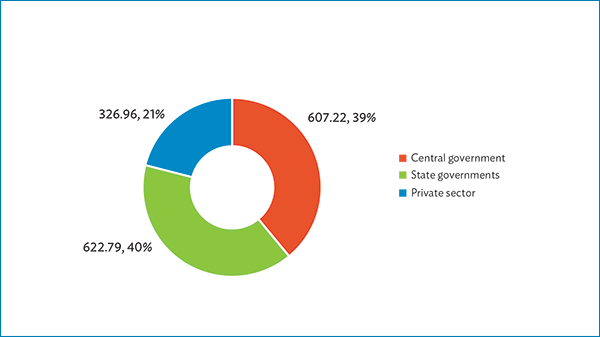
Source: Government of India, Ministry of Finance, Department of Economic Affairs. 2019. National Infrastructure Pipeline. Volume 1.
From a sector-focus perspective, the transport, energy and urban sectors have the highest proposed investment under the NIP, with 73% of the capital expenditure expected in these three sectors alone. A breakdown of the sector-wise expected investments till 2025 is presented in below figure.
Sector-wise Breakdown of Investments Proposed Under the National Infrastructure Pipeline, 2020–2025

Source: Government of India, Ministry of Finance, Department of Economic Affairs. 2019. National Infrastructure Pipeline. Volume 1.
Typical Contours of Infrastructure Financing
Equity sponsors play an important role in project development. Below table shows the most active project sponsors between July 2021 and August 2022 in India.
Name Total Project Financing ($ million) Total Project Financing (₹ billion) No. of Projects Adani Group 1,909.8 156.6 2 IRB Infrastructure Developers Ltd 220.6 18.1 2 Dilip Buildcon Limited 394.3 32.3 4 Zurich Airports 1,390.0 114.0 1 Ashoka Buildcon 182.6 15.0 1 Renew Power Limited 213.4 17.5 2 Mitsui 157.0 12.9 1 Torrent Group 73.4 6.0 1 KNR Construction 60.0 4.9 2 Enel SpA 50.0 4.1 1 Source: World Bank. Infrastructure Finance, PPPs and Guarantees. Custom Query (accessed 15 July 2023).
Credit Rating Agencies in India
There are six credit rating agencies in India.4 Credit rating agencies are regulated by the Securities and Exchange Board of India.
- CRISIL Limited. CRISIL Limited, formerly Credit Rating Information Services of India Limited, pioneered credit rating in India in 1987. CRISIL Ratings is a business division of CRISIL Limited, majority of which is owned by S&P Global Inc., a leading provider of transparent and independent ratings, benchmarks, analytics, and data to capital and commodity markets worldwide. CRISIL is a full-service rating agency. In the context of emerging options for infrastructure financing, CRISIL has developed specific criteria for rating Real Estate Investment Trusts and Infrastructure Investment Trusts. In consultation with the MOF and other stakeholders, CRISIL developed a new credit rating framework for operational infrastructure projects based on “expected loss methodology.” The ratings assigned under this framework are an opinion on the expected loss to be incurred over the life of the debt instrument and take into account not only the probability of default, but also post-default recoveries. In February 2017, CRISIL assigned the first infrastructure expected loss rating in India to Purulia and Kharagpur Transmission Co., an SPV owned by Sterlite Power Transmission.5
- ICRA Limited. ICRA Limited, formerly Investment Information and Credit Rating Agency of India Limited, is a public limited company set up in 1991 in Gurugram. Moody’s Investors Service, an international credit rating agency, is ICRA’s largest shareholder. ICRA is also a full-service rating agency, and its product portfolio includes rating for corporate debt, financial rating, structured finance, infrastructure, insurance, mutual funds, project and public finance, small and medium-sized enterprises, and market-linked debentures, among others.6
- CARE Ratings Limited. CARE Ratings Limited (or CareEdge Ratings) commenced operations in April 1993. It covers the full spectrum of credit rating, including manufacturing, infrastructure, financial sector and banks, and nonfinancial services, among others. The company has launched a new international credit rating agency called the ARC Ratings by teaming up with four partners from Brazil, Malaysia, Portugal, and South Africa. ARC Ratings has commenced operations and completed sovereign ratings of countries, including India.7
- India Ratings and Research Private Limited. India Ratings is a wholly owned subsidiary of the Fitch Group. It offers credit ratings for insurance companies, banks, corporate issuers, project finance, financial institutions, finance and leasing companies, managed funds, and urban local bodies.8
- Acuite Ratings & Research Limited. Established in 2005, Acuite is a joint initiative of the Small Industries Development Bank of India, Dun & Bradstreet India, and leading banks in India. It is also a full-service rating agency. Some of its products include bond ratings, commercial paper ratings, bank loan ratings, small and medium-sized enterprises ratings, and various grading services.9
- Infomerics Valuation and Rating Private Limited is a credit rating agency registered with the Securities and Exchange Board of India and accredited by the Reserve Bank of India. It was conceived and instituted by a team of professionals with experience in finance, banking, and administrative service.
- 4Securities and Exchange Board of India.Name and Registered Addresses of Credit Rating Agencies.
- 5CRISIL Ratings Limited.CRISIL Ratings.
- 6ICRA Limited.Our Profile.
- 7CARE Ratings Limited.About Us.
- 8India Ratings and Research.Overview.
- 9Acuite Ratings & Research.Credit Ratings.
Source: Asian Development Bank. 2019. Public–Private Partnership Monitor. Second Edition.