
Overview
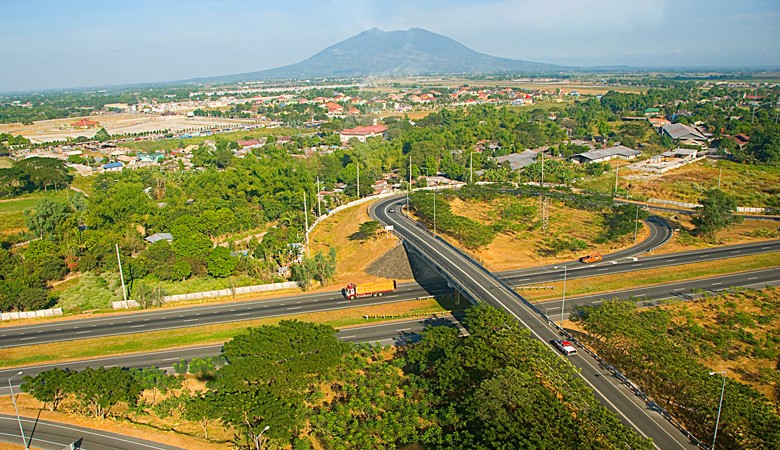
Number of PPPs and Investment in PPPs
-
PPP Investment
$ 45.39 B -
Number of PPPs Reaching FC
305 -
Value of PPPs Reaching FC
----
Revenue Model and Government Support to PPPs
-
Number of PPPs with Govt. Support
1 -
Number of User Charge PPPs
119 -
Number of Govt. Pay PPPs
140
PPPs under Preparation and Procurement
-
Number of PPPs under Preparation
85 -
Number of PPPs under Procurement
8
FC = financial close, Govt. = government, B = billion.
Sources: Public–Private Partnership Center. https://ppp.gov.ph/; World Bank. Infrastructure Finance, PPPs and Guarantees. Country Snapshots. Philippines. https://ppi.worldbank.org/en/snapshots/country/philippines (accessed 28 August 2020).
The Amended BOT Law and its IRR provided the primary enabling legal framework for PPPs in the Philippines in the 1990s. The enactment of the PPP Code on 5 December 2023 and the issuance of its IRR on 22 March 2024 significantly improved the enabling environment for PPPs in the country. The PPP Code repeals, among others, the Amended BOT Law and consolidates the legal frameworks for private sector participation in both national and local infrastructure and development projects, including joint venture arrangements and other contractual arrangements for toll road projects or toll facilities.
The PPP enabling framework in the Philippines now comprises the PPP Code, its IRR, and the guidelines issued by each of the Investment Coordination Committee (ICC) of the NEDA Board, the PPPGB, the PDMF Committee, the Development Budget Coordination Committee (DBCC), the COA, the regulatory boards, and the implementing agencies. On 25 April 2024, the NEDA Board approved the new NEDA Board–ICC Guidelines on the Review and Approval of PPP Proposals Requiring ICC and/or NEDA Board Approval pursuant to the PPP Code. The PPP Code and its IRR mandate the issuance of other guidelines to operationalize their provisions and to ensure efficient submission by implementing agencies.1
The PPP Code institutionalizes and strengthens the PPP Center and the PPPGB.
The powers and functions of the PPP Center include
- assisting implementing agencies in identifying, prioritizing, developing, and maintaining a pipeline of PPP projects;
- providing project advisory services and technical assistance to implementing agencies, approving bodies, and other oversight agencies in all PPP-related matters;
- reviewing PPP contracts for national PPP projects;
- providing regular monitoring and status reports on the implementation of the PPP program;
- developing the capacities of implementing agencies, approving bodies, PPP units, and other relevant government stakeholders on PPPs;
- serving as the central repository of all PPP project information;
- acting as procurement agent upon the request of the implementing agency;
- acting as secretariat to the PDMF Committee; and
- managing and administering the PDMF and now also the new PPP Risk Management Fund created under the PPP Code.
The PPP Center reports to the PPPGB and is attached to NEDA for policy and program coordination. The PPPGB is the overall policymaking body for all PPP-related matters, including the PDMF, and is responsible for setting the strategic direction of the PPP program and PPP projects and creating an enabling policy and institutional environment for PPPs.
As of August 2024, the NEDA Board has approved 186 IFPs with an indicative total project costs of ₱9,680.33 billion ($166.02 billion as of 28 October 2024) and were identified as PPP projects under physical connectivity (roads and bridges, rail, air, urban transport, maritime, and data management) and health for an indicative total project costs of ₱2,852.05 billion ($48.92 billion as of 28 October 2024).2
- 1Although there are still some guidelines that have yet to be issued, this does not in any way prevent PPPs from proceeding pursuant to the PPP Code and its IRR. The guidelines, once issued, are, as a general rule, applied prospectively.
- 2NEDA. 2024. Infrastructure Flagship Projects (accessed 27 October 2024)
-
National Framework for Enabling PPPs
PPP Legal and Regulatory Framework
Parameters
COMPAREDOWNLOADDoes the country have - National PPP law and PPP regulations? Public financial management laws and regulations? Sector-specific laws and regulations? Procurement laws and regulations? Environmental laws and regulations? Laws and regulations for social compliance? Laws and regulations governing land acquisition and ownership? Taxation laws and regulations? Employment laws and regulations? Licensing requirements? What are the other components of the PPP legal and regulatory framework? Other key supporting components (elaborated below) include NEDA Board-ICC Guidelines on the Review and Approval of PPP Proposals Requiring ICC and/or NEDA Board Approval pursuant to the PPP Code, 25 April 2024; and other guidelines to be issued pursuant to the PPP Code and its IRR.- Yes
LEARN MORENational Framework for Enabling PPPs
PPP Legal and Regulatory Framework
Evolution of the Public–Private Partnership Legal and Regulatory Framework in the Philippines
For more than 3 decades, the Amended BOT Law had been the enabling law for PPPs in the Philippines—until the PPP Code took effect in December 2023. Although there were no changes to the Amended BOT Law after it took effect in 1994, its IRR was revised four times—in 2008, 2012, March 2022, and September 2022. The table below presents the evolution of the legal and regulatory framework of PPPs in the Philippines across the various administrations.
Year Enactment/Issuance Description President Corazon Aquino 1987 Philippine Constitution Declared that the state recognizes the indispensable role of the private sector, encourages private enterprise and provides incentives to needed investments 1989 Administrative Order No. 105 Create the Coordinated Council on Philippines Assistance Program (CCPAP) to take the lead role in coordinating efforts to effectively mobilize international aid and to ensure its successful implementation 1990 Build–Operate– Transfer Law (Republic Act No. 6957) Authorized all government infrastructure agencies, including government-owned or controlled corporations (GOCCs) and LGUs to enter into contract with the private sector for the financing, construction, and operation and maintenance (O&M) of any financially viable infrastructure facility, but only through the build–operate–transfer (BOT) and build–transfer (BT) schemes, and on a solicited basis 1991 Local Government Code of 1991 (Republic Act No. 7160) Empowered LGUs to exercise powers for its efficient and effective governance and those essential to the promotion of general welfare; authorized LGUs to discharge functions and responsibilities necessary, appropriate, or incidental to the efficient and effective provision of basic services and facilities through joint ventures and other cooperative arrangements with the private sector, such as PPPs President Fidel Ramos 1993 Memorandum Order No. 166 Directed the CCPAP chair, with the assistance of the CCPAP Secretariat, to establish and operate a one-stop BOT Center, to be accessible to both the public and private sectors 1994 Administrative Order No. 109 Created the Presidential Committee on Flagship Programs and Projects to orchestrate the identification, prioritization, and implementation of flagship programs and projects—that is, highly strategic infrastructure programs and projects approved by the President and the Cabinet Republic Act No. 7718 Authorized private sector participation not only in infrastructure projects but also in development projects, to be implemented through the various BOT schemes described therein and other variations approved by the President of the Philippines; authorized unsolicited proposals and direct negotiation; designated the CCPAP as the agency responsible for the coordination and monitoring of projects implemented under the law IRR of the Amended BOT Law Implemented the provisions of the Amended BOT Law (Republic Act No. 6957, as amended by Republic Act No. 7718) President Joseph Estrada 1999 Administrative Order No. 67 Converted the CCPAP into the Coordinating Council for Private Sector Participation (CCPSP), which was tasked to coordinate and monitor the program of the government on private sector participation (PSP) in its infrastructure and other development activities, expanded the coverage of the BOT Program into other forms of PSP; formalized provision by the CCPSP of technical assistance support through technical assistance agreements with implementing agencies Administrative Order No. 69 Prescribed procedures for review by the Local Water Utilities Administration (LWUA) of BOT and similar proposals on water supply and water districts President Gloria Macapagal-Arroyo 2002 Executive Order No. 144 Converted the CCPSP into the BOT Center to undertake activities related to the development of BOT, and also PSP programs and projects, including projects with ODA under the BOT Law, and assisting in BOT/PSP project development by providing technical assistance to national implementing agencies, including GOCCs and LGUs; empowered the BOT Center to establish, manage, and administer the Project Development Facility (PDF), a revolving fund technical assistance fund for the preparation of feasibility studies and bid documents 2008 Revised IRR of the Amended BOT Law Revised the original IRR of the Amended BOT Law President Benigno Simeon Aquino III 2010 Executive Order No. 8 Issued to fast-track the implementation of PPP programs and projects, as a cornerstone strategy of the national development plan to accelerate the infrastructure development of the country and sustain economic growth
Renamed the BOT Center as the PPP Center, tasked to conduct project facilitation and assistance to national government agencies (NGAs) and LGUs; provide advisory services, technical assistance, trainings, and capacity development in PPP project preparation and development; monitor and facilitate the implementation of their priority PPP programs and projects; manage and administer the Project Development and Monitoring Facility (PDMF) (formerly the PDF) for the preparation of business cases, pre-feasibility and feasibility studies, and tender documents of PPP programs and projects; and establish and manage a central database system of PPP programs and projects
2012 Revised IRR of the Amended BOT Law Further revised the revised IRR of the Amended BOT Law 2013 Executive Order No. 136 Amended Executive Order No. 8 to create the PPP Governing Board (PPPGB), to be headed by the secretary of socioeconomic planning as chair, as the overall policymaking body for all PPP-related matters, including the PDMF; tasked the PPPGB to set the strategic direction of the PPP Program and create an enabling policy and institutional environment for PPP; created the PDMF Committee to approve applications to avail of the PDMF and to formulate, prescribe, and recommend policies, procedures, and guidelines for the use of the PDMF for the development of PPP projects and recovery of costs charged to the fund President Rodrigo Duterte 2022 Revised IRR of the Amended BOT Law (March 2022) Further revised the revised IRR of the Amended BOT Law to clarify ambiguous provisions President Ferdinand Marcos, Jr 2022 Revised IRR of the Amended BOT Law (September 2022) Further revised the IRR of the Amended BOT Law to clarify and streamline the timelines, conform provisions to best practices, and address stakeholder concerns on the financial viability and bankability of PPP projects and potential delays owing to extra steps, rigid processes, or ambiguous provisions 2023 Executive Order No. 30 Added a private sector representative to the PPPGB members, coming from a reputable organization in the banking, business, or infrastructure sector, to be appointed by the President PPP Code of the Philippines (Republic Act No. 11966) Enacted to provide an enabling environment for the private sector to mobilize its resources to finance, design, construct, operate, and maintain infrastructure or development projects and services 2024 IRR of the PPP Code Implemented the provisions of the PPP Code BOT = build–operate–transfer, BT = build–transfer, CCPAP = Coordinating Council on the Philippine Assistance Program, CCPSP = Coordinating Council for Private Sector Participation, GOCC = government-owned or controlled corporation, IRR = Implementing Rules and Regulations, LGU = local government unit, LWUA = Local Water Utilities Administration, NGA = national government agency, O&M = operation and maintenance, PDF = Project Development Facility, PDMF = Project Development and Monitoring Facility, PPPGB = PPP Governing Board, PPP = public–private partnership, PSP = private sector participation.
Although the Amended BOT Law and its revised IRR comprised the enabling framework for PPPs in the Philippines through the years, other laws and regulations enabled cooperation between the private sector and public entities to deliver infrastructure and public service. The table below sets these out.
Laws and Regulations Enabling Private Sector Participation in the Philippines
Date Law/Regulation Private Sector Participation Enabled 19 June 1971 Republic Act No. 6234, as amended: MWSS Charter Reorganization of Metropolitan Waterworks and Sewerage System (MWSS), including privatization of its operations to address the looming water crisis, by authority of the President 31 March 1977 Presidential Decree No. 1112: Toll Operation Decreea Toll road projects through toll operation agreements and supplemental toll operation agreements (STOAs) entered into with the Toll Regulatory Board (TRB) 9 July 1990, amended 5 May 1994 Republic Act No. 6957, as amended by Republic Act No. 7718: Amended BOT Law; and its revised IRRb BOT contracts for the design, financing, construction, and O&M of infrastructure or development projects by the private sector 10 October 1991 Republic Act No. 7160, as amended: Local Government Code of 1991 Contracts for basic services and facilities of LGUs, including joint venture agreements 5 April 1993 Republic Act No. 7648: Electric Power Crisis Actc Negotiated contracts entered into by the President of the Philippines for the construction, repair, rehabilitation, improvement, or maintenance of power plants, projects, and facilities to address the electric power crisis 7 June 1995 Republic Act No. 8041: National Water Crisis Act of 1995; Executive Order No. 286 dated 6 December 1995 and Executive Order No. 311 dated 20 March 1996c Reorganization of MWSS, including privatization of its operations to address the looming water crisis, by authority of the President of the Philippines 30 April 2005 Executive Order No. 423, Series of 2005 Authorized NEDA to issue the guidelines for joint ventures between the public and private sectors 2013, 2023 Revised Guidelines and Procedures for Joint Venture Agreements Between Government and Private Entities pursuant to Executive Order No. 423 (NEDA Joint Venture Guidelines)b Joint ventures between the public and private sectors, except LGUs and government corporate entities in the exercise of their primary mandate to dispose of government assets and properties (revised in 2023) Joint Venture Guidelines of GOCCsb Joint venture projects of concerned GOCCs Local PPP Codesb PPPs (including joint ventures) of LGUs BOT = build–operate–transfer, GOCC = government-owned or controlled corporation, IRR = Implementing Rules and Regulations, LGUs = local government unit, MWSS = Metropolitan Waterworks and Sewerage System, NEDA = National Economic and Development Authority, O&M = operation and maintenance, STOA = supplemental toll operation agreement, TRB = Toll Regulatory Board.
Among the notable PPP contracts entered into pursuant to the above laws are (i) the concession agreements of MWSS for its east and west zones, which were executed pursuant to the Water Crisis Act (Republic Act No. 8041) and its charter (Republic Act No. 6234, as amended); and (ii) the STOAs for the North Luzon Expressway (NLEX) and the South Luzon Expressway (SLEX), which the TRB executed pursuant to the Toll Operation Decree (Presidential Decree No. 1112).
The Public–Private Partnership Code of the Philippines
Republic Act No. 11966, otherwise known as the Public–Private Partnership (PPP) Code of the Philippines, was signed into law on 5 December 2023 and came into effect on 23 December 2023. Its IRR was issued on 21 March 2024. The PPP Code governs national and local PPP contracts and repeals, among others, the Amended BOT Law, the provision of the Toll Operation Decree (Presidential Decree No. 1112) granting the TRB the authority to enter into toll operation agreements, the joint venture guidelines issued by NEDA and GOCCs, and the local PPP codes. It consolidated the legal frameworks for private sector participation in both national and local infrastructure and development projects, including joint venture arrangements and other contractual arrangements for toll road projects or toll facilities.
The PPP Code effected the following major reforms to achieve three main objectives: address ambiguities in the existing law, respond to key challenges affecting the implementation of PPP projects, and foster a more competitive and enabling environment for PPPs.
Major Reforms Under the Public–Private Partnership Code of the Philippines
Major Reforms Details Improve and consolidate the legal frameworks for PPPs in the Philippines - Consolidates the PPP frameworks embodied in the BOT Law, the NEDA joint venture guidelines, local PPP/joint venture ordinances and codes, guidelines issued by agencies with special charters, and the STOAs entered into by the TRB in relation to NLEX, SLEX, and the Metro Manila Expressway
- Clarifies tariff regulation to remove uncertainty and make it predictable, prevent conflict of interest, and protect public interest, by requiring all regulatory approvals to be made prior to the approval of the PPP project, with the private partner having the right to file the application for tariff and its adjustments during project implementation
- Clarifies the rules on the following:
- Allowable investment recovery mechanisms— that availability payments are not considered government undertakings, subsidy, or government contribution (see section Types of Public–Private Partnership for details)
- When failure of bidding should be declared
- Instances when the implementing agency may consider, on a negotiated basis, a single complying and responsive bid
- When the variation, expansion, or extension of an existing PPP project is subject to the prior approval of the approving body (see paragraph Adjustment and revision to the PPP contract for details)
- Divestment of ownership, rights, or interests in a PPP project by the private partner or the implementing agency (see paragraph Lock-in condition for details)
- Wind-up and transfer measures (see paragraph Wind-up and transfer measures for details)
Address key challenges of implementing PPP projects - Provided for new approval thresholds for national PPP projects by the appropriate approving bodies
- Removes approval thresholds for local PPP projects based on project cost but requires regional development council (RDC) endorsement for local PPP projects with proposed government undertakings or availability payments using national government funds (for which ICC approval is required in this case) and/or those that affect national or sectoral development plans, prior to confirmation by the local development council (LDC) and approval by the local approving body
- Lengthens approval timeline of approving bodies to a maximum of 120 calendar days from receipt of complete requirements from the implementing agency but clarifies that failure to act on the part of the approving body within such period shall be deemed an approval and the implementing agency may proceed with the procurement of the PPP project
Institutionalize and strengthen the PPP Center, the PPPGB, and the PDMF - Further empowers the PPP Center for more efficient and effective performance of its mandate and gives it powers and functions involving the provision of assistance and capacity building to national and local implementing agencies, program and project monitoring, policy formulation and recommendation, and promotion of the PPP program
- Mandates the PPPGB as the overall policymaking body for all PPP-related matters, including the PDMF, and responsible for setting the strategic direction of the PPP program and PPP projects and creating an enabling policy and institutional environment for PPPs
- Institutionalizes the PDMF, which the PPP Center continues to manage and administer as a revolving fund, to be used for the procurement of advisory and support services related to the preparation, structuring, evaluation, procurement, probity management, financial close, and monitoring of implementation of PPP projects (see section Project Development Funding for details)
Provide a more competitive environment for USPs - Allows USPs for projects included in the list of PPP projects of implementing agencies, subject to reimbursement by the private proponent of the implementing agency’s documented development costs for a project incurred over the past 3 years, subject to a cap
- Clarifies prohibited government undertakings for USPs
- Gives implementing agencies the right to consider multiple USP submissions (subject to their determination of the most advantageous proposal for the government and the public)
- Grant of original proponent status (OPS) is only after completion of negotiation, with the OPS valid for 1 year
- Lengthens the period to conduct the comparative challenge (which the implementing agency has the right to propose, for the approving body’s approval) from the previous 60 working days to 1 year, provided it is not less than 90 calendar days
- Shortens the period for the original proponent to match the superior proposal submitted by a challenger from the previous 30 working days to 30 calendar days (See section Unsolicited Public–Private Partnership Proposals for details)
Foster an enabling environment for PPPs by institutionalizing PPP best practices - Equitable risk allocation, value for money (VFM), and sustainability—requires the approving body to assess all PPP projects based on its overall feasibility and VFM, and in accordance with the principle of protecting public interest by providing affordable, accessible, and efficient public services, and to adhere to the principles stipulated under the Generic Preferred Risk Allocation Matrix (GPRAM) and that deviations therefrom must be justified by the implementing agency and approved by the approving body (see Table and section Risk Allocation for details)
- Parameters, terms, and conditions (PTCs)—requires the approving body to evaluate and render its decision on the PPP project, and set forth the required PTCs, considering the nature and complexity of the PPP project, which will be the basis for the drafting and approval of tender documents and the PPP contract (see section Review and Approval of the Project for details)
- Dispute avoidance and alternative dispute resolution (ADR) mechanisms— requires all PPP contracts to include provisions on the use of dispute avoidance and ADR mechanisms based on the Alternative Dispute Resolution Act of 2004 (see section Dispute Resolution for details)
- Contract management and risk mitigation —requires PPP projects to adopt contract management and risk mitigation plans, which include the agreed project execution plan, all risks assumed by the government under the contract, risks assumed by the implementing agency, risk-mitigating measures, estimated costs to be incurred, a target timeline to have each measure in place, and the appropriate action plan by the implementing agency to manage each type of risk
- Mitigation of interconnectivity and interface risks—requires PPP projects that will interconnect or interface with a local or national facility to submit to the PPP Center and the ICC, in the case of national PPP projects, or to the appropriate approving body, in the case of local PPP projects, a memorandum of agreement containing an interconnection/interface plan agreed upon by all relevant parties
- Creation of a PPP Risk Management Fund and management of contingent liabilities—created a PPP Risk Management Fund to be managed by the PPP Center, to be used for the payment of contingent liabilities arising from PPPs in accordance with their contract terms, which will be funded by general appropriations, income from existing PPP projects, and other sources as may be determined by the DBCC (see section PPP Risk Management Fund for details)
- Establishment of a PPP unit—authorizes the head of the implementing agency to establish a PPP unit or assign responsibility to an appropriate unit to act as its PPP unit, which will plan, oversee, and monitor PPP projects of the implementing agency
- Public disclosure of tender documents and PPP contracts—requires the implementing agency and the PPP Center to publish, through their respective websites, copies of all tender documents and PPP contracts executed under the PPP Code
- Procurement of independent consultants—institutionalizes the procurement of independent consultants to provide independent advice to both parties during the design and construction, as well as O&M, phases of the PPP project
- Alternative sources of funding—allows alternative financial instruments for PPP projects, such as green financing, corporate or project bonds and securities, and other forms of capital market financing
- Land value capture strategies—requires PPP project design to consider adopting land value capture strategies to optimize financial and economic value of the PPP project
ADR = alternative dispute resolution, BOT = build–operate–transfer, DBCC = Development Budget Coordination Committee, ICC = Investment Coordination Committee of the NEDA Board, LDC = local development council, NEDA = National Economic and Development Authority, NLEX = North Luzon Expressway, O&M = operation and maintenance, OPS = original proponent status, PDMF = Project Development Monitoring Facility, PPP = public–private partnership, PPPGB = PPP Governing Board, PTC = parameters, terms, and conditions, RDC = regional development council, STOA = supplemental toll operation agreement, SLEX = South Luzon Expressway, USP = unsolicited proposal, TRB = Toll Regulatory Board, VFM = value for money. Sources: Government of the Philippines. 2023. Public–Private Partnership Code of the Philippines; 2024. Implementing Rules and Regulations of the PPP Code.
The PPP Code has addressed most of the bankability issues that have discouraged bidders in past PPPs in the Philippines. However, there remain a few issues that need to be addressed.
Outstanding Bankability Issues in the Public–Private Partnership Legal and Regulatory Framework
Issue Status Quo International Best Practice USPs The original proponent has the right to match the superior proposal of a challenger within 30 calendar days The right to match in USPs is discouraged. Lenders’ direct agreement The implementing agency only allows an acknowledgment and consent agreement (in prescribed form annexed to the PPP contract) to be signed among the implementing agency, the concessionaire, and the lender’s agent, wherein the implementing agency acknowledges the assignment by the concessionaire of its rights under the PPP contract and the creation of permitted security interest. Allow lenders’ direct agreements for PPPs. International arbitration While it is mandatory for all PPP contracts to include provisions on ADR mechanisms, such as international arbitration, and the parties are given complete freedom to choose which ADR mechanisms are to be followed, this is subject to applicable laws, rules, and regulations. Philippine law requires that arbitration of constructionrelated disputes in the Philippines be referred to the Construction Industry Arbitration Commission (CIAC), with the legal seat to be the Philippines and the venue to be in Metropolitan Manila. Allow international arbitration for all types of disputes in PPPs. Government payment and fiscal commitment and contingent liabilities (FCCL) framework Government payment to the private partner under the PPP contract for contingent liabilities remains a significant issue given the rule that government is obligated to pay only pursuant to an appropriation law, and there is still no clear framework on managing FCCL in PPPs. As per the PPP Code, the PPP Center, in coordination with the Inter-Agency Technical Working Group, has been tasked to formulate guidelines on the management of contingent liabilities arising from PPP projects and use of the PPP Risk Management Fund for approval by the DBCC. Incorporate FCCL principles based on best practices in the PPP framework. ADR = alternative dispute resolution, DBCC = Development Budget Coordination Committee, CIAC = Construction Industry Arbitration Commission, FCCL = fiscal commitment and contingent liabilities, PPP = public–private partnership, USP = unsolicited proposal.
Sources: Government of the Philippines. 1985. Executive Order No. 1008; 2023. Public–Private Partnership Code of the Philippines.
Public–Private Partnership Regulatory Framework in the Philippines
The existing legal and regulatory framework governing PPPs in the Philippines currently includes
- the PPP Code of the Philippines and its IRR and
- other guidelines issued pursuant to the PPP Code and its IRR, as listed in the table below.
The PPP Code and its IRR mandate the issuance of guidelines and requirements to operationalize their provisions, as set out in the table below. Although some of these guidelines have yet to be issued, the PPP Code does not impose any strict deadline for their issuance. The absence of these guidelines also does not prevent any PPP contract being developed, tendered, and signed pursuant to the PPP Code and its IRR.
Guidelines and Requirements to Be Issued Pursuant to the Public–Private Partnership Code and Its Implementing Rules and Regulations
Issuing Agency Guidelines to Be Issued NEDA Board - Supplemental guidelines to ensure efficient submission and publication of Consolidated List of Investment Programs (CLIPs), in coordination with the PPP Center
NEDA BoardInvestment Coordination Committee (ICC) - Detailed guidelines on the process and procedures for the review and approval of national PPP projects, including the forms and templates to be used by the implementing agency and the approving body, which shall clearly define the timelines for approval (not to exceed 120 calendar days from receipt of complete requirements), actions required from entities involved, and the list of complete set of documentary requirements, which shall also cover:
- review and approval of proposed changes for approved PTCs prior to bid submissiona
- in case of USPs, guidelines on cases where the approving body requires PTCs outside of the negotiated PTCsa
- in case of a single complying and responsive solicited bid, the reasonable rate of return (RROR), detailed process in approving the RROR, and the methodology in calculating the RROR to be seta
- review and approval of proposed variation, expansion, or extension of an existing PPP project requiring the approval of the approving bodya
- procedure on cases where the approving body failed to render its decision within the 120 calendar day mandatory perioda
- further specifying the requirements on the scope and detail of the feasibility study in accordance with prudent industry practicea
- completeness of submitted requirements for purposes of approval, list of documentary requirements, guidance on what constitutes government undertakings, and procedures and mechanisms to facilitate, simplify, and expedite the approval process for projects under the fasttrack (green lane) process, such as the creation of a subcommittee to which the review of projects under the green lane can be delegateda
- Procedural guidelines for stakeholder consultations for national PPP projects, which shall contain the target stakeholders, which may include, among others, facility users, landowners, informal settlers, businesses or existing operators, and project-affected persons
- Procedural guidelines for national PPP projects on the contents, process of submission, and further operationalization of the PPP Code IRR provision on mitigation of interconnectivity and interface risks
- Detailed guidelines on the methodology to establish the legal, technical, and financial qualifications of private proponents for national PPP projectsb
- Guidelines on validation of the determination by the implementing agency that its project does not fall under any of the scenarios contemplated under the PPP Code IRR requiring ICC approval of the PPP project
- Guidelines or protocols in reviewing and updating the project cost threshold amounts
- Guidelines on cases where the implementing agency intends to procure an approved PPP project through a different procurement modalitya
- Guidelines on the conduct of valuation for national PPP projects
PPP Governing Board (PPPGB) - Detailed guidelines, forms, and templates that the appropriate body shall use in reviewing and approving local PPP projects, which shall adhere to the same principles guiding the ICC in developing guidelines, forms, and templates in processing national PPP projects, specifying the requirements on the scope and detail of the feasibility study in accordance with prudent industry practicec
- Procedural guidelines for stakeholder consultations for local PPP projects, which shall contain the target stakeholders, which may include, among others, facility users, landowners, informal settlers, businesses or existing operators, and project-affected persons
- Procedural guidelines for local PPP projects on the contents, process of submission, and further operationalization of the PPP Code IRR provision on mitigation of interconnectivity and interface risks
- Guidelines on land value capture strategies
- Guidelines and requirements to be followed by all LDCs when endorsing local PPP projectsc
- Guidelines and requirements to be followed by all RDCs when endorsing local PPP projects affecting national or sectoral development plans and national projects or involving government undertakings and/or availability paymentsc
- Supplemental guidelines on the operationalization of the reimbursement of development costs of the government in USPs
- Guidelines on fees the PPP Center may collect from private proponents submitting USPs
- Guidelines to operationalize the PPP Code IRR provision that no USP submitted by a certain private proponent subsequently determined by the PPP Center to be incomplete three times on separate occasions may be entertained for determination of completeness by the approving bodyd
- Detailed guidelines on the methodology to establish the legal, technical, and financial qualifications of private proponents for local PPP projects
- Guidelines on reimbursement of appeal fees for appeals that are found meritorious
- Guidelines on the requirements and procedures governing cases where the PPP Center is requested by the implementing agency to act as the procurement agent, and where the PPP Center acts as such accordingly
- Guidelines on the procurement of and fees to be paid to a transaction advisor
- Guidelines on RROR trust accounts
- Guidelines on the amount of termination payments and related reportorial requirements
- Guidelines for the PDMF use and recovery of costs charged to the fund, including reporting mechanism on the use of the fund, as recommended by the PDMF Committee
- Guidelines on the establishment of a PPP Risk Management Fund by local implementing agencies
- Guidelines and policy matter opinions on other punishable acts or omissions not enumerated in the PPP Code and its IRR
PPP Center - Guidelines, forms, and templates for the preparation of the lists of PPP projects of implementing agencies
- Supplemental guidelines to ensure efficient submission of the list of PPP projects of implementing agencies, in coordination with oversight agencies
- Detailed guidelines on the procedures for submitting USPs, including a list of requirements to determine completeness of the submitted USP, the descriptions for each requirement, and the use of a digital platform to facilitate efficient processinge
Implementing agency - If the approving body is head of the implementing agency, guidelines for approval that outline the process of its review and approval of national PPP projects with a project cost of below ₱15 billion, to be submitted to the PPP Center within 7 calendar days from approval by the head of the implementing agency
- Guidelines on the provision of medical assistance to government employees and officials processing PPP projects, the Prequalification, Bids, and Awards Committee (PBAC) members, and other public officials providing services to the PBAC (Section 170 of PPP Code IRR)
Commission on Audit (COA) - Necessary framework and guidelines on accounting and auditing PPP projects (in consultation and coordination with the PPP Center)
Development Budget Coordination Committee (DBCC) - Guidelines on the nature and authorization of the PPP Risk Management Fund; mechanisms on the management of contingent liabilities arising from PPP projects; determination of amount, timing, and process for the payment of contribution to be made by the implementing agency for each project; process for the application of implementing agency for fund support; process and criteria for evaluation and approval by the DBCC of fund support applications; process for disbursement of funds (subject to applicable legal requirements); protocols for reporting project risks and contingent liabilities; the status of contribution of implementing agencies; applications for fund support; and disbursements made (to be formulated by the PPP Center in coordination with the Inter-Agency Technical Working Group on Contingent Liabilities created under DBCC Resolution No. 2015-2)
Regulatory bodies - Within 180 calendar days from effectivity of the IRR (in coordination with the PPP Center), issuance of a policy document, detailing the guidelines, frameworks, or mechanisms for the consultation, application, review, and approval of the initial tariff and adjustments, which shall include:
- procedures in securing regulatory approvals of the initial tariff and its adjustments, for solicited projects and USPs
- procedures for publication of, hearing for, and decision and order on the proposed initial tariff, and its adjustments
- factors in setting and adjusting the tariff, which may include a parametric formula
- appeal process for decisions of the regulatory bodies
- aThe NEDA Board issued these guidelines in April 2024 under ICC Guidelines on the Review and Approval of Public–Private Partnership Proposals Requiring ICC and/or NEDA Board Approval (ICC PPP Approval Guidelines).
- bThese guidelines are in Annex 10 to the ICC PPP Approval Guidelines but cover only unsolicited proposals.
- cThe PPPGB issued interim guidelines for the approval of local PPP projects under PPPGB Resolution No. 2024-04-02, pending issuance of the detailed guidelines after stakeholder consultation. In July 2024, it issued Resolution No. 2024-07-02, containing the final guidelines for the approval of local PPP projects, as well as the prescribed forms and templates, which were made available to the public in September 2024.
- dThe PPPGB issued these guidelines under PPPGB Resolution No. 2024-07-03.
- eThe PPP Center issued the Procedures for the Submission of Unsolicited Proposals to the PPP Center for Determination of Completeness and Appropriate Approving Body on 6 April 2024.
COA = Commission on Audit, CLIPs = Consolidated List of Investment Programs, DBCC = Development Budget Coordination Committee, ICC = NEDA Board-Investment Coordination Committee, IRR = Implementing Rules and Regulations, LDC = local development council, NEDA = National Economic and Development Authority, PBAC = PPP Prequalification, Bids, and Awards Committee, PDMF = Project Development Monitoring Facility, PPP = public–private partnership, PPPGB = PPP Governing Board, PTCs = parameters, terms and conditions, RDC = regional development council, RROR = reasonable rate of return, USP = unsolicited proposal.
Sources: Government of the Philippines. 2023. Public–Private Partnership Code of the Philippines; 2024. Implementing Rules and Regulations of the PPP Code.
ICC = Investment Coordination Committee, IRR = Implementing Rules and Regulations, NEDA = National Economic and Development Authority, PPP = public–private partnership.
National Framework for Enabling PPPs
Types of PPPs
COMPAREDOWNLOADService Contracts
Management Contracts
Affermage or Lease Contracts
Design-Bid-Build (DBB)
Design-Build (DB)
Build-Operate-Transfer (BOT)
Design-Build-Finance-Operate-Transfer (DBFOT)
Build-Own-Operate (BOO)
Concessions
Joint Venture
Hybrid Contracts
Others
- Lease Contracts
LEARN MORENational Framework for Enabling PPPs
Types of PPPs
The PPP Code IRR defines “PPP” as “a contractual arrangement between an implementing agency and a private partner to finance, design, construct, operate, and maintain, or any combination or variation thereof, infrastructure or development projects and services which are typically provided by the public sector, where each party shares in the associated risks, and where the investment recovery of the private partner is linked to performance.” The PPP Code and its IRR cover all contractual arrangements that satisfy this definition of a PPP, including but not limited to the following:
- joint ventures;
- toll operation agreements or STOAs, or any contractual arrangement involving the construction, operation, and maintenance, or their combination or variation, of toll facilities in accordance with Presidential Decree No. 1112 (Toll Operation Decree) and Presidential Decree No. 1113, as amended by Presidential Decree No. 1894 (Philippine National Construction Corporation Franchise);
- those providing for the rehabilitation, operation and/or maintenance, including the provision of working capital and/or improvements to, by the private partner of an existing land or facility owned by the government for a fixed period of time covering more than one (1) year;
- those when such lease is a component of a PPP project.
- BOT and its variants, as provided by the former Amended BOT Law and detailed in the table below; and
- O&M.
The Amended BOT Law provided for nine specific types of PPP contractual arrangements or schemes the public sector and private sector could enter into to implement an infrastructure or development project. Other than these nine schemes, variations approved by the President of the Philippines may likewise be undertaken under the Amended BOT Law.
Build–Operate–Transfer Contractual Arrangements Under the Amended BOT Law
Contractual Arrangement Definition Role of Private Partner Role of Implementing Agency Build– operate– transfer A contractual arrangement whereby the private partner undertakes the construction, including financing, of a given infrastructure facility and its O&M. The private partner operates the facility over a fixed term during which it is allowed to charge facility users appropriate tolls, fees, rentals, and charges not exceeding those proposed in its bid or as negotiated and incorporated in the contract to enable the private partner to recover its investment, and O&M expenses in the project. The private partner transfers the facility to the government agency or local government unit concerned at the end of the fixed term, which shall not exceed 50 years. This arrangement includes a supply-andoperate situation, which is a contractual arrangement whereby the supplier of equipment and machinery for a given infrastructure facility, if the interest of the government so requires, operates the facility providing in the process technology transfer and training to Filipino nationals. - Undertakes financing, construction, O&M of facility for a fixed term
- Collects tolls, fees, and other charges to recover investment plus profit
- Transfers ownership of facility after contract term to government entity
- May assign O&M to a facility operator
- Provides concession and regulates activities of BOT contractor
- Acquires ownership of facility at the end of contract term
- May opt to share in the profits of the private partner
Build– transfer A contractual arrangement whereby the private partner undertakes the financing and construction of a given infrastructure or development facility and after its completion turns it over to the implementing agency concerned, which shall pay the proponent on an agreed schedule its total investments expended on the project, plus a reasonable rate of return thereon. This arrangement may be employed in the construction of any infrastructure or development project, including critical facilities that, for security or strategic reasons, must be operated directly by the government. - Finances and constructs infrastructure or development facility
- Turns over ownership of facility to government after project completion
- Acquires ownership of facility after construction
- Compensates project proponent at agreed amortization schedule
Build–own–operate A contractual arrangement whereby a private partner is authorized to finance, construct, own, operate, and maintain an infrastructure or development facility from which the private partner is allowed to recover its total investment and O&M costs plus a reasonable return thereon by collecting tolls, fees, rentals, or other charges from facility users. - Finances, constructs, owns, operates, and maintains facility in perpetuity
- Collects tolls, fees, rentals, and other charges to recover investments and profits
- May assign O&M to a facility operator
- Provides authorization and assistance in securing approval of BOO contract
- Can opt to buy the output/service provided by the BOO operator
Build–lease– transfer A contractual arrangement whereby a private partner is authorized to finance and construct an infrastructure or development facility and upon its completion turns it over to the implementing agency concerned on a lease arrangement for a fixed period after which ownership of the facility is automatically transferred to the implementing agency concerned. - Finances and constructs facility
- Turns over project to government after completion under lease arrangement
- Turns over ownership of facility to government after lease period
- Compensates proponent for lease of facility at agreed term and schedule
- Acquires ownership of facility after lease period
Build– transfer– operate A contractual arrangement whereby the public sector contracts out the building of an infrastructure facility to a private entity such that the contractor builds the facility on a turnkey basis, assuming cost overrun, delay, and specified performance risks. Once the facility is commissioned satisfactorily, title is transferred to the implementing agency. The private entity, however, operates the facility on behalf of the implementing agency under an agreement. - Finances and constructs facility on a turnkey basis (assumes cost overrun, delay, specified performance risks)
- Transfers title of facility to implementing agency after commissioning
- Operates the facility for implementing agency under an agreement
- May assign O&M to a facility operator
- Assumes ownership of facility after commissioning
- Allows private proponent to receive compensation for the proponent’s investment costs and reasonable return thereon, and the operating charges
Contract– add–operate A contractual arrangement whereby the implementing agency adds to an existing infrastructure facility that it is renting from the government. It operates the expanded project over an agreed franchise period. There may or may not be a transfer arrangement with regard to the facility. - Adds to an existing facility that the private partner is renting and operates an expanded project for an agreed franchise period
- May assign O&M to a facility operator
- Collects rental payment from private partner under agreed terms and schedule
- Re-acquires control over rented property/ facility at the end of lease term, normally including improvements thereon
Develop– operate– transfer A contractual arrangement whereby favorable conditions external to a new infrastructure project that is to be built by a private project proponent are integrated into the arrangement by giving that entity the right to develop adjoining property and, thus, to enjoy some of the benefits the investment creates, such as higher property or rent values. Has the right to develop adjoining property of an infrastructure to enjoy external benefits that the primary investment creates (such as higher property values or commercial development rights) May assign O&M to a facility operator May opt to share in the financial benefits of the investment
Re-acquires ownership of properties turned over to investor after concession period
Rehabilitate– operate– transfer (ROT) A contractual arrangement whereby an existing facility is turned over to the private sector to refurbish, operate, and maintain for a franchise period, at the expiry of which the legal title to the facility is turned over to the government. The term is also used to describe the purchase of an existing facility from abroad, importing, refurbishing, erecting, and consuming it within the host country. Takes over O&M of an existing facility for a franchise period and/or imports existing facility for refurbishing, erecting, and maintaining it within the host country
Transfers ownership of a facility or equipment to government after franchise period
May assign O&M to a facility operator
Provides franchise to ROT company
May opt to share in the profits of the ROT company
Re-acquires ownership of facility equipment after franchise period
Rehabilitate– own–operate (ROO) A contractual arrangement whereby an existing facility is turned over to the private sector to refurbish and operate with no time limitation imposed on ownership. As long as the operator is not in violation of its franchise, it can continue to operate the facility in perpetuity Takes over an existing facility to refurbish and operate with no time limitation imposed on ownership
Can continue to operate the facility in perpetuity
May assign O&M to a facility operator
Turns over existing facility to ROO proponent, with franchise to operate
May opt to share in the income of ROO company
O&M = operation and maintenance, ROO = rehabilitate-own-operate, ROT = rehabilitate–operate–transfer.
Note: The term “project proponent” in the Amended BOT Law has been replaced with “private partner” to be consistent with the term used in the PPP Code.
Source: Government of the Philippines. 2022. The Philippine Amended BOT Law.
The above enumeration of contractual arrangements is not exhaustive. Other forms of contractual arrangements may now qualify as a PPP under the PPP Code, provided that such arrangements satisfy the elements of a PPP as defined in the IRR of the PPP Code or are as may be approved by the appropriate approving body.
Contractual Arrangements of Successfully Procured Projects
Project Sector Contractual Arrangement Manila Metro Rail Transit Line 3 (1993) Railways Solicited build–lease–transfer Ninoy Aquino International Airport Expressway Project (2013) Roads Solicited build–transfer–operate variant Automatic Fare Collection System Project (2014) Railways Solicited mixed Mactan–Cebu International Airport Passenger Terminal Building Project (2014) Airports Solicited build–operate–transfer Light Rail Transit Line 1 Cavite Extension Operation and Maintenance Project (2014) Railways Solicited build–transfer–operate Bulacan Bulk Water Supply Project (2016) Water Solicited build–operate–transfer Cavite–Laguna Expressway Project (2015) Roads Solicited build–transfer–operate North Luzon Expressway–South Luzon Expressway Connector Road Project (2016) Roads Unsolicited build–operate–transfer Clark International Airport Expansion Project— Engineering, Procurement and Construction Project (2018) Airports Solicited build–transfer Clark International Airport Expansion Project— Operation and Maintenance Project (2019) Airports Solicited build–operate–transfer New Manila International Airport (Bulacan International Airport) Project (2019) Airports Unsolicited build–operate–transfer Civil Registry System—Information Technology Project Phase II Project (2016) Information and communication technology Solicited Build–Transfer–Operate PPP for School Infrastructure Project I Project (2012) Education Solicited build–lease–transfer PPP for School Infrastructure Project II Project (2014) Education Solicited build–transfer Ninoy Aquino International Airport PPP Project (2024) Airports Solicited rehabilitate-operate-expand-transfer PPP = public–private partnership.
Source: PPP Center. Projects Database (accessed 27 October 2024).
The type of PPP is also based on the investment recovery scheme used for the project. In undertaking PPP projects in the Philippines, the private partner is allowed by the PPP Code to recover its investments and earn reasonable profit through any of the following investment recovery schemes or a combination of them. These two forms are distinguished from each other based on the rights, obligations, and risks assumed by the public and private parties in the PPP.
- Revenue-based PPP. In a revenue-based investment recovery scheme, the private partner is authorized to charge and collect, in whole or in part, from the users, reasonable tolls, fares, fees, rentals, and other charges, subject to appropriate regulation. Where applicable, the private partner may likewise be repaid in the form of a share in the revenue of the PPP project. This is also referred to as a concession-based PPP.
- Availability-based PPP. In an availability-based investment recovery scheme, the implementing agency commits to make predetermined payments to the private partner, which do not take the form of charges paid by the users of the works or of the service, but of regular payments, known as “availability payments,” by the implementing agency in exchange for delivering an asset or service in accordance with the PPP contract. Availability payments are not considered government undertakings, subsidies, or government contributions.
Other allowable investment recovery schemes that may supplement the above schemes are commercial development rights and the granting of a portion or percentage of a reclaimed land, subject to fair valuation and the constitutional requirements on landownership. The granting of commercial development rights is a standard provision supplementing the rights and obligations of the concessionaire in PPP toll road, airport, and rail projects in the Philippines. However, on a stand-alone basis, they are not considered PPPs.
National Framework for Enabling PPPs
Eligible Sectors for PPPs
COMPAREDOWNLOADTransportation Infrastructure
Road Infrastructure
Highways, including expressways, roads, bridges, interchanges, tunnels, viaducts, and related facilities
Rail and Mass Transit Infrastructure
Land transportation systems, including railways, road-based transportation systems, bus rapid transit, high priority public utility vehicle systems, active transportation, transit-oriented developments, public utility vehicle stations, transport plazas, intermodal terminals, park and ride, and related facilities; transport and traffic management projects, including transportation databases, automated fare and toll collection systems, traffic signaling, traffic monitoring systems, traffic enforcement systems, congestion and management systems, and related facilities
Waterways Infrastructure
Maritime infrastructure like navigable inland waterways, shipping and ferry services, shipping vessels or components thereof, shipping and freight enterprises, and related facilities
Seaport Infrastructure
Port infrastructure like piers, wharves, quays, storage, handling, roll-on roll-off facilities, and other related facilities
Logistics Infrastructure
COMPAREDOWNLOADWater, Wastewater, and Solid Waste Management Infrastructure
Water Resources and Irrigation Infrastructure
Irrigation and related facilities; multipurpose water resources projects covering a combination of irrigation, power, water supply, flood control, and related facilities
Water Supply Infrastructure
Water supply, water treatment, desalination, and related facilities
Solid Waste Management Infrastructure
Environmental and solid waste management-related facilities such as but not limited to waste collection, transportation and disposal facilities, transfer stations, composting plants, material recovery, landfill and tidal barriers, among others
COMPAREDOWNLOADICT Infrastructure
Telecommunication Infrastructure
Telecommunication systems, backbone network, terrestrial, aerial, and space infrastructure, and related service facilities
IT and Informatics Infrastructure
Information Technology (IT) networks and Database Infrastructure, geospatial resource mapping and cadastral survey for resource accounting and planning and related facilities
COMPAREDOWNLOADEnergy and Electricity Infrastructure
Power Generation
Power generation facilities, including hydropower plants; downstream oil and gas industry facilities, and other energy-related facilities
Energy Conservation Infrastructure
Energy efficiency and conservation, renewable energy, electric vehicle charging stations, and related infrastructure
COMPAREDOWNLOADOther Infrastructure
Tourism Infrastructure
Tourism estates or townships, including ecotourism projects such as terrestrial and coastal/marine nature parks, among others and related infrastructure facilities and utilities; heritage preservation and adaptive reuse projects
Agriculture Infrastructure
Markets, slaughterhouses, trading posts, and related facilities; warehouses and postharvest facilities; public fish ports and fishponds, including storage and processing facilities; agri-fishery industrial hubs, agribusiness facilities, agricultural research facilities, agricultural estates, agri-logistics systems, contract farming, and related facilities; cold chain systems or centers, and related facilities
Climate Change Infrastructure
Climate change adaptation and mitigation and disaster risk reduction and management infrastructure projects, biodiversity projects, and related facilities
LEARN MORENational Framework for Enabling PPPs
Eligible Sectors for PPPs
The PPP Code covers all infrastructure or development project or services that are typically provided by the public sector.
The September 2022 revised IRR of the Amended BOT Law provided an expanded non-exclusive list of the types of projects that may be undertaken as PPP, including more land transportation systems (not just railways), transport and traffic management projects, flood control projects, urban development and township projects, heritage preservation and adaptive reuse projects, agri-fishery projects, and disaster risk reduction and management projects. The IRR of the PPP Code includes a similar but even more expanded non-exclusive list of eligible types of projects, as detailed in the table below. The implementing agency may request a non-policy matter opinion from the PPP Center on whether a project is covered by the PPP Code and its IRR.
Sectors Eligible Projects Roads - Highways, including expressways, roads, bridges, interchanges, tunnels, viaducts, and related facilities
Transport - Land transportation systems, including railways, road-based transportation systems, bus rapid transit, high priority public utility vehicle systems, active transportation, transit-oriented developments, public utility vehicle stations, transport plazas, intermodal terminals, park and ride, and related facilities
- Transport and traffic management projects, including transportation databases, automated fare and toll collection systems, traffic signaling, traffic monitoring systems, traffic enforcement systems, congestion and management systems, and related facilities
Ports - Port infrastructure like piers, wharves, quays, storage, handling, roll-on roll-off facilities, and other related facilities
Maritime - Maritime infrastructure like navigable inland waterways, shipping and ferry services, shipping vessels or components thereof, shipping and freight enterprises, and related facilities
Airports - Airports, air navigation, and related facilities
Energy - Power generation, transmission, sub-transmission, distribution, including hydropower plants, and related facilities
- Downstream oil and gas industry facilities, and other energy-related facilities
- Energy efficiency and conservation, renewable energy, electric vehicle charging stations, and related infrastructure
ICT - Telecommunications, backbone network, terrestrial, aerial, and space infrastructure, and related service facilities
- Information technology networks and database infrastructure, geospatial resource mapping and cadastral survey for resource accounting and planning, and related facilities
Water and sanitation - Irrigation and related facilities
- Water supply, sewerage, drainage, wastewater and water treatment, desalination, and related facilities
- Multipurpose water resources projects covering a combination of irrigation, power, water supply, flood control, and related facilities
Social infrastructure - Educational infrastructure, including technological equipment used to facilitate learning and teaching, and related facilities
- Health infrastructure, hospitals, clinics, research facilities, clinical laboratories, and other related facilities
- Prisons, lease of security-related government assets, O&M of military facilities and equipment, and other national defense or security-related facilities
Property development - Land reclamation, dredging, flood control projects, and related facilities
- Government buildings, convention centers, and other related facilities
- Urban redevelopment, townships, and housing projects
Tourism/ heritage - Industrial and tourism estates or townships, including ecotourism projects such as terrestrial and coastal/marine nature parks, among others, and related infrastructure facilities and utilities
- Heritage preservation and adaptive reuse projects
Agri-fishery/ agribusiness - Markets, slaughterhouses, trading posts, and related facilities
- Warehouses and postharvest facilities
- Public fish ports and fishponds, including storage and processing facilities
- Agri-fishery industrial hubs, agribusiness facilities, agricultural research facilities, agricultural estates, agri-logistics systems, contract farming, and related facilities
- Cold chain systems or centers, and related facilities
Environment - Environmental and solid waste management-related facilities such as but not limited to waste collection, transportation and disposal facilities, transfer stations, composting plants, material recovery, landfill and tidal barriers, among others
- Climate change adaptation and mitigation and disaster risk reduction and management infrastructure projects, biodiversity projects, and related facilities
Other sectors/ projects Other infrastructure or development projects and services, as may be authorized by the implementing agency pursuant to the Public–Private Partnership Code and its Implementing Rules and Regulations, and following applicable laws, rules, and regulations ICT = information and communication technology, O&M = operation and maintenance.
Note: All items in the column for Eligible Projects that appear in blue font are the changes effected by the PPP Code IRR to the previous list provided by the revised IRR of the Amended BOT Law.
Source: Government of the Philippines. 2023. Public–Private Partnership Code of the Philippines; 2024. Implementing Rules and Regulations of the PPP Code.
National Framework for Enabling PPPs
PPP Institutional Framework
Parameters
COMPAREDOWNLOADDoes the country have a national PPP unit? What are the functions of the national PPP unit? Supporting the design and operationalization of the national PPP-enabling framework?
Helping develop a national PPP pipeline?
Supporting the arrangement of funding for project preparation (budgetary allocations, technical assistance funding from multilateral development agencies, operating a dedicated project preparation/project development fund)?
Guidance for project preparation to and coordination with the government agencies responsible for sponsoring the projects?
Making recommendations to the PPP Committee and/or other approving authorities to provide approvals associated with various stages of PPP process?
- Yes
LEARN MORENational Framework for Enabling PPPs
PPP Institutional Framework
The table summarizes the institutional framework for PPPs under the PPP Code and its IRR.
National Economic and Development Authority Entities Supporting Public–Private Partnerships in the Philippines
Entity Powers and Functions NEDA and NEDA Board - Independent planning agency of the Philippine government headed by the President of the Philippines
- Primarily responsible for formulating continuing, coordinated, and fully integrated social and economic policies, plans, and programs of the country, such as the Philippine Development Plan 2023–2028; the NEDA Board is the decision/policymaking body of NEDA
- Composed of two separate distinct entities: the NEDA Board and the Secretariat
- The NEDA Board is the approving body for national PPP projects and PPP projects implemented by a national and local implementing agency, with project cost of ₱15 billion and above, upon favorable recommendation of the ICC.
NEDA Board Executive Committee - Provides policy direction and resolves policy issues involving few agencies or a specific socioeconomic sector, without the necessity of convening the entire NEDA Board, and in accordance with existing laws, rules, and regulations
- Approves development plans and programs consistent with the policies set by the President of the Philippines
- confirms ICC-approved projects that are classified as extremely urgent by the ICC
NEDA Secretariat - Research and technical support arm of the NEDA Board
- Provides, through its various organizational units, technical staff support and assistance, including the conduct of studies and development of policy measures and other recommendations, on the various aspects of the substantive functions of development planning and policy formulation, and coordination, evaluation, and monitoring of plan implementation
- Secretariat of the NEDA Board
- Provides macroeconomic forecasting, and policy analysis and research and high-level advice, to the Congress and the Executive Branch, with key responsibilities including:
- coordination of such activities as the formulation of policies, plans, and programs to efficiently set the broad parameters for national and subnational (area-wide, regional, and local) development
- review, evaluation, and monitoring of infrastructure projects identified under the Comprehensive and Integrated Infrastructure Program consistent with the government’s thrust of increasing investment spending for the growing demand on quality infrastructure facilitiesa
- undertaking of short-term policy reviews to provide critical analyses of development issues and policy alternatives to decision-makers
Investment Coordination Committee of the NEDA Board (ICC) - A Cabinet-level inter-agency committee of the NEDA Board created to assist the NEDA Board in the performance of its duties
- Evaluates the fiscal, monetary, and balance of payments implications of major national projects (including PPPs) and recommends to the President the timetable for the implementation of these projects on a regular basis
- Advises the President on matters related to the domestic and foreign borrowings program
- Submits to the President a status of the fiscal, monetary, and balance of payments implications of major national projects
- Approving body for proposed national PPP projects costing below ₱15 billion but falling under any of the scenarios under the PPP Code
- Authorized to update the approval threshold amounts under the PPP Code
ICC Cabinet Committee (ICC-CC) Deliberates on PPP projects based on the recommendation of the ICC-TB, the report and recommendations of the PPP evaluating units (NEDA, Department of Finance [DOF], and PPP Center) during the approval process in the PPP project evaluation report, and other relevant information that may be presented to it ICC Technical Board (ICC-TB) Deliberates on PPP projects based on the PPP Project Evaluation Report/recommendations, and other relevant information that may be presented to it, before the proposal is elevated to the ICCCC, with or without conditions, upon majority vote of the ICC-TB PPP Governing Board (PPPGB) - Overall policymaking body for all PPP-related matters, including the PDMF
- Responsible for setting the strategic direction of the PPP program and PPP projects and creating an enabling and institutional environment for PPP
PPP Center of the Philippines - Reports to the PPPGB and is an attached agency of NEDA for budgetary purposes and administrative supervision
- Acts as secretariat to the PDMF Committee and the PPPGB
- Manages and administers the PDMF
- Manages the PPP Risk Management Fund established under the PPP Code
- Provides assistance and capacity building:
- assists implementing agencies in identifying, prioritizing, developing, and maintaining a pipeline of PPP projects; provides project advisory services and technical assistance to implementing agencies, approving bodies, and other oversight agencies in all PPP-related matters
- facilitates appraisal and approval of PPP projects by the NEDA Board and the ICC
- reviews PPP contracts for national PPP projects; develops the capacities of implementing agencies, approving bodies, PPP units, and other relevant government stakeholders on PPPs
- advises and assists implementing agencies and oversight agencies in developing and periodically updating an organizational development plan that will enable them to competently perform their functions under the PPP Code and recommends to the Department of Budget and Management (DBM) the standards of training, qualification, and compensation for necessary personnel under these organizational development plans
- acts as procurement agent upon the request of the implementing agency
- For monitoring purposes:
- serves as the central repository of all PPP project information and is obliged to publish through its website copies of all tender documents and PPP contracts
- is authorized to require submission of PPP project documents (including executed PPP contracts and their amendments or supplements, including settlement agreements)
- is required to provide regular monitoring and status reports on the implementation of the PPP program and all PPP projects under implementation
- ensures sustainability of the implemented PPP program and projects through monitoring, documenting, and sharing lessons learned and best practices to implementing agencies, approving bodies, oversight committees or agencies, and other relevant stakeholders
- For purposes of policy formulation and recommendation:
- recommends plans, policies, and implementation guidelines related to PPPs
- drafts policy in response to requests by government agencies and private entities
- issues non-policy matter opinions related to PPPs
- Promotes and markets the PPP program and PPP projects, in collaboration with other government investment promotion agencies
Regional development council (RDC) - The highest planning and policymaking body in the region, serving as the counterpart of the NEDA Board at the subnational level
- Coordinates and sets the direction of all economic and social development efforts in the region
- Serves as a forum where local efforts can be related and integrated with regional and national development activities
- Acts through its sub-committee, the Regional PPP Center, in the endorsement process for local PPP projects, where required
NEDA regional office - Serves as the technical and administrative secretariat of the RDC
- aThe Comprehensive and Integrated Infrastructure Program contains public infrastructure projects funded by the government through sources such as official development assistance loans, the General Appropriations Act, the corporate budget, PPPs, and purely by the private sector (i.e., private-led energy projects, among others).
DBM = Department of Budget and Management, DOF = Department of Finance, ICC = Investment Coordination Committee of the NEDA Board, ICC-CC = ICC Cabinet Committee, ICC-TB = ICC Technical Board, NEDA = National Economic and Development Authority, PDMF = Project Development and Monitoring Facility, PPP = public–private partnership, PPPGB = PPP Governing Board, RDC = regional development council.
Sources: Government of the Philippines. 1987. Executive Order No. 230; Executive Order No. 292; 2010. Administrative Order No. 8; 2013. Executive Order No. 136; 2023. Public–Private Partnership Code of the Philippines; NEDA. Comprehensive and Integrated Infrastructure Program (CIIP); NEDA Board; NEDA Secretariat; Investment Coordination Committee (ICC); About RDC; FAQs.
Other Principal Public Entities Supporting Public–Private Partnerships in the Philippines
Entity Powers and Functions Department of Finance (DOF) - Primarily responsible for the sound and efficient management of the financial resources of the Philippine government and its subdivisions, agencies, and instrumentalities
- Following the abolition of the Municipal Development Fund Office in 2022, now serves as fund administrator for ODA projects, including specific undertakings executed in the Municipal Development Fund Office’s favor by beneficiary LGUs
- With respect to PPP projects, has the following duties:
- prior to approval of national PPP projects with a project cost of below ₱15 billion, may be consulted by the approving body in relation to the feasibility of the government undertakings and/or availability payments, issuing a non-binding letter in relation to the results of such consultation within 20 calendar days from request of the implementing agency
- prior to confirmation by LDCs of local PPP projects, may be consulted by LDCs in relation to the feasibility of the LGU’s government undertakings and/or availability payments, and issues a non-binding letter in relation to the results of such consultation within 20 calendar days from request of the implementing agency
- prior to endorsement of local PPP projects that involve government undertakings and/or availability payments using national government funds, may be consulted by the RDC in respect of the feasibility of the government undertakings and/or availability payments, and issues a non-binding letter in relation to the results of such consultation within 20 calendar days from request of the implementing agency
- may be involved to assist in the negotiation process for USPs
- mandated to review the draft PPP contract (for a national PPP project or local project with national government undertaking or availability payment) and provide initial comments on it (with respect to national government undertakings or availability payments) within 15 calendar days from receipt of the draft PPP contract
- undertakes final review of the draft PPP contract, as revised and to issue its clearance of the draft PPP contract (with respect to national government undertakings or availability payments), for consideration of the head of the implementing agency
Department of Interior and Local Government - Coordinates PPP programs and projects at the local government level
- Organizes capacity building, training, and technical assistance programs for LGUs and their key officials, in coordination with the PPP Center
- Assists the PPP Center in gathering reports on the implementation of PPP programs and projects of LGUs and in addressing impediments or bottlenecks
- Provides inputs for and assists in disseminating the PPP resource materials to LGUs
Office of the Solicitor-General - Statutory counsel of the Philippine government and its instrumentalities and agencies, officials, and agents, and reviews PPP contracts to which they are parties
- With respect to PPP projects, has the following duties:
- may be involved to assist in negotiation process for USPs for national projects of implementing agencies where it is the statutory counsel
- has a representative as a non-voting member in the PBAC of national implementing agencies, where it is a statutory counsel
- reviews the draft PPP contract (for a national PPP project where it is the statutory counsel of the implementing agency) and provides initial comments on it within 15 calendar days from receipt of draft PPP contract
- undertakes final review of the draft PPP contract, as revised, and issues its clearance of the draft PPP contract, for consideration of the head of the implementing agency
- may provide assistance to implementing agencies (where it is the statutory counsel) in drafting the memorandum of agreement addressing the interconnectivity and interface risks of the PPP project
Office of the Government Corporate Counsel - Statutory counsel of all GOCCs (including government instrumentalities vested with corporate powers or government corporate entities), except as may otherwise be provided by their respective charters or authorized by the President, their subsidiaries, corporate offsprings, and governmentacquired asset corporations
Commission on Audit (COA) - One of the three independent constitutional commissions
- All PPP projects are subject to the Government Auditing Code of the Philippines and the 2009 Revised Rules of Procedure of the COA and any amendments thereto
- All revenues, share, and/or receipts pertaining to or accruing to the implementing agency or to the government derived from any PPP contract are subject to examination/audit by COA
- In consultation and coordination with the PPP Center, is mandated to adopt and promulgate the necessary framework and guidelines on accounting and auditing PPP projects
- Has one representative as an observer in the national or local implementing agency PBAC
Development Budget Coordination Committee (DBCC) - Primarily reviews and approves the macroeconomic targets, revenue projections, borrowing level, aggregate budget level, and expenditure priorities and recommends to the Cabinet and the President on the consolidated public sector financial position and the national government fiscal program
- Recommends for presidential approval the level of the annual government expenditure program and the ceiling of government spending for economic and social development, national defense, general government, and debt service, and allocation of expenditures for each development activity between current operating expenditures and capital outlay
- Recommends to the President the amount set to be allocated for capital outlay under each development activity for various capital or infrastructure projects
- Will approve the guidelines on the management of contingent liabilities arising from PPP projects and the use of the PPP Risk Management Fund to be formulated by the PPP Center, in coordination with the Inter-Agency Technical Working Group on Contingent Liabilities
PPP Unit of implementing agency - Unit created or assigned by the head of the implementing agency responsible for planning, overseeing, and monitoring PPP projects of the implementing agency
Prequalification, Bids, and Awards Committee (PBAC) of implementing agency - Committee created by the head of the implementing agency that shall be responsible for all aspects of the pre-bidding and bidding processes
COA = Commission on Audit, DOF = Department of Finance, DBCC = Development Budget Coordination Committee, GOCC = government-owned or controlled corporation, LDC = local development council, LGUs = local government unit, ODA = official development assistance, PBAC = Prequalification, Bids, and Awards Committee, RDC = regional development council, PPP = public–private partnership, USP =- unsolicited proposal.
Sources: DBM. About the DBCC; Government of the Philippines. 1970. Executive Order No. 232; 1987. Executive Order No. 292; 2022. Executive Order No. 173; 2023. Public–Private Partnership Code of the Philippines.
Implementing agencies
The government entities specifically authorized to enter into contracts pursuant to the PPP Code (“implementing agencies”) are departments, bureaus, offices, instrumentalities, commissions, and authorities of the national government, state universities and colleges (SUCs), local universities and colleges (LUCs), LGUs, and GOCCs.
Implementing agencies are required to identify, develop, and prepare their respective lists of PPP projects in accordance with the PPP Code and its IRR, and to submit these lists to NEDA and the PPP Center. They should include in their development plans, strategies, and investment programs such lists of PPP projects that they intend to implement by soliciting proposals from private proponents, without prejudice to the right of private proponents to submit USPs. In developing their respective list of PPP projects, implementing agencies must consider the Consolidated List of Investment Programs (CLIPs), including national, local, regional, and sectoral development plans and investment programs of relevant government agencies. Only projects that are included in the CLIPs may be included in the list of PPP projects of implementing agencies. The various CLIPs are programming documents that contain the priority programs and projects to be implemented by national and local implementing agencies to meet the PDP targets and results matrix.1
- 1CLIPs refer to national, local, regional and sectoral investment programs such as, but not limited to, the Public Investment Program, the Three -Year Rolling Infrastructure Program, Infrastructure Flagship Projects, Regional Development Investment Programs, Provincial Development Investment Programs, City Development Investment Programs, Local Development Investment Programs, Annual Investment Programs, Land Use Development and Infrastructure Plans, Institutional Development Plan, and their successors.
Entities responsible for PPP project identification, approval, and oversight
Parameter Who is responsible for identifying, preparing, and procuring the PPP projects? Respective national and local implementing agencies with the support of the PPP Center and in coherence with the CLIPs Is there a PPP committee for providing approvals at various stages of PPP projects? Who are the approving authorities? - For national PPPs: NEDA Board, ICC, head of national implementing agency or board of GOCC or SUC, as the case may be, depending on project approval threshold
- For specific national and local PPPs: ICC
- For local PPPs: Sanggunian for LGUs or Board for LUCs, after confirmation by the LDC and/or RDC, as the case may be
Does the country have an independent think-tank for various PPP planning, budgeting, and policy decisions? NEDA for programs and policies for national developmentPPPGB for programs and policies for local developmentIs there a legislature for the PPP program oversight? Joint Congressional Oversight Committee created under the PPP Code - Yes
CLIPS = Consolidated List of Investment Programs, GOCC = government-owned or controlled corporation, ICC = Investment Coordination Committee of the NEDA Board, LGU = local government unit, LDC = local development council, LUCs = local universities and colleges, NEDA = National Economic and Development Authority, PPP = public–private partnership, PPPGB = PPP Governing Board, RDC = regional development council, sanggunian = local legislative body of the LGU, SUC = state university or college.
Sources: Government of the Philippines. 2023. Public–Private Partnership Code of the Philippines; Tavidell Law.
In 2015, the PPPGB issued guidelines on the identification, selection, and prioritization of PPP projects, which institutionalize the criteria and process in the identification, selection, and prioritization of PPP projects using the Multi-Criteria Analysis (MCA) approach in determining potential PPP projects to ensure a credible list of PPP projects. These guidelines prescribe the process of identifying PPP projects. They also prescribe the MCA screen drivers, evaluation criteria, relative weights, as well as scoring guidelines.2 The PPP Center may update these guidelines, which were issued under the previous Amended BOT Law, but there is no requirement to issue these guidelines under the PPP Code.
The PPP Center maintains a comprehensive database of PPP projects, which it makes available to the public through its website. The database classifies projects as projects in the pipeline, those under implementation, and concluded projects. Projects in the pipeline are further classified into projects under the preparation phase, approval phase, negotiation phase, and procurement phase.3
Oversight agencies for national PPP projects are NEDA, the PPP Center, and RDCs. For local PPP projects, the oversight agencies are the aforementioned agencies and the local sanggunian concerned. Any updates to the lists of PPP projects should also be submitted to these oversight agencies within 7 calendar days from approval of the implementing agency.
The appropriate approving body for a particular PPP project depends on whether it is a national or a local PPP project. For national PPP projects, there are also approval thresholds that determine the appropriate approving body for the project based on its project cost, as detailed in the table below.4 The approval requirements for local PPP projects are further discussed in Chapter IV (Local Government Public–Private Partnership Landscape).
- 2PPPGB. 2015. Guidelines on the Identification, Selection, and Prioritization of Public–Private Partnership (PPP) Project.
- 3PPP Center. List of Projects.
- 4Project cost refers to the total cost to be expended to plan, develop, and construct the project, including cost of feasibility studies, engineering and design, construction, equipment, land/ROW, taxes imposed on said cost, interest charges, and other financing costs incurred during construction and development. For O&M projects without initial capital expenditures, the present value of costs incurred in delivering the contractual service, including any reinvestment requirements, shall be considered the project cost. The discount rate used in determining such present value is the government borrowing rate. Initial capital expenditures refer to capital expenditures expended during construction.
Approving Bodies and Approval Thresholds/Coverage for National Public–Private Partnership Projects
Approving Body Approval Thresholds NEDA Board, upon favorable recommendation of the ICC Cabinet Committee (ICC-CC) - National PPP projects costing ₱15 billion ($257.25 million as of 28 October 2024) and above
- PPP projects of state universities and colleges costing ₱15 billion and above and not requiring any financial government undertakings from the national government, to be processed through a fast-track (green lane) process to be established by the ICC
- National PPP projects costing ₱15 billion and above and implemented by more than one national implementing agency
- PPP projects costing ₱15 billion and above and implemented by a national implementing agency and a local implementing agency
ICC Cabinet Committee (ICC-CC) - National PPP projects costing below ₱15 billion that meet any of the following criteria:
- physically overlaps with a project approved by the government authority or with a project being developed by another government entity based on national or sectoral development plans
- negatively affects the economic benefits, demand, and/or financial viability of a project approved by a government authority, or a project being developed by another government entity based on national or sectoral development plans
- requires financial government undertakings to be sourced and funded under the GAA
- involves availability payments to be sourced and funded under the GAA
- the contribution of an implementing agency in a proposed joint venture exceeds 50% of its entire assets
- Proposed government undertakings or availability payments using national government funds for local PPP projects
- National PPP projects costing below ₱15 billion and implemented by three or more national implementing agencies
- PPP projects costing below ₱15 billion and implemented by a national implementing agency and a local implementing agencya
Governing board of national implementing agency National PPP projects that are not within the approving authority of either the NEDA Board or the ICC-CC Head of department or agency to which national implementing agency is attached (if without a governing board) Head of national implementing agency (if without a governing board or mother agency) - aWhere the PPP project is to be implemented by a national and a local implementing agency, the concerned implementing agencies may opt to subject the PPP project for approval of the ICC instead of all approving bodies concerned, without prejudice to the authority of the local sanggunian in the case of LGUs, or boards in the case of LUCs, to approve the PPP project.
GAA = General Appropriations Act, NEDA = National Economic and Development Authority, ICC = Investment Coordination Committee of the NEDA Board, ICC-CC = ICC Cabinet Committee.
Sources: Government of the Philippines. 2023. Public–Private Partnership (PPP) Code of the Philippines; 2024. Implementing Rules and Regulations of the PPP Code. NEDA. 2024. NEDA Board-ICC Guidelines on the Review and Approval of Public–Private Partnership Proposals Requiring ICC and/or NEDA Board Approval.
Entities responsible for PPP project monitoring
Parameter Is there an entity for monitoring of PPP projects post-commercial close? Is there an entity for monitoring and management of fiscal risks and liabilities from PPP projects for the Department of Finance? - Yes
The PPP Center is responsible for providing regular monitoring and status reports on the implementation of the PPP program and all PPP projects entered into by implementing agencies, including on potential public interest concerns and violations of the PPP Code, to the Office of the President, the Congress of the Philippines, and relevant oversight committees and agencies. It is also required to publish the same on the official website of the PPP Center.
The implementing agency exercises powers of supervision, monitoring, and control over the implementation of PPP contracts it enters into. It must ensure proper implementation of the project and timely compliance with the contractual obligations by adopting a contract management plan for each contract. It is also responsible for submitting periodic monitoring reports to the appropriate oversight agencies. In addition, the PPP unit established by the head of the implementing agency (if any) is responsible for planning, overseeing, and monitoring PPP projects of the implementing agency. The PPP unit also provides reports to the PPP Center.5
In 2015, the PPPGB issued Resolution No. 2015-09-01 on PPP Project Monitoring Framework and Protocols to be followed by implementing agencies and LGUs.6 The PPP Project Monitoring Framework and Protocols aims to
- identify the roles and responsibilities of key parties involved in monitoring the implementation of PPP projects;
- define the protocols for generating, processing, and sharing information on monitoring the implementation of PPP projects;
- document lessons learned and best practices during project implementation that can be used in planning, evaluating, and implementing future PPP projects; and
- enable the national government to effectively manage the fiscal risks arising from PPPs. The PPP Center and the DBM formulated the Joint Memorandum Circular 2018-01 to standardize the reporting and monitoring of public and private sector spending on PPPs, including contingent liabilities arising from PPPs.7
- 5Government of the Philippines. 2023. Public–Private Partnership Code; 2024. Implementing Rules and Regulations of the PPP Code.
- 6PPP Center. 2018. Public–Private Partnership Projects Monitoring Framework and Protocols. The resolution is expected to be updated by the PPP Center to fully reflect the PPP Code. In the meantime it can still be used for guidance.
- 7DBM. 2018. Reporting of PPP Project Spending and Contingent Liabilities.
National Framework for Enabling PPPs
The PPP Process
Parameters
COMPAREDOWNLOADDoes the PPP legal and regulatory framework provide for a PPP implementation process covering the entire PPP life cycle? Does the Feasibility Assessment Stage cover Technical feasibility?
Socioeconomic feasibility?
Environmental sustainability?
Financial feasibility?
Fiscal affordability assessment?
Legal assessment?
Risk assessment and PPP project structuring?
Value for Money assessment?
Market sounding with stakeholders?
Is the PPP procurement plan required? Is there a need to set up a separate PPP procurement committee? Is competitive bidding the only method for selection of PPP private developer? Is the prequalification stage necessary? Or does the PPP legal and regulatory framework allow flexibility to skip the prequalification stage? Flexibility is allowed for simultaneous submission of qualification requirements and bid proposals (single-stage bidding) Does the PPP legal and regulatory process provide the option to the preferred bidder for contract negotiations? For unsolicited proposals and single complying and responsive bids in solicited projects Does the PPP legal and regulatory framework allow unsuccessful bidders to challenge the award/submit complaints? What is the maximum time allowed for submitting a complaint/challenging the award by unsuccessful bidders from the announcement of the preferred bidder? 5 days from receipt of decision Does the PPP legal and regulatory framework provide for transparency? Which of the following are required to be published? Findings from the feasibility assessment?
Procurement notice?
Outcome of stakeholder consultations from market sounding?
Clarifications to prequalification queries?
Prequalification results?
Clarifications to pre-bid queries?
Results for the bid stage and selection of preferred bidder?
Final concession agreement to be entered between the government agency and the preferred bidder? And other PPP project agreements executed between government agency and preferred bidder?
All tender documents and PPP contracts, except provisions that are proprietary or if disclosure may pose threats to national security or public safety Confidentiality
- Yes
- No
LEARN MORENational Framework for Enabling PPPs
The PPP Process
Under the PPP Code and its IRR, the overall PPP process in the Philippines includes the following stages:
- Preparation includes the following:
- identification, involving the establishment of the PPP unit of the implementing agency, the identification of PPP projects, and the preparation, submission and publication of the list of PPP projects; and
- development, involving the preparation of the feasibility study, including risk allocation and mitigation, project structuring, and stakeholder consultation.
- Review and Approval includes assessment and approval of the project by various approving entities.
- Procurement includes bid documentation and bid process management up to award of the PPP project to the winning bidder.
- Award and Execution of PPP Contract includes the issuance of the notice of award to the winning bidder, compliance with requirements of the notice of award, and execution of the PPP contract by the implementing agency and the winning bidder.
- Implementation includes all activities from commercial close up to hand-back/transfer of the project by the private partner to the implementing agency at the end of the PPP contract period.
Public–private partnership project preparation process
Project identification
Implementing agencies should consider the CLIPs, including national, local, regional, and sectoral development plans and investment programs of relevant government entities. Only projects that are included in the CLIPs may be included in the list of PPP projects to be prepared by the implementing agency.
The guiding principles for identifying PPP projects are
- effectiveness in meeting government objectives;
- appropriateness of the chosen procurement modality and source of funding;
- preliminary indicators of VFM, economic viability, and financial viability;
- accountability and transparency;
- consumer rights;
- affordability;
- market acceptability and commercial attractiveness; and
- public access, safety, and security.
Implementing agencies and the PPP Center must ensure the lists of PPP projects proposed for implementation are widely publicized to inform interested parties, including on their respective websites. In addition, a consolidated list of all submitted lists of PPP projects is posted on the website of the PPP Center. Unsolicited proposals are included in the consolidated list of PPP projects of the PPP Center once they have been endorsed by the PPP Center for processing.
Project development
In developing PPP projects, implementing agencies should consider the following factors
- legal, technical, economic, and financial feasibility of the project;
- VFM of the proposed project;
- optimal risk allocation;
- affordability of tariffs;
- climate and disaster resilience and sustainability;
- commercial feasibility and market acceptability;
- social and environmental safeguards;
- lessons learned from previous or ongoing PPP projects; and
- whole-of-government approach.
Furthermore, the prior conduct of stakeholder consultation is required for the development of a PPP project.
A major part of the development process is the preparation of a complete feasibility study for the project, which requires extensive due diligence of the various aspects of the project.
The table below details the required information and contents of a feasibility study for PPP projects requiring NEDA Board or ICC approval.
Required Contents of a Complete Feasibility Study
Required Information Required Contents/Details a. Problem definition or statement of objectives b. Project description - Scope of works including descriptions of project components
- Project location/s
- Areas of service/influence, including target users
- Products and/or services, including specifications
c. Expected outcomes and key success indicators of project, and key assumptions - Expected outcomes
- Key success indicators of the project
- Key assumptions, including bases/references, if applicable
d. Assessment of PPP contractual arrangement options considered, and/or of the proposed contractual arrangement e. Project context in government’s/ implementing agency’s overall strategy/program, sectoral program context, and regional and spatial context - Overview of government’s/implementing agency’s national strategy and program
- Specific link of the proposed project to achieve government’s/implementing agency’s national strategy and program, which should also answer how the project addresses the gaps, needs, priorities, and/or objectives of the sector
- Linkages of the proposed project with other government/implementing agency project/s
f. Analysis of technical solutions or alternatives, including analysis of risks and impacts - Criteria and/or justification for choosing the following:
- proposed solution/project design/chosen technology, which should include minimum level of detail of a conceptual design, schematic design, or operational plan, as applicable, which should contain a graphical representation of the elements of the intended physical structures of the project with preliminary specifications, scale, shape, and timelines per phase/work component
- proposed project location/orientation and/or alignment (e.g., alternative alignments for rail and road projects, location for airport)
- Technical viability of implementing the project considering the following:
- technical risks applicable for the project
- measures to mitigate each technical risk identified
- Discussion on alternative technical solutions, as applicable
- Discussion on project site, which may include discussion on geotechnical report, and/or land acquisition and resettlement action plan
g. Stakeholder analysis Result of stakeholder consultations conducted, including methodology used, timeline, and sample size, among others, which should also include information on the stakeholders of the project, stakeholders’ concerns, and proposed measures to address said concerns h. Project costs - Breakdown of project cost items should include the following, as applicable:
- cost of feasibility studies, business case, surveys, engineering and design, and other development costs
- cost of construction
- cost of equipment
- cost of land and right-of-way
- cost of a chosen technology
- cost of mitigating related risks and impacts
- cost related to implementing project safeguards on environmental quality; natural resource sustainability; climate change and natural hazards; equity in development benefits; gender equality, disability, and social inclusion (GEDSI); disability and accessibility; and health, among others
- interest charges and other financing cost incurred during construction
- taxes imposed
- For purely operation and maintenance PPP projects without initial capital expenditures:
- present value of costs incurred in delivering the contracted service
- present value of reinvestment requirements
i. Legal due diligence, which includes policy and regulatory framework of the market/s affected by the project, and the institutional analysis - Analysis of all legal/regulatory/policy frameworks applicable to the project (e.g., Right of Way Act, Indigenous Peoples’ Rights Act, etc.)
- Institutional analysis, including a list of all government agencies involved in the project (implementing agency/ies, regulatory body, etc.)
j. Demand and supply/ market analysis - Existing demand, including historical data, if applicable
- Projected demand, along with assumptions
- Information/findings on alternative products/services available to users of the project, as applicable, including market shares of potential competitors providing the alternative products/services
- Other information on industry structure and prevailing conditions of the market, including supply chain of markets affected and barriers to entry
- For user fee-based PPP projects, assessment of tariff to be charged vis-à-vis its impact to the demand (e.g., willingness to pay survey, market survey, comparable market analysis, among others)
k. Financial analysis - Analysis on the project’s ability to meet operational costs and debt service obligations
- Details of project’s proposed investment recovery scheme: depending on the proposed investment recovery scheme, the following should be provided, as applicable:
- tariff to be charged during the opening year
- parametric formula for tariff adjustment
- availability payment
- other proposed investment recovery scheme/s not mentioned above
- assessment/justification of the proposed investment recovery scheme/s
- Assumptions, including bases/references, in calculating financial revenues and costs
- Resulting viability indicators
- Sensitivity analysis with respect to changes in costs, revenues, and demand, among others
- For joint venture projects, proposed profit sharing between implementing agency and private proponent
- For solicited projects, proposed maximum reasonable rate of return in case of a single complying and responsive bidder
l. Economic analysis - Analysis of project desirability in terms of its net contribution to the economic and social welfare of the country as a whole
- Economic costs considered, including descriptions and assumptions, with bases/ references. This should consider the ICC-prescribed shadow factors for unskilled labor and foreign cost componenta
- Economic benefits streams considered, including descriptions and assumptions, with bases/references
- Resulting viability indicators, considering the ICC-prescribed Social Discount Rateb
- Sensitivity analysis with respect to changes in costs, benefits, and demand, among others
m. Social and environmental analysis, including project safeguards Environment, climate change, and sustainability considerations:
- Environmental impact of the project, including proposed safeguard measures to avoid/minimize effects of such impacts
- Climate change resiliency and sustainability considerations, including proposed safeguard measures
Equity in development benefits:
- Accomplished Gender Responsiveness Checklist as part of project appraisal
- GEDSI considerations, including proposed safeguard measures addressing the identified issues
Other considerations, as applicable:
- Cultural resources and heritage considerations, including proposed preservation measures
- Proposed workplace standards on health and safety
- Proposed cybersecurity standards/practices
n. Risk allocation and risk mitigation plan - Risk allocation
- Risk mitigation plan for each risk identified
o. Value for money analysis - Calculations for PPP shadow bid, including assumptions with bases/references
- Calculations for the Public Sector Comparator, including assumptions with bases/ references
- Resulting value for money, including analysis of whether the project provides better value for money as a PPP in comparison with the traditional public procurement option
- Sensitivity analysis with respect to changes in the PPP shadow bid and/or the Public Sector Comparator
p. Information on job creation/employment impact of the project - Estimated number of jobs to be generated
- Job type
- Amount of wages/salaries
- Disaggregated data on sex and disability
- aThe shadow factors to consider in economic analysis are the shadow exchange rate and the shadow wage rate. The shadow exchange rate is applied to correct the distortion in the prevailing exchange rate owing to balance of payments disequilibrium and the projection structure. The shadow exchange rate currently adopted is 1.20 of the prevailing exchange rate, and is applied to all direct and indirect foreign exchange costs of a project and those benefits that may be expressed in foreign exchange. The shadow wage rate is used to reflect the true economic value of labor employed in a project. It is applicable only to the unskilled labor component of wages paid and is currently estimated at 60% of legislated wage rates.
- bThe Social Discount Rate, currently set at 10%, reflects the hurdle rate which the economic internal rate of return of a proposed project must equal or exceed for it to become an economically viable investment.
GEDSI = gender equality, disability, and social inclusion, ICC = Investment Coordination Committee of the NEDA Board, NEDA = National Economic and Development Authority, PPP = public–private partnership.
Sources: ICC. 2016. Revisions on ICC Guidelines and Procedures (Updated Social Discount Rate for the Philippines); NEDA. 2022. ICC Evaluation Criteria for the Review of Public – Private Partnership Projects; 2024. NEDA Board-Investment Coordination Committee (ICC) Guidelines on the Review and Approval of PPP Proposals Requiring ICC and/or NEDA Board Approval.
The risk allocation developed in the feasibility study must comply with the Generic Preferred Risk Allocation Matrix (GPRAM). There is no GPRAM specific to each sector. The GPRAM lists 41 key risks for a PPP project, along with the preferred risk allocation for each. The details are provided in the table below. The implementing agency must justify any deviation from the GPRAM.
Preferred Risk Allocation Under the Generic Preferred Risk Allocation Matrix
Type of Risk Public Shared Private Existing structure and assets (refurbishment/ extensions) a b Existing facilities: current service contracts For non-novated contractsFor contracts novated to itExisting facilities: current government employees Geotechnical site conditions a b Permits and approvals/site preparation Delays and lapses caused by national and local government agenciesRelated to appropriateness of its designEnvironmental liabilities existing prior to the project a b Environmental liabilities created during operation Cultural heritage a b Availability of site If it provides siteIf it provides siteDesign/technical risk Government-initiated changeContractor-design faultInterconnectivity risk Ensure setting of appropriate interconnectivity requirements and necessary actions by third-party owners/operators
Ensure its design meets interconnection requirements Interoperability risk As a matter of public policy, pursue interoperability with related public infrastructure, including those privately owned or operated
Ensure operational aspect of interoperability of the project Construction For delay caused by government
Commissioning
Interest rates prior to construction completion
Interest rates post-completion of construction
Exchange rate
Inflation And/or users to shoulder inflation risk through indexation of government/user payments for operation and maintenance services to inflation
Financing unavailable
Sponsor risk
Change in ownership of private partner Bears by nature of it entering into a contract with private partner
Bears by virtue of limitations placed on its changing of ownership or control arrangements Tax changes Tax increases or new taxes (from national and local governments) arising from discriminatory changes in tax law or changes in real property taxGeneral changes in taxationLessee risk
Inputs/operating cost overrun
Maintenance and refurbishment
Changes in output specification outside agreed specification range (including modifications and augmentations) If it initiated the changeIf it initiated the changeOperator failure/shortfall in service quality
Technical obsolescence or innovation If it wishes to update output specifications
Third party liability If it is the party at faultIf it is the party at faultDemand risk [In availability public–private partnership]
[In concession public–private partnership]Changes in competitive network
Ancillary commercial businesses
Industrial relations
Approvals For delays and lapses caused by national and local government agencies where private partner has met all necessary requirementsFor risks with respect to appropriateness of its submissions to approving authorityChanges in law/policy Beyond materiality thresholdUp to materiality thresholdEconomic regulation
Availability of government appropriations
Changes in statutory rates of general application
Force majeure risk
Default and termination If it is the cause of the default and terminationIf force majeure caused the terminationIf it is the cause of the default and terminationResidual value on transfer to government (life cycle maintenance, refurbishment, and performance requirements) Source: PPP Center. 2016. Generic Preferred Risk Allocation Matrix.
The GPRAM is based on the principle that risks should be borne by the party that is best able to manage it. It identifies the proposed risk allocation and rationale, possible risk mitigation strategies, and suggested contract provisions for each type of risk.1
Under the GPRAM, commercial and business risks (such as demand risk in revenue-based PPPs), supply risk, construction and commissioning risk, operation risk, financing risk, and industrial related risk are allocated to the private sector while political and regulatory risks (e.g., risks on economic regulation and availability of government appropriations) are allocated to the public sector. For availability PPPs, however, the demand risk is assumed by the government. Force majeure and change in law risks are typically shared, with the private sector assuming the risk up to a monetary threshold; beyond that, it is the public sector that bears the risk. The public sector assumes the risk arising from discriminatory changes in tax laws from national and local governments while general changes in taxation are allocated to the private sector. The private sector bears the risk on the residual value on transfer to the government (i.e., life cycle maintenance, refurbishment, and performance requirements).2
Material adverse government action (MAGA), which has been a contentious issue in the procurement of PPP contracts in the past, is now defined in the PPP Code as “any act of the government which the Private Partner had no knowledge of, or could not be reasonably expected to have had knowledge of, prior to the effectivity of the PPP contract, and that occurs after the effectivity of the PPP contract, other than an act which is authorized or permitted under the PPP contract, which (1) specifically discriminates against the sector, industry, or project, and (2) has a significant negative effect on the ability of the Private Partner to comply with any of its obligations under the approved PPP contract.” The earlier definition of MAGA in the revised IRR of the Amended BOT Law states that MAGA provisions in the PPP contract “shall also provide for the rules on materiality or amount threshold, nature and manner of recourse, and a cap in case of monetary compensation.” As this provision was not carried over to the MAGA definition in the PPP Code, it appears that the government will now fully bear the risks arising from MAGA (noting that the MAGA clause under the PPP Code is as yet untested).
Interconnectivity and interoperability risks are shared under the GPRAM. The private partner must ensure its design meets interconnection requirements. On the other hand, the government must ensure the setting of appropriate interconnectivity requirements and necessary actions by owners or operators of related projects and network components since it is best placed to require necessary complementary actions by those third-party owners or operators. The PPP Code further details the interconnection/interoperability approving process.
The implementing agency must present the proposed risk allocation for the project to the approving body in the feasibility study and as part of the PTC forms.
- 1PPP Center. 2016. Generic Preferred Risk Allocation Matrix.
- 2PPP Center. 2016. Generic Preferred Risk Allocation Matrix.
Public–private partnership project review and approval process
The approval process requires the implementing agency to submit the following minimum PTCs along with the feasibility study to the approving body
- scope of the PPP project;
- contractual arrangement;
- contract duration;
- rights and obligations of the implementing agency and the private proponent, and corresponding penalties for failure to fulfill obligations under the PPP contract;
- performance standards and targets upon which the key performance indicators, targets, and measurement for monitoring and reporting results may be derived in preparing the draft PPP contract;
- safeguards that will protect the interests of the government and the public;
- investment recovery scheme, including terms of payment;
- revenue share for the government, if any;
- government undertakings, including appropriate compensation to the government, as applicable;
- risk allocation for the PPP project, including a risk mitigation plan for risks assumed by the government;
- contingent liabilities arising from risks, including an intent to avail of the PPP Risk Management Fund, as applicable;
- bid parameter;
- ceiling for debt-to-equity ratio;
- in case of solicited projects, the proposed public bidding process—i.e., whether single stage or two stage; and
- in case of USPs, the proposed period for comparative challenge process, whether single stage or two stages—i.e., not less than 90 calendar days and not more than 1 year.
The criteria for evaluation and approval of PPP projects, whether national or local, by the approving body are, among others:
- The project context and objectives are clearly specified.
- The scope, outputs, and performance indicators of the project are clearly specified.
- The proposed project is technically feasible and optimal, considering, among others, the technical requirements of gender and people with disabilities in accordance with existing legal requirements.
- The proposed project has an environment, climate change, and social safeguards framework, including identified risks and mitigating measures.
- The project cost is sufficient to achieve the technical requirements of the project, including the general performance standards and targets set for the project, and those components needed to meet gender, social, and environmental standards.
- Operating costs are sufficient to achieve the operational requirements.
- The project is economically viable, and the information used are reasonable and robust to determine viability.
- The VFM analysis shows that PPP modality is the more viable procurement option than traditional government procurement.
- The project is financially viable for investors at the project level, and the information used is reasonable and robust to determine viability.
- The project’s cash flows are healthy and sufficient to service debt obligations.
- Risk allocation complies with the GPRAM and any deviation is justified by the implementing agency (and approved by the approving body).
- Government undertakings and investment recovery schemes are justified by the implementing agency.
- The proposed bid parameter is the most advantageous to the government, fosters competition, fairness, and transparency, and ensures the best interest of the public.
- The implementing agency has the capability to deliver its assumed obligations for the project.
- The proposed tariff regime is affordable to users.
- Fiscal considerations are sufficiently provided, including contingent liabilities, foregone government revenue streams, and indirect costs associated with the project.
The approving body is required to render its decision on the national PPP project within 120 calendar days from its receipt of complete requirements.3 If the approving body fails to render a final decision within this period, the project shall be deemed approved and the implementing agency may proceed with the procurement of the project within 7 calendar days from receipt of a notification from the PPP Center.
For USPs, the approval phase commences after successful negotiation and the grant of original proponent status (OPS) to the private proponent, as discussed in the section Unsolicited Public–Private Partnership Proposals.
The final PTCs set forth by the approving body will be the basis for the drafting and approval of the tender documents and the PPP Contract. In solicited projects, changes to the PTCs of the draft PPP contract may be allowed before submission of bids, with the prior approval of the head of the implementing agency and the approving body. Changes to PTCs of the draft PPP contract after bid submission and prior to contract execution are not allowed, except for changes to contract terms affected or decided by the winning bidder’s bid. For USPs, changes to the PTCs of the draft PPP contract are not allowed, except for changes to contract terms affected or decided by the winning challenger’s bid.
- 3All submissions of solicited PPP proposals requiring ICC and/or NEDA Board approval must be submitted to the ICC Project Documents Portal.
Public–private partnership approval guidelines
The ICC PPP Approval Guidelines and their attachments, which the NEDA Board approved on 25 April 2024, prescribe the detailed guidelines on the process and procedures for the review and approval of PPP projects requiring approval by the NEDA Board or the ICC and the following matters where the approving body is the ICC or the NEDA Board:
- proposed change in the PTCs of the draft PPP contract prior to submission of bids for solicited national PPP projects;
- proposed variation, expansion, or extension of all contracts covering PPP projects executed prior to or after the effectivity of the PPP Code;
- withdrawal or substitution of a consortium member that results in a change of control of the private partner or consortium that will affect its majority ownership and/or beneficial ownership after the approval of the project;
- RROR in case of single complying bid for solicited project;
- in case of USPs, guidelines on cases where the appropriate approving body requires PTCs outside of the negotiated PTCs;
- guidelines on cases where the appropriate approving body failed to render its decision on a PPP project within 120 calendar days from receipt of complete requirements;
- changes in procurement modality after the PPP project has been approved by the appropriate approving body; and
- requirements to establish the qualification of the private proponent for unsolicited proposals.
Attachments to NEDA Guidelines, Dated 25 April 2024
Attachment Description Annex 1 General NEDA Board–ICC procedures on the review and approval of PPP proposals requiring ICC and/or NEDA Board approval Annex 2 Sample computation on determining the reasonable rate of return for the toll road industry Annex 3 List of documentary requirements for the approval of the following PPP projects:
a. national PPP projects with project cost of ₱15 billion and above
b. national PPP projects with project cost of below ₱15 billion but meets any of the five criteria requiring approval by the ICC
c. national PPP projects implemented by more than one national implementing agency
d. PPP projects implemented by a national and a local implementing agency
e. national PPP projects to be implemented by state universities and colleges via green laneAnnex 4 List of documentary requirements for the approval of the proposed government undertakings or availability payments using national government funds for local PPP projects Annex 5 List of documentary requirements for the approval of changes to PTCs of the draft PPP contract prior to submission of bids Annex 6 List of documentary requirements for the approval of the contract variation, expansion, or extension of an executed PPP contract Annex 7 List of documentary requirements for the approval of the changes in, withdrawals, or substitution of private partners or member firms of a consortium Annex 8:
PTC Form 1
PTC Form 2
PTC Form 3
PTC Form 4
PTC Form 5PTC forms
Proposed general PTCs
Government undertakings, and other financial obligations of the government
Proposed risk allocation and risk mitigation plan
Identified interconnection and interface risks, and mitigating measures
Mandatory provisions in the draft PPP contract for unsolicited proposals.Annex 9 Private proponent information and qualification form Annex 10 List of requirements to establish the qualification of the private proponent for unsolicited proposals ICC = Investment Coordination Committee of the NEDA Board, NEDA = National Economic and Development Authority, PPP = public–private partnership, PTC = parameters, terms, and conditions.
Source: NEDA. 2024. NEDA Board-Investment Coordination Committee (ICC) Guidelines on the Review and Approval of PPP Proposals Requiring ICC and/or NEDA Board Approval.
PPP project procurement process and award and execution of PPP contracts
The implementing agency conducts the procurement process through its PBAC, created by its head.4 The PBAC is responsible for all aspects of pre-bidding and bidding, including, among others:
- preparation and issuance of the tender documents,
- publication of the invitation to qualify/prequalify and bid/for comparative proposals,
- assessment of qualification/prequalification of prospective bidders/challengers,
- conduct of pre-bid conferences and issuance of bid bulletins and supplemental notices,
- interpretation of bidding rules,
- conduct of bidding,
- evaluation of bids,
- resolution of protests, and
- recommendation for the acceptance of the bid and/or for the award of the PPP contract.5
After securing the approval of the approving body, the implementing agency proceeds with the publication of the invitation to prequalify/qualify and/or bid in the case of solicited projects, and invitation for comparative proposals in the case of USPs, on the websites of the implementing agency and the PPP Center. In case the Implementing Agency does not have a website, it may publish such invitation on its official digital platform. For solicited projects, the deadline to publish the invitation to qualify/prequalify and bid is within 90 calendar days from issuance of the notice of approval by the approving body. In the case of USPs, the invitation for comparative proposals must be published within 7 calendar days from issuance of the document showing the approving body’s approval of the USP. The implementing agency has 20 calendar days after the 7-day period to prepare and issue the comparative challenge documents.
Upon issuance of the invitation, the PBAC prepares and issues the tender documents/comparative challenge documents to prospective bidders, which include
- instructions to bidders/challengers,
- a draft PPP contract reflecting the PTCs approved by the approving body,6
- a bid form reflecting the required information to properly evaluate the bid proposal,
- forms of bid and performance securities,
- requirements and timelines/milestones of agencies concerned in granting of administrative or local franchise, if applicable, and
- other documents as may be deemed necessary by the PBAC.
The PBAC decides on the best mechanism in assessing the qualification/prequalification of prospective bidders/ challengers and in evaluating proposals. For example, it may adopt a shortlisting mechanism in the case of evaluating qualification/prequalification documents or a scoring system in the evaluation of technical proposals.
The implementing agency recommends whether to conduct the procurement in a single-stage or two-stage bidding process, subject to the approval of the approving body as part of the PTCs. In a single-stage bidding process, simultaneous submission of qualification requirements and bid proposals is required. On the other hand, in a two-stage bidding process, the prequalification requirements are submitted first, and only those that pass the prequalification stage will be allowed to submit their bid proposals. Further, the implementing agency may resort to simultaneous evaluation of the technical and financial proposals where the nature of the PPP project warrants the appreciation of both technical and financial proposals as a whole to determine the best proposal. Simultaneous evaluation of technical and financial proposals must be completed within 45 calendar days from the date the bids are opened.
The procurement process, which begins on the date the invitation to prequalify/qualify and/or bid or invitation for comparative proposals is published and ends on the date the implementing agency confirms fulfillment by the winning bidder of the post-award requirements for both solicited and unsolicited projects, must not exceed 1 year and be not less than 90 days for the submission of comparative proposals. For USPs, the original proponent is given 30 calendar days to match or better the financial proposal of the most superior comparative proposal. The period for the right to match is excluded from the counting of the period for the comparative challenge process.
The PBAC issues bid bulletins or supplemental notices to provide any substantive interpretation or changes of the bidding rules up to 30 days before bid submission date. The implementing agency must secure clearance from the reviewing bodies, consisting of the PPP Center, its statutory counsel, and the DOF (if the project involves a national government undertaking or availability payments) before it releases the final draft of the PPP contract to bidders/challengers no later than 30 calendar days before the deadline for submission of bids/ comparative proposals.
The procurement milestones for a two-stage bidding process for a solicited PPP project up to contract award and execution are summarized in the table below.
- 4The voting members of the PBAC are from the implementing agency, although it may hire external consultants. There are non-voting members and observers from other agencies and groups, such as the statutory counsel of the implementing agency, the Philippine Competition Commission, the PPP Center, the regulatory body, facility users, and recognized consumer group.
- 5Government of the Philippines. 2024. Implementing Rules and Regulations of the PPP Code.
- 6At this stage, the PTCs are approved by the approving body but the contract itself is not yet approved by the applicable reviewing body/bodies (PPP Center, DOF, and statutory counsel, as applicable).
Procurement Milestones for a Two-Stage Bidding Process for a Solicited Public–Private Partnership Project
No. Procurement Milestones Time Frame No. of Days 1 Implementing agency and PPP Center publish and post invitation to prequalify and bid on respective websites
PBAC prepares and issues the tender documents to prospective bidders90 calendar days from issuance of notice of approval of PPP project and PTCs by approving body
Upon issuance of invitation to prequalify and bid90 2 Prospective bidders prepare and submit their prequalification documents (i.e., legal, technical, and financial capability requirements) manually or electronically as prescribed by PBAC At least 15 calendar days from last date of publication of invitation to prequalify and bid 15 or more 3 PBAC opens prequalification documents to ascertain whether they are complete 10 calendar days after deadline for submission of prequalification documents 10 4 PBAC evaluates prequalification documents and notifies prequalified and disqualified bidders 20–30 calendar days (maximum) after opening of prequalification documents 30 5 PBAC conducts pre-bid conference At least 45 calendar days before deadline for submission of bids 6 PBAC holds one-on-one meetings with prospective biddersa As stated in the tender documents, provided it is held at least 30 calendar days before deadline for submission of bids 7 Head of implementing agency approves PPP contract and releases final approved PPP contract to bidders 10 days from receipt of final comments/ clearance from reviewing bodies and at least 30 calendar days before deadline for submission of bids 8 Freeze period – No new bid bulletins or changes thereto shall be issued At least 30 calendar days before deadline for submission of bids 30 9 Bidders prepare and submit in two envelopes:
1. Technical proposal, including bid security valid for 180 calendar days from opening of bids
2. Financial proposalOn or before deadline stated in instructions to bidders, such that the entire procurement process will not exceed 1 year - 10 PBAC opens technical proposals On date stated in instructions to bidders (usually on bid submission date) - 11 PBAC evaluates technical proposals and notifies bidders whose technical proposals passed the technical evaluation criteria and of the date, time, and place of opening of the financial proposal envelopes 30 calendar days from date of opening of technical proposals 30 12 PBAC opens and evaluates financial proposals of bidders whose technical proposals passed the technical evaluation criteria 15 calendar days from date evaluation of technical proposals is completed 15 13 PBAC submits recommendation for contract award to head of implementing agency 7 calendar days from date financial evaluation is completed 7 14 Head of implementing agency approves award 7 calendar days from date PBAC submits recommendation to award to head of implementing agency 7 15 Head of implementing agency signs and issues notice of award to winning bidder, indicating requirements for contract award to be submitted (post-award requirements), and notifies decision to all unsuccessful biddersb, c 3 calendar days from date head of implementing agency approves award 3 16 Winning bidder submits all post-award requirements 20 calendar days from date winning bidder officially receives notice of award 20 17 Head of implementing agency notifies winning bidder of its compliance with all post-award requirements 5 calendar days from date implementing agency receives all post-award requirements 5 18 Head of implementing agency and authorized signatory of winning bidder sign PPP contractd, e 5 calendar days from date winning bidder receives implementing agency’s notice that all post-award requirements have been complied with 5 - aThis step is discretionary on the part of the implementing agency. Comments of the bidder on the concession agreement are discussed during the one-on-one meeting.
- bFailure to submit these requirements within the prescribed 20-calendar day period will result in forfeiture of its bid security.
- cWithin 7 calendar days from issuance of the notice of award, the PPP Center and implementing agency are required to post the notice of award and/or bidding results on their websites and/or official digital platforms.
- dFailure by the winning bidder to sign the contract will result in forfeiture of its bid security.
- eThe implementing agency is required to submit the original signed copy of the PPP contract to the approving body and the PPP Center within 5 calendar days after the signing.
PBAC = Prequalification, Bids, and Awards Committee, PPP = public–private partnership.
Source: Government of the Philippines. 2024. Implementing Rules and Regulations of the PPP Code.
As presented on the PPP Center website, the processes for the approval and procurement and the contract award and execution stages of solicited national PPP projects, with corresponding timelines, are depicted in the figure Submission of a Solicited National Public-Partnership Project, while the processes for the development, approval, and procurement (comparative challenge) and contract award and execution stages for national unsolicited PPP projects are depicted in the following figures.
Submission of a Solicited National Public–Private Partnership Project
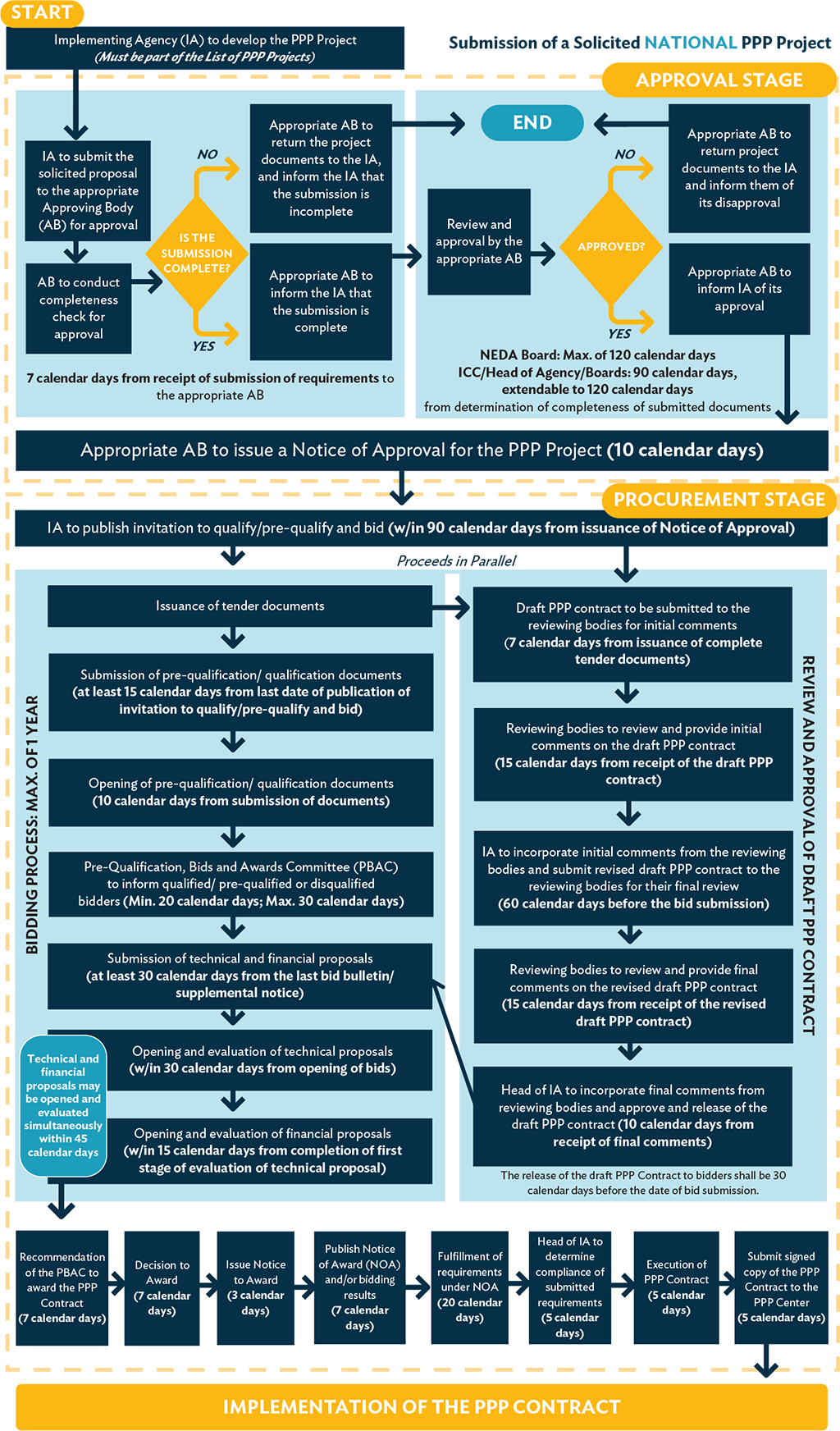
AB = approving body, IA = implementing agency, ICC = Investment Coordination Committee of the NEDA Board, NEDA = National Economic and Development Authority, NOA = notice of award, PBAC = Prequalification, Bids, and Awards Committee, PPP = public–private partnership.
Source: PPP Center. Submission of a Solicited National PPP Project.
Submission of an Unsolicited National Public–Private Partnership Project
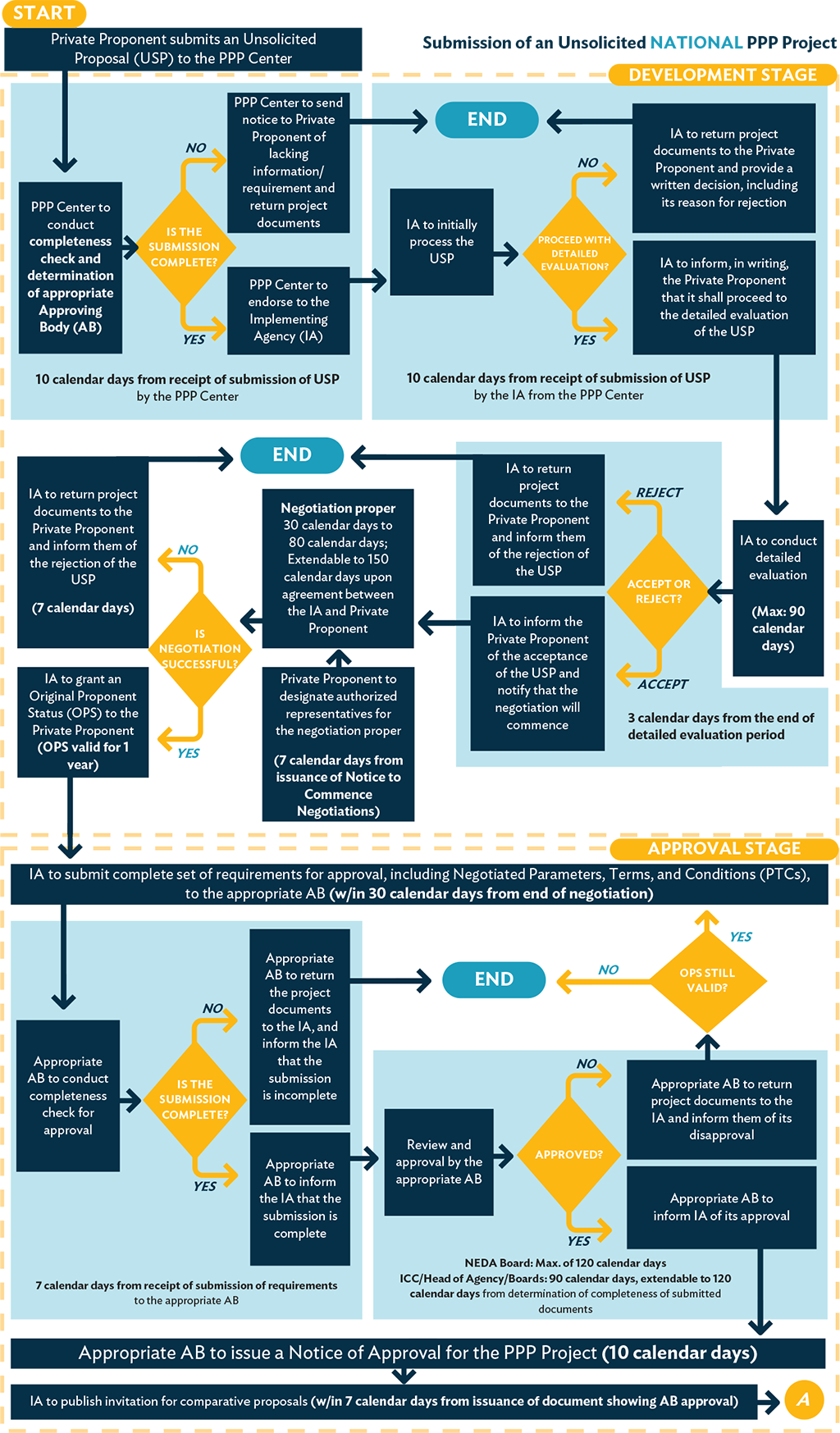
AB = approving body, IA = implementing agency, ICC = Investment Coordination Committee of the NEDA Board, NEDA = National Economic and Development Authority, OPS = original proponent status, PPP = public–private partnership, PTCs = parameters, terms, and conditions, USP = unsolicited proposal.
Note: The procurement process is the same for USPs for national and local PPP projects.
Source: PPP Center. Submission of an Unsolicited National PPP Project.
Submission of an Unsolicited National Public–Private Partnership Project (Comparative Challenge)
Submission of an Unsolicited NATIONAL PPP Project
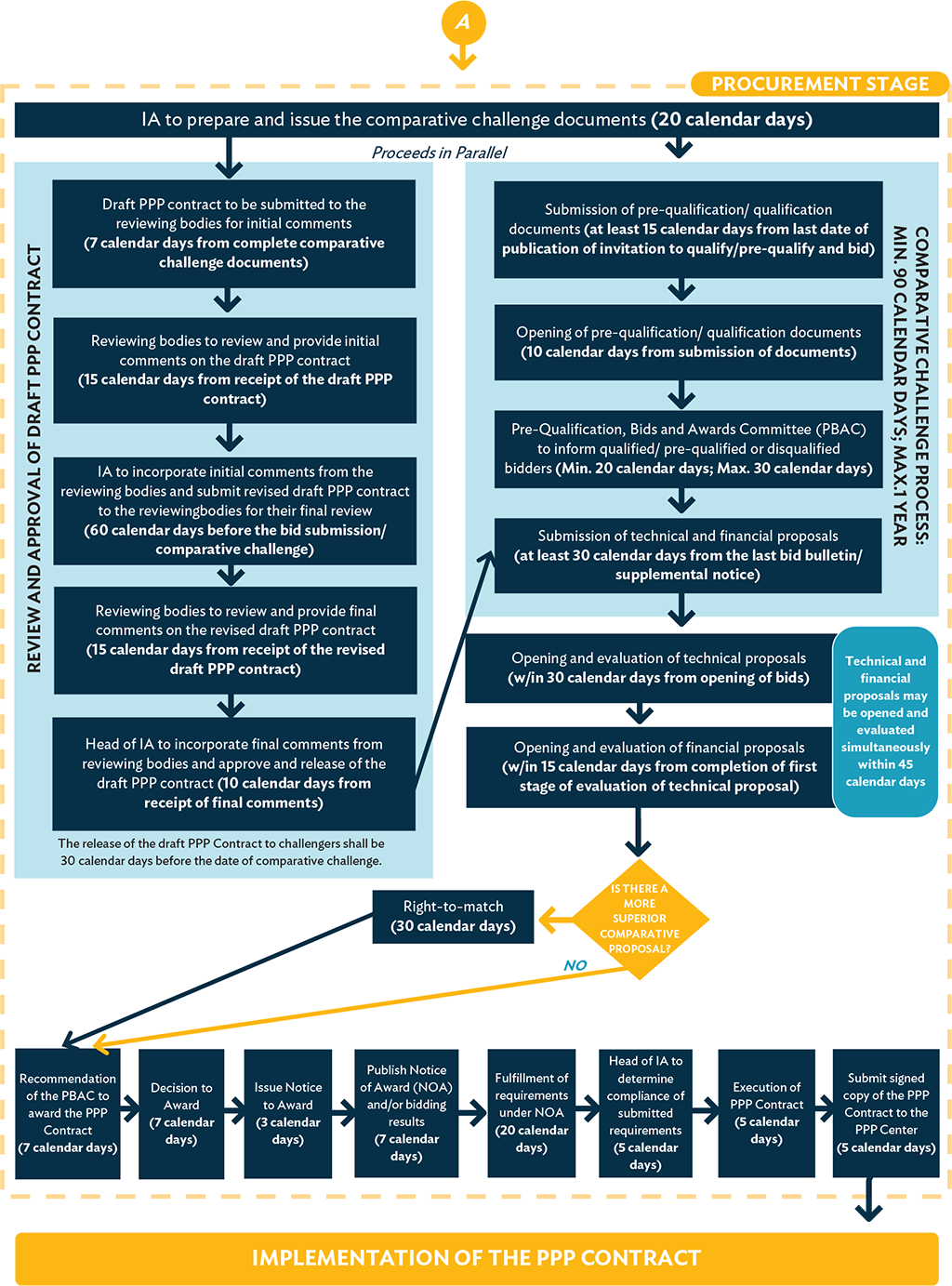
IA = implementing agency, NOA = notice of award, PBAC = Prequalification, Bids, and Awards Committee, PPP = public–private partnership.
Note: The procurement process is the same for unsolicited proposals for national and local PPP projects.
Source: PPC Center. Submission of an Unsolicited National PPP Project.
PPP = public–private partnership.
National Framework for Enabling PPPs
Standard Operating Procedures, Tool Kits, Templates, and Model Bid Documents for PPPs
Parameters
COMPAREDOWNLOADDoes the country have PPP Guidelines/PPP Guidance Manual? Does the PPP Guidelines/PPP Guidance Manual adequately cover the process, entities involved, roles and responsibilities of various entities, approvals required at various stages, and the timelines for the various stages of the PPP project life cycle? What are the templates and checklists available in the PPP Guidelines/PPP Guidance Manual? Project Needs Assessment and Options Analysis checklist?
Project Due Diligence checklist?
Technical Assessment checklist?
Environmental Assessment checklist?
PPP Procurement Plan template?
Does the country have standardizedmodel bidding documents for PPPs? Model Request for Qualification (RFQ) document?
Model Request for Proposal (RFP) document?
Model PPP/Concession Agreement?
State Support Agreement?
VGF Agreement?
Guarantee Agreement?
Power Purchase Agreement?
Capacity Take-or-Pay Contract?
Fuel Supply Agreement?
Transmission and Use of System Agreement?
Performance-Based Operations and Maintenance Contract?
Engineering, Procurement and Construction Contract?
Only for LGU PPP Projects Model RFQ, RFP, and PPP Agreement are available Does the country have standardized PPP agreement terms? Except for LGU PPP Projects Does the country have standardized/ model tool kits to facilitate identification, preparation, procurement, and management of PPP projects? PPP Family Indicator?
PPP Mode Validity Indicator?
PPP Suitability Filter?
PPP Screening Tool?
Financial Viability Indicator Model?
Economic Viability Indicator Model?
VFM Indicator Tool?
Readiness Filter?
Is there a framework for monitoring fiscal risks from PPPs including the following? Process for assessing fiscal commitments?
Process for approving fiscal commitments?
Process for monitoring fiscal commitments?
Process for reporting fiscal commitments?
Process for budgeting fiscal commitments?
Are there fiscal prudence norms/thresholds to limit fiscal exposure to PPPs? Is there a process for assessing and budgeting contingent liabilities from PPPs? - Yes
- No
LGU = local government unit, PPP = public–private partnership, RFQ = request for qualification, RFP = request for proposal.
Government of the Philippines. 2012. PPP Manual for LGUs – Volume 3: Utilizing LGU PPP Project Templates and Bid Documents; PPP Center. PPPGB Guidelines and Issuances.
Other critical contractual provisions and PPP enabling considerations
Parameters
COMPAREDOWNLOADDoes the law specifically enable lenders the following rights: Security over the project assets?
a Security over the land on which they are built (land use right)?
Security over the shares of a PPP project company?
Can there be a direct agreement between the government and lenders?
b Do lenders get priority in the case of insolvency?
c Can lenders be given step-in rights?
Does the law specifically enable compensation payment to the private partner in case of early termination due to: Public sector default or termination for reasons of public interest?
Private sector default?
Force majeure?
Does the law enable the concept of economic/financial equilibrium? d Does the law enable compensation payment to the private partner due to: Material adverse government action?
Force majeure?
Change in law?
- aOn a case-by-case basis
- bUsually in the form of an acknowledgment and consent agreement attached to the PPP contract as an annex, to be signed by the implementing agency/ies, the agent of the lenders, and the concessionaire, wherein the implementing agency/ies acknowledges the assignment of the concessionaire's rights under the concession agreement and consents to the creation of a security interest over equity interests in the concessionaire and other permitted security interests, in accordance with the concession agreement.
- cAny residual obligations of the borrower to the lenders not satisfied out of the proceeds of the lenders' collateral will rank at least pari passu (equal footing) in priority of payment with all its unsecured obligations, other than obligations subject to statutory preference. Under loan documents, the borrower is restricted from notarizing documents (which may give rise to financial obligations) as they are given statutory preference.
- dOnly for material adverse government action, force majeure, and change in law.
- Yes
- No
LEARN MORENational Framework for Enabling PPPs
Standard Operating Procedures, Tool Kits, Templates, and Model Bid Documents for PPPs
Key Clauses Related to PPP Agreement
The PPP Code prescribes the following mandatory provisions in the PPP contract:
- specific contractual arrangement; term and scope of work;
- minimum performance standards and specifications;
- key performance indicators, targets, and procedures for measuring and reporting results, including dimensions of GEDSI;
- implementation milestones, including those for securing other approvals, period within which financial close shall be achieved by the private partner, and project completion date;1
- cost recovery scheme via proposed tariff, as the case may be;
- obligation of the private partner to disclose loan or financing documents;
- liquidated damages;
- performance security requirements, including their validity and top-up mechanism procedures;
- minimum insurance coverage as may be required for the project;
- acceptance tests and procedures;
- warranty period and procedures after transfer and warranty security;
- lock-in conditions, as applicable;
- grounds for contract termination, including events of default and effects of contract termination, formula for termination payment, and manner and timeline of payment;
- conditions and procedures for lender step-in rights;
- conditions for acceptable permitted security interest;
- manner and procedures for the resolution of corruption;
- wind-up and transfer measures;
- compliance with all other applicable laws, rules, and regulations;
- total cost of the project; project specifications and features;
- gender, social, disability, and environmental safeguards;
- provisions on the use of dispute avoidance and ADR mechanisms;
- ownership or retention of patents, technology, and consultant reports; and
- monitoring, evaluation, and reporting scheme/plan for all safeguard-related mandatory provisions of the PPP contract.
The draft PPP contract must be consistent with the PTCs approved by the approving body. The implementing agency must send the draft PPP contract to be released to prospective bidders/challengers to reviewing bodies, for initial comments. The reviewing bodies for national PPP projects are the PPP Center, the statutory counsel of the national implementing agency, and the DOF, in case the draft PPP contract involves national government undertakings or availability payments. The reviewing bodies for local PPP projects are the statutory counsel of the local implementing agency and the DOF, in case the draft PPP contract involves national government undertakings or availability payments. Reviewing bodies have 15 calendar days from receipt of the draft PPP contract to review and provide their initial comments. Thereafter, clearance from the reviewing bodies of the final draft of the PPP contract must be obtained by the implementing agency. Reviewing bodies have 15 calendar days from receipt of the draft PPP contract, as revised, to review and provide their clearance. The head of the implementing agency will then approve the draft PPP contract and release it to bidders/challengers within 10 calendar days from receipt of the final comments/clearance from the reviewing bodies. The release of the final draft of the PPP contract to bidders/challengers cannot be later than 30 calendar days from the deadline for the submission of bids/comparative proposals.2
- 1Should the private partner fail to achieve financial close within the period prescribed in the PPP contract without the fault of the government, the private partner will be liable for penalties under the contract.
- 2Government of the Philippines. 2024. Implementing Rules and Regulations of the PPP Code.
More details on some mandatory clauses
- Contracting parties. The contracting parties to a PPP contract are the implementing agency/ies and the private partner that is the winning bidder in a competitive selection process for a solicited PPP project or the comparative challenge process for USPs.
- Payments. Under the PPP Code, the private partner may recover its investments and reasonable profit through a revenue- or availability-based investment recovery scheme or a combination of these schemes. Other investment recovery schemes, such as commercial development rights or the granting of a portion or percentage of a reclaimed land may also be allowed to supplement these schemes.
- Risk Allocation. The PPP Code requires an equitable risk allocation in PPP projects. The feasibility study for the project must include a risk allocation and risk-mitigating plan, which will form part of the PTCs to be set by the approving body. A risk allocation that complies with the GPRAM adopted by the ICC-IC is one of the criteria for approval of PPP projects. The implementing agency must justify any deviation from the GPRAM.
- Lenders’ security and step-in rights. Creating a security interest over the shares in a PPP project company and the execution of a direct agreement between the implementing agency and project lenders are not provided for in the PPP Code or its IRR. However, they are permitted on a contract case-by-case basis. Some PPP contracts, such as the concession agreements for the MCIA Project, the Clark International Airport O&M Project, and the Manila LRT1 Extension O&M Project provide for the form of the direct agreement, an acknowledgment and consent agreement annexed to the PPP contract, to be signed by the implementing agency, the agent of the lenders, and the concessionaire, wherein the implementing agency acknowledges the assignment of the concessionaire’s rights under the concession agreement and consents to the creation of a security interest over equity interests in the concessionaire and other permitted security interests, in accordance with the concession agreement.3
Since 2018, the Personal Property Security Act governs the creation and perfection of security interest over movable and immovable assets in PPP projects. However, its full implementation is subject to the Land Registration Authority establishing the personal property security registry.4 In the meantime, personal property security interests created under the Act may still be registered with the chattel mortgage registry of the relevant office of the register of deeds.5 - Government support/state guarantees. There are various government support or government undertakings available to the private partner in solicited projects. Government support or undertakings using national government funds require the approval of the ICC and compliance with government funding guidelines, as discussed in the section Government Financial Support for Public–Private Partnership Projects.6
- Ownership of project assets. Generally, the government would obtain ownership of project assets, but the time when ownership is transferred to the government depends on the contractual arrangement for the project. For example, in a build–transfer–operate (BTO) or build–transfer (BT) scheme, ownership of the assets is transferred to the government as soon as the project is commissioned satisfactorily. The private partner later recovers its investment plus a reasonable return thereon through collection of tariffs or, in the case of the BT scheme, availability payments from the government. In contrast, in a build–operate–transfer (BOT) or build–lease–transfer (BLT) scheme, ownership of project assets is transferred only after an agreed period or at the end of the contract term. During the contract term, it operates the facility and collects the tariff from its users under the BOT scheme or leases the facility to, and collects the rentals from, the government under the BLT scheme.
- Adjustment and revision to the PPP contract. A contract variation, expansion, or extension of an executed PPP contract may be allowed. Prior approval of the appropriate approving body is required for the following variations: (i) changes in the agreed schedule or parametric formula to calculate tariff and adjustments, as stipulated in the PPP contract, unless already regulated and publicly disclosed; (ii) a decrease in the implementing agency’s revenue or profit share derived from the project, except as may be allowed under a formula approved by the relevant regulatory or approving body; (iii) changes in the approved scope of works, a decrease in the performance standards, a deferment of committed service levels, or a change in the contractual arrangement; (iv) an extension in the contract term; or (v) increase in the financial liabilities of the government under the PPP project.
- Lock-in condition. Under the PPP Code, a private partner may divest its ownership, rights, or interests in a PPP project after a lock-in period defined in the PPP contract, provided such divestment is approved by the head of the implementing agency and the new private partner has qualifications equal to or better than those of the previous private partner. The implementing agency may also divest its ownership, rights, or interests in a PPP project. However, if it will involve full or partial divestment or transfer of ownership of government assets or properties, it must, at a minimum, be approved by the approving body and is subject to applicable legal requirements.
- Termination and compensation. All PPP contracts must define termination events, such as implementing agency event of default, private partner event of default, and force majeure and other no-fault termination events, as well as the relevant curing periods and remedies, including the calculation of termination payments applicable to each termination event. Please see succeeding section Termination and compensation.
- Wind-up and transfer measures. All PPP contracts must include provisions on wind-up and transfer measures, which include, among others, (i) mechanisms and procedures for the transfer of assets to the implementing agency, as applicable, (ii) the transfer of technology required for the operation of the PPP project, subject to limitations under existing legal requirements, (iii) the training of the personnel of the implementing agency or of a successor in the O&M of the PPP project, (iv) the provision by the private partner of a warranty that the PPP project meets the project technical specifications, agreed system features, and performance standards and services for a certain period after the transfer of the PPP project to the implementing agency, and (v) in case of joint venture arrangements, the compensation to which the private partner is entitled in case of buy-out and transfer of assets to the implementing agency.
- 3Tavidell Law.
- 4Government of the Philippines. 2018. Personal Property Security Act; The Land Registration Authority launched the Personal Property Security Registry on 3 February 2025 at https://ppsr.lra.gov.ph/.
- 5Land Registration Authority. 2021. LRA Circular No. 19-2021.
- 6Please see discussion below under Government Support for Public–Private Partnership Projects for further details.
As per the PPP Code, all PPP contracts shall define the events that may lead to contract termination, which include, but are not limited to, implementing agency event of default, private partner event of default, force majeure and other no-fault termination events, and other termination events, as the parties may agree to in the PPP contract. Remedies, curing periods, lender step-in rights, remittance procedures, default interest rates, and written notice requirements shall also be provided for in the contract. The amount of termination payment is determined by the parties pursuant to the contract, following the guidelines and related reportorial requirements to be issued by the PPPGB.7 The formulae for the calculation of the applicable termination payment depending on the termination event are in a schedule annexed to the PPP contract. An independent appraiser chosen by the parties is required for the purposes of computing the termination payment based on the calculation method detailed in the PPP Contract. Its cost will be borne by the party at fault, except in cases of termination that is neither party’s fault, in which case the cost will be divided equally between the parties. The amount of termination payment determined by the independent appraiser is binding on both parties, absent manifest error or fraud. For the continuity of public services, the government is authorized to take possession of the assets or facilities prior to the calculation of termination payment.
In 2015, the PPPGB issued Policy Circular 06-2015 on Termination Payment for PPP Projects, which enumerates events that may lead to termination and provides guidance on calculating termination payments. As a general rule, the method of calculation of termination payment should allow lenders to recover the outstanding senior debt on the core asset of the project as of the date of termination, except debt owed to related entities. In the case of termination owing to government default, the private partner is likewise entitled to a reasonable rate of return. For termination owing to force majeure, the government pays either the depreciated value of the assets or the value of the assets appraised at their damaged condition, at the time of termination.8 However, as this policy circular is a guidance and not a regulation, it is not mandatory. The termination payments for each PPP contract are structured on a per project basis and subject to comments from bidders during the procurement stage. Pending the issuance of the new guidelines on termination payments and related reportorial requirements by the PPPGB pursuant to the PPP Code, this policy circular may guide implementing agencies in developing the termination payment provisions of the PPP contract.
Philippine law does not cover the concept of economic or financial equilibrium in the way that other jurisdictions do. Its nearest Philippine law equivalent may be that found in Article 1267 of the Civil Code, which provides that, “[w]hen the service has become so difficult as to be manifestly beyond the contemplation of the parties, the obligor may also be released therefrom, in whole or in part.” However, this provision simply allows the private partner in a PPP contract to be excused from performance of the contract; it does not sanction or require the parties to collaborate and, if necessary, renegotiate contract terms, to arrive at mutually acceptable conditions to address the consequences of the changed circumstances that are adversely affecting the economic or financial balance of the contract. PPP contracts in the Philippines address changes relating only to material adverse government action, force majeure, and change in law.
- 7Pending the new issuance, the 2015 PPPGB Policy Circular 06-2015 on Termination Payment for PPP Projects can be used for guidance.
- 8PPPGB. 2015. Policy Circular 06-2015 on Termination Payment for PPP Projects.
Sources: Government of the Philippines. 2023. Public-Private Partnership (PPP) Code of the Philippines; 2024. Implementing Rules and Regulations of the PPP Code. NEDA. 2024. NEDA Board-ICC Guidelines on the Review and Approval of Public–Private Partnership Proposals Requiring ICC and/or NEDA Board Approval.
National Framework for Enabling PPPs
Unsolicited PPP Proposals
Parameters
COMPAREDOWNLOADDoes the PPP legal and regulatory framework allow submission and acceptance of unsolicited proposals? What are the advantages provided to the project proponent for an unsolicited bid? Competitive advantage at bid evaluation?
Swiss Challenge?
a Compensation of the project development costs?
Government support for land acquisition and resettlement cost?
Government support in the form of viabiity gap funding and guarantees?
- aComparative challenge is more commonly referred to as "Swiss challenge."
- Yes
- No
LEARN MORENational Framework for Enabling PPPs
Unsolicited PPP Proposals
The PPP Code implemented reforms in the legal framework for unsolicited PPP proposals.
Under the PPP Code, USPs are allowed for projects included in the lists of PPP projects of implementing agencies, excluding those already approved as PPP projects by the approving body, provided they do not contain any of the government undertakings, which are prohibited. Projects with ROW provided by the government may be allowed for USPs, provided the government receives appropriate compensation at least equal to the value of the costs of ROW to be provided. Appropriate compensation may be a portion of the implementing agency or government share in the tariff collection or regular payments to the implementing agency or to the government. In joint venture arrangements, government equity and contribution of assets, properties, and/or rights may be allowed.1
The previous requirement of the Amended BOT Law that a USP, if involving a project included in the list of priority projects of an implementing agency, must involve a new concept or technology no longer applies.
The processing of the USP for both national and local PPP projects commences with the completeness check by the PPP Center within 10 calendar days from its official acknowledgment of the electronic copy of the USP. Prior to the submission of a USP to the PPP Center, a private proponent may meet with the PPP Center to clarify the process and/or requirements in the determination of completeness of a USP. Submission of project documents to the PPP Center for a USP shall be done only through the Unsolicited Proposals Submission Portal on the PPP Center website. The PPP Center will not entertain any other form of USP submission. A complete USP submission to the PPP Center contains the following documents:
- letter of the private proponent to the PPP Center submitting the USP for completeness check,
- complete feasibility study,
- electronic copy of the economic model,
- electronic copy of the financial model,
- completeness check (CC) forms:2
- CC Form 1 (proposed general parameters, terms, and conditions), which includes the general information about the proposed project,
- CC Form 2 (government undertakings, and other financial obligations of the government), compliant with the rules provided under the PPP Code and its IRR,
- CC Form 3 (proposed risk allocation and risk mitigation plan), which includes the risk allocation matrix, the possible resulting contingent liabilities for risks taken on by the government, and the proposed risk-mitigating measures,
- CC Form 4 (identified interconnectivity and interface risks, and mitigating measures), which includes the assessment of the actual and potential interconnectivity and interface risks between the proposed project and other government project/s, and
- CC Form 5 (mandatory provisions in the draft PPP contract), which shall require the private proponent to specify the sections in the draft PPP contract where mandatory provisions, as required by the PPP Code and its IRR, will be found,
- valuation reports on government assets or property, equity contribution of the government and private proponent, and reclaimed land, as applicable,
- project site plan,
- draft PPP contract, and
- private proponent information and qualification form.3
Upon receipt of the complete USP endorsed by the PPP Center, the implementing agency, if it is not developing a solicited project with a similar scope and/or objective as the USP, may continue to process the USP or reject it if the USP is not aligned with the development plans of the implementing agency. If the implementing agency is already developing a solicited proposal with similar scope and/or objective as the USP, the implementing agency may continue to process the USP and cease processing the solicited project, subject to reimbursement, or reject the USP and continue processing the solicited project.4 The implementing agency must provide the private proponent written notice of its decision within 10 calendar days from its receipt of the USP from the PPP Center.
The implementing agency may entertain similar USPs within 10 calendar days of its receipt of the first USP. If there are more than one complete USP for the same or similar project, the implementing agency determines the most advantageous proposal for the government and the public, considering, among others, economic and financial viability of the project, proposed project scope and terms, investment recovery scheme, risks proposed to be assumed by the government, and qualifications of the private proponent. Other private proponents may submit a comparative proposal during the comparative challenge period. The implementing agency likewise has the option to reject the USP or all similar proposals in writing with the corresponding justification.5
If the implementing agency decides to continue processing the USP, it will proceed with its detailed evaluation within 90 calendar days from its written decision. The implementing agency may request assistance from the PPP Center in conducting the detailed evaluation. After its detailed evaluation of the USP that it finds complete, the implementing agency may accept the proposal and proceed to negotiation. The good faith negotiations between the implementing agency and the private proponent will be for a period of 80 calendar days (standard period) but not less than 30 calendar days based on the complexity of the project, subject to extension provided the total negotiation period does not exceed 150 calendar days, after which, if successful, the implementing agency grants OPS to the private proponent. The OPS will be valid for a period not exceeding 1 year from conferment.
The implementing agency and the private proponent must submit the complete set of requirements for approval, including the negotiated PTCs, to the approving body within 30 calendar days from the end of negotiation. The approving body has 120 calendar days from its receipt of complete requirements to act on the submission. If the approving body fails to render a final decision within this period, the PPP project will be deemed approved, and the implementing agency may proceed with the comparative challenge within 7 calendar days from receipt of notification from the PPP Center. The proposed PTCs, as submitted, will be used to guide the comparative challenge process.
Upon approval of the USP by the approving body, the USP will be subjected to a Swiss challenge/ comparative challenge. The implementing agency will conduct the comparative challenge, within the period it proposed (minimum 90 days/maximum 1 year) and approved by the approving body.6
The PPP Code has lengthened the period for the Swiss challenge/comparative challenge from the previous 60 working days under the Amended BOT Law to a period that is not less than 90 calendar days but not exceeding 1 year. On the other hand, the period for the original proponent to exercise its right to match has been reduced from 30 working days to 30 calendar days.
- 1Government of the Philippines. 2024. Implementing Rules and Regulations of the PPP Code.
- 2The contents of the submitted proposed PTCs should be consistent with the contents of the submitted financial model.
- 3PPP Center. 2024. PPP Center USP Completeness Check Procedures. The PPP Center Completeness Check Procedures apply to both national and local USP submissions.
- 4In case the implementing agency has already incurred development costs for a project that is subject of a USP, the winning private proponent must reimburse the implementing agency the documented development costs incurred over the previous 3 years, not exceeding 6% of the project cost, excluding the cost of ROW acquisition. The reimbursement amount must be included in the bidding documents for the comparative challenge, to be reimbursed by the winning bidder as a condition for award. In case the USP does not proceed owing to failure of negotiation, the private proponent that submitted the USP shall reimburse the development costs.
- 5PPPGB. 2024. PPP Governing Board Resolution No. 2024-07-03. No USP subsequently determined by the PPP Center to be incomplete three times on separate occasions (three-strike rule) may be entertained for determination of completeness. However, after the lapse of 180 calendar days after such determination, the private proponent may resubmit the USP to the PPP Center for a completeness check, which will be considered as a new submission subject anew to the three-strike rule.
- 6The original proponent will be required on the first day of the publication of the invitation for comparative proposals to submit a bid bond equal to the amount and in the form required from the comparative proponents.
Source: Government of the Philippines. 2023. Public–Private Partnership Code of the Philippines.
National Framework for Enabling PPPs
Foreign Investor Participation Restrictions
Parameters
COMPAREDOWNLOADIs there any restriction for foreign investors on: Land use/ownership rights as opposed to similar rights of local investors?
Currency conversion?
PPP projects with foreign sponsor participation (number) - Yes
- No
- Unavailable
LEARN MORENational Framework for Enabling PPPs
Foreign Investor Participation Restrictions
The imposition of the nationality requirement in areas of activity affected by PPP projects is one of the challenges of the PPP program as it restricts competition.
The Philippine Constitution and a number of Philippine laws limit the extent to which foreign investors may participate in the ownership and operation of certain businesses. This is referred to as the nationality requirement and applies to three aspects of the investment: (i) the ownership of the entity, (ii) the composition of the board of directors, and (iii) the executive and managing officers of the entity, who must all be Filipinos.
- Under the Philippine Constitution, a franchise, certificate, or any other form of authorization for the operation of a public utility may be granted only to Filipino citizens or to corporations or associations organized under the laws of the Philippines, at least 60% of whose capital is owned by Filipino citizens. A recent change in law has limited public utilities to the following sectors: distribution/transmission of electricity, petroleum and petroleum product pipeline transmission systems, water pipeline distribution systems and wastewater pipeline systems (including sewerage pipeline systems), seaports, and public utility vehicles.1 This opens the doors of certain sectors to foreign participation (e.g., toll roads, railways, and airports) but the nationality requirement continues to be a challenge to the sectors still considered as public utilities where development is also most needed.
- The Philippine Constitution also provides that the exploration, development, and utilization of natural resources must be under the full control and supervision of the state, the state may directly undertake such activities, or it may enter into co-production, joint venture, or production-sharing agreements with Filipino citizens, or corporations or associations at least 60% of whose capital is owned by Filipino citizens. Another recent reform lifted the application of this rule to renewable energy projects utilizing solar, wind, hydro, and ocean or tidal energy.
- The 60% Filipino equity requirement likewise applies to ownership of private lands and lease of public lands, education services, and agricultural activities relating to rice and corn.
- Further, foreign nationals cannot own more than 50% of the capital of entities engaged in the operation and management of telecommunications, which is considered critical infrastructure, if the country of such foreign national does not accord reciprocity to Philippine nationals.2
- 1Government of the Philippines. 2021, Republic Act No. 11659.
- 2Government of the Philippines. 2021. Republic Act No. 11659; 2022. Executive Order No. 175.
PPP = public–private partnership.
National Framework for Enabling PPPs
Dispute Resolution
Parameters
COMPAREDOWNLOADDoes the country have a Dispute Resolution Tribunal? Does the country have an Institutional Arbitration Mechanism? Can a foreign law be chosen to govern PPP contracts? What dispute resolution mechanisms are available for PPP agreements? Court litigation
Local arbitration
a International arbitration
a Has the country signed the New York Convention on the Recognition and Enforcement of Foreign Arbitral Awards? - aIt is mandatory that arbitration of construction-related disputes be submitted to the Construction Industry Arbitration Commission arbitration process, with the legal seat to be the Philippines and a venue in Metropolitan Manila.
- Yes
- No
LEARN MORENational Framework for Enabling PPPs
Dispute Resolution
The new PPP Code requires all PPP contracts to include provisions on the use of dispute avoidance and ADR) mechanisms such as arbitration, as defined in the ADR Act of 2004. The parties have complete freedom to choose which ADR mechanisms to follow. However, under Philippine law, arbitration of construction-related disputes is under the exclusive jurisdiction of the Construction Industry Arbitration Commission (CIAC), as per the Construction Industry Arbitration Law. Thus, it is mandatory for PPP contracts to provide that construction disputes be finally settled by the CIAC arbitral tribunal in accordance with the Rules of Procedure Governing Construction Arbitration pursuant to the Construction Industry Arbitration Law, with the legal seat to be the Republic of the Philippines and the venue to be in Metropolitan Manila.
The ADR Act provides that international commercial arbitration shall be governed by the Model Law on International Commercial Arbitration adopted by the United Nations Commission on International Trade Law (UNCITRAL) on 21 June 1985 and the ADR Act’s provisions on international commercial arbitration (sections 19 to 31). Domestic arbitration is governed by the Arbitration Law, and by certain provisions of the ADR Act applicable to international commercial arbitration as well as by principles of the UNCITRAL Model Law. The Philippines ratified the New York Convention with the reservation that it does so on the basis of reciprocity.1
For national PPP contracts entered into under the Amended BOT Law (and therefore prior to the adoption of the PPP Code), PPP contracts already included provisions on the use of ADR mechanisms, such as arbitration. In case of a dispute, the parties are obliged to resolve it amicably within 30 days after notice of the dispute. Technical issues, such as termination payment, which the parties cannot resolve in 30 days must be referred to an independent expert, whose decision is final and binding on the parties. Disputes which the parties fail to amicably settle within the 30-day period or which the independent expert fails to decide on must be finally settled by arbitration in accordance with the selected arbitration rules and seat, as stated in the PPP contract.
The Philippine Dispute Resolution Center, Inc. was incorporated in 1996 out of the Arbitration Committee of the Philippine Chamber of Commerce and Industry. As an arbitral institution, it does not itself resolve disputes. It promotes and encourages the use of arbitration, mediation, and other modes of avoiding or settling commercial disputes such as dispute boards.2 It also provides ADR services to the business community. It has a list of accredited arbitrators and mediators from which parties to a PPP contract may select to resolve their disputes.
- 1New York Convention. Contracting States.
- 2Philippine Dispute Resolution Center, Inc. About Us.
PPP = public–private partnership.
Parameters
COMPAREDOWNLOADDoes the country have a Dispute Resolution Tribunal? Does the country have an Institutional Arbitration Mechanism? Can a foreign law be chosen to govern PPP contracts? What dispute resolution mechanisms are available for PPP agreements? Court litigation
Local arbitration
a International arbitration
a Has the country signed the New York Convention on the Recognition and Enforcement of Foreign Arbitral Awards? - aIt is mandatory that arbitration of construction-related disputes be submitted to the Construction Industry Arbitration Commission arbitration process, with the legal seat to be the Philippines and a venue in Metropolitan Manila.
- Yes
- No
PPP = public–private partnership.
National Framework for Enabling PPPs
Environmental and Social Issues
Parameters
COMPAREDOWNLOADIs there a local regulation establishing a process for environmental impact assessment? Is there a legal mechanism for the private partner to limit environmental liability for what is outside of its control or caused by third parties? Is there a local regulation establishing a process for social impact assessment? Is there involuntary land clearance for PPP projects? - Yes
LEARN MORENational Framework for Enabling PPPs
Environmental and Social Issues
The PPP Code declares that the State shall ensure the integration of climate resilience, environment and social sustainability, and gender and development policies and programs in the planning, design, and implementation of all PPP projects.
A PPP project’s environmental impact assessment process is governed by the Environmental Impact Statement (EIS) System under Presidential Decree No. 1586, currently being implemented by the Environmental Management Bureau (EMB) of the Department of Environment and Natural Resources (DENR). The EIS System focuses primarily on the assessment of the direct and indirect impacts of a project on the biophysical and human environment and on ensuring these impacts are mitigated by appropriate environmental protection and enhancement measures. For PPP projects that are considered environmentally critical projects or located in environmentally critical areas, the EIS System requires the implementing agency and/or the private partner to first secure an environmental compliance certificate (ECC) before proceeding with the development of the project. The ECC contains specific measures and conditions that the private partner will have to undertake before and during the operation of a project and, in some cases, during the project’s abandonment phase, to mitigate identified environmental impacts.1 PPP projects that are not environmentally critical projects or located in environmentally critical areas must secure a certificate of non-coverage from the EMB.2
All PPP projects must meet environmental standards and comply with the permitting processes imposed by the Clean Air Act, the Clean Water Act, and the Toxic Substances and Hazardous and Nuclear Waste Control Act, and their respective IRRs, as well as the Guidelines for Community Noise issued by the World Health Organization. In assessing those pollutants, the private partner must take into consideration both the direct and the collateral environmental impacts, such as effects on water and air quality, possible noise pollution resulting from any excavation and construction works and the consequent potential groundwater contamination, solid waste, soil erosion, and the potential adverse effects on aquatic environment and vegetation.
A number of laws and regulations govern the process for social compliance for PPP projects. These include the following laws and their IRRs, among others: the Right-of-Way Act; the Indigenous Peoples’ Rights Act of 1997; laws on the resettlement of informal settlers and project-affected persons such as the Urban Development and Housing Act of 1992 and the Department of Human Settlements and Urban Development Act of 2019; and gender laws such as the Women in Development and Nation Building Act, the Magna Carta of Women, and the Anti-Sexual Harassment Act of 1995. In addition, the PPPGB Guidelines on Public Consultation and Engagement for PPP Projects institutionalizes the consultation and engagement of the public, with the end view of improving transparency in the development and implementation of PPP projects.
Under the Right-of-Way Act, the implementing agency may offer to acquire the ROW site or location from the property owner through negotiated sale at a compensation price, which is the sum of (i) the current market value of the land, (ii) the replacement cost of structures and improvements therein, and (iii) the current market value of crops and trees (if any). The property owner has 30 days to decide whether or not to accept the offer as payment for their property. Upon refusal or failure of the property owner to accept such offer or to submit the documents necessary for payments, the implementing agency shall immediately initiate expropriation proceedings.
In 2018, the PPPGB issued Resolution “Safeguards in PPP: Mainstreaming Environmental, Displacement, Social, and Gender Concerns,” with the goal of preventing delays owing to environmental, displacement, social, and gender concerns in the PPP process during the project development phase, review and approval phase, procurement phase, and implementation phase. Environmental concerns include resilience to humancaused and natural hazards and climate change mitigation. Displacement concerns include ROW acquisition, dismantling of affected structures, management of affected employees, and livelihood restoration. Social and gender concerns include considerations for Indigenous Peoples, gender equality, vulnerable people, and culture and heritage preservation. Such resolution aims to assist the implementing agency in undertaking the activities during throughout the PPP process detailed in the table below.
- 1Department of Environment and Natural Resources (DENR). 2003. Implementing Rules and Regulations (IRR) for the Philippine Environmental Impact Statement (EIS) System.
- 2DENR. 2014. Revised Guidelines for Coverage Screening and Standardized Requirements Under the Philippine EIS System.
Salient Activities to Mainstream Environmental, Displacement, Social, and Gender Concerns
PPP Phase Activity Project development phase Identify applicable requirements in laws, decrees, orders, issuances, rules, and regulations, and the corresponding required studies, outputs, or standards for the PPP project, and ensure safeguards are considered in the project feasibility study and design. Review and approval phase Ensure the approved terms of the project consider various safeguard concerns identified during the project development phase, including the proposed mitigating measures. Procurement phase Ensure safeguard considerations are integrated in the PPP contract, including identified mitigating measures. Implementation Identify specific monitoring, evaluation, and feedback mechanisms to ensure safeguard measures embedded in the PPP contract are complied with, and in providing the implementing agency with mechanisms for managing unforeseen safeguard concerns. PPP = public–private partnership.
Source: PPPGB. 2018. Resolution No. 2018-12-02.
PPP = public–private partnership.
National Framework for Enabling PPPs
Land Rights
Parameters
COMPAREDOWNLOADWhich of the following is permitted to the private partner: Transfer land lease/use/ownership rights to third party
a Use leased/owned land as collateral
b Mortgage leased/owned land
b Is there a legal mechanism for granting wayleave rights, for example, laying water pipes or fiber cables over land occupied by persons other than the government or the private partner? Is there a land registry/cadastre with public information on land plots? Which of the following information on land plots is available to the private partner? Appraisal of land value
a Landowners
a Land boundaries
a Utility connections
a Immovable property on land
a Plots classification
a - aOwnership of private lands and lease of public lands (e.g., via a forest land use agreement) is subject to the 60% Filipino nationality requirement.
- bHowever, there are executed PPP contracts that prohibit the constitution of a real estate mortgage over project assets or the private partner's possessory rights over them.
- Yes
- No
LEARN MORENational Framework for Enabling PPPs
Land Rights
Ownership of private lands and lease of public lands (e.g., via a forest land use agreement) is subject to the 60% Filipino nationality requirement.
The Right-of-Way Act facilitates the acquisition of ROW, site, or location for national government infrastructure projects. For PPP projects, the private sector might be requested to either finance the ROW cost, which can be recovered partly or fully by the investor from the tolls, fees, or tariffs to be charged to the users of the completed project, or advance the funds covering the ROW cost, which would be reimbursed later by the implementing agency, with the exception of in USPs, where the private partner will have to bear the ROW costs.1
Government Support for PPP Projects
Project Funding Support
Parameters
COMPAREDOWNLOADProject Funding Support Is there a dedicated government financial support mechanism for PPP projects? a What are the instruments of government financial support available under this government financial support mechanism? Capital grant
b Operations grant
b Annuity/availability payments
b Guarantees to cover
Currency inconvertibility and transfer risk
Foreign exchange risk
War and civil disturbance risk
Considered as force majeure, which is a shared risk Breach of contract risk
Regulatory risk
Expropriation risk
Government payment obligation risk
b Credit risk
b Minimum demand/revenue risk
(Availability-based PPP) Risk of making annuity/availability payments in a timely manner
What are the caps/ceilings for the government financial support under each of the abovementioned government financial support instruments? 50% of project cost, for subsidies to project cost (capital expenditures) and O&M cost; 50% of outstanding capital stock of joint venture company Is there a minimum PPP project size (investment) for a PPP project to be eligible for receiving government financial support? Are there minimum equity investment requirements which the private developer should meet for availing any of the above government support mechanism? b Are there minimum financial commitment requirements for the private developer equity before the government support could be drawn? b Is the government financial support required, usually the bid parameter for PPP projects? Are unsolicited PPP proposals eligible to receive government financial support? Are there standard operating procedures for providing government financial support to PPP projects? Appraisal and approval process
Budgeting process
Disbursement process
Monitoring process
Accounting, auditing, and reporting process
Who are the signatories to the government financial support agreement? Head of implementing agency. In addition, the DOF must approve any financial support requiring national government funds Who is responsible for monitoring the performance of PPP projects availing government financial support? Independent engineer, implementing agency, and PPP Center What are the other forms of government support available for PPP projects? Land acquisition funding support?
c Funding support for resettlement and rehabilitation of affected parties?
Tax holidays/exemptions?
Real estate development rights?
d Advertising and marketing rights?
Interest rate/cost of debt subventions?
Other subsidies and subventions?
Can the other forms of government support be availed over and above the government financial support through various instruments listed above? - aThere is no dedicated financial support mechanism. Financial support is decided and set up on a per project basis.
- bThis is on a per project basis.
- cWhere land is required, the project is usually on government land or on land acquired by the government.
- dThough such rights are granted, the government does not provide financial support for real estate development.
- Yes
- No
LEARN MOREGovernment Support for PPP Projects
The government support or government undertakings should be based on the approved risk allocation matrix issued by the approving body. The various types of government support mechanisms for providing project funding support to national and/or local PPPs in the Philippines authorized under the PPP Code are described but are not limited to those mentioned in the table below.
Government Undertakings for Public–Private Partnership Projects
Type of Government Undertaking Definition/Details Subsidy An agreement where the implementing agency will (i) defray, pay for, or shoulder a portion of the project cost or the expenses and costs in operating or maintaining the PPP project; (ii) bear a portion of capital expenditures; (iii) contribute any property or assets to the PPP project; and/or (iv) waive charges or fees relative to business permits or licenses to be obtained for the construction of the project. Items (i) and (ii) must not exceed 50% of the project cost. In case of solicited proposals, the expenses for existing ROW and ROW to be acquired are not included in this cap. VGF refers to a type of subsidy the government may extend to make an economically viable revenue-based PPP project financially viable. VGF may also be extended to revenue-based PPP projects having an element of availability-based PPP. Government payments for ROW and resettlement are not considered as VGF. Performance undertaking An undertaking of a department, bureau, office, commission, authority, agency, GOCC, or LGU, or by the Republic of the Philippines, other than the implementing agency, in assuming responsibility for the performance of the implementing agency’s obligations under the contractual arrangement, including the payment of monetary obligations, in case of default. It may be subject to payment of risk premium to the government or the LGU, or any other authorized agency. Guarantee on demand An agreement where the implementing agency undertakes to assume the market demand risks associated with the PPP project. However, the adoption of availability-based schemes and availability payments is not considered guarantee on demand. Guarantee on loan repayment An agreement where the implementing agency guarantees to assume responsibility for the repayment of debt directly incurred by the private partner in implementing the project in case of a loan default. However, government repayment of debt as part of termination payments is not considered guarantee on loan repayment. Guarantee on private sector return An agreement where the implementing agency guarantees to provide a predetermined rate of return on the investment of the private partner, but this does not cover termination payments arising from government events of default. Government equity The subscription by the implementing agency of shares of stock or other securities convertible to shares of stock of the project company, whether paid by money or assets.
Government equity, including contribution of assets, properties, and/or rights, and other government undertakings in a joint venture PPP, must not exceed 50% of project cost in the case of contractual joint venture, and 50% of the outstanding capital stock of the project company in the case of a corporate joint venture.Credit enhancements This is support to a PPP project by the implementing agency that is contingent upon the occurrence of certain events and/or risks, which may include, but is not limited to, government guarantees on the performance or the obligation of the implementing agency under the PPP contract. Other government undertakings Payment of ROW-related costs (also allowed on a case-by-case basis to unsolicited proposals in exchange for appropriate compensation)
Exemptions from any tax, unless prohibited by existing laws and regulations
Contribution of assets, properties, and/or rights
Monetary payment of contingent liability through the PPP Risk Management Fund of the national government, in the case of local PPPsGOCC = government-owned or controlled corporation, LGU = local government unit, PPP = public–private partnership, ROW = right-of-way, VGF = viability gap funding.
Source: Government of the Philippines. 2024. Implementing Rules and Regulations of the PPP Code.
In addition, where the implementing agency fails to implement the initial tariff and its adjustments pursuant to a PPP contract, the PPP Code provides that the private partner may recover the difference through measures consistent with the PPP contract and applicable legal requirements. However, enforceability of this provision may be a challenge. The Philippine Constitution indeed requires that no money shall be paid by the implementing agency except in pursuance of an appropriation made by law. The Constitution prevails over a law, therefore an appropriation by law is needed before the government’s payment obligation may arise. However, contingent liabilities such as compensation for delay/failure to implement an adjustment in tariff and termination payments are not covered by an appropriation by law at the time they materialize.
For instance, in 2010, the Philippine Supreme Court declared void, for violating this rule, the provisions of STOAs requiring payment by the TRB to the grantee of compensation for the grantee’s loss of revenue resulting from the non-implementation of the calculation/formula of authorized toll price and toll rate adjustments. This decision impacts the ability of the implementing agency to pay contingent liabilities under the PPP contract, such as termination payments and contingent liability that may arise from its delay in implementing or failure to implement tariff adjustments as per the PPP contract, in the absence of a supporting appropriation bylaw.
Obtaining an appropriation through the passage of a law—the GAA—may take up to a year as the GAA is done on an annual basis. The Philippine Constitution requires the President of the Philippines to submit a budget of expenditure and sources of financing within 30 days from the opening of every regular session of Congress on the fourth Monday of July of each year, marked by the President’s state of the nation address. As all government spendings must be justified anew each year, individual agencies prepare and submit to the DBM, for review and inclusion in the President’s proposed budget for submission to Congress, their estimates of expenditures or proposed budgets for the succeeding year. Budget deliberations per agency are done in separate hearings by the House of Representatives and the Senate for inclusion in the GAA bill. The President then signs the GAA bill into law, usually in December. Another process with the DBM follows for the release of the funds to the implementing agency. Before these processes are completed, implementing agencies cannot pay any unbudgeted amount that is due under the PPP contract, thus incurring default interest.1
Thus, to address these issues, the government incorporated the following mechanisms in PPP contracts:
- Balancing payment. This mechanism involves the netting of payments due and payable by one party to the other party, subject to the timing considerations and formula under the PPP contract. The frequency and schedule for balancing payments vary from one PPP contract to another.
- Trust liability bank account (TLBA). The TLBA is an account established for each PPP project by the implementing agency and the Bureau of Treasury with an authorized government depository bank, in accordance with the relevant section of the general provisions of the GAA, the PPP contract and applicable guidelines issued by the Permanent Committee of the DOF, DBM, and COA. It is used to record the deposits of receipts collected or received by the implementing agency arising from the PPP project, the whole or a portion of which is intended for the private partner pursuant to the PPP contract. The deposit in the TLBA is booked as a trust liability account of the implementing agency concerned and held for the specific purpose provided in the PPP contract.2
- Long grace period for amounts due from the implementing agency. The contract provides for a long grace period ranging from 6 to 24 months for the implementing agency to pay any remaining balance due to the concessionaire after the application of funds drawn from the TLBA, subject to late payment interest. Failure of the implementing agency to pay the amount due (if it exceeds the agreed threshold), plus the interest, within the grace period, will entitle the concessionaire to immediately terminate the concession agreement.
In addition, the PPP Risk Management Fund was established under the PPP Code specifically to be used for payment of contingent liabilities arising from PPPs. The PPP Risk Management Fund will address the issue because, first, there is already an authorization for implementing agencies to use the fund to pay contingent liabilities, so prior appropriation is no longer needed by the implementing agencies if they use the fund; and, second, there will be available a fund to cover contingent liabilities (that will be funded).
- 1DBM. Basic Concepts in Budgeting.
- 2Department of Finance, Department of Budget and Management, and Commission on Audit Permanent Committee, 2023. Guidelines on Managing Receipts from Public–Private Partnership Projects, Joint Circular No. 2023-01.
PPP Risk Management Fund
The PPP Code created the PPP Risk Management Fund, to be managed by the PPP Center, to ensure fiscal sustainability and negotiation of better financing terms for PPP projects. The fund is to be used for the payment of contingent liabilities arising from PPPs and to be funded by general appropriations, income from existing PPP projects, and other sources as may be determined by the DBCC. The DBCC is tasked to determine the target amount in the PPP Risk Management Fund, using risk-adjusted methods to estimate the exposure of the government to PPP contingent liabilities. For local PPP projects, the LGU may establish a similar PPP Risk Management Fund, subject to the guidelines to be issued by the PPPGB. Sources of the fund may include the budget of the LGU and the income of the LGU from PPP projects. LGUs may likewise access the PPP Risk Management Fund of the national government, subject to their payment of contributions in accordance with the guidelines to be issued by the DBCC.
DOF = Department of Finance, O&M = operation and maintenance, PPP = public–private partnership.
Sources: Government of the Philippines. 2023. Public-Private Partnership (PPP) Code of the Philippines; 2024. Implementing Rules and Regulations of the PPP Code. NEDA. 2024. NEDA Board-ICC Guidelines on the Review and Approval of Public–Private Partnership Proposals Requiring ICC and/or NEDA Board Approval.
Project Development Funding
Parameters
COMPAREDOWNLOADProject Development Funding What are the various sources of funds for PPP project preparation? Budgetary allocations
Dedicated project preparation/project development fund
Technical assistance from multilateral/bilateral/and donor agencies
Recovery of project preparation funding from the preferred bidder
At what stage of the PPP project, can the project preparation/development funding be availed by the government agency? Pre-feasibility stage
Detailed feasibility stage
Transaction stage
Is there a threshold size (investment) for a PPP project to avail project development funding? Is there a list of project preparation/project development activities towards which the project development funding can be utilized? Can the project development funding be utilized to appoint transaction advisors for PPP projects? Is there a specific process to be followed by government agencies to appoint transaction advisors? Timesheet-based
Milestone-based
What are the payment mechanisms for making payments to transaction advisors? Are there standard agreements and documents to avail project development funding? a Who are the signatories to the project development funding agreements? PPP Center head and implementing agency head - aThe forms are available at PPPC Center. 2023. The Project Development and Monitoring Facility Guidelines.https://ppp.gov.ph/pdmf-guidelines/
- Yes
- No
LEARN MOREGovernment Support for PPP Projects
Project Development and Monitoring Facility
The Project Development Monitoring Facility (PDMF) is a revolving fund, formerly known as the Project Development Facility, established by law, and is managed and administered by the PPP Center. The PPP Code institutionalizes the PDMF as a funding mechanism available to all national and local implementing agencies for the procurement of advisory and support services related to the preparation, structuring, evaluation, procurement, probity management, financial close, and monitoring of implementation of PPP projects. These services may include preparation and conduct of business case, pre-feasibility and feasibility studies, preparation of tender documents, appointment of probity advisors, procurement of independent consultants, and third-party appraisers who will conduct valuation of government assets, and other activities in the preparation, procurement, and implementation of PPP projects. The PDMF may also be used for other services pursuant to the PDMF guidelines. The PDMF guidelines were updated in October 2023. It is expected that the PDMF Committee will update those guidelines with the approval of the PPPGB pursuant to the PPP Code.
The sources of funds for the PDMF currently include the GAA and ODA from ADB and Australia. To sustain the PDMF, the PPP Center may recover amounts disbursed and receive fees following the PDMF guidelines.
As per the PDMF guidelines, in case of successful bidding, as a condition precedent for signing the PPP contract, the implementing agency shall require the winning bidder/winning comparative proponent to pay the PPP Center the amount recoverable by it from the implementing agency. The amount recoverable is calculated as the actual amount disbursed from the PDMF for consulting services contracts signed by the PPP center plus 10% of the actual amount disbursed. The obligation of the winning bidder to reimburse the cost of PDMF support will be included in the bidding documents. In case the project is not found to be viable for PPP implementation or the implementing agency fails to successfully award the project, the consultancy services contract will be terminated, and the implementing agency shall pay the recoverable amount to the PPP Center.
Oversight and Management of the Project Development and Monitoring Facility
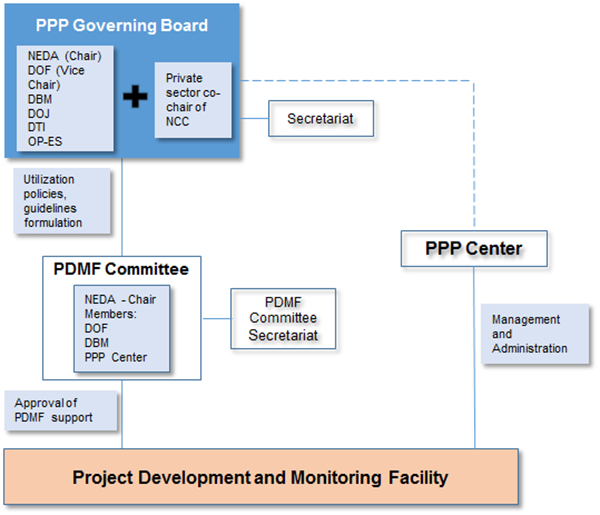
DBM = Department of Budget and Management, DOF = Department of Finance, DOJ = Department of Justice, DTI = Department of Trade and Industry, NCC = National Competitiveness Council, NEDA = National Economic and Development Authority, OP-ES = Office of the President-Executive Secretary, PDMF = Project Development Monitoring Facility, PPP = public–private partnership.
Source: PPP Center. PDMF. Oversight and Management; Public–Private Partnership (PPP) Code of the Philippines.
Application Process for Project Development and Monitoring Facility
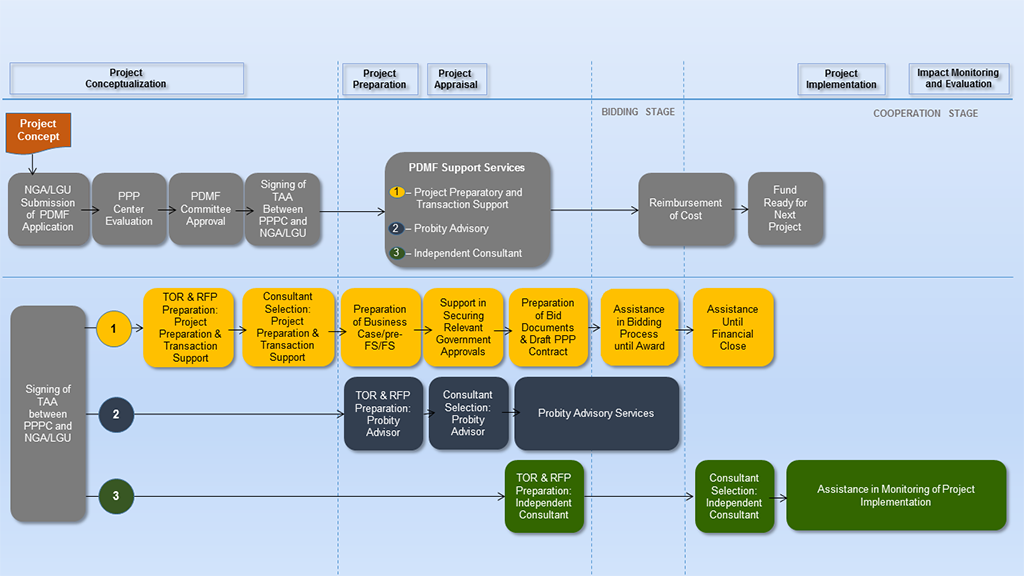
FS = Feasibility Study, LGU = local government unit, NGA = national government agency, PDMF = Project Development Monitoring Facility, PPP = public–private partnership, PPPC = PPP Center, RFP = request for proposal, TAA = technical assistance agreement, TOR = terms of reference.
Source: PPP Center. PDMF Process.
PPP = public–private partnership.
Source: PPPC Center. 2023. The Project Development and Monitoring Facility Guidelines.
Maturity of the PPP Market
Parameters
COMPAREDOWNLOADPPP Project Statistics Is there a national PPP database for the country?
Is the distribution of PPP projects across infrastructure sectors available? Is the distribution of PPP projects across various stages of the PPP life cycle available? - Yes
LEARN MOREMaturity of the PPP Market
The PPP Center maintains a project database listing the names, size, and status of the projects, and distribution of projects across sectors. In March 2025, the PPP Center launched its PPP Projects Dashboard, which is accessible through https://ppp.gov.ph/project-dashboard/. This interactive platform on the country’s PPP projects is still in its beta phase.
Public–Private Partnership Projects Database, October 2024
Description Total number of PPP projects (national and local) 444 PPP projects in the pipeline (in preparation and procurement) 173 Contracts under implementation 215 Concluded and terminated contracts 56 Total amount of attracted and planned investments ₱7,069.82 billiona - a$121.25 billion as of 28 October 2024.
PPP = public–private partnership.
Source: PPP Center. 2024. Summary of PPP Projects.
PPP = public–private partnership.
Source: PPP Center. Projects Database (accessed 27 October 2024).
PPP Project Pipeline
Parameters
COMPAREDOWNLOADDoes the country publish a national PPP project pipeline? At what frequency is the national PPP project pipeline published? Regularly and as often as possible Is the national PPP project pipeline based on the national infrastructure plan for the country? - Yes
- No
- Not Applicable
- Unavailable
LEARN MOREMaturity of the PPP Market
The Philippines maintains two lists of infrastructure projects. NEDA publishes a list of infrastructure flagship projects (IFPs), which are funded by the GAA, ODA, and PPPs, and are in the following sectors: agriculture, digital connectivity, education, health, physical connectivity, power and energy, water resources, and other infrastructure. As of August 2024, there were 47 IFPs identified as PPP projects under physical connectivity (roads and bridges, rail, air, urban transport, maritime, and data management) and health.1 Inclusion in the list of IFPs is in accordance with NEDA’s August 2023 “Revised Guidelines for the Formulation, Prioritization and Monitoring of the Government’s Infrastructure Flagship Projects (IFPs).” These guidelines guide the formulation of the list of IFPs to ensure the alignment of the IFP portfolio with the priorities and strategies of the administration as espoused in the PDP and the eight-point Socioeconomic Agenda.2
The PPP Center maintains a database of PPP projects and publishes a list of PPP projects identified across the following sectors: agriculture/food security, airport, education, energy, health, ICT, ports, property development, rail, roads, solid waste management, tourism, terminals, transport, and water and sanitation. The projects are classified according to their stages of development: PPP projects under implementation, PPP projects in the pipeline, and concluded and terminated PPP projects. The PPP projects in the pipeline are further categorized according to their phases of development:
- Preparation phase. For solicited proposals, these are PPP projects under conceptualization or development. PPP projects under conceptualization are proposals under initial conceptualization phase, with ongoing preparation of a project concept note, or with ongoing processing of project development support. PPP projects under development are proposals with approved project development support, with ongoing procurement of consultants for project development, or ongoing preparation of a feasibility study/business case. For USPs, these are proposals either undergoing evaluation by the implementing agency prior to negotiation or endorsed by the PPP Center to the implementing agency after the completeness check.
- Negotiation phase. This applies to USPs submitted prior to the effectivity of the PPP Code, which have been approved and are currently undergoing negotiation on the PTCs of the project, and those upon the effectivity of the PPP Code that have been accepted to proceed to negotiation by the appropriate implementing agency.
- Approval phase. This phase includes national and local PPP project proposals that are currently undergoing evaluation by the appropriate approving body.3
- Procurement phase. For solicited proposals, these are PPP projects in the procurement stage, from the publication of the invitation to prequalify and bid up to the determination of the winning private proponent. For USPs, these are PPP projects in the comparative challenge stage, from the publication of the invitation to challengers up to the determination of the winning private proponent.
- 1NEDA. 2024. Infrastructure Flagship Projects (accessed 27 October 2024).
- 2NEDA. 2023. Revised Guidelines for the Formulation, Prioritization and Monitoring of the Government’s Infrastructure Flagship Projects (IFPs).
- 3PPP Center. 2024. Summary of PPP Projects; Summary of PPP Projects in the Pipeline; Summary of PPP Projects Under Implementation; Summary of Concluded and Terminated Projects.
PPP = public–private partnership.
Source: PPP Center. Projects Database (accessed 27 October 2024).
Sources of PPP Financing
Parameters
COMPAREDOWNLOADSources of PPP Financing Who are the typical entities financing PPP projects in the country? Private developers
Construction contractors
Institutional/financial/private equity investors
Pension funds
a Insurance companies
b Banks
Nonbanking financial corporations/Financial institutions
c Donor agencies
Government agencies and state-owned enterprises
What is the distribution of financing among these entities financing PPP projects? Mainly financed through bank loans and equity Does the country have the history/track record of issuing bonds by infrastructure projects? How many infrastructure projects private developers for infrastructure projects have raised funding through bond issuances? What is the value of funding raised through capital markets by PPPs? Does the country have a matured derivatives market to hedge certain risks associated with PPPs? Does the country have a national development bank? Does the country have credit rating agencies to rate infrastructure projects? Typically, what are the credit ratings achieved/received by infrastructure projects? Is there a threshold credit rating for infrastructure PPPs below which institutional investors, pension funds, and insurance companies would not invest in infrastructure PPPs? What is the typical funding model for infrastructure PPPs -- corporate finance or project finance? Both models are used Are there regulatory limits/restrictions for the maximum exposure that can be taken by banks to infrastructure projects? - aGovernment pension funds, Social Security System and Government Service Insurance System (GSIS), do not participate in financing. However, GSIS insurance coverage is a requirement in some projects.
- bInsurance companies typically do not participate as a financier, but they provide insurance coverage instead.
- cExcept for captive financial institutions of large conglomerate groups, which may participate as financiers in some cases.
- Yes
- No
- Unavailable
LEARN MOREMaturity of the PPP Market
Through the years, the Philippine banking sector has grown, adding further liquidity to the market. The Bangko Sentral ng Pilipinas (Central Bank of the Philippines, BSP) reports that “[t]he Philippine banking system sustained its solid footing amid the pandemic.”1 Total assets of the Philippine banking system grew by 7.2% year on year to ₱20.6 trillion as of end-January 2022, a growth rate higher than the 5.7% rate in January 2021. In July 2024, total assets of the Philippine banking system further expanded at 12.2% year-on-year to ₱25.9 trillion, higher than the 7.9% growth recorded in July 2023.2
The development of the project finance market is driven by the policy direction of the administration on the funding sources of major infrastructure projects. The past administration encouraged “hybrid” PPPs, wherein the government develops the infrastructure project assets, and then involves the private sector in their O&M (thus limiting funding from commercial banks), and unsolicited PPP proposals, on the basis that this reduces project preparation and implementation time and cost in a highly regulated PPP environment.3 Thus, the bulk of the projects during the past administration are (i) USPs for joint ventures under the 2013 NEDA Joint Venture Guidelines, the joint venture guidelines of the relevant agency, or local PPP codes; and (ii) big-ticket infrastructure projects funded by ODA, with counterpart funding by the Philippine government in accordance with the GAA.
The current administration recognizes the importance of PPPs, highlighted by the passage of the PPP Code and its IRR, and is now strengthening its partnership with the private sector by reinvigorating PPPs to support the country’s economic recovery and meet its goals for digital and physical connectivity, food security, and LGU empowerment, among others, as set out in the PDP.
The government has been looking into the Philippine bond market as another alternative source of financing for PPP projects. In 2016, ADB provided support for the issuance of the Philippines’ first peso-denominated green project bond for the refinancing of the Tiwi and Makiling–Banahaw (Tiwi–MakBan) geothermal facilities.4
At the same time, the Securities and Exchange Commission (SEC) approved the supplemental listing and disclosure rules applicable to PPP companies that the Philippine Stock Exchange proposed.5 Under the listing rules, a PPP company may apply for listing under the rules if it is a corporation that was awarded a PPP contract, a special purpose company incorporated by the awarded corporation, or an awarded joint venture or consortium that shall assume and accede to all rights and obligations of the latter. The PPP project cost must not be less than ₱5 billion ($85.75 million as of 28 October 2024), as indicated in the financial bid. The PPP company can apply for initial listing upon showing of any of the following: (i) it has completed its construction works or a phase thereof in case the project consists of several phases, and has commenced commercial operations and/or maintenance services; (ii) it has commenced commercial operations or maintenance services (in no commercial operations), provided that the contract awarded is not solely for O&M. Prior to initial listing, existing shareholders of the PPP company are prohibited from offering their shares in the PPP company during the initial public offering period. However, to date, no PPP company has ever been listed on the stock exchange pursuant to these rules.
In parallel, in 2019, the Association of Southeast Asian Nations (ASEAN) Capital Markets Forum (ACMF), a high-level grouping of capital market regulators from all 10 ASEAN jurisdictions, developed the Roadmap for ASEAN Sustainable Capital Markets, comprising actionable recommendations to provide strategic direction and guide ACMF members in developing action plans and initiatives across the region, building on its recent efforts in the sustainability sphere.6 The Philippines adopted recommendations in this road map for its own road map for sustainable finance.
In 2020, the BSP launched the Sustainable Finance Policy Framework, which sets out the expectations of the BSP on the integration of sustainability principles, including those covering environmental and social risk areas, in the corporate governance and risk management frameworks as well as in the strategic objectives and operations of banks.7 In 2022, the BSP released the Philippine Sustainable Finance Roadmap and Sustainable Finance Guiding Principles. This serves as the foundation for effective strategies to facilitate the mainstreaming of sustainable finance in the country while the guiding principles establish a common understanding among various stakeholders of the economic activities considered sustainable. The road map identified the following common issues: the need for strong coordinating efforts in the financial ecosystem, lack of awareness of the available resources to finance sustainable activities, and the need for transparency and a sustainable pipeline database. It lays out three pillars for the country’s strategic plans for sustainable finance: creating a conducive environment, mainstreaming sustainable finance, and developing a sustainable pipeline.8 In 2024, the BSP issued the Philippine Sustainable Finance Taxonomy Guidelines, which serves as a tool to classify whether an economic activity is environmentally or socially sustainable and as a guide for different stakeholders in making informed investment or financing decisions.9
The SEC has adopted the ASEAN Green Bond Standards, the ASEAN Social Bond Standards, and the ASEAN Sustainability Bond Standards to attract sustainable investments in the debt security market and address key areas of environmental and social concern. In 2018, it issued “Guidelines on the Issuance of Green Bonds Under the ASEAN Green Bond Standards in the Philippines.”10In 2019, the SEC issued its “Guidelines on the Issuance of Sustainability Bonds Under the ASEAN Sustainability Bond Standards in the Philippines.”11 In 2023, the SEC issued its “Guidelines on Eligible Blue Projects and Activities for the Issuance of Blue Bonds in the Philippines,” based on the Blue Finance Guidance Framework developed by the IFC and the Green and Blue Bond Framework of ADB. Blue bonds are a subset of green bonds, the proceeds of which will exclusively finance or refinance new and/or existing eligible blue projects and/or activities.12 In 2024, Maynilad Water Services, Inc. issued the first-ever blue bonds registered with the SEC, having an aggregate issue size of ₱15 billion ($257.25 million as of 28 October 2024).
- 1Bangko Sentral ng Pilipinas (BSP). 2022. Recent Trends in the Philippine Financial System. Issue No. 2022-01.
- 2BSP. 2024. Recent Trends in the Philippine Banking System As of July 2024.
- 3ADB. 2020. Public–Private Partnership Monitor Philippines.
- 4ADB. 2016. ADB Backs First Climate Bond Asia Landmark $225 Million Philippines Deal.
- 5SEC. 2016. SEC Approved Public Private Partnership Listing Rules.
- 6ASEAN Capital Markets Forum (ACMF). 2019. The Road map for ASEAN Capital Markets; BSP. 2022. The Philippine Sustainable Finance Roadmap and Guiding Principles.
- 7BSP. 2020. Sustainable Finance Framework. Manila.
- 8BSP. 2022. The Philippine Sustainable Finance Roadmap and Guiding Principles.
- 9BSP. 2024. Philippine Sustainable Finance Taxonomy Guidelines.
- 10SEC. 2018. Memorandum Circular No. 12, Series of 2018; 2023. Memorandum Circular No. 15, Series of 2023; ASEAN Green Bonds refer to bonds that comply with the ASEAN Green Bond Standards, where the proceeds will be exclusively applied to finance or refinance, in part or in full, new and/or existing eligible green projects. Eligible green projects include, but are not limited to, renewable energy, energy efficiency, pollution prevention and control, environmentally sustainable management of living natural resources and land use, terrestrial and aquatic biodiversity conservation, clean transportation, sustainable water and wastewater management, climate change adaptation, eco-efficient and/or circular economy adapted, production technologies and processes, and green buildings that meet regional, national, or internationally recognized standards or certifications.
- 11SEC. 2019. Memorandum Circular No. 8, Series of 2019.
- 12Blue projects may include ecosystem management and natural resource restoration of coastal, marine, river, lake, and other marine or water-based ecosystems, sustainable fisheries management, and sustainable aquaculture, among others, as long as they directly aim to address sustainable water management and ocean protection.
Typical contours of infrastructure financing
The table below reflects the key parameters and contours of the infrastructure financing in the Philippines:
Key Infrastructure Financing Sources in the Philippines
Non-Limited Recourse Loan ($) Non-Limited Recourse Local Currency Loan Project Financing, Local Public Sector Banks Interest Rate Swaps Currency Swaps Project Financing through Project Bond Issuance Maximum tenor, in years 15 15 UA UA UA UA Upfront arrangement fee, bps 100–300 50–150 UA UA UA UA Benchmark rate SOFR ₱ BVAL reference rates UA UA UA UA Margin rate, bps 100–500 100–300 Political risk cover premium UA UA UA UA UA UA Percentage of foreign debt out of total debt for project financing UA UA UA UA UA UA Percentage of project bonds out of total debt for project financing UA UA UA UA UA UA Typical debt to equity ratio 75:25 Timeline to financial close (month) 6–12 Minimum DSCR covenant levels, x 1.05x-1.3x bps = basis points, BVAL = Bloomberg Valuation Service, DSCR = debt service coverage ratio, SOFR = secured overnight financing rate.
UA = Unavailable.
Source: ADB. 2020. Public–Private Partnership Monitor. Philippines.
The project financing scenario in the Philippines is monopolized by local banks with strong relationships with local conglomerates. Domestic banks do not require any political risk guarantee, unlike international lenders, and offer terms which are light on covenants.13
Effective 1 July 2023, the BSP enhanced the single borrower’s loan limit (SBL) rules to allow banks to support the financing requirements of the Philippine economy, by excluding loans and other credit accommodations covered by an effective credit risk transfer arrangement, in the form of a guarantee or credit derivative that complies with minimum operational requirements, from the total credit commitment of such banks to a borrower in reckoning compliance with the SBL. This will increase banks’ liquidity. The SBL is unchanged, at 25% of the bank’s net worth.
- 13Tavidell Law.
International financial institutions
International financial institutions and multilateral institutions such as ADB and the International Finance Corporation (IFC) have limited participation in lending to the private sector for the purpose of PPP project financing. Lending is monopolized by local banks, which have easy access to local currency via their deposit banks.
The table below provides the list of lenders actively participating in project finance in the Philippines in the past 36 months.
Active Lenders to Public–Private Partnership Projects in 36 Months Preceding December 2023
Name Debt Provided ($ million) No. of Transactions Bank of the Philippine Islands 474.5 2 Land Bank of the Philippines 364.72 1 Standard Chartered Bank 310 1a SMBC 310 1 HSBC 310 1a Mitsubishi UFJ Financia 310 1 ANZ 310 1 ING 310 1a Development Bank of the Philippines 147.82 5 Rizal Commercial Banking Corporation 83 2 Security Bank Corporation 69.83 1a Metropolitan Bank and Trust Company 63.18 1 BDO Unibank, Inc. 63.18 1a - aProvided another loan for another project but amount is not available.
Source: World Bank. Infrastructure Finance, PPPs and Guarantees. Country Snapshots. Philippines. Custom Query (accessed 28 August 2024).
Government financial institutions
Development Bank of the Philippines
DBP is a government financial institution established in 1958 to take over and expand the functions of the Rehabilitation Finance Corporation, created in 1947 to finance the reconstruction of properties damaged by World War II.14 Its primary objective is to provide banking services principally to cater to the medium- and long-term needs of agricultural and industrial enterprises, with an emphasis on small and medium-scale industries.15 DBP is an active lender to PPP projects in the Philippines.
Land Bank of the Philippines
LBP is another government financial institution active in the project finance market for PPPs. LBP was established in 1963 under the Agricultural Land Reform Code (Republic Act No. 3844) to finance the acquisition and distribution of agricultural estates for division and resale to small landholders and the purchase of landholdings by agricultural land tenants. LBP is the first universal bank by charter, with expanded commercial banking powers to sustain its social mission of spurring countryside development.16 It is empowered to grant loans to agricultural, industrial, home-building, or home financing projects and other productive enterprises and to extend credit assistance to farmers’ cooperatives and associations to facilitate the production and marketing of crops and the acquisition of essential commodities. In 1988, LBP became the financial intermediary of the government’s Comprehensive Agrarian Reform Program. In 2021, LBP acquired the special preferred shares of the Philippine Deposit Insurance Corporation in United Coconut Planters Bank.17
Philippine Guarantee Corporation
The Philippine Guarantee Corporation is a GOCC attached to the DOF. It serves as the principal agency for State Guarantee Finance of the Philippines. It provides credit guarantees in support of trade and investments; exports; infrastructure; energy; tourism; agricultural business/modernization; housing; micro, small, and medium-sized enterprises; and other priority sectors of the economy, to facilitate and promote socioeconomic and regional development.18
The table below provides the list of project sponsors actively participating in PPPs in the Philippines in the past 36 months. The project sponsors listed have at least two PPP projects that reached financial close or were under preparation or procurement in 2021, 2022, and 2023.
- 14ADB. 2016. Philippines: Public–Private Partnerships by Local Government Units.
- 15Development Bank of the Philippines (DBP). About DBP.
- 16A universal bank has the authority to exercise powers and services in in addition to those authorized for a commercial bank, such as the powers of an investment house and the power to invest in non-allied enterprises, among others. BSP. Manual of Regulations for Banks 101 Classifications, Powers and Scope of Authorities.
- 17Land Bank of the Philippines (LBP). 2022. Executive Summary.
- 18Philippine Guarantee Corporation. About Us, Our Mandate.
Active Project Sponsors in the Philippines in 36 Months Preceding December 2023
Project Sponsor Country of Origin Total Investment Number of PPP Projects ($ million) (₱ billion) Aboitiz InfraCapital, Inc./Aboitiz Equity Ventures/Aboitiz Power Philippines 453.34 26.43 5 Citicore Holdings Investment, Inc. Philippines UA UA 2 JG Summit Holdings, Inc. Philippines 54.71 3.19 2 Manila Water Company, Inc. Philippines 161.19 9.40 2 Metro Pacific Investments Corporation Philippines 809.14 47.18 2 MTD Capital Berhad Malaysia 1,745.70 101.79 2 Prime Asset Ventures, Inc./PrimeWater Infrastructure Corporation Philippines UA UA 4 SMC Infrastructure/ San Miguel Holdings Corporation Philippines 22,025.64 1,284.29 11 Udenna Infrastructure Corporation Philippines 2,578.67 150.36 4 PPP = public–private partnership.
UA = Unavailable.Sources: DOE. 2024. List of Renewable Energy (RE) Plants with Certificate of Endorsement (COE) to Energy Regulatory Commission (ERC) for Feed-in Tariff (FIT) Eligibility As of March 2024; PPP Center. Corporate Planning and Development Division. Projects List (provided on 9 August 2024); World Bank. Infrastructure Finance, PPPs and Guarantees. Country Snapshots. Philippines. Custom Query (accessed 28 August 2024); Tavidell Law.
Credit rating agencies in the Philippines
The credit rating agencies involved in rating infrastructure projects are the Philippine Rating Services Corporation (PhilRatings) and Credit Rating and Investors Services (CRISP) Inc.
PPP = public–private partnership.
Source: ADB. 2020. Public–Private Partnership Monitor: Philippines; Tavidell Law.
National PPP landscape
Republic Act No. 12145, which became law on 10 April 2025, reorganized NEDA into the Department of Economy, Planning, and Development (DEPDev) and reconstituted the NEDA Board into the Economy and Development Council (ED Council). Thus, any reference to NEDA and the NEDA Board on the site should be read as a reference to the DEPDev and the ED Council, respectively.